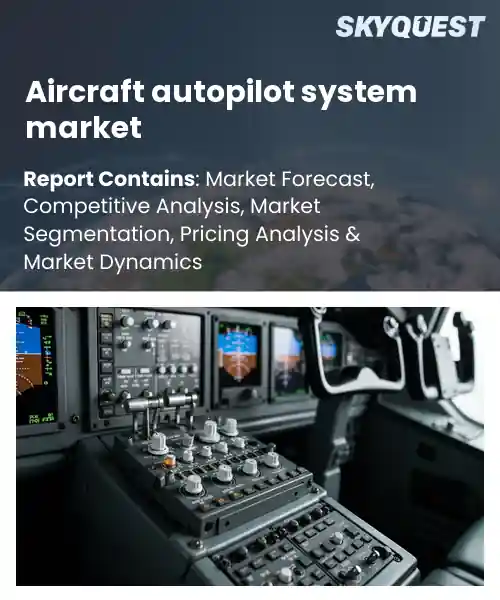
Aircraft autopilot system market
Report ID: SQMIG20A2674
Report ID: SQMIG20A2674
[email protected]
USA +1 351-333-4748
Report ID:
SQMIG20A2674 |
Region:
Global |
Published Date: June, 2026
Pages:
157
|Tables:
185
|Figures:
79


Global Aircraft Autopilot System Market size was valued at USD 6.1 Billion in 2024 and is poised to grow from USD 6.51 Billion in 2025 to USD 10.93 Billion by 2033, growing at a CAGR of 6.7% during the forecast period (2026-2033).
The global aircraft autopilot system market encompasses hardware, software solutions that enable commercial, military, and business aircraft to execute flight control tasks automatically. The key benefits of this technology include improved safety, decreased crew workload and better fuel economy, all three of which contribute to increasing airline profits and regulatory compliance. The market grew from basic gyroscopic stabilisation systems in the 1950s, to fly-by-wire systems in the 1980s, and then rapidly expanded as a result of the advent of integrated flight management systems in the early 2000s. For example, the autopilot systems on the Boeing 787 Dreamliner and the Airbus A350 now use sensors to continuously adapt to the aircraft's performance, demonstrating that these systems have evolved from simple attitude holds to fully automated cruise management systems.
The growth catalyst for the autopilot market is airlines’ drive for operational efficiency, by rising fuel costs and tighter emissions rules. To cut expenses, carriers adopt advanced autopilot modules that compute optimal climb and descent trajectories, a capability that trims fuel consumption and carbon output. Manufacturers such as Honeywell and Thales have responded by integrating AI‑based predictive algorithms that modify flight paths when weather changes, a feature proven on trans‑Atlantic services where airlines achieve roughly three percent fuel savings per trip. This success draws investment toward sensor‑fusion and satellite‑augmentation platforms, creating a pathway for navigation and supporting autonomous air‑taxi concepts.
How are AI and IoT Integration Influencing the Aircraft Autopilot System Market?
The use of artificial intelligence to create automated systems for aircraft, allowing predictive control of flight that can adjust in response to weather changes and other variables without needing to be controlled by a pilot, will radically alter existing autopilot systems. In addition, the growing adoption of the Internet of Things has connected numerous onboard sensors, providing a stream of real-time data to the cloud, where machine learning models can develop a more refined set of algorithms to support navigation. By incorporating AI and IoT into aircraft, safety is improved through earlier detection of anomalies. At the same time, by providing more autonomous decision-making capabilities, AI reduces the pilot's workload. Many manufacturers are placing AI chips directly onto their flight computers, while airlines gain immediate access to updated flight software from manufacturers via secure networks. As a result, the rate of adoption is accelerating, as airline operations focus on improving productivity and decreasing operating expenses.
In March 2025, Honeywell has introduced an advanced autopilot system powered by AI across its commercial and defense aircraft fleets. This system uses advanced predictive analytics, intelligent flight automation, and advanced sensor fusion to build a world-class level of situational awareness, reduce the pilot's workload, make real-time optimised decisions about flight, and enhance safety/efficiency. The introduction of this next generation autonomous autopilot will also assist in the transition to more fully autonomous flight operations within the aviation industry.
Market snapshot - (2026-2033)
Global Market Size
USD 6.1 Billion
Largest Segment
Three-Axis Autopilot
Fastest Growth
Autonomous Flight Control Systems
Growth Rate
6.7% CAGR
To get more insights on this market click here to Request a Free Sample Report
Global aircraft autopilot system market is segmented by system type, aircraft type, component, application, end user, technology and region. Based on system type, the market is segmented into attitude & heading hold autopilot, two-axis autopilot, three-axis autopilot, four-axis autopilot, flight director integrated autopilot, digital fly-by-wire autopilot and autonomous flight control systems. Based on aircraft type, the market is segmented into commercial aircraft, business jets, general aviation aircraft, military aircraft, helicopters and unmanned aerial vehicles (UAVs). Based on component, the market is segmented into flight control computers, autopilot actuators, flight management systems, sensors & gyroscopes, navigation modules and control display units. Based on application, the market is segmented into commercial aviation, military aviation, business aviation, general aviation and UAV operations. Based on end user, the market is segmented into aircraft OEMs, airlines, defense organizations and MRO providers. Based on technology, the market is segmented into conventional autopilot, digital autopilot, AI-assisted flight control and autonomous flight systems. Based on region, the market is segmented into North America, Europe, Asia Pacific, Latin America and Middle East & Africa.
Three-axis autopilot segment dominates because it delivers comprehensive pitch, roll, and yaw regulation, meeting the stringent stability and performance expectations of modern aircraft. Its proven reliability and compatibility with existing avionics architectures make it the default choice for manufacturers upgrading legacy fleets. Pilots prefer using this feature because it helps them to fly more accurately than would otherwise happen, thus leading to greater acceptance of this technology by commercial and business operations and regional charter operations globally.
Meanwhile, autonomous flight control systems segment emerges as the most rapidly expanding area because artificial intelligence algorithms enable self optimizing flight trajectories and reduced human intervention. Growing demand for fully automated missions, regulatory encouragement for safety critical automation, and breakthroughs in sensor fusion accelerate its adoption, creating opportunities for system integrators and market entrants.
Sensor gyroscope segment dominates because precise attitude reference is fundamental to any autopilot function, and these devices provide the core inertial data required for stable flight. With their established accuracy, resistance to vibration, and ongoing improvement via MEMS technology, these components have become essential members of all aircraft types. Equipment manufacturers focus on implementing these components into the aircraft's design early on so that they are reliable and easy to certify, allowing them to remain at the forefront of the industry while also minimizing the maintenance cost over time.
However, flight management system segment experiences the strongest growth because it integrates navigation, performance planning and data communication, enabling advanced route optimization and reduced fuel consumption. Airlines and operators seek greater operational efficiency, and regulatory trends favor data driven flight planning, prompting upgrades and creating a surge in demand for flight management solutions.
To get detailed segments analysis, Request a Free Sample Report
North America’s dominance stems from a mature aerospace ecosystem anchored by world‑leading aircraft manufacturers and a deep pool of engineering talent. Significant investments in research and development in the area support ongoing innovation in both flight control algorithms and sensor integration. Companies working with one another, along with academic partners, help expedite transferring technology from R&D to new products and reduce the time needed for new developments. Established regulatory bodies offer well-defined pathways to support timely certification processes, making it easier and faster for new products to be adopted in the marketplace. Strong defense programmes and commercial airline demand reinforce a robust demand base, while the presence of major defense contractors supports advanced avionics capabilities. Together these factors create a self‑reinforcing cycle that sustains North America’s pre‑eminence in the global autopilot landscape.
Aircraft autopilot system market in the United States is anchored by a concentration of legacy manufacturers and emerging start‑ups that together push the envelope of autonomous flight capabilities. Extensive testing infrastructure, a supportive innovation ecosystem, and close ties to federal aviation authorities enable swift certification of advanced features. Collaborative efforts made by commercial airlines, military platforms, and research universities create an ongoing stream of improvements and advancements to assure continuing leadership of the United States in this industry.
Aircraft autopilot system market in Canada thrives on a collaborative network of aerospace firms, research institutes, and government programs that emphasize safety and reliability. Proximity to the United States facilitates cross‑border supply chains, while domestic policy incentives encourage investment in next‑generation avionics. As a result, Canada continues to be recognized as an innovative and dependable supplier of new technologies to the world marketplace.
Europe’s rapid expansion is propelled by a convergence of strong engineering traditions, ambitious sustainability goals, and cohesive regulatory harmonisation across the bloc. The EU funded collaborative research projects that promote breakthroughs in AI flight control and sensor fusing technology. These technologies are being integrated in upcoming aircraft by major manufacturers. Strict environmental requirements drive the development of improved autopilot systems that increase fuel efficiency and decrease emissions. A mature supply chain network and extensive knowledge in precision manufacturing allow for the fast scaling and delivery of such innovative products. Together, these dynamics generate a fertile environment for accelerated growth and reinforce Europe’s position as a leading hub for advanced aircraft cockpit technologies.
Aircraft autopilot system market in Germany benefits from a legacy of precision engineering and a dense cluster of component suppliers. Strong ties between automotive and aerospace sectors accelerate cross‑industry technology transfer, especially in sensor integration and control software. Government‑backed research programmes focus on safety‑critical systems and sustainable flight operations, reinforcing Germany’s role as a dominant player within the European landscape.
Aircraft autopilot system market in the United Kingdom is characterised by a fast‑growing ecosystem of specialist firms and academic research centres that attract international investment. Post-Brexit strategic initiatives will help to increase domestic capabilities and export potential, while increased defense contracts and commercial airline partnerships will create the demand for new and innovative autopilot solutions. The combination of innovation and skilled personnel, and the favorable policies that support these initiatives, will continue to support the United Kingdom's role as a stimulating engine for accelerating the market.
Aircraft autopilot system market in France draws on a deep aerospace heritage anchored by major original equipment manufacturers and a vibrant network of suppliers. There is a strong emphasis on digital transformation and incorporating artificial intelligence into Flight Control systems as well as constantly evolving products. An emphasis on collaboration between research institutions and industry stakeholders fosters the development of reliable and very efficient autopilot systems in order to maintain a dominant position in the competition of the European market for aviation flight control systems.
Asia Pacific is strengthening its position through a combination of aggressive investment in aerospace infrastructure, strategic partnerships, and a rising demand for modern air travel across emerging economies. Countries in this region are developing domestic capabilities by combining modern electronics manufacture with software development to create a vertically integrated value chain. Partnering with established global OEMs can facilitate technology transfer and ensure that local capabilities continue to develop. Government policies promoting aviation safety and export‐based growth add to the momentum in the markets. As more regional carriers acquire new aircraft with advanced autopilot functions, the need for locally manufactured, cost‐competitive solutions will continue to grow, further establishing Asia Pacific’s place in the global autopilot industry.
Aircraft autopilot system market in Japan is driven by a strong tradition of precision manufacturing and a concerted focus on reliability. Very close cooperation between electronics companies and the aerospace engineering community has produced very advanced control systems and government sponsored research will continue to spur the development of autonomous flight technology. Working with foreign partners improves the ability of all parties to adopt best practices around the world, which makes Japan an important contributor to the development of safety-focused autopilot technologies.
Aircraft autopilot system market in South Korea benefits from rapid advancements in semiconductor and software industries that feed directly into avionics development. By providing targeted government assistance, the collaboration between larger conglomerate companies and specialised startups creates a vibrant ecosystem of next generation flight control technology. If they focus on high-performance computing and miniaturised sensors, South Korea will provide advanced autopilot capabilities and solidify its developing role in both the regional and global market.
To know more about the market opportunities by region and country, click here to
Buy The Complete Report
Increasing Demand for Autonomous Flights
Regulatory Push for Enhanced Safety
High Development Cost Barriers
Complex Integration Challenges
Request Free Customization of this report to help us to meet your business objectives.
The aircraft autopilot market is intensifying as legacy OEMs and agile newcomers vie for dominance, spurred by increasing demand for higher‑level automation in commercial and business jets. Major players are pursuing M&A, such as Boeing’s acquisition of Honeywell’s autopilot unit, while Airbus deepens its partnership with Thales on fly‑by‑wire integration. Simultaneously, startups accelerate tech innovation with AI‑driven flight‑control algorithms and open‑architecture hardware, reshaping competitive dynamics.
Top Player’s Company Profile
Recent Developments
SkyQuest’s ABIRAW (Advanced Business Intelligence, Research & Analysis Wing) is our Business Information Services team that Collects, Collates, Correlates, and Analyses the Data collected by means of Primary Exploratory Research backed by robust Secondary Desk research.
As per SkyQuest analysis the global aircraft autopilot market is projected to reach $10.93 billion by 2033 driven primarily by the rising demand for autonomous flights that promise lower pilot workload and fuel savings; a second strong catalyst is the regulatory push for enhanced safety which pushes manufacturers to embed fault‑detection and redundancy features. High development cost barriers remain the main restraint, limiting adoption especially among cost‑sensitive carriers. North America continues to dominate the market thanks to its mature aerospace ecosystem and robust R&D spending. Within the product mix the three‑axis autopilot segment holds the largest share, offering comprehensive pitch roll and yaw control that appeals across commercial and business aircraft.
| Report Metric | Details |
|---|---|
| Market size value in 2024 | USD 6.1 Billion |
| Market size value in 2033 | USD 10.93 Billion |
| Growth Rate | 6.7% |
| Base year | 2024 |
| Forecast period | (2026-2033) |
| Forecast Unit (Value) | USD Billion |
| Segments covered |
|
| Regions covered | North America (US, Canada), Europe (Germany, France, United Kingdom, Italy, Spain, Rest of Europe), Asia Pacific (China, India, Japan, Rest of Asia-Pacific), Latin America (Brazil, Rest of Latin America), Middle East & Africa (South Africa, GCC Countries, Rest of MEA) |
| Companies covered |
|
| Customization scope | Free report customization with purchase. Customization includes:-
|
To get a free trial access to our platform which is a one stop solution for all your data requirements for quicker decision making. This platform allows you to compare markets, competitors who are prominent in the market, and mega trends that are influencing the dynamics in the market. Also, get access to detailed SkyQuest exclusive matrix.
Table Of Content
Executive Summary
Market overview
Parent Market Analysis
Market overview
Market size
KEY MARKET INSIGHTS
COVID IMPACT
MARKET DYNAMICS & OUTLOOK
Market Size by Region
KEY COMPANY PROFILES
Methodology
For the Aircraft autopilot system market, our research methodology involved a mixture of primary and secondary data sources. Key steps involved in the research process are listed below:
1. Information Procurement: This stage involved the procurement of Market data or related information via primary and secondary sources. The various secondary sources used included various company websites, annual reports, trade databases, and paid databases such as Hoover's, Bloomberg Business, Factiva, and Avention. Our team did 45 primary interactions Globally which included several stakeholders such as manufacturers, customers, key opinion leaders, etc. Overall, information procurement was one of the most extensive stages in our research process.
2. Information Analysis: This step involved triangulation of data through bottom-up and top-down approaches to estimate and validate the total size and future estimate of the Aircraft autopilot system market.
3. Report Formulation: The final step entailed the placement of data points in appropriate Market spaces in an attempt to deduce viable conclusions.
4. Validation & Publishing: Validation is the most important step in the process. Validation & re-validation via an intricately designed process helped us finalize data points to be used for final calculations. The final Market estimates and forecasts were then aligned and sent to our panel of industry experts for validation of data. Once the validation was done the report was sent to our Quality Assurance team to ensure adherence to style guides, consistency & design.
Analyst Support
Customization Options
With the given market data, our dedicated team of analysts can offer you the following customization options are available for the Aircraft autopilot system market:
Product Analysis: Product matrix, which offers a detailed comparison of the product portfolio of companies.
Regional Analysis: Further analysis of the Aircraft autopilot system market for additional countries.
Competitive Analysis: Detailed analysis and profiling of additional Market players & comparative analysis of competitive products.
Go to Market Strategy: Find the high-growth channels to invest your marketing efforts and increase your customer base.
Innovation Mapping: Identify racial solutions and innovation, connected to deep ecosystems of innovators, start-ups, academics, and strategic partners.
Category Intelligence: Customized intelligence that is relevant to their supply Markets will enable them to make smarter sourcing decisions and improve their category management.
Public Company Transcript Analysis: To improve the investment performance by generating new alpha and making better-informed decisions.
Social Media Listening: To analyze the conversations and trends happening not just around your brand, but around your industry as a whole, and use those insights to make better Marketing decisions.
REQUEST FOR SAMPLE
 REQUEST FREE CUSTOMIZATION
Global Aircraft Autopilot System Market size was valued at USD 6.1 Billion in 2024 and is poised to grow from USD 6.51 Billion in 2025 to USD 10.93 Billion by 2033, growing at a CAGR of 6.7% during the forecast period (2026-2033).
The aircraft autopilot market is intensifying as legacy OEMs and agile newcomers vie for dominance, spurred by increasing demand for higher‑level automation in commercial and business jets. Major players are pursuing M&A, such as Boeing’s acquisition of Honeywell’s autopilot unit, while Airbus deepens its partnership with Thales on fly‑by‑wire integration. Simultaneously, startups accelerate tech innovation with AI‑driven flight‑control algorithms and open‑architecture hardware, reshaping competitive dynamics. 'Honeywell Aerospace', 'Collins Aerospace', 'Garmin', 'Thales', 'Safran Electronics & Defense', 'BAE Systems', 'Moog', 'L3Harris Technologies', 'Lockheed Martin', 'Genesys Aerosystems', 'Avidyne Corporation', 'Dynon Avionics', 'Universal Avionics', 'Teledyne Technologies', 'Curtiss-Wright', 'Elbit Systems', 'Northrop Grumman', 'MicroPilot', 'UAV Navigation (Grupo Oesía)', 'Embention'
Commercial airlines and private operators are progressively seeking higher levels of automation to reduce pilot workload, enhance safety margins, and improve operational efficiency. This growing preference stimulates investment in advanced autopilot technologies that support precise navigation, adaptive flight control, and seamless integration with emerging air traffic management systems. As aircraft manufacturers incorporate these capabilities into new designs, suppliers experience heightened demand for sophisticated hardware and software solutions, thereby driving market expansion through continual product innovation and broader adoption across diverse aviation segments.
Ai‑Driven Autonomy Expansion: Aircraft manufacturers are embedding advanced artificial intelligence algorithms into autopilot suites to enable higher‑order decision making, such as dynamic route optimization and predictive conflict avoidance. These capabilities reduce pilot workload, enhance safety margins, and support emerging concepts like single‑pilot operations for regional jets. The shift is driven by growing confidence in machine‑learning reliability, regulatory openness to data‑driven safety cases, and the need to differentiate products in a competitive market, prompting rapid integration of AI modules across new airframes globally soon.
Why does North America Dominate the Global Aircraft autopilot system market? |@12


Want to customize this report? This report can be personalized according to your needs. Our analysts and industry experts will work directly with you to understand your requirements and provide you with customized data in a short amount of time. We offer $1000 worth of FREE customization at the time of purchase.
Feedback From Our Clients


 USA (+1) 351-333-4748

