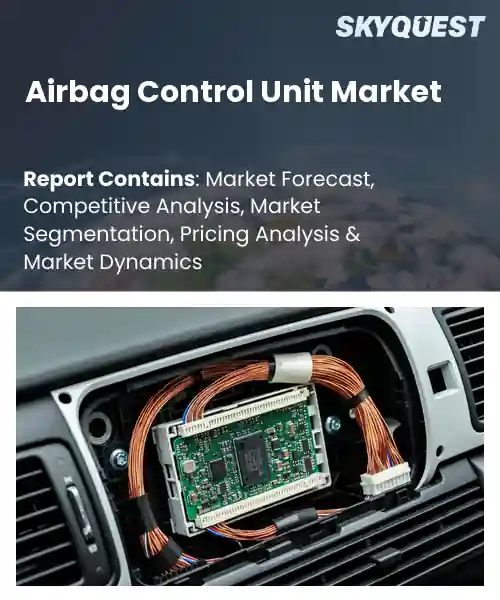
Airbag Control Unit Market
Report ID: SQMIG25A2758
Report ID: SQMIG25A2758
[email protected]
USA +1 351-333-4748
Report ID:
SQMIG25A2758 |
Region:
Global |
Published Date: June, 2026
Pages:
157
|Tables:
178
|Figures:
79


Global Airbag Control Unit Market size was valued at USD 8.91 Billion in 2024 and is poised to grow from USD 9.9 Billion in 2025 to USD 22.98 Billion by 2033, growing at a CAGR of 11.1% during the forecast period (2026-2033).
The global airbag control unit market has become a key sector of automotive safety and it is pushed more and more by stricter regulatory rules worldwide. Over the past years, rules like the European Union’s dual stage airbags requirements , and the United States FMVSS 208 have pushed car makers to put more and more advanced control modules inside vehicles. It’s a combination effect, it offers the compliance pressure alongside higher consumer attention to crash safety, and suddenly this market goes from a smaller part into something like a serious strategic spend for original equipment manufacturers, (and not just a little add on). early players such as Toyota and Volkswagen showed that improved micro controller architectures helped lower deployment latency. that made a benchmark , and it then sped up adoption across different regions.
Moreover, there is another major driver for growth, electrification plus the increasing presence of driver assistance features, which need higher resolution sensing and quicker decision cycles. As electric vehicles start replacing internal combustion models, manufacturers add multiple airbags and they have to coordinate with battery management units, so unintended deployment doesn’t happen when voltage events show up. This technical overlap opens doors for semiconductor companies like NXP and Infineon to offer integrated safety-critical chips, and that basically extends the whole value chain. In real deployments , like the Tesla Model Y and the Volvo XC90, modular control units also make software updates easier. Those updates can tweak deployment thresholds, which improves safety outcomes and can also boost aftermarket revenue.
AI is changing predictive maintenance by placing machine learning models inside the electronic control modules themselves. The sensors keep collecting data on things like temperature, voltage , and signal integrity. Then the AI does pattern spotting in near real time, looking for those faint warning signs that usually show up before a part actually wears out or fails. Due to that, manufacturers can plan interventions before a fault becomes visible, which lowers warranty spend and supports overall vehicle safety. It also enables remote diagnostics, so service centers can update firmware or re calibrate parameters without needing physical access. As more automakers adopt connected electronic safety systems, the need for smarter self healing control units grows, and that pushes investment into AI driven analytics platforms that fit with existing production lines from the start.
Market snapshot - (2026-2033)
Global Market Size
USD 8.91 Billion
Largest Segment
Frontal Airbag Control Units
Fastest Growth
Multi-Airbag Integrated Control Units
Growth Rate
11.1% CAGR
To get more insights on this market click here to Request a Free Sample Report
The global airbag control unit market is segmented based on product type, vehicle type, sensor type, airbag type supported, sales channel, propulsion type, and region. By product type, the market is categorized into frontal airbag control units, side airbag control units, curtain airbag control units, multi-airbag integrated control units, and others. Based on vehicle type, the market is segmented into passenger cars, light commercial vehicles (LCVs), heavy commercial vehicles (HCVs), and buses & coaches. Based on sensor type, the market is divided into accelerometers, pressure sensors, gyroscopic sensors, multi-sensor systems, and others. By airbag type supported, the market comprises frontal airbags, side airbags, curtain airbags, knee airbags, and others. Based on sales channel, the market is segmented into OEM and aftermarket. By propulsion type, the market is classified into internal combustion engine (ICE) vehicles, hybrid electric vehicles (HEVs), plug-in hybrid electric vehicles (PHEVs), and battery electric vehicles (BEVs). Geographically, the market is analyzed across North America, Europe, Asia Pacific, Latin America, and the Middle East & Africa.
As per the airbag control unit market analysis, the Frontal Airbag Control Units segment dominates because they are the main safeguard in the most common collision scenario. The deployment logic is intricate , and the validation is strict , so OEMs have to stay alert about timing, plus reliability. That fits with the ongoing safety rules, and also what consumers expect, so they end up sitting right at the center of vehicle safety architecture. OEM engineers keep revising firmware for newer vehicle platforms, while suppliers push further on testing abilities to keep everything compliant.
At the same time, Curtain Airbag Control Units are gaining the strongest growth momentum, mainly because cabin intrusion protection is turning into a real differentiator for premium models. Automakers are rolling out bigger sensor arrays , and they are leaning on lightweight materials too , so deployment extends across several seating zones. This whole push opens design avenues , and it directly boosts demand for more capable control algorithms.
According to the airbag control unit market forecast, the Multi Sensor Systems segment leads, since they blend different data streams to make crash detection more accurate. When they merge acceleration , pressure and gyroscopic inputs , they can lower false deployments and they also support more tailored deployment strategies for different impact angles. This more holistic sensing lines up with stricter safety expectations and the broader electrification direction, so manufacturers tend to install complete sensor suites as a baseline feature.
Meanwhile, Accelerometers are showing up as the key high growth area, partly because they are still the most cost effective starting option for airbag logic. MEMS improvements have increased sensitivity while shrinking physical size, which helps for broader placement across vehicle structures. That encourages adoption in new model lines, and it also supports step by step safety upgrades, which overall stimulates market expansion.
To get detailed segments analysis, Request a Free Sample Report
As per the airbag control unit market regional forecast, Asia-Pacific benefits from this mix of advanced engineering know how, strong automotive manufacturing clusters, and deep integration of safety technologies into vehicle design, it’s not just one thing but like several things stacking up. In the area, leading suppliers have already built solid partnerships with original equipment manufacturers, so they can iterate electronic control architectures faster, and still hit very strict safety expectations. Also, supportive regulatory environments nudge early adoption of more sophisticated airbag systems, and there’s this culture of ongoing innovation that helps keep production methods cost‑effective. So basically, when high volume vehicle assembly, a skilled workforce , and proactive policy frameworks combined, they offer a resilient ecosystem that keeps pushing Asia Pacific toward the front of the global market.
Japan Airbag Control Unit Market
The Airbag Control Unit Market outlook in Japan is shaped by a mature automotive sector that prioritises precision engineering along with tough safety standards. Domestic manufacturers tend to focus on compact , high performance modules that match low‑emission vehicle strategies. There are also collaborative research initiatives between industry and academia, this helps with next‑generation sensor fusion capabilities, and that strengthens Japan’s image for reliability and that deeper technological knowhow in safety electronics.
South Korea Airbag Control Unit Market
The Airbag Control Unit sector in South Korea is driven by a lively automotive environment that merges rapid production scaling with aggressive uptake of electronic safety solutions. Local suppliers often lean toward modular designs, they support diversified vehicle platforms so they can adapt quickly when consumer demands shift. Plus, strong government incentives for smart mobility push investment into advanced control algorithms, which puts South Korea in a visible role as an innovator in the region.
The airbag control unit market penetration in North America is driven rapidly because there’s a bigger emphasis on protecting occupants, and also because sophisticated vehicle electronics are being integrated across a wide set of manufacturers. At the same time, consumer expectations for advanced safety features are aligning with regulatory encouragement, in favor of comprehensive airbag deployment strategies. The region also has a robust research ecosystem that speeds up development of intelligent control units, with connectivity and real time data processing in the mix. On top of that, there’s intense supplier competition which helps drive continuous improvements in reliability and cost efficiency, so adoption spreads across both passenger vehicles and commercial vehicles.
United States Airbag Control Unit Market
The Airbag Control Unit industry in the United States comes from a diversified automotive base that values cutting edge electronic safety solutions. OEMs focus on scalable architectures, these can be configured across many vehicle classes, from light trucks to luxury sedans. Strong emphasis on integrated sensor networks and advanced diagnostic capabilities keeps the innovation cycle moving, while collaborative industry consortia help ensure alignment with changing safety directives. That overall setup supports a steady stream of next‑generation control technologies.
Canada Airbag Control Unit Market
The Airbag Control Unit Market in Canada benefits from a more focused automotive supply chain that leans heavily on reliability , and compliance with rigorous safety benchmarks. manufacturers tend to adopt robust control modules built for harsh climatic conditions, so performance stays consistent across different terrains. Strategic partnerships with North American research institutions encourage development of adaptive algorithms, and that improves deployment precision. The market’s stance toward quality and regulatory alignment supports a steady expansion path, without too many disruptions.
Europe keeps tightening its grip, mostly by working toward harmonized safety regulations, shared industry benchmarks and more backing for high precision manufacturing. In practice, the region’s automakers fold in advanced control units that help with multi stage deployment and even more capable diagnostic routines, all while matching the ever more strict crash safety demands. At the same time, cross border research efforts spread newer ideas like sensor fusion and predictive control logic faster than before. And because sustainability is pushed hard too, European companies move toward modular, lighter designs that fit the wider vehicle efficiency targets, so Europe’s strategic edge locks in.
Germany Airbag Control Unit Market
The Airbag Control Unit Market in Germany shows a clear bias toward engineering discipline and a long standing habit of rigorous safety trials. OEMs often lean on high integrity electronic architectures that connect smoothly with a broad set of vehicle dynamics systems. There are also joint development programs with niche component providers, which help shape finely calibrated control algorithms. That combination improves deployment accuracy, and it’s basically what supports Germany’s leadership in safety technology, fairly steadily.
United Kingdom Airbag Control Unit Market
The Airbag Control Unit Market in United Kingdom feels more like a lively mix, with specialist makers and research bodies focused on safety innovation. There’s a strong preference for modular, software centered designs. Those designs make it easier to adjust for new vehicle platforms, plus autonomous driving prototypes. Supply chain partnerships then speed up the incorporation of advanced sensor arrays and, with regulatory alignment in place, safety performance stays consistent across the market. Overall, this keeps the United Kingdom’s image as a place for next level safety solutions.
France Airbag Control Unit Market
The Airbag Control Unit Market in France is powered by a determined focus on automotive safety, together with a collaborative web of suppliers and manufacturers. Integrated electronic systems get a lot of attention, since they support sophisticated airbag strategies across different vehicle categories. Companies also invest in R&D centers that focus on sensor technology and predictive control, which improves system responsiveness. This coordinated momentum keeps France’s competitive position strong across the broader European safety landscape.
To know more about the market opportunities by region and country, click here to
Buy The Complete Report
Growing Adoption Of Smart Airbag Systems
Increasing Regulatory Safety Requirements
High Development Cost And Complexity
Supply Chain Constraints For Semiconductor Components
Request Free Customization of this report to help us to meet your business objectives.
The competitive landscape is shaped by big OEM-tier suppliers pushing harder into R&D to sneak advanced sensor fusion into ACUs, while the smaller players chase strategic alliances , so they can speed up integration with electric-vehicle architectures. In the meantime Autoliv’s recent partnership with Continental on a modular airbag control platform and ZF’s purchase of a firmware specialist show how consolidation plus joint development are helping each other, driving differentiation and market-share gains.
Top Player’s Company Profile
Recent Developments in the Airbag Control Unit Market
SkyQuest’s ABIRAW (Advanced Business Intelligence, Research & Analysis Wing) is our Business Information Services team that Collects, Collates, Correlates, and Analyses the Data collected by means of Primary Exploratory Research backed by robust Secondary Desk research.
As per SkyQuest analysis, the global airbag control unit market is expected to grow, mainly because more smart airbag systems are being adopted, systems that link with vehicle networks for quicker, data heavy deployment choices. Another major trigger is the tightening of regulatory safety requirements worldwide, which pushes OEMs to upgrade older, legacy modules and put money into multi‑stage, adaptive control logic. Market leadership sits with the frontal airbag control unit segment , since it matters a lot for the most common crash contexts, and Asia Pacific stays dominant due to production volume, engineering know how, and its safety policies. Still, the high development cost and overall complexity act as a limiter, keeping smaller players from entering too easily.
| Report Metric | Details |
|---|---|
| Market size value in 2024 | USD 8.91 Billion |
| Market size value in 2033 | USD 22.98 Billion |
| Growth Rate | 11.1% |
| Base year | 2024 |
| Forecast period | (2026-2033) |
| Forecast Unit (Value) | USD Billion |
| Segments covered |
|
| Regions covered | North America (US, Canada), Europe (Germany, France, United Kingdom, Italy, Spain, Rest of Europe), Asia Pacific (China, India, Japan, Rest of Asia-Pacific), Latin America (Brazil, Rest of Latin America), Middle East & Africa (South Africa, GCC Countries, Rest of MEA) |
| Companies covered |
|
| Customization scope | Free report customization with purchase. Customization includes:-
|
To get a free trial access to our platform which is a one stop solution for all your data requirements for quicker decision making. This platform allows you to compare markets, competitors who are prominent in the market, and mega trends that are influencing the dynamics in the market. Also, get access to detailed SkyQuest exclusive matrix.
Table Of Content
Executive Summary
Market overview
Parent Market Analysis
Market overview
Market size
KEY MARKET INSIGHTS
COVID IMPACT
MARKET DYNAMICS & OUTLOOK
Market Size by Region
KEY COMPANY PROFILES
Methodology
For the Airbag Control Unit Market, our research methodology involved a mixture of primary and secondary data sources. Key steps involved in the research process are listed below:
1. Information Procurement: This stage involved the procurement of Market data or related information via primary and secondary sources. The various secondary sources used included various company websites, annual reports, trade databases, and paid databases such as Hoover's, Bloomberg Business, Factiva, and Avention. Our team did 45 primary interactions Globally which included several stakeholders such as manufacturers, customers, key opinion leaders, etc. Overall, information procurement was one of the most extensive stages in our research process.
2. Information Analysis: This step involved triangulation of data through bottom-up and top-down approaches to estimate and validate the total size and future estimate of the Airbag Control Unit Market.
3. Report Formulation: The final step entailed the placement of data points in appropriate Market spaces in an attempt to deduce viable conclusions.
4. Validation & Publishing: Validation is the most important step in the process. Validation & re-validation via an intricately designed process helped us finalize data points to be used for final calculations. The final Market estimates and forecasts were then aligned and sent to our panel of industry experts for validation of data. Once the validation was done the report was sent to our Quality Assurance team to ensure adherence to style guides, consistency & design.
Analyst Support
Customization Options
With the given market data, our dedicated team of analysts can offer you the following customization options are available for the Airbag Control Unit Market:
Product Analysis: Product matrix, which offers a detailed comparison of the product portfolio of companies.
Regional Analysis: Further analysis of the Airbag Control Unit Market for additional countries.
Competitive Analysis: Detailed analysis and profiling of additional Market players & comparative analysis of competitive products.
Go to Market Strategy: Find the high-growth channels to invest your marketing efforts and increase your customer base.
Innovation Mapping: Identify racial solutions and innovation, connected to deep ecosystems of innovators, start-ups, academics, and strategic partners.
Category Intelligence: Customized intelligence that is relevant to their supply Markets will enable them to make smarter sourcing decisions and improve their category management.
Public Company Transcript Analysis: To improve the investment performance by generating new alpha and making better-informed decisions.
Social Media Listening: To analyze the conversations and trends happening not just around your brand, but around your industry as a whole, and use those insights to make better Marketing decisions.
REQUEST FOR SAMPLE
 REQUEST FREE CUSTOMIZATION
Global Airbag Control Unit Market size was valued at USD 8.91 Billion in 2024 and is poised to grow from USD 9.9 Billion in 2025 to USD 22.98 Billion by 2033, growing at a CAGR of 11.1% during the forecast period (2026-2033).
The competitive landscape is shaped by large OEM‑tier suppliers intensifying R&D to embed advanced sensor fusion in ACUs, while niche players pursue strategic alliances to accelerate integration with electric‑vehicle architectures; Autoliv’s recent partnership with Continental on a modular airbag control platform and ZF’s acquisition of a firmware specialist illustrate how consolidation and joint development are driving differentiation and market share gains. 'Robert Bosch GmbH', 'Continental AG', 'ZF Friedrichshafen AG', 'Autoliv Inc.', 'DENSO Corporation', 'Aptiv PLC', 'Joyson Safety Systems', 'Hyundai Mobis Co., Ltd.', 'Hitachi Astemo, Ltd.', 'Veoneer, Inc.', 'Marelli Holdings Co., Ltd.', 'Infineon Technologies AG', 'NXP Semiconductors N.V.', 'Analog Devices, Inc.', 'Texas Instruments Incorporated', 'STMicroelectronics N.V.', 'Panasonic Automotive Systems Co., Ltd.', 'Mitsubishi Electric Corporation', 'Tokai Rika Co., Ltd.', 'AISIN Corporation'
Manufacturers are integrating smart airbag control units that communicate with vehicle networks, enabling rapid deployment decisions based on real‑time crash data. This integration enhances passenger protection and meets escalating consumer expectations for safety. As regulatory bodies encourage advanced safety technologies, OEMs prioritize these systems to differentiate their offerings. The resulting increase in development activity drives demand for sophisticated control units, fostering growth across the supply chain and encouraging further innovation in sensor fusion and software algorithms through continuous testing and validation.
Advanced Sensor Integration: Automakers are increasingly embedding diverse sensor arrays—such as radar, lidar, and high‑resolution cameras—directly into airbag control units to enable real‑time collision assessment and predictive deployment. This convergence supports advanced driver‑assistance systems and paves the way toward higher levels of vehicle autonomy. By processing richer data streams within the ACU, manufacturers can tailor airbag activation to specific impact scenarios, improving occupant protection while reducing unnecessary deployments. The trend drives tighter integration between safety electronics and perception modules, fostering more intelligent, adaptive restraint solutions.
Why does Asia Pacific Dominate the Global Airbag Control Unit Market? |@12


Want to customize this report? This report can be personalized according to your needs. Our analysts and industry experts will work directly with you to understand your requirements and provide you with customized data in a short amount of time. We offer $1000 worth of FREE customization at the time of purchase.
Feedback From Our Clients


 USA (+1) 351-333-4748

