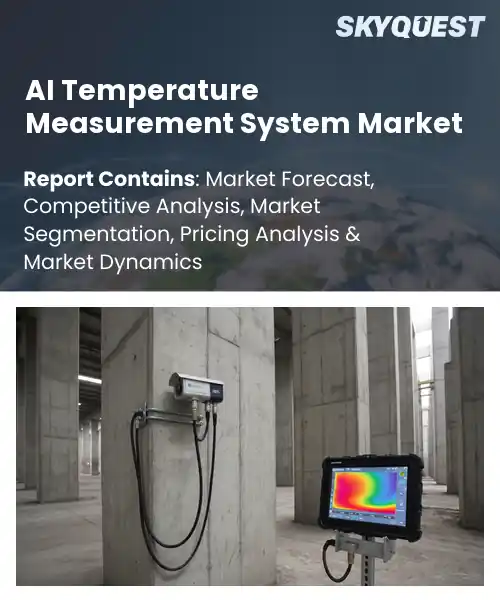
AI Temperature Measurement System Market
Report ID: SQOIG45A2731
Report ID: SQOIG45A2731
[email protected]
USA +1 351-333-4748
Report ID:
SQOIG45A2731 |
Region:
Global |
Published Date: February, 2026
Pages:
157
|Tables:
146
|Figures:
78


Global AI Temperature Measurement System Market size was valued at USD 2.1 Billion in 2024 and is poised to grow from USD 2.39 Billion in 2025 to USD 6.83 Billion by 2033, growing at a CAGR of 14.0% during the forecast period (2026-2033).
Growing demand for contactless monitoring solutions, rising adoption of AI-powered healthcare technologies, increasing emphasis on workplace and public safety, advancements in thermal imaging sensors, and integration of predictive analytics are driving sales of AI temperature measurement systems.
AI temperature measurement systems can help automate early detection helps reduce health risks, prevent equipment failures, and improve operational efficiency. In addition, the growing emphasis on public health and operational safety from a regulatory perspective is further driving interest in contactless technologies, too. The growing adoption in airports, hospitals, and manufacturing environments is further driving demand for cloud analytics and edge AI systems that can improve processing, privacy, and real-time decision-making capabilities. Growing adoption of high-resolution thermal sensors integrated with machine learning coupled with the shift from point-in-time thermometry to continuous monitoring are expected to primarily drive AI temperature measurement system market growth through 2033.
On the contrary, high initial investment costs for advanced thermal imaging systems, concerns regarding accuracy and environmental interference, data privacy challenges, and lack of standardized regulations across regions are anticipated to slow down AI temperature measurement system market penetration in the future.
How is AI-enabled IoT Improving Accuracy in Temperature Measurement Systems?
AI-enabled IoT is improving temperature measurement accuracy by combining smart sensors with on-device intelligence and connected calibration systems. Edge AI filters noise and adjusts for environmental conditions, making readings more reliable in real-world environments. These advances enable applications such as health screening, process monitoring in industry, and cold chain management. Rather than sporadic and often unaware temperature checks, companies can now benefit from continuous and context-aware temperature monitoring, which can enhance decision and operational effectiveness.
In February 2026, Teledyne FLIR announced the latest developments in thermal modules that use embedded AI for image processing. These developments improve the accuracy of measurements, speed up the deployment of monitoring systems, and increase the efficiency of temperature measurement.
Market snapshot - (2026-2033)
Global Market Size
USD 2.1 Billion
Largest Segment
Infrared (IR) Thermal Imaging
Fastest Growth
AI-based Facial Recognition + Temperature Detection
Growth Rate
14.0% CAGR
To get more insights on this market click here to Request a Free Sample Report
Global AI temperature measurement system market is segmented by technology, component type, deployment mode, application, end user, and region. Based on technology, the market is segmented into Infrared (IR) thermal imaging, AI-based facial recognition + temperature detection, machine learning algorithms, and others. Based on component type, the market is segmented into hardware, software, and services. Based on deployment mode, the market is segmented into on-premises and cloud-based. Based on application, the market is segmented into healthcare, manufacturing, food safety, and others. Based on end user, the market is segmented into hospitals, industrial plants, restaurants, and others. Based on region, the market is segmented into North America, Europe, Asia Pacific, Latin America, and Middle East & Africa.
The AI-based facial recognition + temperature detection segment is slated to hold the highest global AI temperature measurement system market share in the future. The ability of these systems to integrate identity confirmation with thermal screening to provide context aware temperature readings is helping them hold sway over others. Integration with enrollment databases and access control automates decision workflows, while continual model refinement on facial and thermal patterns improves calibration. These capabilities reduce manual checks, increase throughput in busy environments, and create strong vendor demand for integrated turnkey solutions.
However, infrared (IR) thermal imaging is emerging as the fastest growing segment as per this AI temperature measurement system industry analysis. Advances in sensor fidelity and falling component costs are creating new business scope via this segment. Its relative simplicity and compatibility with edge AI enable quick retrofits and non intrusive scanning across varied environments, driving experimentation, vendor innovation, and new commercialization pathways that broaden overall market opportunity.
The cloud-based segment is estimated to lead the global AI temperature measurement system market revenue generation in the future. The presence of data aggregation, continuous model updates, and elastic processing helps in advanced AI inferences, thus solidifying the position of this segment. Centralized analytics helps in faster detection of anomalies and retraining of models, and services help in minimizing integration hassles in multiple locations. The presence of data aggregation and OTA updates helps in continuous performance improvement, thus attracting those who want to have low-maintenance, high-performance solutions.
However, on-premise deployments have the highest growth rate, driven by concerns for privacy and latency-critical industrial applications, which require localized processing of data. Investments in edge AI appliances and on-site integrations help in providing strict data governance and deterministic response times, thus creating potential for high-end system integrators in healthcare and manufacturing.
To get detailed segments analysis, Request a Free Sample Report
Strong manufacturing base and large electronics and semiconductor ecosystems are helping Asia Pacific lead global AI temperature measurement system demand. Due to the region's expertise in sensor design, imaging components, and edge computing, system manufacturers can meet the needs of different types of environments by providing compact and dependable solutions. Through cross-border supply chain integration, along with existing export channels, the Asia Pacific region continues to strengthen its global reach. Consequently, significant domestic demand for temperature measurement systems from customers in the industrial, healthcare, and transportation sectors provides a practical means by which to develop and implement these systems/refine their functionality, while also reducing the cost per unit through economies of scale.
The presence of advanced sensor engineering, incumbent electronics manufacturers, and disciplined quality protocols are shaping AI temperature measurement system innovation in the country. Preference for integrated solutions is high among corporate and institutional establishments across Japan. Close collaboration between industry and academic institutions is also boosting refinement of advanced AI temperature measurement systems.
High AI temperature measurement system adoption among cutting edge semiconductor suppliers and system integrators is driving sustained market development. Favorable government and private investments in the field of artificial intelligence are observed, with a positive effect on the adoption of the product in the fields of manufacturing, healthcare, and security. Local manufacturers are focused on the miniaturization and edge computing capabilities of the product, with a high density of electronic manufacturers and a culture of fast product innovation.
Quick adoption of highly developed cloud technologies and high emphasis on accuracy, data governance and seamless integration are influencing AI temperature measurement system demand in the region. With access to both venture capital backing and procurement channels, both startups and established vendors are able to quickly refine existing products, develop new products, and implement go to market strategies. Rise adoption of electronic records and building management systems (BMS) solutions are also expected to create new business scope in North America. Healthcare providers, commercial real estate business owners and critical infrastructure providers are forecasted to lead AI temperature measurement system deployment across the region going forward.
Presence of a mature ecosystem of cloud platforms, systems integrators, and analytics allows the United States to lead AI temperature measurement system adoption in this region. Healthcare networks, commercial buildings, and public spaces require solutions that provide a high level of interoperability, data governance, and privacy-aligned solutions. Strong innovation in the private sector, along with collaboration between vendors and end users, provides a high level of customization, especially in complex operating environments. Emphasis on standards, independent validation, and services contracts provides a high level of procurement optimization.
AI temperature measurement system adoption in Canada is shaped by public health priorities, regional procurement practices, and emphasis on privacy and data sovereignty. Solutions are being provided to operate in dispersed and remote environments, favoring a strong focus on hardware solutions with a high level of ease of maintenance. Strong collaboration between local research centers and domestic technology vendors has led to a strong acceleration of pilot programs, emphasizing a high level of interoperability with existing clinical and safety workflows.
High emphasis on standardization and presence of skilled engineering talent are helping govern AI temperature measurement system sales in Europe. Governments and industry groups are working towards standards for interoperability, privacy and certification paths that will hold all companies accountable and provide confidence to buyers. A large number of research networks and partnerships with certified laboratories facilitate the credible clinical validation of products as well as industrial validation through partnerships. High emphasis on Industry 4.0 and rising investments in automation are also creating new opportunities. Government procurements and participation within the health care systems are creating demonstration projects that help define the performance of the systems.
High adoption of industrial automation and emphasis on enhancing engineering robustness are shaping AI temperature measurement system adoption in Germany. Partnerships between manufacturers, automation experts, and testing organizations ensure rigorous testing. Procurement in the automotive and process industries is also high, focusing on the reliability, maintainability, and local support infrastructure that drives adoption.
Robust research collaborations and a focus on clinical validation and public sector procurement is boosting AI temperature measurement system demand in the country. Emphasis on the solution’s alignment with standards, accountability, and testing ensures trust with procurement organizations in the public sector. Partnerships between manufacturers, service providers, and testing organizations ensure the AI temperature measurement system deployment in across multiple facilities in the United Kingdom.
AI temperature measurement system market in France reflects cooperation among healthcare institutions, research, and industry. Vendors emphasize clinical validation and user experience, providing solutions tailored to hospital workflows and public health screening. Focus on interoperability with national health systems and regulatory alignment promotes deliberate product refinement. Local manufacturing linkages and multilingual support simplify deployments across varied settings while targeted pilot programmes generate operational insights that guide commercial adoption and scaling.
To know more about the market opportunities by region and country, click here to
Buy The Complete Report
Surge in demand for precise, continuous temperature inputs for predictive analytics across manufacturing, healthcare, energy, and research sectors is creating new business scope for market players. Precise temperature data feeds can enable better performance of machine learning models, detect anomalies, and promote predictive maintenance strategies. This indicates a level of alignment between data-driven operational goals and temperature sensors' potential, which can promote these systems across various institutional and industrial applications.
Integration With Industrial IoT Platforms
Seamless integration with Industrial Internet of Things ecosystems can further enhance the value proposition of AI-driven temperature measurement systems by providing a centralized data aggregation and analytics solutions. With thermal sensors connected to a unified IoT ecosystem, organizations can integrate temperature patterns with other equipment, environmental, and process data to optimize operational workflows and safety protocols, which further strengthens the global AI temperature measurement system market outlook through 2033.
Data Privacy and Regulatory Concerns
Heightened concerns about data privacy, ownership, and regulatory issues can affect the implementation of AI-based temperature measurement systems. For instance, in situations where data related to temperature is associated with personal identity information or industrial processes, regulatory issues can affect implementation. Organizations may delay implementation or limit functionality in an attempt to comply with regulatory issues related to data collection, retention, and transmission. Such a situation slows down the pace of market penetration for AI-based temperature measurement systems.
High Implementation and Maintenance Costs
Implementation costs for deploying AI-based temperature measurement systems and subsequent maintenance costs can act as a constraint for their wider acceptance in the market. For instance, costs related to software and hardware integration, calibration, validation, and trained manpower can increase the overall costs for deploying an AI-based temperature measurement system. When costs are seen as a barrier to deployment, and their benefits are not substantial enough to justify their use, their implementation is delayed or restricted in terms of scale.
Request Free Customization of this report to help us to meet your business objectives.
The competitive landscape is marked by consolidation of thermal imaging incumbents, aggressive venture-backed scaleups, and technology differentiation through AI modelization and privacy preserving sensing. Recent strategic moves include large scale acquisition of sensor leaders such as Teledyne FLIR, enterprise investments and pilot partnerships by sensor AI startups, and rapid productization of AI thermal analytics for healthcare and built environments.
Edge Integrated Thermal Intelligence: Deployment of AI temperature measurement algorithms at the edge is emerging as a popular AI temperature measurement system industry trend. On-device inference is allowing for increased reliability in various applications, such as manufacturing, healthcare, and infrastructure. Vendors are also focusing on hardware software stacks for AI-based applications in edge computing technology.
Cross Industry Predictive Diagnostics: AI driven temperature profiling is creating new opportunities across industries as they opt for predictive diagnostic capabilities. Collaboration between industries is helping reduce the risks of equipment failures, product spoilage, and health anomalies through pattern recognition and analysis. Industry collaboration fosters standardized data models and interoperable workflows, which highlight the importance of this AI temperature measurement system market trend in the long run.
SkyQuest’s ABIRAW (Advanced Business Intelligence, Research & Analysis Wing) is our Business Information Services team that Collects, Collates, Correlates, and Analyses the Data collected by means of Primary Exploratory Research backed by robust Secondary Desk research.
As per SkyQuest analysis, increasing adoption of AI-powered thermal monitoring solutions and rising emphasis on contactless temperature screening for public health and workplace safety are anticipated to drive the demand for AI temperature measurement systems going forward. On the contrary, factors such as high implementation costs, accuracy issues owing to environmental factors, and data privacy are expected to impede the growth of AI temperature measurement systems in the future. North America is expected to lead the market for AI temperature measurement systems owing to its well-established healthcare infrastructure, adoption of AI technologies, and stringent safety regulations in the workplace environment. The AI temperature measurement system market is expected to benefit from the integration with predictive maintenance systems and cloud-based thermal analytics are anticipated to be key trends driving the AI temperature measurement system sector across the forecast period.
| Report Metric | Details |
|---|---|
| Market size value in 2024 | USD 2.1 Billion |
| Market size value in 2033 | USD 6.83 Billion |
| Growth Rate | 14.0% |
| Base year | 2024 |
| Forecast period | (2026-2033) |
| Forecast Unit (Value) | USD Billion |
| Segments covered |
|
| Regions covered | North America (US, Canada), Europe (Germany, France, United Kingdom, Italy, Spain, Rest of Europe), Asia Pacific (China, India, Japan, Rest of Asia-Pacific), Latin America (Brazil, Rest of Latin America), Middle East & Africa (South Africa, GCC Countries, Rest of MEA) |
| Companies covered |
|
| Customization scope | Free report customization with purchase. Customization includes:-
|
To get a free trial access to our platform which is a one stop solution for all your data requirements for quicker decision making. This platform allows you to compare markets, competitors who are prominent in the market, and mega trends that are influencing the dynamics in the market. Also, get access to detailed SkyQuest exclusive matrix.
Table Of Content
Executive Summary
Market overview
Parent Market Analysis
Market overview
Market size
KEY MARKET INSIGHTS
COVID IMPACT
MARKET DYNAMICS & OUTLOOK
Market Size by Region
KEY COMPANY PROFILES
Methodology
For the AI Temperature Measurement System Market, our research methodology involved a mixture of primary and secondary data sources. Key steps involved in the research process are listed below:
1. Information Procurement: This stage involved the procurement of Market data or related information via primary and secondary sources. The various secondary sources used included various company websites, annual reports, trade databases, and paid databases such as Hoover's, Bloomberg Business, Factiva, and Avention. Our team did 45 primary interactions Globally which included several stakeholders such as manufacturers, customers, key opinion leaders, etc. Overall, information procurement was one of the most extensive stages in our research process.
2. Information Analysis: This step involved triangulation of data through bottom-up and top-down approaches to estimate and validate the total size and future estimate of the AI Temperature Measurement System Market.
3. Report Formulation: The final step entailed the placement of data points in appropriate Market spaces in an attempt to deduce viable conclusions.
4. Validation & Publishing: Validation is the most important step in the process. Validation & re-validation via an intricately designed process helped us finalize data points to be used for final calculations. The final Market estimates and forecasts were then aligned and sent to our panel of industry experts for validation of data. Once the validation was done the report was sent to our Quality Assurance team to ensure adherence to style guides, consistency & design.
Analyst Support
Customization Options
With the given market data, our dedicated team of analysts can offer you the following customization options are available for the AI Temperature Measurement System Market:
Product Analysis: Product matrix, which offers a detailed comparison of the product portfolio of companies.
Regional Analysis: Further analysis of the AI Temperature Measurement System Market for additional countries.
Competitive Analysis: Detailed analysis and profiling of additional Market players & comparative analysis of competitive products.
Go to Market Strategy: Find the high-growth channels to invest your marketing efforts and increase your customer base.
Innovation Mapping: Identify racial solutions and innovation, connected to deep ecosystems of innovators, start-ups, academics, and strategic partners.
Category Intelligence: Customized intelligence that is relevant to their supply Markets will enable them to make smarter sourcing decisions and improve their category management.
Public Company Transcript Analysis: To improve the investment performance by generating new alpha and making better-informed decisions.
Social Media Listening: To analyze the conversations and trends happening not just around your brand, but around your industry as a whole, and use those insights to make better Marketing decisions.
REQUEST FOR SAMPLE
 REQUEST FREE CUSTOMIZATION
Global Ai Temperature Measurement System Market size was valued at USD 2.1 Billion in 2024 and is poised to grow from USD 2.39 Billion in 2025 to USD 6.83 Billion by 2033, growing at a CAGR of 14.0% during the forecast period (2026-2033).
The competitive landscape is marked by consolidation of thermal imaging incumbents, aggressive venture-backed scaleups, and technology differentiation through AI modelization and privacy preserving sensing. Recent strategic moves include large scale acquisition of sensor leaders such as Teledyne FLIR, enterprise investments and pilot partnerships by sensor AI startups, and rapid productization of AI thermal analytics for healthcare and built environments. 'FLIR Systems', 'Optris', 'Raytek', 'Testo AG', 'Omron', 'ThermoWorks', 'Siemens', 'Honeywell', 'Land Instruments International', 'Microchip Technology', 'Pico Technology', 'Smart Sensor', 'Maxim Integrated', 'Keysight Technologies', 'Bosch', 'Fluke Corporation', 'Advanced Thermal Solutions', 'NovaSensor', 'National Instruments', 'Sensirion'
The growing need for precise, continuous temperature inputs for predictive analytics across manufacturing, healthcare, energy, and research sectors supports adoption of AI temperature measurement systems by enabling more informed process control and product quality assurance. Accurate thermal data feeds facilitate machine learning model performance, allow early detection of anomalies, and support predictive maintenance strategies that reduce unplanned interruptions. This alignment between data-driven operational objectives and sensor capabilities encourages investment, integration, and scaling of solutions across institutional and industrial deployments broadly.
Edge Integrated Thermal Intelligence: Deployment of AI temperature measurement algorithms at the edge is accelerating adoption by enabling real time insights, reduced latency, and lower reliance on cloud connectivity. On device inference supports resilient monitoring in manufacturing, healthcare, and infrastructure, while preserving bandwidth and improving responsiveness. This trend encourages optimized sensor fusion, model architectures, and privacy preserving techniques, fostering scalable distributed deployments. Vendors are focusing on hardware software stacks to simplify installation and maintenance, expanding applicability across constrained environments and enabling faster operational decisions.
Asia Pacific Dominate the Global AI Temperature Measurement System Market?


Want to customize this report? This report can be personalized according to your needs. Our analysts and industry experts will work directly with you to understand your requirements and provide you with customized data in a short amount of time. We offer $1000 worth of FREE customization at the time of purchase.
Feedback From Our Clients


 USA (+1) 351-333-4748

