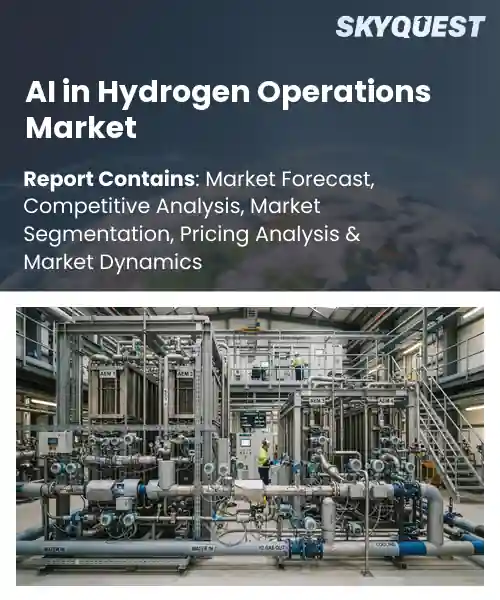
AI in Hydrogen Operations Market
Report ID: SQMIG45E3274
Report ID: SQMIG45E3274
[email protected]
USA +1 351-333-4748
Report ID:
SQMIG45E3274 |
Region:
Global |
Published Date: September, 2026
Pages:
157
|Tables:
156
|Figures:
78


Global Ai In Hydrogen Operations Market size was valued at USD 350.0 Million in 2024 and is poised to grow from USD 413.0 Million in 2025 to USD 1552.41 Million by 2033, growing at a CAGR of 18.0% during the forecast period (2026-2033).
The global AI‑enabled hydrogen operations market revolves around the integration of machine‑learning analytics into production, storage, and distribution of clean hydrogen. Its relevance stems from hydrogen’s role as a cornerstone of decarbonization strategies across electricity, industry, and transport. Over the past decade, falling renewable‑energy costs and policy incentives have accelerated electrolyzer deployments, creating data‑rich environments where AI can optimize electrolyzer efficiency, predict maintenance needs, and balance grid load. For example, a European consortium used predictive algorithms to cut electrolyzer downtime by 15 percent, demonstrating how data‑driven control translates into cost reductions and faster scaling for regional energy hubs worldwide by 2030. The dominant growth catalyst now lies in AI‑driven asset optimization, which converts sensor streams into actionable insights that boost plant reliability and lower operating expenses. When AI models forecast pressure anomalies in storage vessels, operators can intervene before safety valves engage, preventing shutdowns and extending equipment lifespan. This capability attracts capital and fuels partnerships between technology firms and hydrogen producers, as illustrated by an Asian pilot where analytics cut storage losses by 12 percent and enabled a 20‑percent increase in output. Consequently, the market expands its addressable base, inviting new entrants to develop AI stacks tailored for electrolyzers, thereby accelerating commercialization.
How are AI and IoT integration enhancing safety and efficiency in hydrogen operations?
AI and IoT integration is reshaping hydrogen production, storage, and distribution by creating a connected safety net that continuously monitors critical parameters. Sensors embedded in electrolyzers, pipelines, and storage tanks feed real‑time data to AI models that detect anomalies such as pressure spikes, temperature deviations, or leaks before they become hazardous. Predictive analytics enable operators to schedule maintenance proactively, reducing unplanned downtime and extending equipment life. The convergence of edge computing and cloud‑based analytics also supports coordinated response across dispersed assets, ensuring rapid isolation of affected zones. As the hydrogen market expands, these intelligent systems are becoming essential for meeting stringent safety standards while optimizing operational efficiency.A recent development in June 2024 showcased an AI‑driven monitoring platform that automatically flags abnormal sensor readings and initiates corrective actions, illustrating how the technology bolsters safety and drives efficiency in hydrogen operations.
Market snapshot - (2026-2033)
Global Market Size
USD 350.0 Million
Largest Segment
Machine Learning
Fastest Growth
Generative AI
Growth Rate
18.0% CAGR
To get more insights on this market click here to Request a Free Sample Report
Global ai in hydrogen operations market is segmented by ai technology, operational function, hydrogen type, application, end-use industry and region. Based on ai technology, the market is segmented into Machine Learning, Deep Learning, Generative AI, Predictive Analytics, Computer Vision and Others. Based on operational function, the market is segmented into Production Optimization, Storage Management, Transportation & Distribution, Predictive Maintenance, Safety & Risk Management and Others. Based on hydrogen type, the market is segmented into Green Hydrogen, Blue Hydrogen, Gray Hydrogen and Other Hydrogen Types. Based on application, the market is segmented into Process Optimization, Asset Monitoring, Demand Forecasting, Energy Management and Others. Based on end-use industry, the market is segmented into Energy & Power, Chemicals & Fertilizers, Oil & Gas, Transportation, Steel & Metals and Others. Based on region, the market is segmented into North America, Europe, Asia Pacific, Latin America and Middle East & Africa.
Predictive maintenance segment dominates because it directly reduces unplanned downtime and extends asset life in hydrogen production, storage and transport. By leveraging sensor data and AI algorithms, operators can anticipate failures before they occur, aligning with the industry’s emphasis on reliability and cost containment. This capability addresses a core operational pain point, making it the preferred AI investment for hydrogen firms. It also provides predictive insights for storage utilization, allowing firms to capture price arbitrage opportunities and smooth output fluctuations.
Meanwhile, computer vision segment emerges as the fastest growing because visual inspection systems are being integrated across electrolyzer modules and storage tanks, delivering time defect detection. The technology benefits from advances in edge computing and decreasing camera costs, prompting deployment. Its expansion fuels use cases and accelerates market adoption of AI in hydrogen operations.
Energy management segment stands out because it consolidates real time production data, grid signals, and market pricing to optimize electrolysis load, reducing electricity costs and emissions. By orchestrating supply side flexibility, AI enables operators to align generation with renewable availability, a critical lever for profitability and sustainability in hydrogen production. This holistic control makes it the core AI investment. It also provides predictive insights for storage utilization, allowing firms to capture price arbitrage opportunities and smooth output fluctuations.
On the other hand, demand forecasting segment is witnessing the strongest growth momentum because market participants are seeking AI tools to anticipate hydrogen consumption patterns across industrial and mobility sectors. Advanced time series models, enriched by external variables, improve procurement strategies and reduce inventory risk. This surge creates fresh avenues for AI vendors and expands the overall market ecosystem.
To get detailed segments analysis, Request a Free Sample Report
North America leads the AI in hydrogen operations market because of a mature technology ecosystem, strong research institutions, and deep integration of AI with industrial processes. The United States combines a robust venture capital environment with a critical mass of hydrogen production pilots, enabling rapid prototyping of AI-driven monitoring and predictive maintenance tools. Canada contributes through advanced renewable energy policies and collaborative clusters that unite AI startups with hydrogen refineries, fostering open data standards and cross‑border projects. Together, the region benefits from supportive regulatory frameworks, extensive digital infrastructure, and a culture of public‑private partnerships that accelerate deployment of intelligent control systems across the hydrogen value chain. The region also enjoys a deep talent pool in data science and process engineering, allowing firms to integrate machine learning models seamlessly into existing plant control systems. Moreover, federal initiatives encourage standardization of AI protocols for safety and efficiency, reinforcing confidence among investors and operators.
United States AI in Hydrogen Operations Market
AI in Hydrogen Operations Market in the United States is propelled by a confluence of world‑class research universities and a vibrant startup ecosystem that specialize in advanced analytics for energy systems. Collaborations between major hydrogen producers and technology firms enable the creation of digital twins that optimize electrolyzer performance. Government research grants and industry consortia further reduce barriers to scaling intelligent monitoring solutions across commercial and pilot facilities. These efforts are reinforced through integrated data pipelines that streamline real‑time decision making.
Canada AI in Hydrogen Operations Market
AI in Hydrogen Operations Market in Canada benefits from close alignment between federal clean‑energy objectives and provincial innovation hubs that focus on hydrogen projects. Partnerships between national laboratories and AI developers facilitate the deployment of predictive analytics for load balancing and safety assurance in electrolyzer farms. The emphasis on open‑source data sharing encourages rapid iteration of algorithms, while supportive funding mechanisms nurture a pipeline of skilled engineers who translate AI research into operational excellence.
Europe’s acceleration of AI in hydrogen operations stems from coordinated climate strategies, extensive research networks, and a strong industrial base that values digital transformation. The European Union’s emphasis on decarbonisation creates a policy environment that incentivizes the integration of AI for optimizing electrolyzer efficiency and supply‑chain logistics. Collaborative frameworks link leading universities with multinational energy firms, fostering the development of standardized AI models that can be deployed across borders. Additionally, the region’s mature manufacturing sector provides a fertile testing ground for AI‑enhanced safety systems, while public funding programmes lower the risk for early adopters, collectively propelling rapid market expansion.
Germany AI in Hydrogen Operations Market
AI in Hydrogen Operations Market in Germany is anchored by a dense cluster of engineering firms and research institutes that specialize in process automation. National hydrogen strategies promote pilots where AI governs load management and predictive maintenance for large‑scale electrolyzer installations. Close ties between automotive manufacturers and energy providers accelerate the transfer of sensor data analytics, enabling real‑time optimisation of production cycles. The collaborative culture also drives open standards that simplify integration of AI tools across diverse hydrogen assets.
United Kingdom AI in Hydrogen Operations Market
AI in Hydrogen Operations Market in the United Kingdom is driven by a dynamic startup ecosystem that intersects with established energy corporations seeking digital upgrades. Government innovation funds target AI applications that improve electrolyzer reliability and reduce operational downtime. Academic partnerships supply cutting‑edge research on machine‑learning models for forecasting hydrogen demand, while the offshore wind sector offers abundant renewable electricity that feeds AI‑controlled hydrogen production. This convergence of finance, research, and renewable infrastructure fuels the fastest growth trajectory in Europe.
France AI in Hydrogen Operations Market
AI in Hydrogen Operations Market in France is emerging through strong government ambition to position the country as a renewable energy hub. Collaborative projects link AI research labs with emerging hydrogen electrolyzer firms, focusing on algorithmic optimization of energy consumption and safety monitoring. Incentives encourage the adoption of AI‑driven digital twins that simulate plant behavior under varying renewable input. As the ecosystem matures, cross‑industry alliances are expected to broaden the scope of AI applications across the national hydrogen value chain.
Asia Pacific is strengthening its position by leveraging substantial industrial capacity, ambitious national hydrogen agendas, and rapid adoption of AI technologies to improve operational efficiency. Countries in the region combine deep manufacturing expertise with cutting‑edge data analytics, creating ecosystems where AI can be embedded directly into electrolyzer control systems and logistics platforms. Government support and strategic partnerships accelerate the diffusion of intelligent monitoring, predictive maintenance, and optimization tools across both emerging and mature hydrogen projects. This coordinated effort enhances reliability, reduces costs, and positions the region as a global leader in intelligent hydrogen production and utilization.
Japan AI in Hydrogen Operations Market
AI in Hydrogen Operations Market in Japan leverages the nation’s expertise in robotics and process control, linking these capabilities with ambitious hydrogen roadmaps. Cooperation between major chemical conglomerates and AI specialists yields fault‑diagnosis systems that enhance safety and uptime of electrolyzer facilities. Government initiatives promote data‑sharing platforms that connect renewable power sources with hydrogen sites, enabling AI algorithms to balance supply and demand. This synergy between precision engineering and analytics positions Japan as a leading innovator in intelligent hydrogen operations.
South Korea AI in Hydrogen Operations Market
AI in Hydrogen Operations Market in South Korea benefits from a strategic focus on green technology and strong manufacturing capabilities. Leading electronics firms collaborate with hydrogen producers to embed AI‑powered monitoring within electrolyzer control panels, improving real‑time responsiveness to fluctuating renewable inputs. National research programs emphasize algorithms for predictive maintenance, reducing downtime and extending equipment life. The combination of advanced sensor networks and a culture of rapid prototyping accelerates the rollout of intelligent hydrogen solutions across both domestic and export markets.
To know more about the market opportunities by region and country, click here to
Buy The Complete Report
Increasing Adoption of Green Hydrogen
Enhanced Safety Through Predictive Analytics
High Capital Expenditure for AI Integration
Regulatory Uncertainty Around Hydrogen Safety
Request Free Customization of this report to help us to meet your business objectives.
The competitive landscape is shaped by intense rivalry as major energy groups and technology firms race to embed AI in hydrogen production, storage and distribution, driving M&A, strategic alliances and rapid tech innovation; for example, Air Liquide’s acquisition of Hydrogenics, Shell’s partnership with Siemens Energy to deploy AI‑driven plant optimization, and Linde’s joint venture with Microsoft to deliver AI analytics for hydrogen logistics, all accelerating market differentiation and capability expansion.
Top Player’s Company Profile
Recent Developments
SkyQuest’s ABIRAW (Advanced Business Intelligence, Research & Analysis Wing) is our Business Information Services team that Collects, Collates, Correlates, and Analyses the Data collected by means of Primary Exploratory Research backed by robust Secondary Desk research. As per SkyQuest analysis, the market is being propelled primarily by the rising adoption of green hydrogen, which encourages firms to embed AI‑driven monitoring and optimization tools to boost efficiency and lower costs. A second strong catalyst is the enhanced safety offered by predictive analytics that detect anomalies early and protect assets. The dominant region remains North America, where a mature tech ecosystem and strong policy support accelerate deployments. Within the market, the predictive maintenance segment leads, delivering the most tangible ROI by cutting unplanned shutdowns and extending equipment life. However, high capital expenditure required for AI integration acts as a notable restraint, tempering the pace of adoption.
| Report Metric | Details |
|---|---|
| Market size value in 2024 | USD 350.0 Million |
| Market size value in 2033 | USD 1552.41 Million |
| Growth Rate | 18.0% |
| Base year | 2024 |
| Forecast period | (2026-2033) |
| Forecast Unit (Value) | USD Million |
| Segments covered |
|
| Regions covered | North America (US, Canada), Europe (Germany, France, United Kingdom, Italy, Spain, Rest of Europe), Asia Pacific (China, India, Japan, Rest of Asia-Pacific), Latin America (Brazil, Rest of Latin America), Middle East & Africa (South Africa, GCC Countries, Rest of MEA) |
| Companies covered |
|
| Customization scope | Free report customization with purchase. Customization includes:-
|
To get a free trial access to our platform which is a one stop solution for all your data requirements for quicker decision making. This platform allows you to compare markets, competitors who are prominent in the market, and mega trends that are influencing the dynamics in the market. Also, get access to detailed SkyQuest exclusive matrix.
Table Of Content
Executive Summary
Market overview
Parent Market Analysis
Market overview
Market size
KEY MARKET INSIGHTS
COVID IMPACT
MARKET DYNAMICS & OUTLOOK
Market Size by Region
KEY COMPANY PROFILES
Methodology
For the AI in Hydrogen Operations Market, our research methodology involved a mixture of primary and secondary data sources. Key steps involved in the research process are listed below:
1. Information Procurement: This stage involved the procurement of Market data or related information via primary and secondary sources. The various secondary sources used included various company websites, annual reports, trade databases, and paid databases such as Hoover's, Bloomberg Business, Factiva, and Avention. Our team did 45 primary interactions Globally which included several stakeholders such as manufacturers, customers, key opinion leaders, etc. Overall, information procurement was one of the most extensive stages in our research process.
2. Information Analysis: This step involved triangulation of data through bottom-up and top-down approaches to estimate and validate the total size and future estimate of the AI in Hydrogen Operations Market.
3. Report Formulation: The final step entailed the placement of data points in appropriate Market spaces in an attempt to deduce viable conclusions.
4. Validation & Publishing: Validation is the most important step in the process. Validation & re-validation via an intricately designed process helped us finalize data points to be used for final calculations. The final Market estimates and forecasts were then aligned and sent to our panel of industry experts for validation of data. Once the validation was done the report was sent to our Quality Assurance team to ensure adherence to style guides, consistency & design.
Analyst Support
Customization Options
With the given market data, our dedicated team of analysts can offer you the following customization options are available for the AI in Hydrogen Operations Market:
Product Analysis: Product matrix, which offers a detailed comparison of the product portfolio of companies.
Regional Analysis: Further analysis of the AI in Hydrogen Operations Market for additional countries.
Competitive Analysis: Detailed analysis and profiling of additional Market players & comparative analysis of competitive products.
Go to Market Strategy: Find the high-growth channels to invest your marketing efforts and increase your customer base.
Innovation Mapping: Identify racial solutions and innovation, connected to deep ecosystems of innovators, start-ups, academics, and strategic partners.
Category Intelligence: Customized intelligence that is relevant to their supply Markets will enable them to make smarter sourcing decisions and improve their category management.
Public Company Transcript Analysis: To improve the investment performance by generating new alpha and making better-informed decisions.
Social Media Listening: To analyze the conversations and trends happening not just around your brand, but around your industry as a whole, and use those insights to make better Marketing decisions.
REQUEST FOR SAMPLE
 REQUEST FREE CUSTOMIZATION


Want to customize this report? This report can be personalized according to your needs. Our analysts and industry experts will work directly with you to understand your requirements and provide you with customized data in a short amount of time. We offer $1000 worth of FREE customization at the time of purchase.
Feedback From Our Clients


 USA (+1) 351-333-4748

