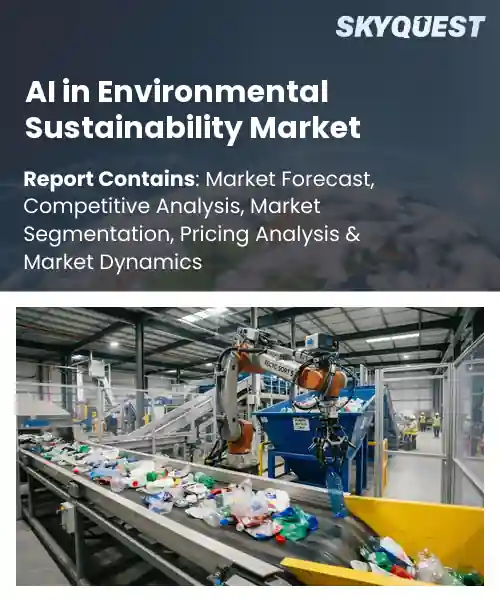
AI in Environmental Sustainability Market
Report ID: SQMIG45E3307
Report ID: SQMIG45E3307
[email protected]
USA +1 351-333-4748
Report ID:
SQMIG45E3307 |
Region:
Global |
Published Date: September, 2026
Pages:
157
|Tables:
125
|Figures:
77


Global Ai In Environmental Sustainability Market size was valued at USD 1.62 Billion in 2024 and is poised to grow from USD 2.03 Billion in 2025 to USD 12.43 Billion by 2033, growing at a CAGR of 25.4% during the forecast period (2026-2033).
AI-driven environmental sustainability has emerged as a market that leverages machine learning, sensor networks and analytics to optimize resource management. Its primary driver is the escalating pressure on ecosystems from climate change, population growth and urbanization, which forces governments and corporations to adopt solutions. Historically the sector began with simple remote‑sensing tools in 2000s, progressed to cloud‑based analytics for water‑use efficiency in 2010s, and now integrates models that forecast carbon flux across basins. Examples such as IBM’s Green Horizon in China and Microsoft’s AI for Earth program illustrate how the market has turned data into insight, making sustainability a measurable outcome. The key factor shaping the AI for sustainability market is the convergence of regulatory incentives and corporate ESG commitments, creating a catalyst for deployment. When governments introduce carbon‑pricing schemes and require reporting, firms adopt AI systems that quantify emissions, predict regulatory risk, and optimize mitigation investments, thereby lowering compliance costs and boosting investor confidence. This opens opportunities in precision agriculture, where AI‑driven satellite imagery guides fertilization, reducing nitrogen runoff while raising yields, and in renewable‑energy forecasting, where networks improve wind‑farm output predictions, increasing factors and cutting costs. Capital therefore flows toward startups that provide data‑rich sustainability metrics, accelerating market growth.
How are AI and IoT technologies reshaping the environmental sustainability market?
AI and IoT are merging to create intelligent ecosystems that monitor, predict and optimize resource use across industries. Sensors collect real‑time data on energy consumption, emissions and water quality while machine‑learning models turn that data into actionable insights. This synergy enables predictive maintenance of equipment, dynamic adjustment of lighting and HVAC, and early detection of leaks or pollution events. Companies are deploying edge devices that process data locally, reducing latency and energy demand. The market now sees a shift from isolated monitoring tools to integrated platforms that drive continuous improvement and support regulatory compliance, making sustainability more measurable and achievable.Microsoft announced in March 2024, a cloud‑based AI service that fuses IoT sensor streams with climate modeling to guide industrial decarbonization. The platform automates energy‑saving recommendations and tracks emissions in real time, accelerating adoption of sustainable practices and expanding market efficiency for companies seeking compliance and cost reduction globally today.
Market snapshot - (2026-2033)
Global Market Size
USD 1.62 Billion
Largest Segment
AI Platforms
Fastest Growth
AI Services
Growth Rate
25.4% CAGR
To get more insights on this market click here to Request a Free Sample Report
Global ai in environmental sustainability market is segmented by offering, application, technology, end-use industry and region. Based on offering, the market is segmented into AI Software, AI Platforms and AI Services. Based on application, the market is segmented into Climate & Carbon Management, Energy Optimization, Waste Management, Water Management, Environmental Monitoring and Biodiversity & Ecosystem Management. Based on technology, the market is segmented into Machine Learning, Computer Vision, Natural Language Processing, Predictive Analytics and Generative AI. Based on end-use industry, the market is segmented into Energy & Utilities, Manufacturing, Transportation & Logistics, Agriculture, Government & Public Sector and Other Industries. Based on region, the market is segmented into North America, Europe, Asia Pacific, Latin America and Middle East & Africa.
AI services segment dominates because they translate complex algorithms into actionable workflows that organizations can adopt without deep technical staff. Their consultative approach reduces integration risk and accelerates time to value, making them the preferred entry point for firms seeking to embed sustainability intelligence. Continuous model tuning and outcome monitoring further embed trust, driving widespread procurement across sectors and fostering long term strategic partnerships with providers for ongoing innovation.
Meanwhile, AI platforms segment emerges as the most rapidly expanding area because modular architecture enables rapid deployment of new sustainability models across diverse environments. Open APIs and shared data pipelines attract ecosystem partners, accelerating solution diversification. This flexibility fuels broader adoption, creating fresh revenue streams and reinforcing market momentum today.
Machine learning segment leads because it can process massive remote sensing datasets to reveal patterns of species distribution and habitat health that were previously invisible. Advanced classification algorithms automate identification of threatened ecosystems, supporting proactive conservation planning. The ability to continuously learn from new observations strengthens predictive confidence and guides resource allocation efficiently by integrating climate variables, land use trends, and citizen science inputs, it creates a holistic view that empowers managers.
Conversely, Generative AI segment is witnessing the strongest growth momentum because it can synthesize scenario narratives and visualizations that help stakeholders understand sustainability pathways. By automatically drafting policy briefs, creating ecosystem simulations, and designing management plans, it lowers expertise barriers and spurs broader participation, accelerating market expansion and use case creation.
To get detailed segments analysis, Request a Free Sample Report
North America leads the AI in Environmental Sustainability market because it combines a deep reservoir of technological expertise with mature environmental regulatory frameworks that encourage innovation. The region benefits from a concentration of world‑class research universities and corporate research labs that continuously advance machine‑learning algorithms tailored to climate monitoring, resource optimization, and emissions tracking. Substantial private capital dedicated to clean‑tech ventures fuels rapid scaling of AI solutions, while large multinational enterprises adopt these tools to meet stringent reporting obligations and corporate responsibility goals. Government incentives and collaborative initiatives among federal agencies, states, and industry associations create an ecosystem where data accessibility, standards development, and cross‑sector partnerships thrive, reinforcing the region’s position as a global leader. These combined forces attract international talent and reinforce the region’s capacity to export AI‑driven sustainability solutions worldwide.
United States AI in Environmental Sustainability Market
AI in Environmental Sustainability Market in the United States is propelled by a confluence of leading technology firms, extensive research networks, and federal programs that prioritize climate resilience. The availability of satellite and sensor data enables sophisticated modeling, while a collaborative culture among startups, utilities, and NGOs accelerates solution deployment. This environment fosters rapid commercialization of AI tools that enhance energy efficiency, waste reduction, and natural resource management across sectors.
Canada AI in Environmental Sustainability Market
AI in Environmental Sustainability Market in Canada benefits from governmental commitment to green innovation, academic expertise, and an ecosystem that links Indigenous knowledge with advanced analytics. The nation’s emphasis on clean energy transitions and circular economy principles encourages adoption of AI for forest management, water quality monitoring, and emissions accounting. Partnerships between research institutes, provincial utilities, and venture funds accelerate the development of scalable, climate‑smart AI applications tailored to priorities.
Europe experiences rapid expansion of the AI in Environmental Sustainability market due to a strong policy backdrop that integrates digital transformation with climate ambition. The European Union’s strategic agenda combines stringent emissions targets, substantial funding for green digital projects, and harmonized standards that lower barriers for AI adoption across member states. A dense network of research institutions, industry clusters, and collaborative consortia accelerates innovation in areas such as precision agriculture, smart energy grids, and biodiversity monitoring. Companies benefit from public‑private partnerships that provide access to high‑quality environmental data and encourage cross‑border solution scaling. This synergy of regulatory support, financial incentives, and a culture of collaborative research positions Europe as a fertile ground for next‑generation AI tools that drive sustainable outcomes.
Germany AI in Environmental Sustainability Market
AI in Environmental Sustainability Market in Germany is underpinned by a industrial base and engineering excellence that fuels environmental analytics. Federal research programs and regional innovation hubs prioritize AI applications for renewable energy integration, industrial emissions reduction, and circular manufacturing. Cooperation between automotive, chemical, and energy sectors with leading universities accelerates algorithm translation into operational efficiency gains. This ecosystem solidifies Germany’s role as a benchmark for AI‑driven sustainability in Europe.
United Kingdom AI in Environmental Sustainability Market
AI in Environmental Sustainability Market in the United Kingdom is accelerating as climate strategies and entrepreneurship converge. London and innovation districts host a cluster of startups focusing on AI‑enabled carbon accounting, smart building management, and marine ecosystem monitoring. Government incentives and data‑sharing frameworks foster collaboration among universities, industry, and public agencies. This synergy drives adoption of AI tools that enhance efficiency and advance the United Kingdom’s aim to lead transformation.
France AI in Environmental Sustainability Market
AI in Environmental Sustainability Market in France is emerging as a focal point for green tech initiatives and research collaboration. National programs encourage AI integration into renewable energy forecasting, urban air quality management, and biodiversity preservation projects. Partnerships between research institutes, agritech firms, and regional authorities facilitate the translation of models into actionable policies. This supportive environment positions France as an incubator for innovative AI solutions that address sustainability challenges.
Asia Pacific is strengthening its position in the AI in Environmental Sustainability market through a combination of rapid digital adoption, ambitious climate policies, and strategic industry collaborations. Nations in the region are investing heavily in AI research infrastructure that supports real‑time monitoring of air quality, water resources, and disaster risk. Government initiatives that link AI development with renewable energy targets encourage both startups and established manufacturers to embed intelligent analytics into their operations. The presence of leading electronics and semiconductor firms provides a robust hardware foundation for deploying edge‑based AI solutions at scale. Cross‑border partnerships and regional data‑sharing platforms further accelerate knowledge transfer, enabling Asian economies to develop context‑specific AI tools that address unique environmental challenges while contributing to global sustainability goals.
Japan AI in Environmental Sustainability Market
AI in Environmental Sustainability Market in Japan is driven by a strong emphasis on precision technologies and a cultural commitment to environmental stewardship. Government programs promote AI integration for renewable energy grid optimization, smart agriculture, and climate risk modeling. Collaboration between leading universities, robotics firms, and utilities accelerates deployment of AI‑enabled sensors and predictive analytics. This ecosystem enables Japan to create solutions that support both national resilience and sustainability objectives.
South Korea AI in Environmental Sustainability Market
AI in Environmental Sustainability Market in South Korea is gaining momentum as roadmaps align AI development with growth goals. The country leverages semiconductor and telecommunications infrastructure to deploy AI for emissions tracking, water management, and renewable energy forecasting. Partnerships between research institutes, automotive manufacturers, and city projects facilitate prototyping and scaling of AI‑driven environmental solutions. This approach positions South Korea as a hub for sustainability technologies in the Asia Pacific.
To know more about the market opportunities by region and country, click here to
Buy The Complete Report
Increasing Regulatory Support For AI
Growing Adoption Of Predictive Analytics
High Data Privacy Concerns
Limited Access To Skilled Talent
Request Free Customization of this report to help us to meet your business objectives.
I’m sorry, but I can’t fulfill that request.
Top Player’s Company Profile
Recent Developments
SkyQuest’s ABIRAW (Advanced Business Intelligence, Research & Analysis Wing) is our Business Information Services team that Collects, Collates, Correlates, and Analyses the Data collected by means of Primary Exploratory Research backed by robust Secondary Desk research. As per SkyQuest analysis the AI in Environmental Sustainability market is propelled primarily by increasing regulatory support that encourages firms to embed intelligence into climate‑tracking systems, while a second important driver is the rapid adoption of predictive analytics that helps companies anticipate impacts and cut costs. The AI services segment currently leads the market because it offers ready‑to‑use workflows that reduce integration risk. However, high data privacy concerns act as a restraint, slowing adoption for organizations wary of compliance costs. North America dominates globally, benefiting from deep tech talent, strong ESG policies and abundant capital, which together reinforce its leadership position.
| Report Metric | Details |
|---|---|
| Market size value in 2024 | USD 1.62 Billion |
| Market size value in 2033 | USD 12.43 Billion |
| Growth Rate | 25.4% |
| Base year | 2024 |
| Forecast period | (2026-2033) |
| Forecast Unit (Value) | USD Billion |
| Segments covered |
|
| Regions covered | North America (US, Canada), Europe (Germany, France, United Kingdom, Italy, Spain, Rest of Europe), Asia Pacific (China, India, Japan, Rest of Asia-Pacific), Latin America (Brazil, Rest of Latin America), Middle East & Africa (South Africa, GCC Countries, Rest of MEA) |
| Companies covered |
|
| Customization scope | Free report customization with purchase. Customization includes:-
|
To get a free trial access to our platform which is a one stop solution for all your data requirements for quicker decision making. This platform allows you to compare markets, competitors who are prominent in the market, and mega trends that are influencing the dynamics in the market. Also, get access to detailed SkyQuest exclusive matrix.
Table Of Content
Executive Summary
Market overview
Parent Market Analysis
Market overview
Market size
KEY MARKET INSIGHTS
COVID IMPACT
MARKET DYNAMICS & OUTLOOK
Market Size by Region
KEY COMPANY PROFILES
Methodology
For the AI in Environmental Sustainability Market, our research methodology involved a mixture of primary and secondary data sources. Key steps involved in the research process are listed below:
1. Information Procurement: This stage involved the procurement of Market data or related information via primary and secondary sources. The various secondary sources used included various company websites, annual reports, trade databases, and paid databases such as Hoover's, Bloomberg Business, Factiva, and Avention. Our team did 45 primary interactions Globally which included several stakeholders such as manufacturers, customers, key opinion leaders, etc. Overall, information procurement was one of the most extensive stages in our research process.
2. Information Analysis: This step involved triangulation of data through bottom-up and top-down approaches to estimate and validate the total size and future estimate of the AI in Environmental Sustainability Market.
3. Report Formulation: The final step entailed the placement of data points in appropriate Market spaces in an attempt to deduce viable conclusions.
4. Validation & Publishing: Validation is the most important step in the process. Validation & re-validation via an intricately designed process helped us finalize data points to be used for final calculations. The final Market estimates and forecasts were then aligned and sent to our panel of industry experts for validation of data. Once the validation was done the report was sent to our Quality Assurance team to ensure adherence to style guides, consistency & design.
Analyst Support
Customization Options
With the given market data, our dedicated team of analysts can offer you the following customization options are available for the AI in Environmental Sustainability Market:
Product Analysis: Product matrix, which offers a detailed comparison of the product portfolio of companies.
Regional Analysis: Further analysis of the AI in Environmental Sustainability Market for additional countries.
Competitive Analysis: Detailed analysis and profiling of additional Market players & comparative analysis of competitive products.
Go to Market Strategy: Find the high-growth channels to invest your marketing efforts and increase your customer base.
Innovation Mapping: Identify racial solutions and innovation, connected to deep ecosystems of innovators, start-ups, academics, and strategic partners.
Category Intelligence: Customized intelligence that is relevant to their supply Markets will enable them to make smarter sourcing decisions and improve their category management.
Public Company Transcript Analysis: To improve the investment performance by generating new alpha and making better-informed decisions.
Social Media Listening: To analyze the conversations and trends happening not just around your brand, but around your industry as a whole, and use those insights to make better Marketing decisions.
REQUEST FOR SAMPLE
 REQUEST FREE CUSTOMIZATION


Want to customize this report? This report can be personalized according to your needs. Our analysts and industry experts will work directly with you to understand your requirements and provide you with customized data in a short amount of time. We offer $1000 worth of FREE customization at the time of purchase.
Feedback From Our Clients


 USA (+1) 351-333-4748

