
Global AI Governance Market
AI Governance Market

Report ID: SQMIG45D2164

sales@skyquestt.com
USA +1 351-333-4748

AI Governance Market Size, Share, and Growth Analysis

Global AI Governance Market

AI Governance Market By Component (Solution, Services), By Deployment (On-Premises, Cloud), By Organization Size (Large Enterprise, SMEs), By Vertical, By Region -Industry Forecast 2026-2033


Report ID: SQMIG45D2164 | Region: Global | Published Date: August, 2025
Pages: 178 |Tables: 117 |Figures: 70

Format - word format excel data power point presentation

AI Governance Market Insights

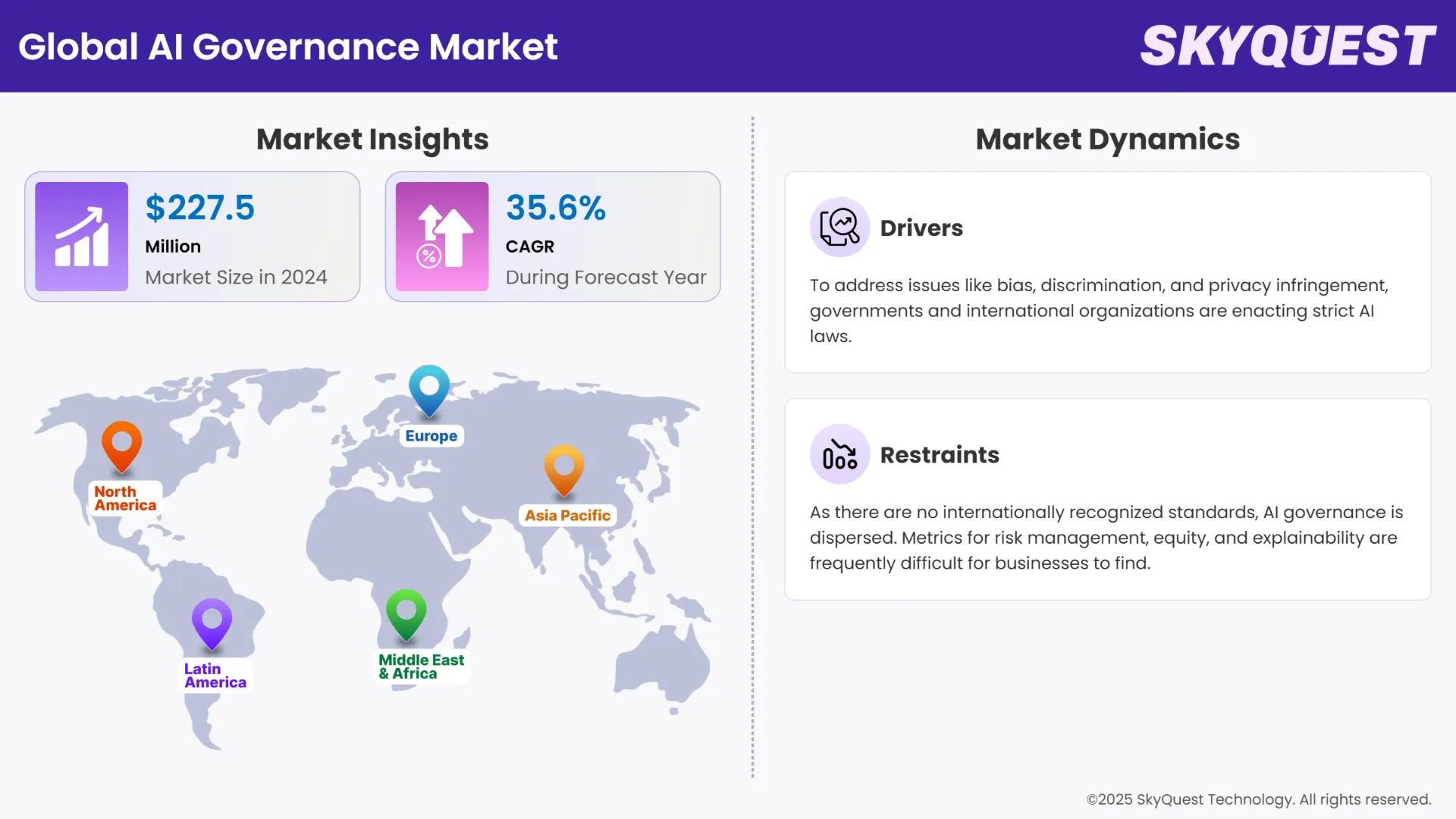
Global AI Governance Market size was valued at USD 198.67 Million in 2024 and is poised to grow from USD 269.39 Million in 2025 to USD 3079.39 Million by 2033, growing at a CAGR of 35.6% during the forecast period (2026–2033).

Key Takeaways: Market Trends & Insights

  • North America dominated the AI Governance market with a largest market share in 2025.
  • The U.S. AI Governance market is expected to grow significantly over the forecast period.
  • By Component, the Solution segment held the largest AI Governance market share in 2024.
  • The Services segment held the highest growing market over the forecast period.
  • North America: Largest Market in 2025
  • Asia-Pacific: Fastest Growing Market
  • 2025 Market Size: USD 269.39 Million
  • 2026 Projected Market Size: USD 365.3 Million
  • 2033 Projected Market Size: USD 3079.39 Million
  • CAGR (2026-2033): 35.6%

The global AI governance market growth is driven rapidly as more people become conscious of the moral, legal, and regulatory concerns related to artificial intelligence. Governments, private companies, and academic institutions are increasingly collaborating to develop robust AI governance frameworks. Lawmakers are keen to enact legislation that protects citizens from the potential negative effects of AI.

The growing awareness of state-sponsored activity in cyberspace makes it evident that AI governance frameworks are required. More advanced computer-based hacking techniques, known as penetration testing, may become available as companies grow more confident in AI-powered security solutions. AI-powered tools have made it possible for MIT experts with cyber defense training to simulate attacks, but establishing efficient protocols is crucial to preventing internal biases and the possibility of a compliance violation. Adherence to fundamental cybersecurity principles, such as safety, ethics, and visibility, is guaranteed by AI governance.

  • For example, in November 2024, Microsoft introduced Zero Day Quest, a multifaceted hacking competition that aims to exploit significant vulnerabilities in cloud and AI systems and has a prize pool of over USD 4 million. This tender emphasizes the value of ethical hacking in strengthening the global cybersecurity infrastructure.

Why is Explainability Technology Crucial for Responsible AI Deployment?

A significant technological change in AI governance technology is the launch of automated bias detection and explainability tools in enterprise AI systems. Throughout the model deployment, IBM added real-time monitoring into its Watsonx.governance suite for bias detection and regulatory compliance. This research allowed businesses to audit AI-based decisions in the boardroom, and to provide clear explanations for outcomes in healthcare and finance. For example, a U.S.-based insurer, by using Watsonx.governance to audit their AI-based claims processing approval system, reduced the number of complaints of algorithmic bias by 35%. As international AI regulation persisted tightening in 2024, especially in the case of the EU AI Act, these tools allowed organizations to maintain ethical AI and to scale their AI responsibly.
AI Governance Market Infographics

To get more insights on this market click here to Request a Free Sample Report

AI Governance Market Segments Analysis

The global AI governance market is segmented into component, deployment, organization size, vertical, and region. By component, the market is divided into solutions and services. Depending on deployment, it is bifurcated into on-premises and clouds. According to organization size, the market is classified into large enterprises and SMEs. As per vertical, it is categorized into BFSI, government & defense, healthcare & life sciences, media & entertainment, retail, it & telecommunication, and automotive. Regionally, it is analyzed across North America, Europe, Asia-Pacific, Latin America, and the Middle East and Africa.

How are AI Governance Solutions Meeting Rising Compliance Demands?

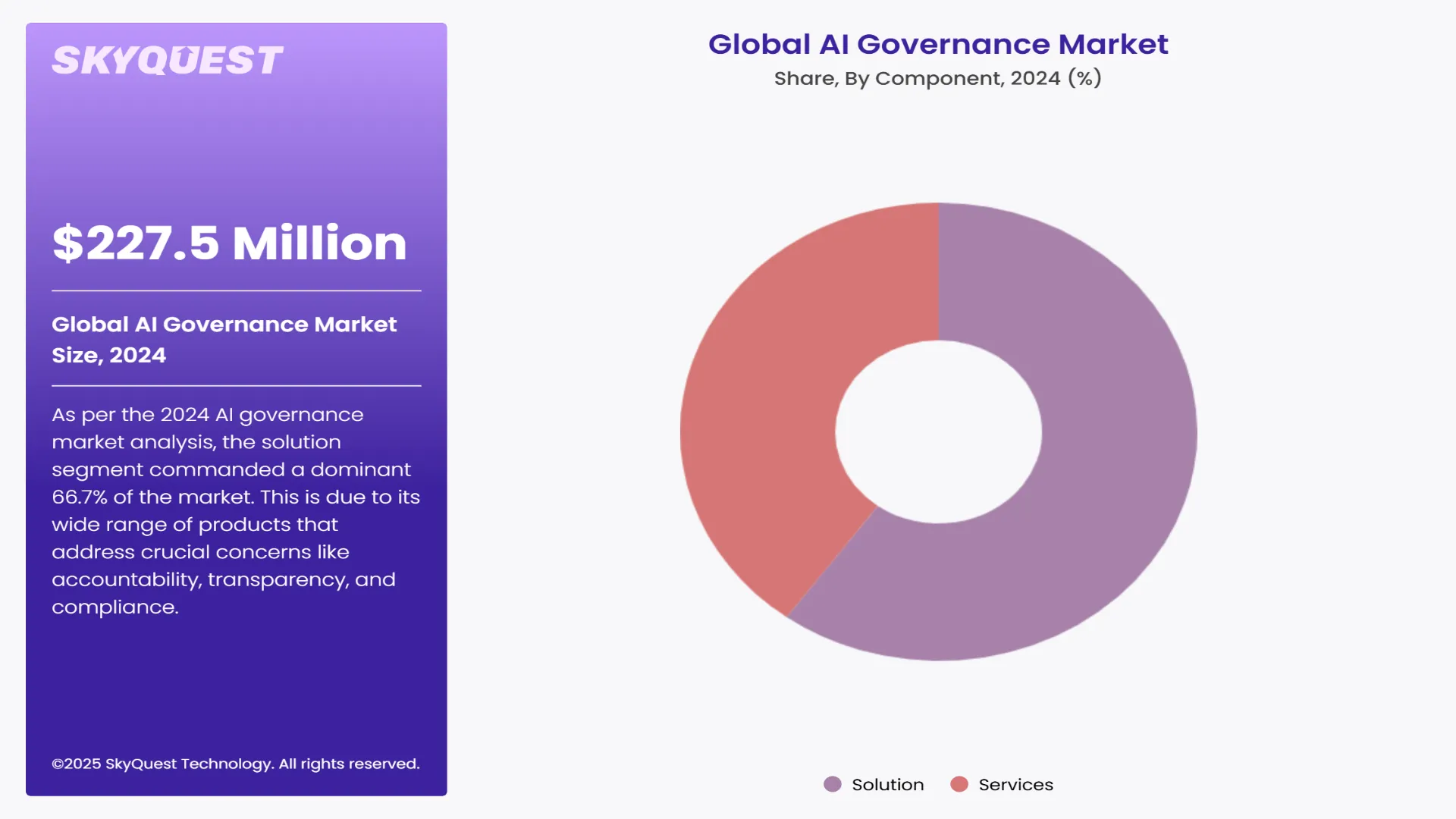
As per the 2024 AI governance market analysis, the solution segment commanded a dominant 66.7% of the market. This is due to its wide range of products that address crucial concerns like accountability, transparency, and compliance. Explainability, bias detection, and AI auditing tools, all essential for businesses to effectively manage risks, are commonly included in these solutions. Companies are spending a lot of money on these solutions to ensure that their AI systems comply with legal and ethical standards. The solution segment's dominance is also being driven by the growing need for scalable, non-traditional governance tools that are easy to integrate into existing AI workflows. As a result, this market niche continues to lead in terms of adoption and innovation.

The services segment offers significant benefits, particularly in the areas of implementation support, consulting, and ongoing monitoring. Services help businesses navigate complex regulatory landscapes and customize governance frameworks to suit their unique needs. These services are crucial for companies that might lack the internal expertise to manage AI governance on their own.

What Gives Large Enterprises an Edge in Implementing AI Governance?

As per the 2024 AI governance market forecast, the large enterprises segment is leading the way in AI adoption and governance because of the existence of AI Sovereignty Implementation Units with the required domain expertise. These businesses disregard the application of AI in customer relationship management, fraud anomaly detection, market trend forecasting, and acquisition pipeline prognostication. To address these issues, large corporations have set up specialized AI supervision units that ensure the ethical and responsible use of AI within a well-defined framework of internal policies and external frameworks such as the EU AI Act, GDPR Compliance, and the US Bill of AI Rights.

  • In June 2024, for example, IBM used WatsonX to elevate its AI governance capabilities in risk management and regulatory compliance to advanced levels at the enterprise tier. Strengthening enterprise AI shielding frameworks for compliance was the aim. Similarly, Microsoft strengthened its AI governance and ethics framework for enterprise solutions in February 2024 with the release of Responsible AI Standard 2.0.

The SMEs category is anticipated to have the highest AI governance market share as more small businesses recognize the significance of AI governance. Scalable and cloud-based solutions are making governance tools more accessible and affordable, despite the fact that SMEs may not have as much money. These companies are deploying AI technologies to remain competitive, which calls for the application of appropriate governance to manage risks and ensure compliance.
Global AI Governance Market By Component 2026-2033
AI Governance Market Segments Analysis

To get detailed segments analysis, Request a Free Sample Report

AI Governance Market Regional Insights

What Regulatory and Industry Forces Are Driving AI Oversight in North America?

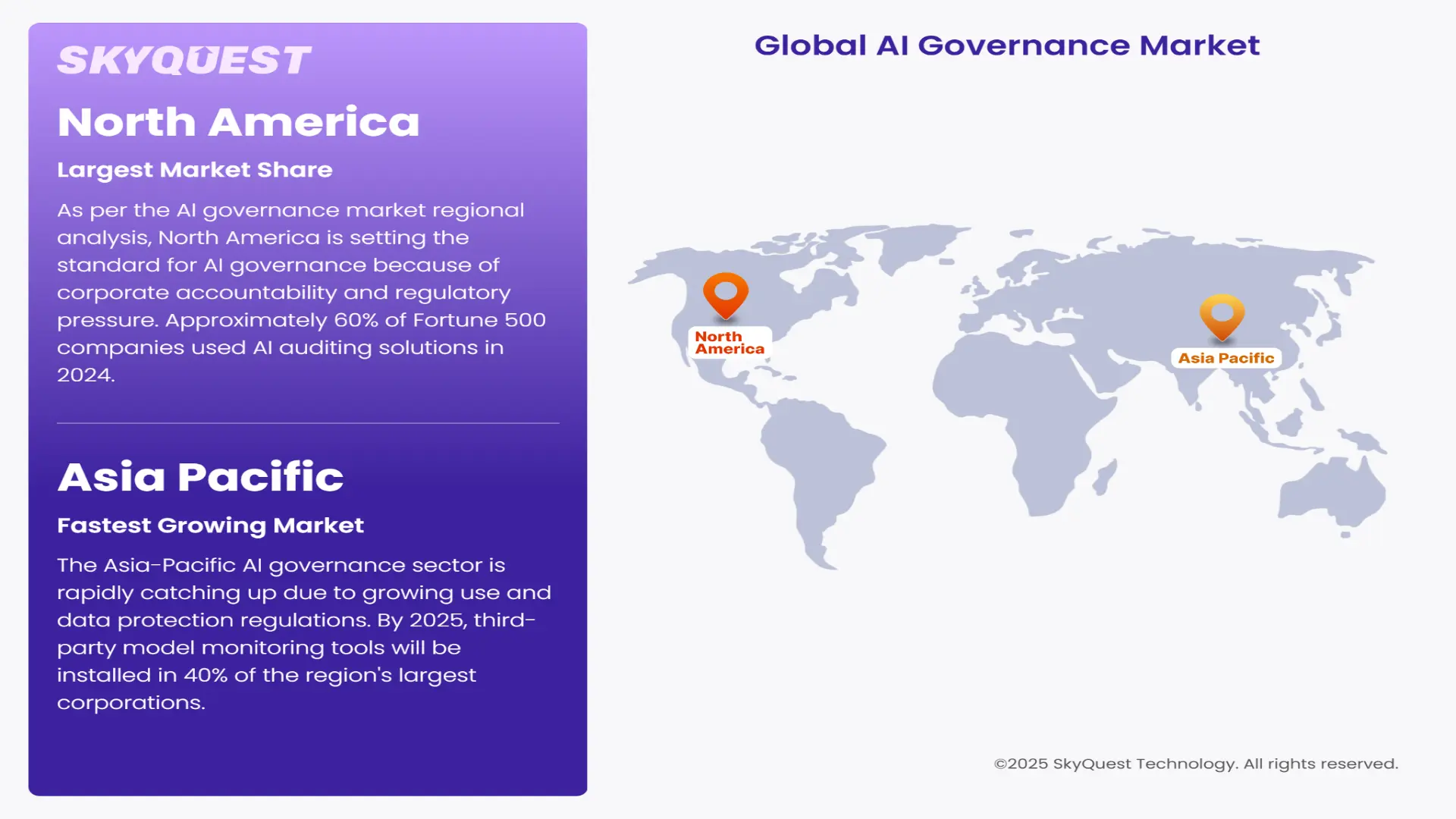
As per the AI governance market regional analysis, North America is setting the standard for AI governance because of corporate accountability and regulatory pressure. Approximately 60% of Fortune 500 companies used AI auditing solutions in 2024. In response to increased oversight, IBM and Microsoft increased the scope of their AI compliance tools. NIST's AI Risk Management Framework, which became a regional standard, assisted businesses in implementing governance tools that respect ethical AI principles and federal compliance standards.

AI Governance Market in the U.S.

Through public-private cooperation, the US is at the forefront of AI governance. Google established internal AI Responsibility Review Boards in 2024, and JPMorgan put in place automatic compliance monitoring for all AI models. In 2023 Executive Order on Safe, Secure, and Trustworthy AI, the Biden administration advocated for the broad adoption of AI governance tools. By 2025, American businesses will be the world's top users of model explainability and bias detection methods.

AI Governance Market in Canada

Proactive policy and solid academic collaborations shape Canada's AI governance sector. The Artificial Intelligence and Data Act (AIDA), which goes into effect in 2025, requires businesses to use tools for risk classification and algorithmic transparency. Manufacturers and the Montreal-based company NuEnergy AI collaborated to implement AI trust dashboards. Canada is still at the forefront of the responsible application of AI across industries because of government support and ethics-focused AI hubs.

How are European Companies Adapting to the EU AI Act?

As the EU AI Act gets closer to being fully implemented, Europe is formalizing AI governance at a faster rate. Businesses got ready for high-risk AI classification and compliance systems in 2024. The first companies to incorporate AI auditing capabilities into enterprise software suites were Siemens and SAP. Through national digital agendas and regulatory sandboxes, governments encouraged the application of ethical AI, establishing Europe as a leader in human-centered and ethical AI worldwide.

AI Governance Market in UK

Practical AI governance is highly valued in the UK's pro-innovation regulatory framework. The Responsible AI Assurance Toolkit for businesses was introduced by the Alan Turing Institute in 2024. HSBC implemented AI supervision layers to keep an eye on financial services algorithms. The UK created its own voluntary Code of Practice that encourages openness, equity, and resilience in the application of AI across industries, despite not being governed by the EU AI Act.

AI Governance Market in France

France's industrial leadership and national sovereignty complement its AI governance. For all of its defense AI projects, Thales introduced a unique AI ethical grading system in 2025. With an emphasis on healthcare and transportation, the French government's "Plan IA" kept funding reliable AI research. Startups benefited from regulatory pilots in AI testing environments since they could confirm risk management and compliance prior to wider adoption.

AI Governance Market in Germany

Germany's efforts to regulate AI are motivated by its emphasis on industrial safety and ethics. To ensure compliance with the GDPR and EU AI Act, Bosch established a unified platform for AI supervision across its automotive AI systems in 2024. The nation places a high priority on auditability, AI documentation, and risk classification. Through programs like Plattform Lernende Systeme, public and private organizations work together to create tools for transparent, auditable AI systems.

How is Asia-Pacific Responding to Rising Demand for AI Governance?

The Asia-Pacific AI governance sector is rapidly catching up due to growing use and data protection regulations. By 2025, third-party model monitoring tools will be installed in 40% of the region's largest corporations. Explainability frameworks were funded by regional tech giants. AI governance is becoming more widely recognized as a competitive advantage, particularly in the financial services industry where success depends on cross-border compliance and customer trust.

AI Governance Market in China

China uses top-down legislation to enforce stringent AI governance. The Chinese Cyberspace Administration required transparency disclosures and algorithm filing in 2024. Alibaba's cloud services are subject to an internal AI ethics compliance unit. Market behavior was impacted by the Provisions on the Management of Algorithmic Recommendations, which required businesses to monitor bias, manipulate risk assessments, and enhance algorithm explainability to comply with national security regulations.

AI Governance Market in Japan

Safe implementation and public trust are given top priority in Japan's AI governance policy. Concerns about bias prompted NEC Corporation to add governance features to their facial recognition technology in 2025. The government's "AI Governance Guidelines" encourage self-regulation with an emphasis on explainability, transparency, and effect assessment. The strategy used by Japan, which is based on ethical design principles and stakeholder consensus, encourages responsible innovation and boosts competitiveness in high-tech businesses.
Global AI Governance Market By Geography, 2026-2033
AI Governance Market Regional Analysis

To know more about the market opportunities by region and country, click here to
Buy The Complete Report

AI Governance Market Dynamics

AI Governance Market Drivers

Growing Regulatory Requirements and Ethics Standards for AI

  • To address issues like bias, discrimination, and privacy infringement, governments and international organizations are enacting strict AI laws. Businesses are required to develop AI that is transparent and intelligible by the EU AI Act, which went into effect in 2024. This makes governance frameworks that guarantee compliance necessary. As companies place a high value on ethical AI practices to safeguard their brand and stay out of trouble with the law, AI governance is being adopted across industries.

Importance of Open and Mindful AI in Business

  • The need to guarantee algorithmic transparency, justice, and accountability is increasing as businesses use AI in HR, finance, and healthcare. To manage the risks associated with the AI lifecycle and allow for human oversight, businesses look for governance solutions. For example, large banks use AI governance platforms to audit loan processing decisions. This pattern illustrates the transition from unrestrained AI use to purposeful, moral application.

AI Governance Market Restraints

Absence of Uniform Governance Frameworks

  • As there are no internationally recognized standards, AI governance is dispersed. Metrics for risk management, equity, and explainability are frequently difficult for businesses to find. This disunity leads to uneven enforcement and oversight of AI, particularly on a global scale. Businesses are reluctant to use scalable governance solutions in the absence of clear guidelines or templates, which hinders wider adoption and creates inconsistent compliance environments.

High Implementation Costs and Technological Complexity

  • Cross-functional cooperation, strong infrastructure, and technical know-how are necessary for putting AI governance frameworks into practice. Complexity is increased by integrating governance tools with current data pipelines and AI models. Furthermore, smaller businesses lack the tools and expertise needed to put in place complete systems for bias identification, auditing, and model tracking. Adoption is hampered by these issues, especially in emerging markets or among non-tech companies assessing AI technologies.

Request Free Customization of this report to help us to meet your business objectives.

AI Governance Market Competitive Landscape

Growing regulatory scrutiny is making the AI governance market more competitive. Prominent corporations like Google, Microsoft, and IBM are incorporating governance features into their AI development platforms. IBM advertises its hybrid AI governance technologies and AI Ethics Board. A framework for internal development is provided by Microsoft's Responsible AI Standard. For startups, explainability and avoiding bias are of utmost importance. Important competitive strategies include integrated governance, regulatory alignment, and strategic investments in AI lifecycle tools.

  • Credo AI (US, 2020): Credo AI, which was established in 2020, provides a thorough AI governance platform to assist businesses in guaranteeing the ethical application of AI in all domains. It makes it possible to detect bias, perform automated risk assessments, and monitor compliance with international standards like the EU AI Act. Credo AI provides reporting and policy management tools to assist businesses in creating ethical, transparent, and auditable AI systems on a large scale.
  • Fiddler AI (US, 2018): A strong Explainable AI platform from Fiddler AI improves model accountability, transparency, and trust. Businesses can use its tools to monitor AI performance, identify bias, diagnose drift, and produce real-time explanations for black-box models. Fiddler AI's platform, trusted by healthcare and financial services companies, is essential to AI governance because it makes AI decision-making processes transparent, equitable, and compliant.

Top Players in AI Governance Market

Recent Developments in AI Governance Market

  • To advance sectors like robotics and finance, Microsoft and the Swiss startup Inait partnered in March 2025 to develop an AI model based on the logic of the mammalian brain. This partnership leverages two decades of neuroscience research to create AI that learns from real-world experiences instead of pre-existing data correlations. The partnership is a significant step toward AI systems that imitate biological cognition and have the potential to completely transform the industry.
  • Microsoft released new AI capabilities for healthcare institutions in October 2024. A service that enables companies to create their own AI agents for applications like appointment scheduling and clinical trial matching is one of these features. Along with foundation models for medical imaging and a platform for healthcare data analysis, these advancements aim to alleviate clinician burnout and enhance workflow management and patient care.
  • IBM Corporation partnered with Amazon Web Services (AWS) to integrate its Watsonx governance platform with Amazon SageMaker, enabling businesses to scale AI solutions with enhanced governance and compliance in response to evolving regulatory requirements in May 2024. By offering adaptable risk assessment and model approval procedures, this collaboration hopes to support companies' safe and efficient use of generative AI in hybrid settings.

AI Governance Key Market Trends

AI Governance Market SkyQuest Analysis

SkyQuest’s ABIRAW (Advanced Business Intelligence, Research & Analysis Wing) is our Business Information Services team that Collects, Collates, Correlates, and Analyses the Data collected by means of Primary Exploratory Research backed by robust Secondary Desk research.

As per SkyQuest analysis, the global AI governance market outlook is changing rapidly as companies and governments seek to control both the ethical and operational issues that arise with AI systems. In response to the requirement for explainability, fairness, and compliance-as well as the growing raft of liberal regulatory measures such as the European Union AI Act-companies are putting in place robust governance frameworks. An incorporated governance process to the whole pipeline of AI development improves auditability and risk management. Startups are creating modular and scalable solutions that enable openness and minimize bias. There is a high deployment cost and low acceptance rate due to absence of standards. With AI penetrating every industry, AI governance will become important in the future for achieving trust, transparency, and responsible innovation.

Report Metric Details
Market size value in 2024 USD 198.67 Million
Market size value in 2033 USD 3079.39 Million
Growth Rate 35.6%
Base year 2024
Forecast period 2026-2033
Forecast Unit (Value) USD Million
Segments covered
  • Component
    • Solution and Services
  • Deployment
    • On-Premises, Cloud
  • Organization Size
    • Large Enterprise, SMEs
  • Vertical
    • BFSI, Government & Defense, Healthcare & Life Sciences, Media & Entertainment, Retail, IT & Telecommunication, Automotive
Regions covered North America (US, Canada), Europe (Germany, France, United Kingdom, Italy, Spain, Rest of Europe), Asia Pacific (China, India, Japan, Rest of Asia-Pacific), Latin America (Brazil, Rest of Latin America), Middle East & Africa (South Africa, GCC Countries, Rest of MEA)
Companies covered
Customization scope

Free report customization with purchase. Customization includes:-

  • Segments by type, application, etc
  • Company profile
  • Market dynamics & outlook
  • Region

To get a free trial access to our platform which is a one stop solution for all your data requirements for quicker decision making. This platform allows you to compare markets, competitors who are prominent in the market, and mega trends that are influencing the dynamics in the market. Also, get access to detailed SkyQuest exclusive matrix.

Table Of Content

Executive Summary

Market overview

  • Exhibit: Executive Summary – Chart on Market Overview
  • Exhibit: Executive Summary – Data Table on Market Overview
  • Exhibit: Executive Summary – Chart on AI Governance Market Characteristics
  • Exhibit: Executive Summary – Chart on Market by Geography
  • Exhibit: Executive Summary – Chart on Market Segmentation
  • Exhibit: Executive Summary – Chart on Incremental Growth
  • Exhibit: Executive Summary – Data Table on Incremental Growth
  • Exhibit: Executive Summary – Chart on Vendor Market Positioning

Parent Market Analysis

Market overview

Market size

  • Market Dynamics
    • Exhibit: Impact analysis of DROC, 2021
      • Drivers
      • Opportunities
      • Restraints
      • Challenges
  • SWOT Analysis

KEY MARKET INSIGHTS

  • Technology Analysis
    • (Exhibit: Data Table: Name of technology and details)
  • Pricing Analysis
    • (Exhibit: Data Table: Name of technology and pricing details)
  • Supply Chain Analysis
    • (Exhibit: Detailed Supply Chain Presentation)
  • Value Chain Analysis
    • (Exhibit: Detailed Value Chain Presentation)
  • Ecosystem Of the Market
    • Exhibit: Parent Market Ecosystem Market Analysis
    • Exhibit: Market Characteristics of Parent Market
  • IP Analysis
    • (Exhibit: Data Table: Name of product/technology, patents filed, inventor/company name, acquiring firm)
  • Trade Analysis
    • (Exhibit: Data Table: Import and Export data details)
  • Startup Analysis
    • (Exhibit: Data Table: Emerging startups details)
  • Raw Material Analysis
    • (Exhibit: Data Table: Mapping of key raw materials)
  • Innovation Matrix
    • (Exhibit: Positioning Matrix: Mapping of new and existing technologies)
  • Pipeline product Analysis
    • (Exhibit: Data Table: Name of companies and pipeline products, regional mapping)
  • Macroeconomic Indicators

COVID IMPACT

  • Introduction
  • Impact On Economy—scenario Assessment
    • Exhibit: Data on GDP - Year-over-year growth 2016-2022 (%)
  • Revised Market Size
    • Exhibit: Data Table on AI Governance Market size and forecast 2021-2027 ($ million)
  • Impact Of COVID On Key Segments
    • Exhibit: Data Table on Segment Market size and forecast 2021-2027 ($ million)
  • COVID Strategies By Company
    • Exhibit: Analysis on key strategies adopted by companies

MARKET DYNAMICS & OUTLOOK

  • Market Dynamics
    • Exhibit: Impact analysis of DROC, 2021
      • Drivers
      • Opportunities
      • Restraints
      • Challenges
  • Regulatory Landscape
    • Exhibit: Data Table on regulation from different region
  • SWOT Analysis
  • Porters Analysis
    • Competitive rivalry
      • Exhibit: Competitive rivalry Impact of key factors, 2021
    • Threat of substitute products
      • Exhibit: Threat of Substitute Products Impact of key factors, 2021
    • Bargaining power of buyers
      • Exhibit: buyers bargaining power Impact of key factors, 2021
    • Threat of new entrants
      • Exhibit: Threat of new entrants Impact of key factors, 2021
    • Bargaining power of suppliers
      • Exhibit: Threat of suppliers bargaining power Impact of key factors, 2021
  • Skyquest special insights on future disruptions
    • Political Impact
    • Economic impact
    • Social Impact
    • Technical Impact
    • Environmental Impact
    • Legal Impact

Market Size by Region

  • Chart on Market share by geography 2021-2027 (%)
  • Data Table on Market share by geography 2021-2027(%)
  • North America
    • Chart on Market share by country 2021-2027 (%)
    • Data Table on Market share by country 2021-2027(%)
    • USA
      • Exhibit: Chart on Market share 2021-2027 (%)
      • Exhibit: Market size and forecast 2021-2027 ($ million)
    • Canada
      • Exhibit: Chart on Market share 2021-2027 (%)
      • Exhibit: Market size and forecast 2021-2027 ($ million)
  • Europe
    • Chart on Market share by country 2021-2027 (%)
    • Data Table on Market share by country 2021-2027(%)
    • Germany
      • Exhibit: Chart on Market share 2021-2027 (%)
      • Exhibit: Market size and forecast 2021-2027 ($ million)
    • Spain
      • Exhibit: Chart on Market share 2021-2027 (%)
      • Exhibit: Market size and forecast 2021-2027 ($ million)
    • France
      • Exhibit: Chart on Market share 2021-2027 (%)
      • Exhibit: Market size and forecast 2021-2027 ($ million)
    • UK
      • Exhibit: Chart on Market share 2021-2027 (%)
      • Exhibit: Market size and forecast 2021-2027 ($ million)
    • Rest of Europe
      • Exhibit: Chart on Market share 2021-2027 (%)
      • Exhibit: Market size and forecast 2021-2027 ($ million)
  • Asia Pacific
    • Chart on Market share by country 2021-2027 (%)
    • Data Table on Market share by country 2021-2027(%)
    • China
      • Exhibit: Chart on Market share 2021-2027 (%)
      • Exhibit: Market size and forecast 2021-2027 ($ million)
    • India
      • Exhibit: Chart on Market share 2021-2027 (%)
      • Exhibit: Market size and forecast 2021-2027 ($ million)
    • Japan
      • Exhibit: Chart on Market share 2021-2027 (%)
      • Exhibit: Market size and forecast 2021-2027 ($ million)
    • South Korea
      • Exhibit: Chart on Market share 2021-2027 (%)
      • Exhibit: Market size and forecast 2021-2027 ($ million)
    • Rest of Asia Pacific
      • Exhibit: Chart on Market share 2021-2027 (%)
      • Exhibit: Market size and forecast 2021-2027 ($ million)
  • Latin America
    • Chart on Market share by country 2021-2027 (%)
    • Data Table on Market share by country 2021-2027(%)
    • Brazil
      • Exhibit: Chart on Market share 2021-2027 (%)
      • Exhibit: Market size and forecast 2021-2027 ($ million)
    • Rest of South America
      • Exhibit: Chart on Market share 2021-2027 (%)
      • Exhibit: Market size and forecast 2021-2027 ($ million)
  • Middle East & Africa (MEA)
    • Chart on Market share by country 2021-2027 (%)
    • Data Table on Market share by country 2021-2027(%)
    • GCC Countries
      • Exhibit: Chart on Market share 2021-2027 (%)
      • Exhibit: Market size and forecast 2021-2027 ($ million)
    • South Africa
      • Exhibit: Chart on Market share 2021-2027 (%)
      • Exhibit: Market size and forecast 2021-2027 ($ million)
    • Rest of MEA
      • Exhibit: Chart on Market share 2021-2027 (%)
      • Exhibit: Market size and forecast 2021-2027 ($ million)

KEY COMPANY PROFILES

  • Competitive Landscape
    • Total number of companies covered
      • Exhibit: companies covered in the report, 2021
    • Top companies market positioning
      • Exhibit: company positioning matrix, 2021
    • Top companies market Share
      • Exhibit: Pie chart analysis on company market share, 2021(%)

Methodology

For the AI Governance Market, our research methodology involved a mixture of primary and secondary data sources. Key steps involved in the research process are listed below:

1. Information Procurement: This stage involved the procurement of Market data or related information via primary and secondary sources. The various secondary sources used included various company websites, annual reports, trade databases, and paid databases such as Hoover's, Bloomberg Business, Factiva, and Avention. Our team did 45 primary interactions Globally which included several stakeholders such as manufacturers, customers, key opinion leaders, etc. Overall, information procurement was one of the most extensive stages in our research process.

2. Information Analysis: This step involved triangulation of data through bottom-up and top-down approaches to estimate and validate the total size and future estimate of the AI Governance Market.

3. Report Formulation: The final step entailed the placement of data points in appropriate Market spaces in an attempt to deduce viable conclusions.

4. Validation & Publishing: Validation is the most important step in the process. Validation & re-validation via an intricately designed process helped us finalize data points to be used for final calculations. The final Market estimates and forecasts were then aligned and sent to our panel of industry experts for validation of data. Once the validation was done the report was sent to our Quality Assurance team to ensure adherence to style guides, consistency & design.

Analyst Support

Customization Options

With the given market data, our dedicated team of analysts can offer you the following customization options are available for the AI Governance Market:

Product Analysis: Product matrix, which offers a detailed comparison of the product portfolio of companies.

Regional Analysis: Further analysis of the AI Governance Market for additional countries.

Competitive Analysis: Detailed analysis and profiling of additional Market players & comparative analysis of competitive products.

Go to Market Strategy: Find the high-growth channels to invest your marketing efforts and increase your customer base.

Innovation Mapping: Identify racial solutions and innovation, connected to deep ecosystems of innovators, start-ups, academics, and strategic partners.

Category Intelligence: Customized intelligence that is relevant to their supply Markets will enable them to make smarter sourcing decisions and improve their category management.

Public Company Transcript Analysis: To improve the investment performance by generating new alpha and making better-informed decisions.

Social Media Listening: To analyze the conversations and trends happening not just around your brand, but around your industry as a whole, and use those insights to make better Marketing decisions.

$5,300

REQUEST FOR SAMPLE

Please verify that you're not a robot to proceed!
Want to customize this report? REQUEST FREE CUSTOMIZATION

FAQs

Global AI Governance Market size was valued at USD 198.67 Million in 2024 and is poised to grow from USD 269.39 Million in 2025 to USD 3079.39 Million by 2033, growing at a CAGR of 35.6% during the forecast period (2026–2033).

Growing regulatory scrutiny is making the AI governance market more competitive. Prominent corporations like Google, Microsoft, and IBM are incorporating governance features into their AI development platforms. IBM advertises its hybrid AI governance technologies and AI Ethics Board. A framework for internal development is provided by Microsoft's Responsible AI Standard. For startups, explainability and avoiding bias are of utmost importance. Important competitive strategies include integrated governance, regulatory alignment, and strategic investments in AI lifecycle tools. 'IBM Corporation', 'Microsoft Corporation', 'Google LLC (Alphabet Inc.)', 'Amazon Web Services (AWS)', 'Salesforce Inc.', 'SAP SE', 'SAS Institute Inc.', 'DataRobot', 'FICO', 'H2O.ai', 'Oracle Corporation', 'Intel Corporation', 'Accenture'

To address issues like bias, discrimination, and privacy infringement, governments and international organizations are enacting strict AI laws. Businesses are required to develop AI that is transparent and intelligible by the EU AI Act, which went into effect in 2024. This makes governance frameworks that guarantee compliance necessary. As companies place a high value on ethical AI practices to safeguard their brand and stay out of trouble with the law, AI governance is being adopted across industries.

Adopting Explainable and Auditable AI: Explainable AI (XAI) is being increasingly used to provide visibility into model decision-making. Auditable AI is becoming more prevalent in regulated industries, such as healthcare and finance, where transparency is important. Using tools such as SHAP and LIME are beginning to witness the ability for stakeholders to understand, validate and autonomously modify AI behavior in real-time and to adaptively incorporate these tools into business AI pipelines.

As per the AI governance market regional analysis, North America is setting the standard for AI governance because of corporate accountability and regulatory pressure. Approximately 60% of Fortune 500 companies used AI auditing solutions in 2024. In response to increased oversight, IBM and Microsoft increased the scope of their AI compliance tools. NIST's AI Risk Management Framework, which became a regional standard, assisted businesses in implementing governance tools that respect ethical AI principles and federal compliance standards.
AGC3x.webp
Aisin3x.webp
ASKA P Co. LTD3x.webp
BD3x.webp
BILL & MELIDA3x.webp
BOSCH3x.webp
CHUNGHWA TELECOM3x.webp
DAIKIN3x.webp
DEPARTMENT OF SCIENCE & TECHNOLOGY3x.webp
ETRI3x.webp
Fiti Testing3x.webp
GERRESHEIMER3x.webp
HENKEL3x.webp
HITACHI3x.webp
HOLISTIC MEDICAL CENTRE3x.webp
Institute for information industry3x.webp
JAXA3x.webp
JTI3x.webp
Khidi3x.webp
METHOD.3x.webp
Missul E&S3x.webp
MITSUBISHI3x.webp
MIZUHO3x.webp
NEC3x.webp
Nippon steel3x.webp
NOVARTIS3x.webp
Nttdata3x.webp
OSSTEM3x.webp
PALL3x.webp
Panasonic3x.webp
RECKITT3x.webp
Rohm3x.webp
RR KABEL3x.webp
SAMSUNG ELECTRONICS3x.webp
SEKISUI3x.webp
Sensata3x.webp
SENSEAIR3x.webp
Soft Bank Group3x.webp
SYSMEX3x.webp
TERUMO3x.webp
TOYOTA3x.webp
UNDP3x.webp
Unilever3x.webp
YAMAHA3x.webp
Yokogawa3x.webp

Want to customize this report? This report can be personalized according to your needs. Our analysts and industry experts will work directly with you to understand your requirements and provide you with customized data in a short amount of time. We offer $1000 worth of FREE customization at the time of purchase.

Feedback From Our Clients


