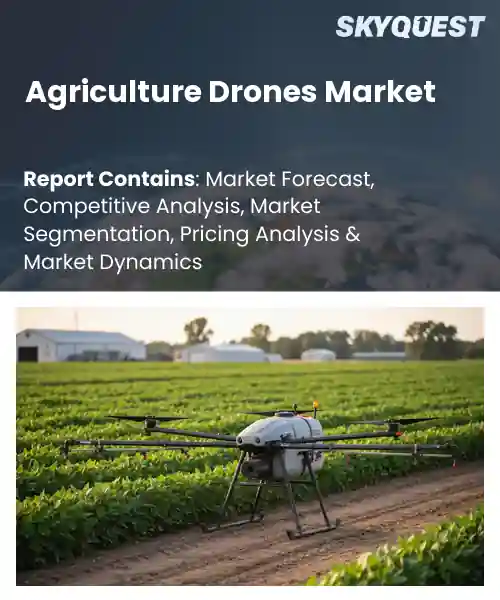
Agriculture Drones Market
Report ID: SQMIG20F2091
Report ID: SQMIG20F2091
[email protected]
USA +1 351-333-4748
Report ID:
SQMIG20F2091 |
Region:
Global |
Published Date: July, 2026
Pages:
157
|Tables:
203
|Figures:
80


Global Agriculture Drones Market size was valued at USD 6.1 Billion in 2024 and is poised to grow from USD 7.15 Billion in 2025 to USD 25.45 Billion by 2033, growing at a CAGR of 17.2% during the forecast period (2026-2033).
Rise in popularity of precision farming, increasing labor shortages in agriculture, rising demand for higher crop productivity, advancements in drone and sensor technologies, and growing emphasis on sustainable farming practices are driving sales of agriculture drones.
Widespread usage of aerial farm drones for crop scouting, field maps, variable-rate spray, irrigation monitoring, and analysis of crop health is projected to boost market development. Additional funding for the development of automated flight systems, multispectral sensors and imaging devices, web-based analytics tools and cloud infrastructure, and AI-enabled farm management systems will work in favor of the market. Continuous developments for battery technology, GPS-guided navigation, real-time imaging capability, and precision fertilizer and herbicide application will further improve the market demand. Furthermore, government programs to promote precision applications and sustainable farming practices will also increase the market size. Growing demand for efficient crop monitoring and precision agriculture, coupled with increasing adoption of smart farming technologies, is expected to primarily drive agriculture drones market growth.
Contrastingly, high initial investment costs, stringent drone regulations, limited technical expertise among farmers, and battery life limitations are anticipated to slow down agriculture drones market penetration in the future.
How is AI Integration Enhancing Precision And Automation Capabilities of Agriculture Drones?
AI is revolutionizing the agriculture drones market with real-time crop analysis, autonomous flying and precision farming. Thanks to the multispectral sensors and artificial intelligence (AI) embedded in them, AI-powered drones can automatically detect stress in agriculture, the presence of weeds, pests and diseases, as well as soil moisture content, without the need for human intervention. The crop insights help them change farming practices, such as sprayer switching rates, flight path optimization, and obstacle avoidance, while reducing chemical, labor, and crop losses. In addition, these drones improve the productivity of farms and promote sustainability in agriculture. Today’s proliferation of precision farming practices has inspired-drone companies to offer integrated AI analytics solutions with their platforms.
Market snapshot - (2026-2033)
Global Market Size
USD 6.1 Billion
Largest Segment
Rotary-Wing Drones
Fastest Growth
Hybrid Drones
Growth Rate
17.2% CAGR
To get more insights on this market click here to Request a Free Sample Report
Global agriculture drones market is segmented by type, component, application, payload capacity, farming environment, farm size, end user, and region. Based on type, the market is segmented into fixed-wing drones, rotary-wing drones, and hybrid drones. Based on component, the market is segmented into hardware, software, and services. Based on application, the market is segmented into crop monitoring & scouting, field mapping & surveying, crop spraying, precision seeding, variable rate application (VRA), irrigation & water management, livestock monitoring, and others. Based on payload capacity, the market is segmented into lightweight (up to 2 kg), medium-weight (2–10 kg), and heavy-weight (above 10 kg). Based on farming environment, the market is segmented into outdoor farming and indoor farming. Based on farm size, the market is segmented into small farms, medium farms, and large commercial farms. Based on end user, the market is segmented into farmers & growers, agricultural service providers (Drone-as-a-Service), agribusiness companies, and research institutes & government agencies. Based on region, the market is segmented into North America, Europe, Asia Pacific, Latin America, and Middle East & Africa.
The fixed wing drones segment is estimated to lead the global agriculture drones market revenue generation across the study period. For commercial agriculture in their long endurance, large coverage means few flight missions are necessary for large fields. Their aerodynamic efficiency means they cruise faster, use less power and so are cost effective for regular mapping and scouting on large farms. Their ability to carry larger batteries and payloads makes them suitable for persistence suitable for commercial farms.
However, rotary wing drones segment is witnessing the strongest growth momentum as per this agriculture drones industry analysis, precision applications need to be agile and able to hover. Their small size and ability to deploy easily means that they can be rapidly adopted by service providers and small farm holders expanding the range of use cases in targeted spraying and seeding adding to the market penetration and stimulation.
The crop spraying segment is anticipated to lead the global agriculture drones market revenue generation across the study period. It directly meets the vital requirement for accurate agrochemical spreading, thus minimizing waste, pollution, and cost per unit yield. The integration of spray control systems with online analytical data, makes it easier to apply consistent amounts of chemicals over large areas, with very low labor overhead. The proven cost benefits and regulatory adherence, makes air application of chemicals for row cropping an unrivalled success story.
Meanwhile, variable rate application is emerging as the key high growth subsegment as sensor integration allows site specific input delivery. Farmers appreciate the capability to modulate rates of fertilizer, pesticides, and so on, leading to the marketing of intelligent flight plans. This precision provides yield increases and avenues to earnings, encouraging market growth.
To get detailed segments analysis, Request a Free Sample Report
Advanced technology ecosystems, extensive arable land, and proactive governmental support for precision agriculture create sustained demand for agriculture drones across the region. Robust research institutions in Japan and South Korea are spearheading advancements in sensor integration and aerial autonomy, whereas multi-thousand-acre farms are deploying unmanned aircraft to overcome high labor costs and reduce input inputs. The close partnership between the agriculture ministries and technology companies hastens testing and legal framework establishment, which make this environment ripe for further adoption. Strong culture of technology focus attracts capital to next generation drone platform developers and makes this region an example in cost-effective solutions.
Agriculture drones market in Japan benefits from a deep integration of robotics expertise and a disciplined approach to farming efficiency. National research agencies partner with drone manufacturers to tailor solutions for the country’s diverse crop profiles, emphasizing high‑resolution imaging and precise variable‑rate application. Farmers appreciate the reliability of compact, easy‑to‑operate systems that align with the country’s emphasis on meticulous field management, driving steady uptake across both smallholder and corporate farms.
Sales of agriculture drones in South Korea are propelled by a robust digital infrastructure and strong governmental incentives for smart farming. Development hubs concentrate on AI-improved analytics that interpret aerial information to provide critical conclusions, allowing farmers to adapt quickly to pest challenges and nutrient requirements. The extension program consists of collaboration between farm cooperatives and tech startups encouraging installation of drone technology throughout high intensive centers of vegetable and rice cultivation.
Expansive farmlands, high commodity values, and a culture of early technology adoption are expected to boost sales of agriculture drones across the region. In the US, robust venture investment and high level of startup activity are leading to rapid hardware and platform innovation, and the existence of regulatory frameworks help to push commercial adoption forward. Canadian agribusinesses are employing drones for operational efficiency in tandem with provincial goals for sustainable, low input practices and chronic labor shortages. Transnational collaborations and collective research aims form a wing of best practice information that, along with the presence of a established drone-supported field, incentivizes the continuous ramp-up of unique photogrammetric platforms.
Agriculture drones market in the United States is characterized by a diverse user base ranging from large grain producers to specialty fruit growers. Industry leaders combine high‑resolution multispectral imaging with robust data processing tools, delivering actionable agronomic recommendations. Extension services and university programs disseminate practical training, empowering producers to embed drone workflows into routine scouting and input management practices, thereby reinforcing adoption momentum across the nation’s extensive agricultural landscape.
Agriculture drones market in Canada focuses on adapting aerial technology to a wide climatic spectrum, from prairie grain fields to maritime orchards. The focus on environmental stewardship encourages application of drones for targeted pesticide use and water management according to national sustainability goals. Collaboration between provincial agricultural agencies and technology developers support test pilots to showcase the economic and environmental advantages, which can persuade the wider adoption of drones in Canadian agriculture.
Coordinated policy frameworks, strong research collaborations, and a commitment to sustainable agriculture are helping promote the demand for agriculture drones across Europe. The EU focus on targeted funding for digital farming is incentivizing cross border research consortia to develop increasingly accurate sensor technology and autonomous navigation. Market actors are cognizant of the prevailing regulatory stringent privacy and data sharing requirements, promoting development of data security inter-operability. Long established tradition of farmer cooperatives is further supporting the energy, by supporting collective fleet investment allowing easier access for smaller operators. In the sum of these complimentary factors, a sustainable model is growing where tech innovation leads to measurable productivity and environmental benefits across the EU.
Agriculture drones market in Germany benefits from a well‑established engineering heritage and a dense network of agronomy institutes. Joint projects investigate combining high accuracy LIDAR and hyperspectral sensors to improve the accuracy of crop health measurement, as farmers in Germany are hungry in fine tuning the management of their fields due to careful soil and field management practices. They are testing on using drone solutions to add to the existing mechanized mechanization practices, resulting in more efficient inputs and grid consistency in output in all regions of Germany.
Agriculture drones market in the United Kingdom emphasizes data-driven decision making within a regulatory environment that encourages innovation. Academic partnerships lead to the creation of user-friendly interfaces that convert aerial images into practical farm plans. British producers, especially those involved in intensive horticulture, utilize drones to mitigate disease pressure through careful irrigation management, supporting broader success indicators such as decreased chemical use.
Agriculture drones market in France is propelled by a strong tradition of precision viticulture and diversified cropping systems. Research institutions collaborate with drone manufacturers to tailor solutions for canopy management and terroir mapping, essential for high‑value wine and specialty produce. French growers adopt these technologies to enhance product quality while meeting stringent environmental standards, reinforcing the country’s reputation for excellence in sustainable agriculture.
To know more about the market opportunities by region and country, click here to
Buy The Complete Report
Precision Farming Adoption
Data Integration Enhancing Efficiency
Regulatory Compliance Challenges
High Initial Investment Costs
Request Free Customization of this report to help us to meet your business objectives.
The competitive landscape is shaped by rapid tech innovation and aggressive capital deployment, with AI‑driven precision platforms and large‑scale financing distinguishing market leaders; GrazeMate’s AI‑drone mustering and GrowAirforce’s deep‑tech AI drone systems illustrate product differentiation, while Zipline’s $600 million funding round underscores strategic scaling to capture emerging agricultural logistics opportunities.
SkyQuest’s ABIRAW (Advanced Business Intelligence, Research & Analysis Wing) is our Business Information Services team that Collects, Collates, Correlates, and Analyses the Data collected by means of Primary Exploratory Research backed by robust Secondary Desk research.
As per SkyQuest analysis, increasing labor shortages in agriculture, rising demand for higher crop productivity, and advancements in drone and sensor technologies are anticipated to drive the demand for agriculture drones going forward. However, high initial investment costs and stringent drone regulations are slated to slow down the adoption of agriculture drones in the future. Asia Pacific is slated to spearhead the demand for agriculture drones owing to widespread adoption of precision agriculture, strong investments in smart farming technologies, supportive regulatory initiatives, and the presence of leading agricultural technology companies. AI-powered crop analytics and autonomous precision spraying technologies are anticipated to be key trends driving the agriculture drones market through 2033.
| Report Metric | Details |
|---|---|
| Market size value in 2024 | USD 6.1 Billion |
| Market size value in 2033 | USD 25.45 Billion |
| Growth Rate | 17.2% |
| Base year | 2024 |
| Forecast period | (2026-2033) |
| Forecast Unit (Value) | USD Billion |
| Segments covered |
|
| Regions covered | North America (US, Canada), Europe (Germany, France, United Kingdom, Italy, Spain, Rest of Europe), Asia Pacific (China, India, Japan, Rest of Asia-Pacific), Latin America (Brazil, Rest of Latin America), Middle East & Africa (South Africa, GCC Countries, Rest of MEA) |
| Companies covered |
|
| Customization scope | Free report customization with purchase. Customization includes:-
|
To get a free trial access to our platform which is a one stop solution for all your data requirements for quicker decision making. This platform allows you to compare markets, competitors who are prominent in the market, and mega trends that are influencing the dynamics in the market. Also, get access to detailed SkyQuest exclusive matrix.
Table Of Content
Executive Summary
Market overview
Parent Market Analysis
Market overview
Market size
KEY MARKET INSIGHTS
COVID IMPACT
MARKET DYNAMICS & OUTLOOK
Market Size by Region
KEY COMPANY PROFILES
Methodology
For the Agriculture Drones Market, our research methodology involved a mixture of primary and secondary data sources. Key steps involved in the research process are listed below:
1. Information Procurement: This stage involved the procurement of Market data or related information via primary and secondary sources. The various secondary sources used included various company websites, annual reports, trade databases, and paid databases such as Hoover's, Bloomberg Business, Factiva, and Avention. Our team did 45 primary interactions Globally which included several stakeholders such as manufacturers, customers, key opinion leaders, etc. Overall, information procurement was one of the most extensive stages in our research process.
2. Information Analysis: This step involved triangulation of data through bottom-up and top-down approaches to estimate and validate the total size and future estimate of the Agriculture Drones Market.
3. Report Formulation: The final step entailed the placement of data points in appropriate Market spaces in an attempt to deduce viable conclusions.
4. Validation & Publishing: Validation is the most important step in the process. Validation & re-validation via an intricately designed process helped us finalize data points to be used for final calculations. The final Market estimates and forecasts were then aligned and sent to our panel of industry experts for validation of data. Once the validation was done the report was sent to our Quality Assurance team to ensure adherence to style guides, consistency & design.
Analyst Support
Customization Options
With the given market data, our dedicated team of analysts can offer you the following customization options are available for the Agriculture Drones Market:
Product Analysis: Product matrix, which offers a detailed comparison of the product portfolio of companies.
Regional Analysis: Further analysis of the Agriculture Drones Market for additional countries.
Competitive Analysis: Detailed analysis and profiling of additional Market players & comparative analysis of competitive products.
Go to Market Strategy: Find the high-growth channels to invest your marketing efforts and increase your customer base.
Innovation Mapping: Identify racial solutions and innovation, connected to deep ecosystems of innovators, start-ups, academics, and strategic partners.
Category Intelligence: Customized intelligence that is relevant to their supply Markets will enable them to make smarter sourcing decisions and improve their category management.
Public Company Transcript Analysis: To improve the investment performance by generating new alpha and making better-informed decisions.
Social Media Listening: To analyze the conversations and trends happening not just around your brand, but around your industry as a whole, and use those insights to make better Marketing decisions.
REQUEST FOR SAMPLE
 REQUEST FREE CUSTOMIZATION
Global Agriculture Drones Market size was valued at USD 6.1 Billion in 2024 and is poised to grow from USD 7.15 Billion in 2025 to USD 25.45 Billion by 2033, growing at a CAGR of 17.2% during the forecast period (2026-2033).
The competitive landscape is shaped by rapid tech innovation and aggressive capital deployment, with AI‑driven precision platforms and large‑scale financing distinguishing market leaders; GrazeMate’s AI‑drone mustering and GrowAirforce’s deep‑tech AI drone systems illustrate product differentiation, while Zipline’s $600 million funding round underscores strategic scaling to capture emerging agricultural logistics opportunities. 'DJI Technology Co., Ltd.', 'AeroVironment, Inc.', 'AgEagle Aerial Systems Inc.', 'XAG Co., Ltd.', 'Parrot Drones SAS', 'Yamaha Motor Co., Ltd.', 'SZ DJI Technology Co., Ltd.', 'Trimble Inc.', 'Sentera, Inc.', 'PrecisionHawk, Inc.', 'Delair SAS', 'DroneDeploy, Inc.', 'American Robotics, Inc.', 'Wingtra AG', 'Quantum Systems GmbH', 'EAVISION Robotic Technologies Co., Ltd.', 'Garuda Aerospace Private Limited', 'Asteria Aerospace Limited', 'ideaForge Technology Limited', 'Hylio, Inc.'
The increasing adoption of precision farming techniques is encouraging growers to incorporate drones for real‑time monitoring of crop health, soil conditions, and pest activity. This capability enables targeted interventions, reduces input waste, and improves overall yield quality, thereby motivating agricultural enterprises to invest in advanced drone systems. As farmers recognize the operational efficiencies and environmental benefits derived from aerial analytics, the demand for sophisticated drone platforms with integrated sensors continues to expand across diverse farming segments. The ease of data collection and decision‑making solidify drones as tools within agronomic practices.
Precision Spraying Adoption Accelerates: The agricultural sector is increasingly deploying drones for targeted pesticide and fertilizer application, reducing waste and environmental impact. Farmers appreciate the ability to treat irregular field zones with centimeter-level accuracy, which enhances crop health and yields. This capability aligns with sustainability goals and labor shortages, prompting early adopters to champion drone‑based spraying as a core component of modern farm management. Vendors are expanding software suites to facilitate easy mission planning and compliance reporting for growers worldwide.
Why does Asia Pacific Dominate the Global Agriculture Drones Market? |@12


Want to customize this report? This report can be personalized according to your needs. Our analysts and industry experts will work directly with you to understand your requirements and provide you with customized data in a short amount of time. We offer $1000 worth of FREE customization at the time of purchase.
Feedback From Our Clients


 USA (+1) 351-333-4748

