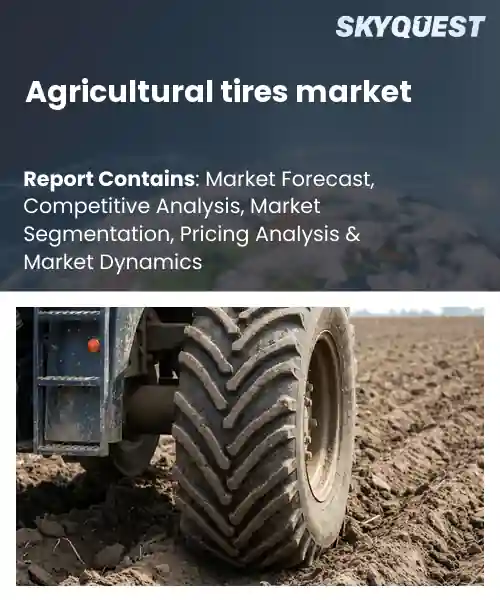
Agricultural tires market
Report ID: SQMIG25B2042
Report ID: SQMIG25B2042
[email protected]
USA +1 351-333-4748
Report ID:
SQMIG25B2042 |
Region:
Global |
Published Date: July, 2026
Pages:
157
|Tables:
176
|Figures:
79


Global Agricultural Tires Market size was valued at USD 8.2 Billion in 2024 and is poised to grow from USD 8.63 Billion in 2025 to USD 12.94 Billion by 2033, growing at a CAGR of 5.2% during the forecast period (2026-2033).
Expansion of the global agricultural tires market is fueled by the surge in precision‑farming technologies that require tires to support heavier, sensor‑laden equipment while preserving field integrity. As farmers adopt autonomous tractors and variable‑rate applicators, manufacturers embed RFID tags and durable tread compounds, raising unit prices yet creating revenue through data‑service subscriptions. Emerging markets in Latin America and Sub‑Saharan Africa illustrate the trend; credit access lets smallholders buy modern machinery equipped with premium tires, which stimulates local tire production. Consequently, the convergence of digital agriculture and rising farm incomes generates a virtuous cycle of demand and innovation for sustainable growth across supply chains.
The key trend driving the global agricultural tires sector comprises specialized rubber products designed for tractors, combines, and other farm machinery, enabling efficient soil preparation, planting, and harvest operations. Its importance stems from the direct link between tire performance and crop productivity, as lower rolling resistance and enhanced traction reduce fuel consumption while protecting delicate soils. Historically, the market evolved from off‑the‑shelf truck tires in the 1960s to purpose‑built, high‑traction designs introduced in the 1990s, exemplified by Michelin’s X‑Zench and Goodyear’s AgriFlex lines. This evolution was driven by rising mechanization on large‑scale farms, where the need for reliable, long‑lasting tires became a critical cost factor for producers.
How is AI-Driven Automation Influencing Productivity in the Agricultural Tires Market?
AI-driven automation is reshaping the agricultural tires sector by linking sensor data, predictive analytics and robotic manufacturing. Smart sensors embedded in tires feed real‑time information on soil conditions and wear, allowing algorithms to schedule optimal replacement and adjust tread designs. At the same time, factories use AI‑guided robotics to align material handling, reduce downtime and improve consistency, which lifts overall output without adding labor. These technologies also enable manufacturers to respond quickly to fluctuating farm equipment sales, keeping supply aligned with demand and lowering inventory costs. The result is a more agile value chain that can sustain growth even as tractor and combine markets face headwinds.
In April 2025 , Continental announced its Commercial Specialty Tires refocus, a shift that incorporates AI‑driven automation across production lines, boosting efficiency and supporting market expansion.
Market snapshot - (2026-2033)
Global Market Size
USD 8.2 Billion
Largest Segment
Tractor Tires
Fastest Growth
Flotation Tires
Growth Rate
5.2% CAGR
To get more insights on this market click here to Request a Free Sample Report
Global agricultural tires market is segmented by product type, tire construction, rim size, application, distribution channel, end user and region. Based on product type, the market is segmented into tractor tires, harvester tires, implement tires, flotation tires, sprayer tires and forestry & agro-industrial tires. Based on tire construction, the market is segmented into radial tires and bias tires. Based on rim size, the market is segmented into below 24 inches, 24–38 inches and above 38 inches. Based on application, the market is segmented into tractors, harvesters, sprayers, trailers & implements, forestry equipment and others. Based on distribution channel, the market is segmented into OEM and replacement market. Based on end user, the market is segmented into farms, agricultural contractors, cooperatives and government & institutional farms. Based on region, the market is segmented into North America, Europe, Asia Pacific, Latin America and Middle East & Africa.
As per the global agricultural tires market growth, Tractor tires segment dominates because it fulfills the core power train needs of most agricultural operations, offering the durability and load bearing capacity required for fieldwork and transport. Farmers prioritize reliability and long service life, prompting manufacturers to focus R&D on tread patterns and compound formulations that resist soil abrasion. This deep rooted reliance creates a stable demand base that anchors the overall market and supports future equipment upgrades and mechanization trends throughout the industry landscape.
Meanwhile, flotation tires segment emerges as the most rapidly expanding area as growers adopt low ground pressure equipment to protect soil health and improve yield. Innovative tread designs and lightweight compounds enable wider adoption in sensitive terrains, driving new purchase cycles and encouraging manufacturers to invest in specialized production lines that broaden market horizons.
Radial tires segment dominates because its construction offers superior heat dissipation, tread stability, and fuel efficiency, which align with modern farm machinery performance standards. Operators value the longer tread life and enhanced traction across varied field conditions, prompting OEMs to prioritize radial designs in new equipment. This technical advantage cultivates strong supplier loyalty and entrenches radial products as the default choice for most new agricultural vehicles throughout the global market.
Conversely, bias tires segment shows the strongest growth momentum as niche operations need sidewall flex for rugged terrains and heavy implements. Innovations improve durability while keeping costs competitive, attracting smallholder farms and specialty contractors. This surge fuels product launches and expands market reach, positioning bias tires as a pivotal driver of upcoming market expansion.
To get detailed segments analysis, Request a Free Sample Report
As per the global agricultural tires market share, Asia Pacific dominates due to its extensive agricultural landscapes coupled with rapid mechanisation across both mature and emerging economies. Strong manufacturing ecosystems provide cost‑effective production capabilities, while deep integration with original equipment manufacturers accelerates product innovation tailored to diverse cropping systems. Governments in the region promote modern farming through supportive policies that encourage adoption of advanced machinery. Consumer preferences for durability and fuel efficiency align with local industry focus on sustainable rubber compounds. Together, these factors create a virtuous cycle of demand, supply excellence, and continuous improvement that secures Asia Pacific’s leading position in the global arena.
Japan Agricultural Tires Market
Agricultural tires market in Japan benefits from high‑tech farming practices that demand precision‑engineered tread patterns and lightweight constructions. Collaborative initiatives between tire manufacturers and agricultural equipment producers drive bespoke solutions for intensive vegetable and rice cultivation. Emphasis on environmental stewardship pushes the development of low‑rolling‑resistance compounds, enhancing fuel efficiency for the country’s compact farm machinery fleet. Consumer expectations for reliability and long service life reinforce a market that values quality over cost, sustaining strong demand for premium agricultural tires.
South Korea Agricultural Tires Market
Agricultural tires market in South Korea is shaped by a blend of advanced mechanisation and a focus on export‑oriented agricultural equipment. Local manufacturers prioritize innovative rubber blends that address the region’s varied soil conditions, from mountainous terraces to flat plains. Strategic partnerships with global equipment brands enable the integration of smart tire technologies, supporting precision farming initiatives. The market also reflects a growing awareness of sustainability, prompting investments in eco‑friendly production processes that align with national environmental objectives, thereby reinforcing demand for high‑performance agricultural tires.
Based on global agricultural tires regional forecast, North America is propelled by large‑scale farming operations that require robust, high‑traction tires to maximize productivity across vast fields. Significant capital investment in cutting‑edge agricultural machinery fuels demand for tires that can withstand demanding workloads while delivering fuel efficiency. Strong research and development ecosystems foster the introduction of advanced tread designs and durable compounds tailored to diverse climate zones. Additionally, supportive industry standards and a focus on sustainability encourage the adoption of tires with reduced rolling resistance, aligning operational efficiency with environmental stewardship, thereby accelerating market growth across the continent.
United States Agricultural Tires Market
Agricultural tires market in the United States is driven by the extensive acreage devoted to commodity crops, necessitating durable tires that can handle heavy equipment and varied terrain. Partnerships between tire producers and major farm equipment manufacturers result in customized solutions that address the high mileage and load requirements of American agriculture. Emphasis on reducing operational costs pushes the development of low‑rolling‑resistance technologies, while a growing focus on sustainability influences the adoption of eco‑friendly rubber formulations. These dynamics sustain robust demand for advanced agricultural tires across the nation.
Canada Agricultural Tires Market
Agricultural tires market in Canada reflects the country’s expansive grain and livestock sectors, where reliable tire performance is critical under harsh weather conditions. Manufacturers prioritize formulations that resist low temperatures and provide traction on moist, compacted soils common to Canadian farms. Collaborative efforts with equipment suppliers ensure tires meet the stringent durability expectations of large‑scale operations. Increasing attention to environmental impact drives the pursuit of greener manufacturing practices, reinforcing demand for tires that balance longevity with reduced ecological footprints.
As per global agricultural tires regional outlook, Europe strengthens its position through rigorous quality standards, a strong emphasis on research and development, and a commitment to sustainability that resonates with environmentally conscious farming communities. The region’s advanced agricultural technology ecosystem encourages the integration of intelligent tire solutions that enhance precision farming and reduce input costs. Collaborative networks between universities, research institutes, and tire manufacturers accelerate innovation in tread design and rubber chemistry, delivering products that meet the demanding performance criteria of diverse European cropping systems. Combined with policy frameworks that support eco‑efficient farming, Europe continues to solidify its role as a leader in high‑performance agricultural tires.
Germany Agricultural Tires Market
Agricultural tires market in Germany benefits from a highly engineered approach to farming equipment, where precision and durability are paramount. Close cooperation between tire manufacturers and agricultural machinery firms yields bespoke tread patterns optimized for the country’s mixed soil conditions. Emphasis on sustainable production drives the adoption of low‑rolling‑resistance compounds that align with Germany’s environmental objectives. Continuous innovation and a reputation for engineering excellence sustain strong demand for premium agricultural tires across the nation.
United Kingdom Agricultural Tires Market
Agricultural tires market in the United Kingdom is influenced by a diversified agricultural base that spans arable, horticultural, and livestock sectors. Manufacturers focus on versatile tire designs that can adapt to the region’s variable climate and soil types. Collaboration with research institutions promotes the development of tires that enhance fuel efficiency and reduce wear, supporting the UK’s goal of greener farming practices. The market’s resilience is reinforced by a commitment to quality and the integration of advanced materials that meet the rigorous expectations of British farmers.
France Agricultural Tires Market
Agricultural tires market in France reflects the country’s strong tradition of viticulture, cereal production, and specialty crops, requiring tires that balance traction and comfort. Local manufacturers prioritize rubber blends that offer resilience against the diverse topography of French farmlands. Partnerships with equipment makers facilitate the creation of tires that support precision agriculture technologies, enhancing yield management. A focus on sustainability and compliance with European environmental standards further drives the adoption of innovative tire solutions that align with France’s progressive agricultural policies.
To know more about the market opportunities by region and country, click here to
Buy The Complete Report
Rising Demand For High Yield
Shift Toward Sustainable Farming
Fluctuating Raw Material Prices
Stringent Environmental Regulations
Request Free Customization of this report to help us to meet your business objectives.
The global agricultural tires market outlook is shaped by a handful of global tire manufacturers intensifying competition through strategic M&A, joint ventures and technology roll‑outs; Michelin’s 2023 acquisition of a sensor‑technology startup, Continental’s 2024 partnership with a leading farm‑equipment maker to embed telematics, and Bridgestone’s 2025 launch of a low‑rolling‑resistance agricultural tire line all aim to capture cost‑sensitive growers and differentiate on data‑driven performance.
Top Player’s Company Profile
Recent Developments
SkyQuest’s ABIRAW (Advanced Business Intelligence, Research & Analysis Wing) is our Business Information Services team that Collects, Collates, Correlates, and Analyses the Data collected by means of Primary Exploratory Research backed by robust Secondary Desk research.
As per SkyQuest analysis, the global agricultural tires industry is propelled primarily by the rising demand for high‑yield crops which pushes farmers to seek durable, high‑traction tires, while a shift toward sustainable farming provides a second boost as growers adopt low‑rolling‑resistance compounds to reduce soil compaction and fuel use; the market is led by Asia Pacific, where extensive mechanisation and supportive policies fuel growth, and tractor tires dominate the segment landscape owing to their central role in field operations. However, fluctuating raw‑material prices, especially for natural rubber, act as a restraint by creating cost uncertainty that can slow investment in advanced tire designs.
| Report Metric | Details |
|---|---|
| Market size value in 2024 | USD 8.2 Billion |
| Market size value in 2033 | USD 12.94 Billion |
| Growth Rate | 5.2% |
| Base year | 2024 |
| Forecast period | (2026-2033) |
| Forecast Unit (Value) | USD Billion |
| Segments covered |
|
| Regions covered | North America (US, Canada), Europe (Germany, France, United Kingdom, Italy, Spain, Rest of Europe), Asia Pacific (China, India, Japan, Rest of Asia-Pacific), Latin America (Brazil, Rest of Latin America), Middle East & Africa (South Africa, GCC Countries, Rest of MEA) |
| Companies covered |
|
| Customization scope | Free report customization with purchase. Customization includes:-
|
To get a free trial access to our platform which is a one stop solution for all your data requirements for quicker decision making. This platform allows you to compare markets, competitors who are prominent in the market, and mega trends that are influencing the dynamics in the market. Also, get access to detailed SkyQuest exclusive matrix.
Table Of Content
Executive Summary
Market overview
Parent Market Analysis
Market overview
Market size
KEY MARKET INSIGHTS
COVID IMPACT
MARKET DYNAMICS & OUTLOOK
Market Size by Region
KEY COMPANY PROFILES
Methodology
For the Agricultural tires market, our research methodology involved a mixture of primary and secondary data sources. Key steps involved in the research process are listed below:
1. Information Procurement: This stage involved the procurement of Market data or related information via primary and secondary sources. The various secondary sources used included various company websites, annual reports, trade databases, and paid databases such as Hoover's, Bloomberg Business, Factiva, and Avention. Our team did 45 primary interactions Globally which included several stakeholders such as manufacturers, customers, key opinion leaders, etc. Overall, information procurement was one of the most extensive stages in our research process.
2. Information Analysis: This step involved triangulation of data through bottom-up and top-down approaches to estimate and validate the total size and future estimate of the Agricultural tires market.
3. Report Formulation: The final step entailed the placement of data points in appropriate Market spaces in an attempt to deduce viable conclusions.
4. Validation & Publishing: Validation is the most important step in the process. Validation & re-validation via an intricately designed process helped us finalize data points to be used for final calculations. The final Market estimates and forecasts were then aligned and sent to our panel of industry experts for validation of data. Once the validation was done the report was sent to our Quality Assurance team to ensure adherence to style guides, consistency & design.
Analyst Support
Customization Options
With the given market data, our dedicated team of analysts can offer you the following customization options are available for the Agricultural tires market:
Product Analysis: Product matrix, which offers a detailed comparison of the product portfolio of companies.
Regional Analysis: Further analysis of the Agricultural tires market for additional countries.
Competitive Analysis: Detailed analysis and profiling of additional Market players & comparative analysis of competitive products.
Go to Market Strategy: Find the high-growth channels to invest your marketing efforts and increase your customer base.
Innovation Mapping: Identify racial solutions and innovation, connected to deep ecosystems of innovators, start-ups, academics, and strategic partners.
Category Intelligence: Customized intelligence that is relevant to their supply Markets will enable them to make smarter sourcing decisions and improve their category management.
Public Company Transcript Analysis: To improve the investment performance by generating new alpha and making better-informed decisions.
Social Media Listening: To analyze the conversations and trends happening not just around your brand, but around your industry as a whole, and use those insights to make better Marketing decisions.
REQUEST FOR SAMPLE
 REQUEST FREE CUSTOMIZATION
Global Agricultural Tires Market size was valued at USD 8.2 Billion in 2024 and is poised to grow from USD 8.63 Billion in 2025 to USD 12.94 Billion by 2033, growing at a CAGR of 5.2% during the forecast period (2026-2033).
The market is shaped by a handful of global tire manufacturers intensifying competition through strategic M&A, joint ventures and technology roll‑outs; Michelin’s 2023 acquisition of a sensor‑technology startup, Continental’s 2024 partnership with a leading farm‑equipment maker to embed telematics, and Bridgestone’s 2025 launch of a low‑rolling‑resistance agricultural tire line all aim to capture cost‑sensitive growers and differentiate on data‑driven performance. 'Michelin', 'Bridgestone', 'BKT', 'Yokohama Off-Highway Tires', 'Titan International', 'Continental', 'CEAT', 'Apollo Tyres', 'JK Tyre & Industries', 'Nokian Tyres', 'Prometeon Tyre Group', 'Linglong Tire', 'Ascenso Tyres', 'Carlstar Group', 'Speedways Rubber Company', 'Tianli Tire', 'Double Coin Holdings', 'Prinx Chengshan', 'Shandong Taishan Tyre', 'Trelleborg Wheel Systems'
Rising demand for high-yield crops pushes farmers to seek tires that deliver superior traction, durability, and fuel efficiency, encouraging manufacturers to develop specialized tread patterns and reinforced carcasses. This need stimulates product innovation, expands the range of premium offerings, and drives adoption across large‑scale operations, thereby increasing overall market volume as growers prioritize equipment that supports intensive planting schedules and maximizes field productivity throughout the season. The enhanced performance also reduces downtime, fostering confidence among agricultural enterprises and prompting further procurement cycles.
Precision Farming Integration: Adoption of GPS‑guided machinery, variable‑rate seeding, and data‑driven field mapping is reshaping tire design requirements, prompting manufacturers to develop low‑rolling‑resistance, high‑traction compounds that support precise equipment operation. Farmers prioritize durability and consistent performance across varying soil conditions, driving demand for tires engineered to reduce energy consumption while maintaining stability during ultra‑accurate planting cycles. This shift encourages collaborative R&D between tire producers and agritech firms, fostering bespoke solutions that align with sustainability goals and operational efficiency targets for modern farm enterprises.
Why does Asia Pacific Dominate the Global Agricultural tires market? |@12


Want to customize this report? This report can be personalized according to your needs. Our analysts and industry experts will work directly with you to understand your requirements and provide you with customized data in a short amount of time. We offer $1000 worth of FREE customization at the time of purchase.
Feedback From Our Clients


 USA (+1) 351-333-4748

