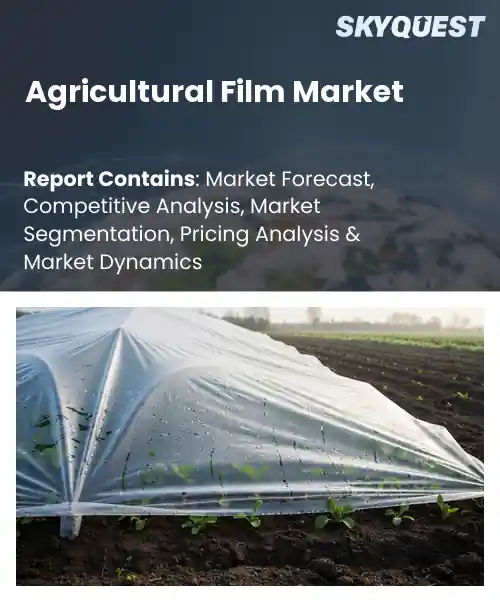
Agricultural Film Market
Report ID: SQMIG15E3907
Report ID: SQMIG15E3907
[email protected]
USA +1 351-333-4748
Report ID:
SQMIG15E3907 |
Region:
Global |
Published Date: July, 2026
Pages:
157
|Tables:
158
|Figures:
78


Global Agricultural Film Market size was valued at USD 12.7 Billion in 2024 and is poised to grow from USD 13.36 Billion in 2025 to USD 20.04 Billion by 2033, growing at a CAGR of 5.2% during the forecast period (2026-2033).
Building on the expanding adoption of biodegradable mulch, the main catalyst for the global agricultural film market is the tightening of environmental regulations that force growers to replace conventional polyethylene with eco‑friendly alternatives. As the European Union, Brazil, and several Asian nations ban single‑use plastics, manufacturers shift to bio‑based resins, narrowing the price gap and encouraging farmer uptake.
Real‑world examples include a Thai agribusiness that cut pesticide costs by 15 % after switching to compostable film and a Spanish greenhouse consortium that lifted yields by 10 % with UV‑filtered covers. Consequently, regulatory pressure, cost‑competitiveness, and proven performance drive a robust growth trajectory.
A major trend shaping the market is the transition toward sustainable and biodegradable agricultural films as governments, farmers, and agricultural companies focus on reducing plastic waste and improving environmental performance. Manufacturers are investing in bio-based materials, recyclable films, and advanced polymer technologies to develop eco-friendly solutions without compromising durability and agricultural efficiency.
How is AI-driven automation reshaping sustainability and efficiency in the agricultural film market?
AI‑driven automation is redefining the agricultural film market by linking data analytics with production and field‑level operations. Sensors embedded in films collect climate, moisture and crop‑growth information, while machine‑learning models predict optimal film thickness, UV‑blocking properties and biodegradability. Manufacturers now use automated extrusion lines that self‑adjust based on real‑time feedstock quality, reducing waste and energy consumption. Farmers benefit from precision‑cut films that match plot dimensions, lowering labor and material costs. The integration of AI with renewable‑based polymers also accelerates the shift toward fully compostable films, aligning the sector with broader sustainability goals and improving overall supply‑chain efficiency.
BASF in July 2023, launched an AI‑controlled extrusion platform that continuously fine‑tunes film thickness and composition, cutting material waste and energy use while delivering higher‑performance biodegradable films that support faster adoption of sustainable farming practices.
Market snapshot - (2026-2033)
Global Market Size
USD 12.7 Billion
Largest Segment
Greenhouse Films
Fastest Growth
Stretch Films
Growth Rate
5.2% CAGR
To get more insights on this market click here to Request a Free Sample Report
Global agricultural film market is segmented by film type, material, application, end user, distribution channel and region. Based on film type, the market is segmented into Greenhouse Films, Mulch Films, Silage Films, Stretch Films, Bale Wrap Films, Tunnel Films and Others. Based on material, the market is segmented into Low-Density Polyethylene (LDPE), Linear Low-Density Polyethylene (LLDPE), Ethylene Vinyl Acetate (EVA), Ethylene Butyl Acrylate (EBA), Polyvinyl Chloride (PVC), Biodegradable/Bio-based Polymers and Others. Based on application, the market is segmented into Crop Protection, Soil Protection & Moisture Conservation, Greenhouse Cultivation, Silage Preservation, Fodder & Bale Wrapping and Others. Based on end user, the market is segmented into Agriculture Farms, Greenhouse Operators, Horticulture & Floriculture Growers, Agricultural Cooperatives and Others. Based on distribution channel, the market is segmented into Direct Sales, Distributors & Dealers, Retail Stores and Online Sales. Based on region, the market is segmented into North America, Europe, Asia Pacific, Latin America and Middle East & Africa.
Low-density polyethylene (LDPE) segment dominates with large agricultural film market share because it offers a balanced blend of cost efficiency, flexibility, and ease of processing, making it the preferred choice for a wide range of agricultural films. Its inherent tensile strength and moisture barrier properties address the core functional requirements of growers, while its established supply chain ensures reliable availability. Consequently, manufacturers and end‑users gravitate toward LDPE to meet performance expectations, significantly and substantially without incurring premium or added costs.
As per agricultural film market outlook, ethylene vinyl acetate (EVA) segment is witnessing the strongest growth momentum because its superior UV resistance and enhanced elasticity enable the production of high‑performance films for demanding horticultural applications. Emerging consumer preferences for longer‑lasting, weather‑resilient solutions are driving rapid adoption, positioning EVA as a catalyst for future market expansion and innovation opportunities.
As per agricultural film market analysis, crop protection application dominates because it directly addresses growers’ primary concern of safeguarding yields from pests, diseases, and extreme weather, making protective films a critical input for modern farming. The ability of these films to integrate insecticidal additives, reflect harmful solar radiation, and maintain optimal micro‑climates creates tangible yield and cost advantages. Hence, producers prioritize crop‑protection oriented films to meet the decisive performance criteria that drive purchasing decisions across the sector.
Meanwhile, soil protection & moisture conservation application emerges as the fastest expanding segment because its films enhance water retention, reduce evaporation, and suppress weed growth, improving resource efficiency. Growing awareness of sustainable irrigation practices and regulatory encouragement of water‑saving technologies are spurring adoption, positioning this application as a key driver of market diversification and value creation.
To get detailed segments analysis, Request a Free Sample Report
Asia Pacific dominates because of intense horticultural activity, widespread adoption of high‑value crops, robust research institutions, and supportive policies encouraging sustainable packaging. The region benefits from a deep supply chain network of polymer manufacturers and converters that deliver tailored films with advanced UV‑block, biodegradable, and micro‑perforated features. Agricultural practices that emphasize multiple cropping cycles create continuous demand for mulch and greenhouse films. Moreover, consumer preference for premium produce drives growers to invest in yield‑enhancing technologies, reinforcing demand. Strong collaboration between government, academia, and industry accelerates innovation, while export‑oriented production leverages cost‑effective manufacturing hubs, consolidating the region’s leadership on the global stage.
As per agricultural film market regional outlook, Japan thrives on sophisticated greenhouse cultivation and precision farming techniques that demand high‑performance films with excellent temperature regulation and light diffusion. Local manufacturers integrate advanced polymer blends to meet stringent quality standards, while research collaborations focus on biodegradable solutions that align with environmental stewardship goals. The market benefits from a well‑established distribution network serving both domestic growers and export‑oriented producers seeking premium produce in the regional supply chain.
As per agricultural film market regional forecast, South Korea is propelled by intensive vegetable and strawberry production that relies heavily on tunnel and greenhouse structures. Domestic firms specialize in lightweight, high‑transparency films that enhance photosynthetic efficiency while reducing water consumption. Strong governmental incentives for sustainable agriculture encourage the shift toward recyclable and biodegradable film options. Collaborative research between universities and polymer producers drives continuous improvement in film durability, aligning with growers’ demand for cost‑effective yet high‑yield solutions across the peninsula.
Europe’s rapid expansion stems from heightened focus on climate‑smart farming, stringent environmental regulations, and a mature horticultural sector that values premium produce. Policymakers incentivize the adoption of films that reduce water usage and improve soil health, prompting growers to replace traditional plastic with biodegradable or recyclable alternatives. Strong research ecosystems in key countries foster innovation in micro‑perforated and UV‑filtering films, enhancing crop protection and yield. Integrated supply chains and cross‑border trade within the bloc enable efficient distribution, while consumer demand for sustainably grown food reinforces market momentum across the continent.
Germany benefits from a well‑established agro‑technology infrastructure and a sizable greenhouse sector that prioritizes high‑efficiency films. Domestic producers combine advanced polymer science with rigorous quality certifications to deliver films offering superior light transmission and weather resistance. Environmental legislation drives the transition toward recyclable and biodegradable options, while collaborative projects with research institutes accelerate development of smart films that respond to moisture and temperature cues, supporting Germany’s reputation as a market leader.
United Kingdom is gaining traction as growers adopt protected cultivation to boost year‑round production. Innovative firms focus on lightweight, UV‑stable films that extend crop cycles while minimizing waste. Government initiatives promoting circular economy practices encourage investment in recyclable and bio‑based film solutions. Partnerships between academic research centers and agribusiness accelerate the commercialization of films with tailored permeability, positioning the United Kingdom as an emerging hub for sustainable agricultural film technologies.
France is propelled by a vibrant horticulture and viticulture sector that increasingly relies on precision films to enhance quality and reduce input costs. French manufacturers leverage expertise in biodegradable polymer blends to comply with rigorous environmental directives. Strong collaboration between agronomic research institutes and film converters drives the creation of high‑performance films that improve micro‑climate control within tunnels. Consumer preference for eco‑friendly produce further accelerates market adoption across the country.
North America strengthens its position through a combination of advanced material engineering, large‑scale commodity farming, and proactive sustainability agendas. Leading polymer producers invest heavily in research that yields films with enhanced durability, moisture regulation, and reduced environmental impact. Collaborative initiatives between universities and agribusinesses accelerate the rollout of smart films equipped with sensor integration for real‑time monitoring. Regulatory frameworks encourage the shift toward recyclable and bio‑based alternatives, while extensive distribution networks ensure rapid adoption across diverse climatic zones, reinforcing the region’s competitive edge globally.
United States is characterized by extensive use in row‑crop applications, large‑scale vegetable production, and innovative greenhouse projects. Domestic firms prioritize high‑strength, UV‑resistant films that withstand diverse weather patterns while promoting water conservation. Strong emphasis on research partnerships with land‑grant universities fuels development of films incorporating nanotechnology for improved gas exchange. Market dynamics are further shaped by federal programs that incentivize adoption of recyclable and biodegradable film solutions.
Canada benefits from a diverse agricultural landscape that includes greenhouse cultivation in southern provinces and extensive field cropping in the prairies. Canadian producers focus on cold‑resistant, light‑diffusing films that extend the growing season and improve crop uniformity. Collaborative research with federal agricultural institutes drives innovation in biodegradable blends suited to the nation’s environmental standards. Government support for sustainable practices accelerates market uptake of films that reduce water usage and soil degradation.
To know more about the market opportunities by region and country, click here to
Buy The Complete Report
Rising Demand for Sustainable Packaging
Advancements in Film Manufacturing Technology
High Initial Capital Investment
Regulatory Compliance Complexity
Request Free Customization of this report to help us to meet your business objectives.
The competitive landscape of the global agricultural film industry is shaped by intensified rivalry as firms pursue strategic M&A, joint ventures, and technology‑driven product innovations; recent large‑scale funding rounds for Indian agri‑tech players such as Arya Collateral, WayCool and Varaha have accelerated market consolidation, while bio‑focused entrants like Granza Bio are leveraging seed capital to introduce novel biodegradable film solutions that challenge traditional polymer providers.
SkyQuest’s ABIRAW (Advanced Business Intelligence, Research & Analysis Wing) is our Business Information Services team that Collects, Collates, Correlates, and Analyses the Data collected by means of Primary Exploratory Research backed by robust Secondary Desk research.
As per SkyQuest analysis, the global agricultural film market growth is propelled primarily by the rising demand for sustainable packaging as growers shift toward biodegradable films to meet environmental regulations and boost yields, while a second driver comes from rapid advancements in film manufacturing technology that enable thinner, stronger and UV‑resistant products at lower cost. High initial capital investment remains a key restraint, limiting new entrants and slowing capacity upgrades. Asia Pacific dominates the market due to intensive horticulture, robust polymer supply chains and supportive policies, and within the market the low‑density polyethylene segment continues to lead due to its cost‑effectiveness, flexibility and wide applicability. The global agricultural film market trend is witnessing consistent growth due to increasing adoption of protected farming techniques, rising demand for higher crop productivity, and the need for efficient resource management in agriculture.
| Report Metric | Details |
|---|---|
| Market size value in 2024 | USD 12.7 Billion |
| Market size value in 2033 | USD 20.04 Billion |
| Growth Rate | 5.2% |
| Base year | 2024 |
| Forecast period | (2026-2033) |
| Forecast Unit (Value) | USD Billion |
| Segments covered |
|
| Regions covered | North America (US, Canada), Europe (Germany, France, United Kingdom, Italy, Spain, Rest of Europe), Asia Pacific (China, India, Japan, Rest of Asia-Pacific), Latin America (Brazil, Rest of Latin America), Middle East & Africa (South Africa, GCC Countries, Rest of MEA) |
| Companies covered |
|
| Customization scope | Free report customization with purchase. Customization includes:-
|
To get a free trial access to our platform which is a one stop solution for all your data requirements for quicker decision making. This platform allows you to compare markets, competitors who are prominent in the market, and mega trends that are influencing the dynamics in the market. Also, get access to detailed SkyQuest exclusive matrix.
Table Of Content
Executive Summary
Market overview
Parent Market Analysis
Market overview
Market size
KEY MARKET INSIGHTS
COVID IMPACT
MARKET DYNAMICS & OUTLOOK
Market Size by Region
KEY COMPANY PROFILES
Methodology
For the Agricultural Film Market, our research methodology involved a mixture of primary and secondary data sources. Key steps involved in the research process are listed below:
1. Information Procurement: This stage involved the procurement of Market data or related information via primary and secondary sources. The various secondary sources used included various company websites, annual reports, trade databases, and paid databases such as Hoover's, Bloomberg Business, Factiva, and Avention. Our team did 45 primary interactions Globally which included several stakeholders such as manufacturers, customers, key opinion leaders, etc. Overall, information procurement was one of the most extensive stages in our research process.
2. Information Analysis: This step involved triangulation of data through bottom-up and top-down approaches to estimate and validate the total size and future estimate of the Agricultural Film Market.
3. Report Formulation: The final step entailed the placement of data points in appropriate Market spaces in an attempt to deduce viable conclusions.
4. Validation & Publishing: Validation is the most important step in the process. Validation & re-validation via an intricately designed process helped us finalize data points to be used for final calculations. The final Market estimates and forecasts were then aligned and sent to our panel of industry experts for validation of data. Once the validation was done the report was sent to our Quality Assurance team to ensure adherence to style guides, consistency & design.
Analyst Support
Customization Options
With the given market data, our dedicated team of analysts can offer you the following customization options are available for the Agricultural Film Market:
Product Analysis: Product matrix, which offers a detailed comparison of the product portfolio of companies.
Regional Analysis: Further analysis of the Agricultural Film Market for additional countries.
Competitive Analysis: Detailed analysis and profiling of additional Market players & comparative analysis of competitive products.
Go to Market Strategy: Find the high-growth channels to invest your marketing efforts and increase your customer base.
Innovation Mapping: Identify racial solutions and innovation, connected to deep ecosystems of innovators, start-ups, academics, and strategic partners.
Category Intelligence: Customized intelligence that is relevant to their supply Markets will enable them to make smarter sourcing decisions and improve their category management.
Public Company Transcript Analysis: To improve the investment performance by generating new alpha and making better-informed decisions.
Social Media Listening: To analyze the conversations and trends happening not just around your brand, but around your industry as a whole, and use those insights to make better Marketing decisions.
REQUEST FOR SAMPLE
 REQUEST FREE CUSTOMIZATION
Global Agricultural Film Market size was valued at USD 12.7 Billion in 2024 and is poised to grow from USD 13.36 Billion in 2025 to USD 20.04 Billion by 2033, growing at a CAGR of 5.2% during the forecast period (2026-2033).
The competitive landscape of the global agricultural film market is shaped by intensified rivalry as firms pursue strategic M&A, joint ventures, and technology‑driven product innovations; recent large‑scale funding rounds for Indian agri‑tech players such as Arya Collateral, WayCool and Varaha have accelerated market consolidation, while bio‑focused entrants like Granza Bio are leveraging seed capital to introduce novel biodegradable film solutions that challenge traditional polymer providers. 'Berry Global Group, Inc.', 'RKW SE', 'Trioworld AB', 'Coveris Management GmbH', 'Armando Alvarez Group', 'Plastika Kritis S.A.', 'POLIFILM GmbH', 'Ab Rani Plast Oy', 'BPI Agriculture Limited', 'Ginegar Plastic Products Ltd.', 'Silostop Agri Limited', 'Hyplast NV', 'Novamont S.p.A.', 'BASF SE', 'Exxon Mobil Corporation', 'Dow Inc.', 'LyondellBasell Industries N.V.', 'China National Chemical Corporation', 'Rani Group Oy', 'Uflex Limited'
The increasing consumer preference for environmentally friendly solutions drives growers to adopt biodegradable agricultural films, which enhance crop protection while reducing plastic waste, thereby aligning with regulatory pressures and corporate sustainability goals, and fostering market expansion as producers seek materials that support eco‑friendly branding and compliance. Additionally, the films’ ability to improve water retention and temperature regulation contributes to higher yields, encouraging broader acceptance across diverse agricultural regions and strengthening the value proposition for manufacturers and distributors through increased profitability.
Sustainable Mulching Practices Expansion: The industry is witnessing a rapid shift toward environmentally friendly mulching solutions, driven by growing farmer awareness of soil health and climate impact. Biodegradable films derived from renewable resources are replacing traditional polyethylene, offering comparable performance while decomposing harmlessly after a single season. This transition is supported by incentive programs and certification schemes that reward sustainable inputs, prompting manufacturers to accelerate R&D on compostable blends and fostering partnerships with agronomists to validate field benefits for increased yield stability worldwide and
Why does Asia Pacific Dominate the Global Agricultural Film Market? |@12


Want to customize this report? This report can be personalized according to your needs. Our analysts and industry experts will work directly with you to understand your requirements and provide you with customized data in a short amount of time. We offer $1000 worth of FREE customization at the time of purchase.
Feedback From Our Clients


 USA (+1) 351-333-4748

