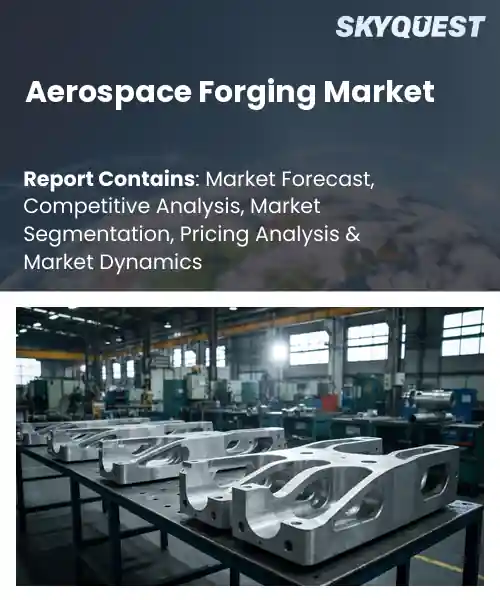
Aerospace Forging Market
Report ID: SQMIG20A2682
Report ID: SQMIG20A2682
[email protected]
USA +1 351-333-4748
Report ID:
SQMIG20A2682 |
Region:
Global |
Published Date: June, 2026
Pages:
157
|Tables:
153
|Figures:
78


Global Aerospace Forging Market size was valued at USD 28.3 Billion in 2024 and is poised to grow from USD 29.52 Billion in 2025 to USD 41.34 Billion by 2033, growing at a CAGR of 4.3% during the forecast period (2026-2033).
At its core the aerospace forging market supplies precision formed metal components such as engine discs landing gear fittings and forgings that underpin aircraft safety and performance. Its primary driver is the airline and defense demand for lighter stronger parts that withstand higher temperatures and cyclic stresses which has pushed material and process innovation. Historically the sector evolved from open die forging to closed die precision forging and specialized methods for titanium and nickel superalloys enabling larger complex parts. Regulatory certification and long life expectations and rising global fleet volumes have further cemented forgings as a strategic supply chain segment.
Consequently this centrality creates growth levers; the principal factor is technological adoption in materials and process controls that alter cost structure and performance. As airframers and engine OEMs push higher bypass ratios and hotter turbines the need for titanium and nickel superalloy forgings rises prompting investments in near net shape forging automation and qualification programs. Reduced machining and scrap lower per part cost enabling suppliers to compete on lead time while repair plus hot isostatic pressing services extend part life while generating aftermarket revenue. This drives supplier consolidation and cross sector partnerships with clear implications for margins and supply resilience.
How is AI improving quality control in the aerospace forging market?
AI is giving a boost to quality control in the aerospace forging market, with computer vision, sensor fusion and machine learning used to spot surface and subsurface defects during manufacturing. The main topics are automated visual inspection of micro defects, process monitoring by correlating temperature and force to material quality and digital twins for simulation and optimization of forging cycles. Now we’re going to a place where we don’t just sample manually, we’re inspecting continuously in a digital way to reduce rework and speed up qualification. Inline cameras and AI models help manufacturers prioritize parts for nondestructive testing and enable more predictable, traceable production.
Machina labs May 2026, AI driven robotics with inline scanning, forming and inspection combined in one automated cell. This improvement provides for faster inspection cycles and immediate corrective action, resulting in improved efficiency and enabling suppliers to meet aerospace quality requirements more quickly.
Market snapshot - (2026-2033)
Global Market Size
USD 28.3 Billion
Largest Segment
Aluminum Alloys
Fastest Growth
Titanium Alloys
Growth Rate
4.3% CAGR
To get more insights on this market click here to Request a Free Sample Report
Global aerospace forging market is segmented by material type, process type, aircraft type, application, end use and region. Based on material type, the market is segmented into Aluminum Alloys, Titanium Alloys, Nickel Alloys, Steel Alloys, Magnesium Alloys and Others. Based on process type, the market is segmented into Open Die Forging, Closed Die Forging, Seamless Rolled Ring Forging, Precision Forging and Isothermal Forging. Based on aircraft type, the market is segmented into Commercial Aircraft, Military Aircraft, Business Jets, Helicopters and Spacecraft. Based on application, the market is segmented into Engine Components, Airframe Components, Landing Gear Components, Structural Components and Others. Based on end use, the market is segmented into OEM (Original Equipment Manufacturer) and MRO (Maintenance, Repair & Overhaul). Based on region, the market is segmented into North America, Europe, Asia Pacific, Latin America and Middle East & Africa.
The Titanium Alloys segment is projected to hold the market share due to the increasing demand for superior strength-to-weight ratios and corrosion resistance for aerospace applications for critical components, thereby, boosting the preference for titanium forgings for engine disks, structural spars, and landing systems. Their parts have high fatigue life and temperature tolerance, reducing part count and downstream processing requirements. OEM certification roadblocks are a boon for existing titanium supply chains. This creates a loop of cause and effect in which performance requirements and qualification cycles reinforce adoption. This guarantees a long term demand.
The fastest growing area, however, is Aluminum Alloys due to continuous improvements in alloy formulations and forging processes that improve strength and manufacturability for large airframe structures. Lighter materials and scalable production economics are driving supplier investments, and new market opportunities in both the OEM and maintenance markets. Aluminum forgings present attractive potential for next generation commercial and business aircraft.
The closed die forging segment is leading due to its high repeatability and tight dimensional control necessary for critical aerospace parts such as landing gear and structural fittings, leading to reduced machining and material waste. The process results in refined grain structures and consistent mechanical properties in line with OEM quality regimes and long production runs. These drive supplier consolidation and long term investments in closed die tooling and process optimization and skills development by manufacturers.
Isothermal Forging is, however, the fastest growing area due to its ability to work difficult superalloys and titanium with excellent thermal control, enabling superior microstructure and fatigue resistance to be achieved for next generation engines. Growing demand for higher performance components and tighter material specifications are driving investments in isothermal equipment and R&D, opening the door to new applications and supplier differentiation.
To get detailed segments analysis, Request a Free Sample Report
Asia Pacific is the leader because it has integrated industrial ecosystems, focused supply chains, concentrated manufacturing capacity, strategic investment in advanced metallurgical capabilities, and strong demand from commercial and defense aviation sectors. Regional manufacturers have large supplier bases which allows for scale, rapid production cycles and proximity to the large airframe and engine manufacturers. Competitiveness is boosted by government support, a favorable industrial policy and stress on workforce skill development. The ongoing adoption of advanced forging technologies, the synergy between industry and academia, and the availability of global tier suppliers of forgings all contribute to the region's status as a significant center for high-quality aerospace forgings. Export growth is fueled by cost-competitive manufacturing, enhanced quality standards, and strategic alliances with international OEMs, whereas domestic fleet modernization programs generate consistent demand for forgings in airframe, engine and landing gear applications.
markets for aerospace forgings Japan’s strengths are a dense network of precision metalworking firms, the closeness between OEMs and suppliers and a tradition of high manufacturing quality. Advanced materials research, expertise in narrow margin tolerance and rigorous certification practices have strategically placed the domestic plant to manufacture complex forgings for engines and primary structures. Workforce skill development addresses specialized production needs, while continuous process improvement and collaborative engineering with global partners enhance competitiveness.
Aerospace Forgings Market South Korea has strong industrial integration, advanced steel and alloy capabilities, and increasing partnerships with international airframe and engine manufacturers. The efficient production of structural and engine forgings is achieved by focusing on automation, quality control systems and clustering of suppliers. The private sector’s investment in machining and finishing capability is complemented by government initiatives that focus on industrial competitiveness and export orientation. This enables suppliers to move into higher value added forgings and secure supply arrangements.
Rapid North American expansion is being driven by integrated innovation across OEMs, tier suppliers and advanced materials manufacturers, along with sustained demand from commercial aerospace and defense programs. Efforts to strategically reshore and diversify supply chains through collaborative development between industry and research institutions are designed to ensure domestic access to critical forgings. The well-developed aftermarket and maintenance ecosystems of the region require high quality replacement components, ensuring a steady activity in the forging, machining and finishing sectors. The region’s ability to deliver sophisticated, high integrity components for powerplant and structural uses rests on close collaboration between engine makers and forging specialists, with a premium on materials science and rigorous process validation. Policy frameworks that promote domestic production and long term supplier relationships also support market momentum.
The United States aerospace forging market is characterized by a strong presence of OEMs, advanced engine and airframe programs, and a dense base of tier suppliers supporting complex forgings. High integrity components for critical applications are ensured by emphasis on certification, traceability and advanced inspection techniques. Investment in automation and digital manufacturing, and collaborative programs between industry and national research centers, build capabilities across forging, heat treatment and precision machining operations to meet supply chain needs.
Aerospace Forging Industry Canada needs specialized forging for regional OEM partners and an expanding maintenance sector is creating demand for replacement parts. Its strengths are metallurgical expertise, fabrication in niche areas and collaborative supplier relationships. Investment in quality management systems and training of the employees will assist the production of critical structure and engine forgings. Proximity to North American supply chains and cross border participation benefit domestic suppliers, opening access to aerospace manufacturing networks and innovation.
Europe is getting stronger by using world-class engineering skills, clusters of suppliers and a focused effort to modernize its manufacturing processes. Regional players are working on materials innovation, precision metallurgy and process qualification to meet stringent airworthiness requirements. Manufacturers, research institutes and certification bodies pool their efforts to accelerate validation of complex forgings for structural and engine applications. Sustainable production, upskilling of the labor force and digitalization of supply chains improves competitiveness. The presence of global OEMs and specialized forging houses ensures close integration of design and production, allowing rapid iteration and quality assurance to underscore Europe’s role in high value aerospace forgings. The harmonization of certification standards across markets and active engagement with the aftermarket and defense sectors support demand for domestically produced forgings. Further investment in automation, simulation driven design and closed loop process controls further uplifts productivity and enables suppliers to pursue complex, high integrity components called for by aircraft manufacturers.
Industry of Aerospace Forgings Germany has a good basis of engineering heritage, industrial capacity and metallurgical know how to support complex forgings for engines and primary structures. Close relationships with OEMs and specialized forging houses allow for rapid qualification and integration of advanced alloys. Investment in process automation, nondestructive evaluation and precision machining to enable high integrity deliveries. Joint research with technical universities spurs material and process innovations which maintain competitiveness in high value forgings.
Aerospace Forging Market United Kingdom has specialized forging houses, strong aerospace design capabilities and close collaboration with engine and airframe manufacturers. Mission critical components are produced on basis of certification, traceability in the supply chain and sophisticated inspection methods. Investment in advanced alloys, digital manufacturing and workforce development enhances ability to produce complex structural and rotating components. Participation in international programs and aftermarket networks is important for domestic suppliers to win sophisticated forging contracts.
Aerospace Forging Market France has combined aerospace clusters, strong materials research, precision engineering supporting complex structural forgings. Close cooperation between OEMs, specialized forging companies and research centers pushes alloy development and process qualification. Emphasis on certification, light weight design and lifecycle performance drive forging specifications. Investment in automated forging cells, advanced heat treatment and inspection capabilities underpins the supplier’s ability to provide high integrity components for both commercial and defense applications.
To know more about the market opportunities by region and country, click here to
Buy The Complete Report
Increasing Demand For Lightweight Components
Technological Advancements In Forging Processes
High Capital Investment Requirements
Stringent Certification and Qualification Processes
Request Free Customization of this report to help us to meet your business objectives.
The global aerospace forging market is consolidating as strategic M&A, supplier partnerships and material and process innovation reshape supply chains. Consolidation moves include recent transactions such as Pursuit Aerospace’s acquisition of Larson Forgings. Suppliers form industry partnerships to adopt new manufacturing technologies, such as additive and forging units of Norm Holding collaborating with EOS. Howmet’s OEM-led alloy and forging innovations raise the technical barriers to entry.
Our Business Information Services team, ABIRAW (Advanced Business Intelligence, Research & Analysis Wing) Collects, Collates, Correlates and Analyses the Data collected through Primary Exploratory Research supported by robust Secondary Desk research.
SkyQuest analysis shows that the global aerospace forging market is primarily driven by increasing demand for lightweight components that improve fuel efficiency and aircraft performance and secondarily by rapid technological advancements in forging processes that improve precision and reduce waste. The market is constrained by the high capital investment required for presses, tooling and qualification programs which slow capacity expansion. Titanium alloys are the main driver of demand, as they offer the best strength-to-weight ratio and fatigue resistance for critical engine and structural parts. The Asia Pacific region remains the dominant region, due to integrated supply chains and the scale of manufacturing. Suppliers are fighting back with automation, near net forging and closer OEM partnerships to win long-term contracts.
| Report Metric | Details |
|---|---|
| Market size value in 2024 | USD 28.3 Billion |
| Market size value in 2033 | USD 41.34 Billion |
| Growth Rate | 4.3% |
| Base year | 2024 |
| Forecast period | (2026-2033) |
| Forecast Unit (Value) | USD Billion |
| Segments covered |
|
| Regions covered | North America (US, Canada), Europe (Germany, France, United Kingdom, Italy, Spain, Rest of Europe), Asia Pacific (China, India, Japan, Rest of Asia-Pacific), Latin America (Brazil, Rest of Latin America), Middle East & Africa (South Africa, GCC Countries, Rest of MEA) |
| Companies covered |
|
| Customization scope | Free report customization with purchase. Customization includes:-
|
To get a free trial access to our platform which is a one stop solution for all your data requirements for quicker decision making. This platform allows you to compare markets, competitors who are prominent in the market, and mega trends that are influencing the dynamics in the market. Also, get access to detailed SkyQuest exclusive matrix.
Table Of Content
Executive Summary
Market overview
Parent Market Analysis
Market overview
Market size
KEY MARKET INSIGHTS
COVID IMPACT
MARKET DYNAMICS & OUTLOOK
Market Size by Region
KEY COMPANY PROFILES
Methodology
For the Aerospace Forging Market, our research methodology involved a mixture of primary and secondary data sources. Key steps involved in the research process are listed below:
1. Information Procurement: This stage involved the procurement of Market data or related information via primary and secondary sources. The various secondary sources used included various company websites, annual reports, trade databases, and paid databases such as Hoover's, Bloomberg Business, Factiva, and Avention. Our team did 45 primary interactions Globally which included several stakeholders such as manufacturers, customers, key opinion leaders, etc. Overall, information procurement was one of the most extensive stages in our research process.
2. Information Analysis: This step involved triangulation of data through bottom-up and top-down approaches to estimate and validate the total size and future estimate of the Aerospace Forging Market.
3. Report Formulation: The final step entailed the placement of data points in appropriate Market spaces in an attempt to deduce viable conclusions.
4. Validation & Publishing: Validation is the most important step in the process. Validation & re-validation via an intricately designed process helped us finalize data points to be used for final calculations. The final Market estimates and forecasts were then aligned and sent to our panel of industry experts for validation of data. Once the validation was done the report was sent to our Quality Assurance team to ensure adherence to style guides, consistency & design.
Analyst Support
Customization Options
With the given market data, our dedicated team of analysts can offer you the following customization options are available for the Aerospace Forging Market:
Product Analysis: Product matrix, which offers a detailed comparison of the product portfolio of companies.
Regional Analysis: Further analysis of the Aerospace Forging Market for additional countries.
Competitive Analysis: Detailed analysis and profiling of additional Market players & comparative analysis of competitive products.
Go to Market Strategy: Find the high-growth channels to invest your marketing efforts and increase your customer base.
Innovation Mapping: Identify racial solutions and innovation, connected to deep ecosystems of innovators, start-ups, academics, and strategic partners.
Category Intelligence: Customized intelligence that is relevant to their supply Markets will enable them to make smarter sourcing decisions and improve their category management.
Public Company Transcript Analysis: To improve the investment performance by generating new alpha and making better-informed decisions.
Social Media Listening: To analyze the conversations and trends happening not just around your brand, but around your industry as a whole, and use those insights to make better Marketing decisions.
REQUEST FOR SAMPLE
 REQUEST FREE CUSTOMIZATION
Global Aerospace Forging Market size was valued at USD 28.3 Billion in 2024 and is poised to grow from USD 29.52 Billion in 2025 to USD 41.34 Billion by 2033, growing at a CAGR of 4.3% during the forecast period (2026-2033).
The competitive landscape of the global aerospace forging market is consolidating as strategic M&A, supplier partnerships, and material and process innovation reshape supply chains. Recent transactions such as Pursuit Aerospace’s acquisition of Larson Forgings illustrate consolidation moves. Suppliers form industrial partnerships to adopt new manufacturing technologies, for example Norm Holding’s additive and forging units working with EOS. OEM-driven alloy and forging innovations at Howmet raise technical entry barriers. 'Precision Castparts Corp.', 'Arconic Corporation', 'Howmet Aerospace Inc.', 'Allegheny Technologies Incorporated', 'Safran S.A.', 'LISI Aerospace', 'Bharat Forge Limited', 'Thyssenkrupp AG', 'Aubert & Duval', 'Farinia Group', 'GKN Aerospace', 'Doncasters Group Ltd.', 'Ellwood Group Inc.', 'Kobe Steel, Ltd.', 'Nippon Steel Corporation', 'VSMPO-AVISMA Corporation', 'Otto Fuchs KG', 'Eramet Group', 'Alcoa Corporation', 'Carpenter Technology Corporation'
Manufacturers and airlines are prioritizing lighter structures to improve fuel efficiency and operational flexibility, which increases demand for aerospace forgings made from advanced alloys and optimized designs. This demand encourages suppliers to expand production capabilities, invest in material science and tooling, and refine forging techniques to meet specifications, thereby supporting market growth. The emphasis on reduced weight drives collaboration across the supply chain to qualify new forgings for airworthiness, accelerate certification processes, and create long term procurement commitments that strengthen investment in forging capacity and technology.
Lightweight Materials Adoption: Demand for higher fuel efficiency and lower emissions is driving aerospace manufacturers to adopt advanced lightweight alloys and composite forging techniques across structural and engine components. Suppliers are investing in material science collaboration to qualify novel titanium, aluminum and hybrid materials for load bearing applications while optimizing forging processes to preserve integrity. This trend shifts supplier capabilities toward integrated material expertise, accelerates co-development partnerships with airframe and engine OEMs, and reshapes procurement priorities toward sustained performance and life cycle value.
Why does Asia Pacific Dominate the Global Aerospace Forging Market? |@12


Want to customize this report? This report can be personalized according to your needs. Our analysts and industry experts will work directly with you to understand your requirements and provide you with customized data in a short amount of time. We offer $1000 worth of FREE customization at the time of purchase.
Feedback From Our Clients


 USA (+1) 351-333-4748

