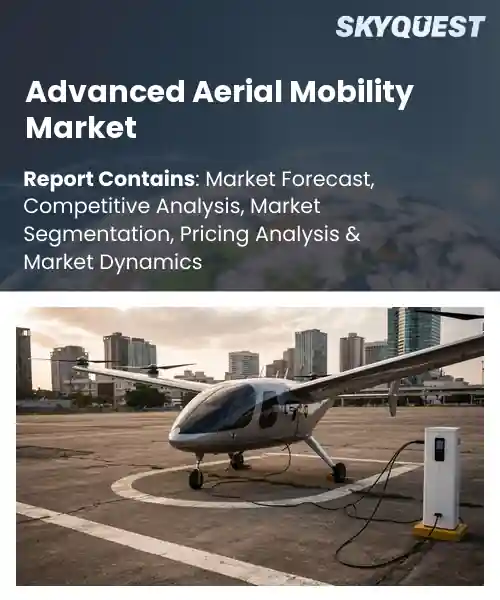
Advanced Aerial Mobility Market
Report ID: SQMIG20A2619
Report ID: SQMIG20A2619
[email protected]
USA +1 351-333-4748
Report ID:
SQMIG20A2619 |
Region:
Global |
Published Date: June, 2026
Pages:
157
|Tables:
124
|Figures:
77


Global Advanced Aerial Mobility Market size was valued at USD 11.75 Billion in 2024 and is poised to grow from USD 14.75 Billion in 2025 to USD 90.75 Billion by 2033, growing at a CAGR of 25.5% during the forecast period (2026-2033).
The primary driver of the advanced aerial mobility market is the convergence of electric propulsion, autonomous systems, and lightweight materials that together lower operational costs and enable safer vertical takeoffs and landings. Building the future of aerial transport has great potential for transforming mobility in cities globally, including large commercial and residential areas outside traditional urban centers, through air transport. Aerial transport will connect people and communities to each other via the fastest way possible – point-to-point – while reducing overall traffic congestion in urban centers due to the inclusion of new logistics capabilities associated with air transport. The evolution of the market from primarily military applications to regulated commercial applications has also been accomplished over the past ten years through several different commercial prototypes including those being tested by Amazon Prime Air, Joby Aviation, and Volocopter.
Building on these demonstrations, regulatory clarity and airspace management are central because certification timelines and traffic management determine where operators can deploy services. Safety standards set by regulators, together with the establishment of vertiport corridors, enable investors to make capital investments and manufacturers to increase their production capacity, reducing costs per unit and speeding up the process of commercialisation. This creates a cause-and-effect cycle that enables new opportunities for on-demand air taxis in urban areas to connect major commercial centres with airports. Pilots in Europe and the United States demonstrate how coordinated policy, public-private partnerships, and targeted infrastructure investment convert prototypes into scalable commercially viable business models.
How is AI Enhancing Safety and Scalability in the Advanced Aerial Mobility Market?
Advanced Aerial Mobility safety and scalability depend on several AI capabilities. Real time perception and onboard autonomy enable reliable detect and avoid functions and smoother pilot assistance. Coordinated airspace management and traffic optimization allow many low altitude vehicles to share corridors safely. Predictive maintenance and operations analytics increase reliability and throughput. Today the market is in demonstration and early trial phases while manufacturers operators and regulators work to build AI based safety cases. Examples include use of simulation driven certification and remote ground stations that extend situational awareness. These advances lower operational risk and open paths to routine frequent services.
In April 2026, Joby Aviation announced a partnership to apply an AI powered airspace intelligence platform that models four dimensional traffic and optimizes flight paths. This approach reduces pilot workload improves conflict prediction and enables more automated airspace coordination so operations can scale while maintaining higher safety margins.
Market snapshot - (2026-2033)
Global Market Size
USD 11.75 Billion
Largest Segment
eVTOL Aircraft
Fastest Growth
Autonomous Cargo Drones
Growth Rate
25.5% CAGR
To get more insights on this market click here to Request a Free Sample Report
Global advanced aerial mobility market is segmented by aircraft type, propulsion technology, application area, component infrastructure and region. Based on aircraft type, the market is segmented into eVTOL aircraft, eSTOL aircraft, autonomous cargo drones and others. Based on propulsion technology, the market is segmented into fully electric, hybrid-electric and hydrogen fuel cell. Based on application area, the market is segmented into urban air mobility, regional aerial mobility, logistics, cargo delivery, emergency medical services and search rescue operations. Based on component infrastructure, the market is segmented into flight platforms, hardware, avionics, software systems, vertiport infrastructure and charging stations. Based on region, the market is segmented into North America, Europe, Asia Pacific, Latin America and Middle East & Africa.
Based on the global advanced aerial mobility market growth, EVTOL segment dominates because its vertical takeoff and landing capability aligns with dense urban operations and passenger mobility needs, drawing major OEM investment and focused certification pathways. The development of cars used as wings with integrated design allows for less complicated and easier operation by service providers. The ability to plan fixed route and schedule will increase confidence in operators based on the manufacturing methods of quieter eVTOLs will lead to infrastructure planning and collaborative partnerships between the use of eVTOLs as the main platform of providing advanced aerial mobility services.
However, autonomous cargo drones are witnessing the strongest growth momentum as logistics operators seek flexible last mile and hub to hub solutions. Advances in autonomy, payload efficiency and air traffic management integration lower operating costs and regulatory friction for non-passenger flights, catalyzing rapid deployments and unlocking new commercial aerial logistics opportunities.
Hydrogen fuel cell segment dominates because its high energy density and rapid refueling profile make it well suited for longer range and heavy payload aerial missions, attracting investment from operators targeting regional routes and cargo transfers. Infrastructure planners and certifying authorities are prioritizing hydrogen pathways that support the design of extended endurance aircraft because hydrogen technology aligns with decarbonisation goals and scalable refuelling partnerships, which reduce lifecycle emissions expectations.
However, fully electric is the most rapidly expanding area as battery advancements and charging network growth unlock urban short range operations. Reduced operational complexity, strong manufacturer commitments and supportive policy lower entry barriers, enabling rapid pilot programs and operator adoption that drive new service models and expand urban aerial mobility commercial potential.
To get detailed segments analysis, Request a Free Sample Report
As per the global advanced aerial mobility market share, North America leads the industry due to concentrated technological innovation, mature supplier ecosystems, abundant private investment, and supportive regulatory frameworks. Electric propulsion, autonomous systems, and advanced air traffic management concepts will be rapidly integrated through collaboration between industry partners, research organizations, and military/civil aviation authorities. Infrastructure readiness in key urban and regional nodes, combined with early adoption by logistics and emergency services, creates demonstrable use cases that attract further industry activity. Market participants benefit from a dense ecosystem of specialized suppliers and test facilities, which supports iterative development and risk reduction throughout product lifecycles.
Advanced aerial mobility market in United States benefits from a dense innovation ecosystem, extensive testing infrastructure, and a wide array of industry incumbents and startups pursuing urban air mobility, cargo and emergency response solutions. Regulatory engagement and public private pilots foster collaborative development. Strong manufacturing and supply chain capabilities support demonstration programs and early operational deployments across diverse operating environments.
Advanced aerial mobility market in Canada emphasizes regional connectivity, remote operations, and integration with existing rotorcraft activity, driven by operators seeking efficient transport to underserved areas. Dialogues are held that deal with standardizing certification pathways and gaining acceptance from the local community. The businesses that manufacture and provide services locally will satisfy local demand for their products while at the same time developing relationships with international partner companies to adopt new technologies and prepare for commencement of operations.
Based on the global advanced aerial mobility market forecast, Asia Pacific expansion is driven by dense urbanization, pressing demand for new mobility solutions, and strategic government initiatives that prioritize smart city integration and transport innovation. Manufacturers and Technology Businesses in the Region have experience with electric propulsion systems, battery systems, sensory systems, and lightweight materials to develop platforms suitable for urban areas with congestion. In addition to the growing desire to modernize airspace, there is also a growing interest in multimodal logistics, which creates opportunities for last-mile delivery solutions for cargo and/or medical evacuation and/or passenger lift concepts. Collaborative pilot programs connecting cities, carriers and providers will assist in testing out concepts across many different weather conditions and regulatory environments.
Advanced aerial mobility market in Japan leverages a strong industrial base in electronics, manufacturing, and battery technology to advance air mobility solutions tailored for compact urban spaces. Municipal authorities, transportation agencies, and large manufacturers must coordinate and develop focused demonstration projects and investigate potential infrastructure for these transportation solutions. Additionally, public acceptance, safety validation, and noise mitigation will be important areas of focus for these projects. Domestic firms aim to integrate autonomous control systems with propulsion into platforms for passenger and logistics applications.
Advanced aerial mobility market in South Korea benefits from strong electronics and automotive sectors that support integration of sensors and connectivity. City and government authorities are considering both infrastructure planning regarding air mobility pilot projects for congestion relief by providing alternative methods of transport. Research institutions and industry consortiums have focused on safety, airspace integration, and certification pathways. Local manufacturers and providers position to commercialize cargo and passenger concepts while engaging international partners for technology exchange.
As per global advanced aerial mobility regional outlook, Europe is strengthening its role through coordinated regulatory efforts, cross border research collaboration, and investments in urban infrastructure adaptation that prioritize integration of advanced aerial platforms into multimodal transport networks. The design of vertiport concepts, noise mitigation systems, and certification processes that prioritize both safety and local acceptance is achieved through collaboration between established aerospace companies, new technology companies and metropolitan governments. Testing facilities and standards from a variety of different locations work together to help streamline proof of concepts in various types of operating environments by creating regional initiatives. Cross-sector partnerships / public-private pilots and focused resources related to certification pathways convert prototypes into established working models through public interaction, as well as environmental impacts.
Advanced aerial mobility market in Germany leverages deep engineering expertise, an established aerospace supply chain, and automotive electrification capabilities to develop air mobility solutions. This is being done via pilot programs focusing on the distribution of goods as well as the delivery of medical supplies to show how they can be used operationally. Manufacturers in Germany, through partnerships between countries and companies, will continue to promote robust manufacturing processes and high levels of safety, while also working with international partners to facilitate faster technology transfer.
Advanced aerial mobility market in United Kingdom combines aerospace heritage, innovative startups, and municipal programs to advance urban air mobility concepts. Areas of focus include the development of vertiports, engagement with communities, and the creation of regulatory pathways that create a balance between the need for safety and operational flexibility. These areas are guided by consideration for sustainability and acceptance of the technology, while also looking at building partnerships internationally in order to support the scaling of technology and integration of services across all areas.
Advanced aerial mobility market in France emphasizes integration of urban planning, noise abatement research, and propulsion development to enable aerial mobility in urban areas. National research centers and industrial players coordinate pilot deployments that explore medical transport, regional connectivity, and cargo services. Regulatory bodies engage with municipalities to shape certification pathways. French firms leverage expertise in aerostructures and systems integration while forming cross border alliances to validate operations across European environments.
To know more about the market opportunities by region and country, click here to
Buy The Complete Report
Rising Urban Mobility Demand
Improvements In Battery Propulsion
Complex Regulatory and Airspace Approval
High Development and Infrastructure Costs
Request Free Customization of this report to help us to meet your business objectives.
Competition in the global advanced aerial mobility market outlook is driven by competitive trials for operational readiness, supplier and certification alliances, and a race in autonomy and airspace integration that incentivizes M&A, joint ventures, and supplier partnerships. Real examples include Wisk’s city and operator trial agreements and Embraer’s spin-off Eve securing strategic airline commitments, all pushing firms to lock in routes, infrastructure partners, and proprietary autonomy stacks.
Top Player’s Company Profile
Recent Developments
SkyQuest’s ABIRAW (Advanced Business Intelligence, Research & Analysis Wing) is our Business Information Services team that Collects, Collates, Correlates, and Analyses the Data collected by means of Primary Exploratory Research backed by robust Secondary Desk research.
As per SkyQuest analysis, a key driver behind the global advanced aerial mobility industry is the convergence of electric propulsion, autonomous systems and lightweight materials that lower operational costs and enable safe vertical takeoffs and landings, while a major restraint is the complex regulatory and airspace approval landscape that slows certification and deployment. North America currently dominates the global advanced aerial mobility market and eVTOL aircraft represent the dominating segment for urban passenger operations. A second driver accelerating adoption is continual improvements in battery propulsion and charging infrastructure which extend range and reduce turnaround. Overall, coordinated regulation, infrastructure investment and technological progress will determine the pace of commercialization.
| Report Metric | Details |
|---|---|
| Market size value in 2024 | USD 11.75 Billion |
| Market size value in 2033 | USD 90.75 Billion |
| Growth Rate | 25.5% |
| Base year | 2024 |
| Forecast period | (2026-2033) |
| Forecast Unit (Value) | USD Billion |
| Segments covered |
|
| Regions covered | North America (US, Canada), Europe (Germany, France, United Kingdom, Italy, Spain, Rest of Europe), Asia Pacific (China, India, Japan, Rest of Asia-Pacific), Latin America (Brazil, Rest of Latin America), Middle East & Africa (South Africa, GCC Countries, Rest of MEA) |
| Companies covered |
|
| Customization scope | Free report customization with purchase. Customization includes:-
|
To get a free trial access to our platform which is a one stop solution for all your data requirements for quicker decision making. This platform allows you to compare markets, competitors who are prominent in the market, and mega trends that are influencing the dynamics in the market. Also, get access to detailed SkyQuest exclusive matrix.
Table Of Content
Executive Summary
Market overview
Parent Market Analysis
Market overview
Market size
KEY MARKET INSIGHTS
COVID IMPACT
MARKET DYNAMICS & OUTLOOK
Market Size by Region
KEY COMPANY PROFILES
Methodology
For the Advanced Aerial Mobility Market, our research methodology involved a mixture of primary and secondary data sources. Key steps involved in the research process are listed below:
1. Information Procurement: This stage involved the procurement of Market data or related information via primary and secondary sources. The various secondary sources used included various company websites, annual reports, trade databases, and paid databases such as Hoover's, Bloomberg Business, Factiva, and Avention. Our team did 45 primary interactions Globally which included several stakeholders such as manufacturers, customers, key opinion leaders, etc. Overall, information procurement was one of the most extensive stages in our research process.
2. Information Analysis: This step involved triangulation of data through bottom-up and top-down approaches to estimate and validate the total size and future estimate of the Advanced Aerial Mobility Market.
3. Report Formulation: The final step entailed the placement of data points in appropriate Market spaces in an attempt to deduce viable conclusions.
4. Validation & Publishing: Validation is the most important step in the process. Validation & re-validation via an intricately designed process helped us finalize data points to be used for final calculations. The final Market estimates and forecasts were then aligned and sent to our panel of industry experts for validation of data. Once the validation was done the report was sent to our Quality Assurance team to ensure adherence to style guides, consistency & design.
Analyst Support
Customization Options
With the given market data, our dedicated team of analysts can offer you the following customization options are available for the Advanced Aerial Mobility Market:
Product Analysis: Product matrix, which offers a detailed comparison of the product portfolio of companies.
Regional Analysis: Further analysis of the Advanced Aerial Mobility Market for additional countries.
Competitive Analysis: Detailed analysis and profiling of additional Market players & comparative analysis of competitive products.
Go to Market Strategy: Find the high-growth channels to invest your marketing efforts and increase your customer base.
Innovation Mapping: Identify racial solutions and innovation, connected to deep ecosystems of innovators, start-ups, academics, and strategic partners.
Category Intelligence: Customized intelligence that is relevant to their supply Markets will enable them to make smarter sourcing decisions and improve their category management.
Public Company Transcript Analysis: To improve the investment performance by generating new alpha and making better-informed decisions.
Social Media Listening: To analyze the conversations and trends happening not just around your brand, but around your industry as a whole, and use those insights to make better Marketing decisions.
REQUEST FOR SAMPLE
 REQUEST FREE CUSTOMIZATION
Global Advanced Aerial Mobility Market size was valued at USD 11.75 Billion in 2024 and is poised to grow from USD 14.75 Billion in 2025 to USD 90.75 Billion by 2033, growing at a CAGR of 25.5% during the forecast period (2026-2033).
Competition in the global advanced aerial mobility market is driven by competitive trials for operational readiness, supplier and certification alliances, and a race in autonomy and airspace integration that incentivizes M&A, joint ventures, and supplier partnerships. Real examples include Wisk’s city and operator trial agreements and Embraer’s spin-off Eve securing strategic airline commitments, all pushing firms to lock in routes, infrastructure partners, and proprietary autonomy stacks. 'The Boeing Company', 'Airbus SE', 'Lockheed Martin Corporation', 'Northrop Grumman Corporation', 'Textron', 'Joby Aviation', 'Archer Aviation', 'EHang Holdings', 'Beta Technologies', 'Volocopter', 'Eve Air Mobility', 'Embraer', 'Hyundai Motor Company', 'Honda Motor Company', 'Toyota Motor Corporation', 'Suzuki Motor Corporation', 'Zipline International', 'Matternet', 'Flytrex', 'Drone Delivery Canada'
Rising urban population and congestion have increased interest in alternative transport solutions, prompting cities and private operators to support advanced aerial mobility initiatives. This demand encourages investment in vehicle development, infrastructure pilots, and route planning, creating commercial incentives for manufacturers and service providers. As commuters and logistics users seek faster, flexible options, stakeholders prioritize integration with existing transport networks and airspace management, which in turn accelerates technology maturation, operational testing, and partnerships that collectively expand market opportunities and supplier confidence.
Urban Integration And Connectivity: Advanced aerial mobility is increasingly positioned as an integral layer within urban transport ecosystems, enabling seamless multimodal connections between ground transit, first-mile/last-mile networks. Design emphasis shifts toward vertiport siting, passenger experience and integration with existing mobility platforms, creating partnerships across public transit authorities, ride-hailing operators and real estate developers. Stakeholders prioritize interoperability, shared data standards and coordinated scheduling to ensure efficient throughput and urban acceptance, while planning focuses on minimizing surface footprint and complementing rather than displacing local transit services.
Why does North America Dominate the Global Advanced Aerial Mobility Market? |@12


Want to customize this report? This report can be personalized according to your needs. Our analysts and industry experts will work directly with you to understand your requirements and provide you with customized data in a short amount of time. We offer $1000 worth of FREE customization at the time of purchase.
Feedback From Our Clients


 USA (+1) 351-333-4748

