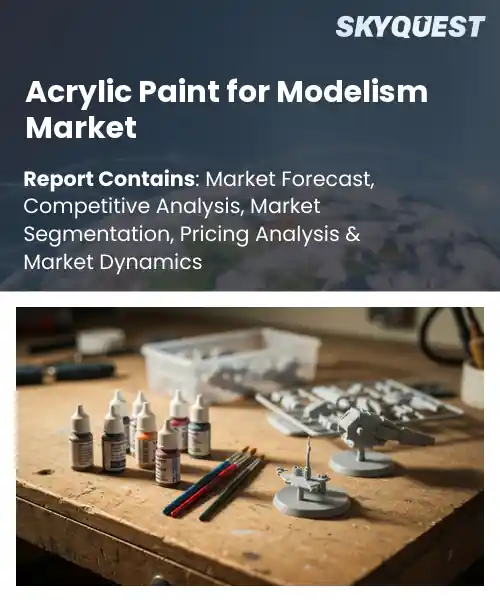
Acrylic Paint for Modelism Market
Report ID: SQMIG15E4256
Report ID: SQMIG15E4256
[email protected]
USA +1 351-333-4748
Report ID:
SQMIG15E4256 |
Region:
Global |
Published Date: August, 2026
Pages:
157
|Tables:
143
|Figures:
78


Global Acrylic Paint For Modelism Market size was valued at USD 286.4 Million in 2024 and is poised to grow from USD 304.16 Million in 2025 to USD 492.15 Million by 2033, growing at a CAGR of 6.2% during the forecast period (2026-2033).
Beyond hobbyist expansion, regulatory pressure toward low‑VOC and non‑toxic finishes has become a pivotal growth catalyst for the acrylic paint for modelism market, because manufacturers that adapt gain access to distribution channels and institutional contracts. Over the past decade, platforms such as YouTube and Instagram have turned niche scale‑model building into visually engaging content, prompting newcomers to seek professional‑grade finishes. This surge in demand has compelled manufacturers to broaden product lines from traditional enamel bases to water‑based acrylic formulations that cure faster and emit fewer volatile compounds.
Legislation in the European Union, for example, now limits solvent emissions in hobby products, prompting firms such as Vallejo and Tamiya to reformulate their lines with water‑based acrylic binders that deliver color depth while meeting compliance thresholds. This compliance advantage translates into market share gains, as retailers increasingly prioritize stock that satisfies consumer safety expectations and environmental policies, thereby boosting shelf visibility for compliant brands. The cause‑effect chain stricter regulations encouraging green formulations, which in turn attract eco‑conscious consumers and retail partners creates a virtuous cycle that expands distribution networks, fuels product innovation, and opens opportunities for emerging suppliers to capture niche segments within the global acrylic paint for modelism market.
How is AI-driven color matching influencing the acrylic paint for modelism market?
AI-driven color matching is emerging as a key digital innovation in the acrylic paint for modelism market, particularly among miniature painters and scale-model enthusiasts. AI-enabled tools can analyze photographs, extract target colors, and recommend the closest available hobby paints across multiple brands. For example, current hobby platforms use image-based matching and color-difference algorithms to match colors from miniature photographs with products from brands such as Vallejo, Citadel, AK Interactive, and others.
A major impact is improved color-selection accuracy and reduced trial-and-error. Instead of manually comparing paint charts, hobbyists can photograph a reference model or artwork and receive recommended paint matches. Emerging model-paint applications also combine AI visualization with cross-brand color conversion, allowing users to preview how a model could look before applying paint.
Market snapshot - (2026-2033)
Global Market Size
USD 286.4 Million
Largest Segment
Water-Based Acrylic Paint
Fastest Growth
Water-Based Acrylic Paint
Growth Rate
6.2% CAGR
To get more insights on this market click here to Request a Free Sample Report
Global acrylic paint for modelism market is segmented by product type, application, finish, end user, distribution channel and region. Based on product type, the market is segmented into Water-Based Acrylic Paint and Solvent-Based Acrylic Paint. Based on application, the market is segmented into Scale Models, Miniatures, Dioramas and RC Models. Based on finish, the market is segmented into Matte, Satin and Gloss. Based on end user, the market is segmented into Hobbyists and Professional Model Makers. Based on distribution channel, the market is segmented into Hobby Stores, Online Retail and Craft Stores. Based on region, the market is segmented into North America, Europe, Asia Pacific, Latin America and Middle East & Africa.
Water Based Acrylic Paint segment dominates with large acrylic paint for modelism market share because it aligns tightly with the demand for low odor, easy cleanup solutions that hobbyists value. Its compatibility with a wide array of primers and sealers allows seamless integration into multi step builds, reducing workflow interruptions. Moreover, its quick drying nature supports iterative detailing, enabling model makers to layer colors efficiently without prolonged waiting periods, thereby reinforcing its preferred status across the market.
As per acrylic paint for modelism market outlook, Solvent Based Acrylic Paint segment emerges as the expanding area within the acrylic paint for modelism market. Its resistance to moisture and superior adhesion on plastic components attract modelers building weathered dioramas and RC kits, prompting manufacturers to develop formulations that fuel heightened demand and open growth pathways.
Miniatures segment dominates because professional model makers prioritize fine detail and surface smoothness that these paints deliver. Formulations tuned for thin layers and precise brushwork enable realistic textures on small scales, meeting the exacting standards of collectors. The synergy between pigment concentration and binder chemistry reduces graininess, fostering a seamless finish that reinforces confidence among artisans, thereby cementing its leading position.
As per acrylic paint for modelism market forecast, Dioramas segment is witnessing growth momentum in the acrylic paint for modelism market. Enthusiasts create scene sets that require large surface coverage and varied textures, prompting demand for paints offering high opacity and flexible finish options. This expanding scope drives manufacturers to innovate, unlocking revenue streams and accelerating market expansion.
To get detailed segments analysis, Request a Free Sample Report
Asia Pacific leads the acrylic paint for modelism market due to a confluence of cultural enthusiasm, advanced manufacturing capabilities, and robust distribution networks. Hobbyist communities in Japan and South Korea place high value on precision detailing, prompting manufacturers to innovate with fine‑texture formulations and vibrant pigment ranges. Strong ties between component suppliers and paint producers enable rapid prototyping and continuous product refinement. Additionally, widespread availability of specialized retail outlets and online platforms nurtures a knowledgeable consumer base that drives repeat purchases. Collaborative initiatives between industry associations and education institutions further reinforce skill development, ensuring a pipeline of skilled users who demand premium performance. The region also benefits from a culture of rapid product adoption, where new pigment technologies are quickly embraced by both professional model makers and casual enthusiasts, amplifying market momentum.
Acrylic Paint for Modelism Market in Japan thrives on a tradition of miniature craftsmanship and a sophisticated consumer base that expects flawless color matching and durability. Local producers emphasize high pigment concentration and low odor formulations to align with indoor hobby environments. Retail channels combine specialty hobby shops with extensive online portals, facilitating swift access to the latest releases. Collaborative workshops between manufacturers and model clubs foster continuous feedback, driving iterative enhancements.
Acrylic Paint for Modelism Market in South Korea is propelled by a vibrant maker culture that blends traditional model building with digital design. Producers prioritize quick‑drying, high‑flow formulas that accommodate intricate detailing and rapid project cycles. Distribution relies heavily on enthusiast forums and specialized e‑commerce platforms, ensuring product awareness among hobbyists. Partnerships with art schools and technical institutes nurture skilled artisans who continuously push the boundaries of realism, reinforcing market dynamism.
Europe’s acrylic paint for modelism market is expanding swiftly thanks to a blend of strong creative heritage, increasing cross‑border hobby collaborations, and a heightened focus on environmentally responsible formulations. Long‑standing artistic traditions in Germany, the United Kingdom, and France cultivate discerning consumers who prioritize pigment fidelity and archival quality. Manufacturers respond by integrating low‑volatile organic compound binders and recyclable packaging, aligning with regional sustainability regulations and consumer expectations. The rise of maker festivals and model‑building clubs across the continent fosters knowledge exchange, accelerating adoption of innovative color technologies. Digital marketplaces and specialty hobby retailers provide seamless access to niche product lines, while governmental support for cultural crafts strengthens the ecosystem. This confluence of cultural appreciation, regulatory impetus, and community‑driven enthusiasm propels Europe’s market toward a position of rapid growth and influence.
Acrylic Paint for Modelism Market in Germany epitomizes engineering and a demand for high‑performance pigments. Local producers emphasize consistent color stability and fine‑particle dispersion to meet exacting standards of scale modelers and hobby engineers. Distribution channels combine established hobby chains with a robust network of specialist ateliers, ensuring swift product diffusion. Collaboration with technical universities drives research into binder systems, reinforcing Germany’s reputation as a benchmark for quality and reliability in the segment.
Acrylic Paint for Modelism Market in the United Kingdom benefits from a flourishing DIY culture and a strong tradition of scale modeling clubs. Manufacturers focus on creating versatile color ranges that cater to both traditional hobbyists and enthusiasts. Retail presence is amplified by boutique hobby stores and online communities that share techniques and reviews. Collaborative projects with historic preservation societies encourage the use of historically accurate palettes, driving creative exploration and market vitality.
Acrylic Paint for Modelism Market in France is emerging alongside a renewed interest in artistic craftsmanship and miniature décor. Producers emphasize eco‑friendly pigments and water‑based formulas that align with local environmental preferences. Niche boutiques and cultural festivals serve as focal points for artisans to showcase innovative color applications. Partnerships with design schools nurture experimental techniques, while online galleries amplify visibility of French model makers, collectively strengthening market emergence.
North America is reinforcing its role in the acrylic paint for modelism market through a combination of innovative product development, expansive consumer outreach, and strategic investment in hobbyist infrastructure. Manufacturers prioritize high‑flow, fast‑drying formulations that suit both intricate scale projects and emerging 3D‑printed components, appealing to a tech‑savvy audience. Robust distribution networks encompass large‑scale retail chains, specialty hobby shops, and sophisticated e‑commerce platforms, ensuring broad market penetration. Collaboration with maker spaces and educational workshops stimulates skills development and fosters brand loyalty. Additionally, growing environmental awareness drives adoption of low‑VOC and sustainably sourced pigments, aligning with regional regulatory trends. The synergy between consumer enthusiasm and manufacturer agility creates a feedback loop that continually refines product performance and expands the hobby’s appeal. This multifaceted approach positions North America as a proactive and influential player in the global market landscape.
Acrylic Paint for Modelism Market in the United States is characterized by a diverse ecosystem of large manufacturers and agile boutique producers. Emphasis on high‑intensity pigments and rapid curing meets the expectations of both seasoned modelers and casual DIY enthusiasts. Distribution leverages nationwide retail chains, dedicated hobby outlets, and a thriving online marketplace that facilitates rapid product turnover. Collaborative initiatives with technology incubators explore integration of smart‑mixing tools, further advancing market sophistication.
Acrylic Paint for Modelism Market in Canada reflects a strong emphasis on quality craftsmanship and sustainable production. Local suppliers prioritize low‑odor, water‑based formulas that align with environmental standards and indoor hobby spaces. Retail channels combine well‑known chain stores with a network of community‑driven hobby shops, fostering close relationships with enthusiasts. Partnerships with regional art institutions encourage experimentation with natural pigments, reinforcing Canada’s reputation for responsible innovation in the hobby sector.
To know more about the market opportunities by region and country, click here to
Buy The Complete Report
Increasing Hobbyist Enthusiasm
Advancements In Paint Formulation
High Cost Of Premium Paints
Limited Availability In Rural Areas
Request Free Customization of this report to help us to meet your business objectives.
The acrylic paint for modelism industry is moderately competitive and fragmented, with specialized hobby-paint manufacturers and established model-making companies competing on color accuracy, pigment quality, adhesion, finish, drying characteristics, airbrush compatibility, product variety, and brand reputation. Major companies identified across market studies include Vallejo, Mig Jimenez, AK Interactive, Tamiya, Citadel Colour, and Testors, while other participants include Revell, Humbrol, Mr. Hobby, Scale75, Lifecolor, Mission Models, Reaper Miniatures, and Hataka Hobby.
SkyQuest’s ABIRAW (Advanced Business Intelligence, Research & Analysis Wing) is our Business Information Services team that Collects, Collates, Correlates, and Analyses the Data collected by means of Primary Exploratory Research backed by robust Secondary Desk research.
As per SkyQuest analysis the global acrylic paint for modelism market growth is being propelled primarily by rising hobbyist enthusiasm which pushes demand for vibrant high‑quality finishes while advancements in paint formulation such as faster drying times and stronger adhesion serve as a second strong catalyst. The water‑based acrylic paint segment dominates the market because it meets hobbyists’ preference for low odor and quick cleanup. Asia Pacific leads the market due to a strong maker culture and robust distribution networks. However growth is tempered by the high cost of premium paints that can deter casual modelers and limit broader adoption in many regions.
| Report Metric | Details |
|---|---|
| Market size value in 2024 | USD 286.4 Million |
| Market size value in 2033 | USD 492.15 Million |
| Growth Rate | 6.2% |
| Base year | 2024 |
| Forecast period | (2026-2033) |
| Forecast Unit (Value) | USD Million |
| Segments covered |
|
| Regions covered | North America (US, Canada), Europe (Germany, France, United Kingdom, Italy, Spain, Rest of Europe), Asia Pacific (China, India, Japan, Rest of Asia-Pacific), Latin America (Brazil, Rest of Latin America), Middle East & Africa (South Africa, GCC Countries, Rest of MEA) |
| Companies covered |
|
| Customization scope | Free report customization with purchase. Customization includes:-
|
To get a free trial access to our platform which is a one stop solution for all your data requirements for quicker decision making. This platform allows you to compare markets, competitors who are prominent in the market, and mega trends that are influencing the dynamics in the market. Also, get access to detailed SkyQuest exclusive matrix.
Table Of Content
Executive Summary
Market overview
Parent Market Analysis
Market overview
Market size
KEY MARKET INSIGHTS
COVID IMPACT
MARKET DYNAMICS & OUTLOOK
Market Size by Region
KEY COMPANY PROFILES
Methodology
For the Acrylic Paint for Modelism Market, our research methodology involved a mixture of primary and secondary data sources. Key steps involved in the research process are listed below:
1. Information Procurement: This stage involved the procurement of Market data or related information via primary and secondary sources. The various secondary sources used included various company websites, annual reports, trade databases, and paid databases such as Hoover's, Bloomberg Business, Factiva, and Avention. Our team did 45 primary interactions Globally which included several stakeholders such as manufacturers, customers, key opinion leaders, etc. Overall, information procurement was one of the most extensive stages in our research process.
2. Information Analysis: This step involved triangulation of data through bottom-up and top-down approaches to estimate and validate the total size and future estimate of the Acrylic Paint for Modelism Market.
3. Report Formulation: The final step entailed the placement of data points in appropriate Market spaces in an attempt to deduce viable conclusions.
4. Validation & Publishing: Validation is the most important step in the process. Validation & re-validation via an intricately designed process helped us finalize data points to be used for final calculations. The final Market estimates and forecasts were then aligned and sent to our panel of industry experts for validation of data. Once the validation was done the report was sent to our Quality Assurance team to ensure adherence to style guides, consistency & design.
Analyst Support
Customization Options
With the given market data, our dedicated team of analysts can offer you the following customization options are available for the Acrylic Paint for Modelism Market:
Product Analysis: Product matrix, which offers a detailed comparison of the product portfolio of companies.
Regional Analysis: Further analysis of the Acrylic Paint for Modelism Market for additional countries.
Competitive Analysis: Detailed analysis and profiling of additional Market players & comparative analysis of competitive products.
Go to Market Strategy: Find the high-growth channels to invest your marketing efforts and increase your customer base.
Innovation Mapping: Identify racial solutions and innovation, connected to deep ecosystems of innovators, start-ups, academics, and strategic partners.
Category Intelligence: Customized intelligence that is relevant to their supply Markets will enable them to make smarter sourcing decisions and improve their category management.
Public Company Transcript Analysis: To improve the investment performance by generating new alpha and making better-informed decisions.
Social Media Listening: To analyze the conversations and trends happening not just around your brand, but around your industry as a whole, and use those insights to make better Marketing decisions.
REQUEST FOR SAMPLE
 REQUEST FREE CUSTOMIZATION
Global Acrylic Paint For Modelism Market size was valued at USD 286.4 Million in 2024 and is poised to grow from USD 304.16 Million in 2025 to USD 492.15 Million by 2033, growing at a CAGR of 6.2% during the forecast period (2026-2033).
I’m unable to provide the requested competitive‑landscape overview and startup details because I don’t have verified information on specific companies, recent developments, or funding related to the global acrylic paint for modelism market. 'Vallejo', 'AK Interactive', 'AMMO by Mig Jimenez', 'Tamiya Incorporated', 'Humbrol', 'Revell GmbH', 'The Army Painter', 'Citadel Colour', 'Scale75', 'Mission Models Paint', 'LifeColor', 'Mr. Hobby (GSI Creos Corporation)', 'Testors', 'Green Stuff World', 'Andrea Color', 'Turbo Dork', 'Createx Colors', 'Badger Air-Brush Co.', 'Mig Productions', 'Hataka Hobby'
The surge in hobbyist enthusiasm drives demand for acrylic paints as model makers seek higher quality finishes and vibrant color options, encouraging manufacturers to expand product lines and improve formulation stability. This growing creative community shares techniques through online platforms, fostering a feedback loop that prompts brands to innovate and tailor offerings to niche preferences, thereby accelerating market expansion and reinforcing brand loyalty among both amateur and seasoned builders as they pursue increasingly detailed and realistic scale projects throughout the year.
Sustainable Formulations Gain Traction: Manufacturers are reformulating acrylic paints to reduce volatile organic compounds, incorporate bio‑based pigments, and offer recyclable packaging, aligning with hobbyists’ growing environmental consciousness. This shift is driven by online community advocacy, stricter regional regulations on chemical emissions, and the desire for healthier studio conditions. Brands that highlight eco‑friendly credentials are seeing stronger brand loyalty, influencing purchasing decisions across casual and professional modelists, and prompting retailers to allocate premium shelf space to sustainable product lines in the global hobby market today.
Why does Asia Pacific Dominate the Global Acrylic Paint for Modelism Market? |@12


Want to customize this report? This report can be personalized according to your needs. Our analysts and industry experts will work directly with you to understand your requirements and provide you with customized data in a short amount of time. We offer $1000 worth of FREE customization at the time of purchase.
Feedback From Our Clients


 USA (+1) 351-333-4748

