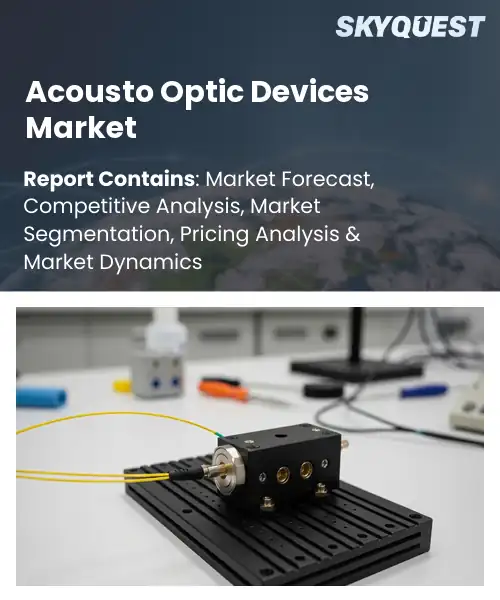
Acousto Optic Devices Market
Report ID: SQMIG45J2553
Report ID: SQMIG45J2553
[email protected]
USA +1 351-333-4748
Report ID:
SQMIG45J2553 |
Region:
Global |
Published Date: June, 2026
Pages:
157
|Tables:
92
|Figures:
76


Global Acousto Optic Devices Market size was valued at USD 682.5 Million in 2024 and is poised to grow from USD 725.63 Million in 2025 to USD 1185.4 Million by 2033, growing at a CAGR of 6.32% during the forecast period (2026-2033).
High demand for high-speed optical communication systems, increasing adoption of LiDAR technology, rising investments in defense and aerospace applications, advancements in laser-based medical devices, and expansion of industrial automation are driving sales of acousto-optic devices.
The increasing use of fiber-optic communications networks and LiDAR systems are spurring the growth of acousto-optic (AO) modulators and deflectors that offer high-speed and low-loss optical signal processing. The ongoing improvements in crystal materials, miniaturization, as laser research are enabling new levels of performance while broadening the scope of AO applications. The proliferation of funding and resources in fields such as autonomous vehicles, medical imaging, and precision manufacturing is further enabling market growth. Growing partnerships between semiconductor vendors and auto companies are also likely to generate new prospects for vendors of acousto optic devices. Rising demand for fast and precise light modulation across telecommunications, defense, healthcare, and industrial applications is expected to primarily drive acousto-optic devices market growth.
Contrastingly, high manufacturing costs, complex fabrication processes, limited availability of high-quality crystal materials, and competition from alternative photonic technologies are anticipated to slow down acousto-optic devices market penetration through 2033.
How is AI-driven Automation Influencing Acousto‑optic Device Manufacturing and Demand?
AI is revolutionizing the acousto-optic devices market by providing enhanced design for products, streamlining manufacturing and helping devices to perform better. AI algorithms use machine learning models that access the properties of the materials and the path of acoustic waves. Such tools assist the engineers to optimize the device design while possibly reducing the number of prototypes needed for each device. AI driving automation delivers repeatability in the device fabrication by ensuring repeatable alignment, testing and quality control, which reduces time and costs of manufacturing, improves the performance of the device and reduces the wastage of raw materials. All these benefits will decrease the costs and improve the reliability of acousto-optic devices used in telecommunications, defense, scientific research, and laser-based applications.
Market snapshot - (2026-2033)
Global Market Size
USD 682.5 Million
Largest Segment
Fastest Growth
Growth Rate
6.32% CAGR
To get more insights on this market click here to Request a Free Sample Report
Global acousto optic devices market is segmented by device type, application, end-user, and region. Based on device type, the market is segmented into Acousto-Optic Modulators (AOM), Acousto-Optic Frequency Shifters, Acousto-Optic Deflectors (AOD), and Acousto-Optic Tunable Filters (AOTF). Based on application, the market is segmented into laser technology, telecommunications, medical (ophthalmology), and scientific research. Based on end-user, the market is segmented into laser manufacturers, research institutes, and defense & military. Based on region, the market is segmented into North America, Europe, Asia Pacific, Latin America, and Middle East & Africa.
The acousto optic modulators segment is estimated to lead the global acousto optic devices market revenue generation across the study period. Cascaded sources are the most flexible in controlling the laser intensity and pulse shaping; fulfilling the necessities of many instruments in the industrial or research application of lasers systems. Their fully developed technology, high diffraction efficiency, and reliability make them the first choice for many manufacturers. The demand is helped by the need for on-going upgrading of the manufacturing equipment, through the years of use in many scientific instruments.
Meanwhile, acousto optic tunable filters emerge as the most rapidly expanding segment as per this acousto optic devices industry analysis, by allowing flexible wavelength selection for hyperspectral imaging and high-performance spectroscopy; by replacing size-consuming, mechanical filters that promote everyday integration in most compact optical systems; and by opening up new realms of spectral coverage, through progress in material innovation, for new or expanding photonics applications.
The laser technology segment is anticipated to account for the highest global acousto optic devices market share in the future. It forms the basis of the major function of acousto optic devicesaccurate modulation, deflection, and filtering to control beam amplitude, frequency, and direction. The all-consuming use of lasers in manufacturing, the defense industry, and research leads to continuous demand for integrated acousto optic solutions and ensures ongoing investment.
Conversely, medical (ophthalmology) is witnessing the strongest growth momentum as acousto optic devices allow noninvasive imaging of the retina as well as helping to improve laser surgery procedures. The new availability of diagnostic tools in eye treatment and increasing occurrence of vision problems is likely to generate demand for these methods but government support of non-invasive techniques could see this market quickening, therefore this application may be the precursor to future growth of acousto optic devices.
To get detailed segments analysis, Request a Free Sample Report
Advanced research ecosystems, robust industrial supply chains, and strong demand from high-tech sectors such as telecommunications, defense, and scientific instrumentation are helping this region maintain its dominance. The fundamental research that is done in universities typically translates very quickly into products in the market due in large part to the level of integration between academia and industry. As a result, manufacturers who supply these products have stable and dependable supply chains, strong manufacturing capabilities for high-quality products, and the trust of customers throughout the world that their products will meet customer requirements for high-quality, reliable product performance. Photonics offers a strong policy environment for supporting investment, and the customer base is mature enough to allow manufacturers continual improvement of their products through product differentiation. Overall, these elements create an ongoing advantage for North America and keep it as the leader in acousto-optic devices.
Demand for acousto optic devices in the United States thrives on a strong alignment between defense research programs and commercial photonics firms. Extensive funding for advanced optics research fuels innovation, while a dense network of specialized suppliers ensures rapid prototyping and scale‑up. Collaboration across leading universities, national laboratories, and industry accelerates technology transfer, positioning the United States as a hub for cutting‑edge device architectures and high‑performance applications in the global supply chain.
Acousto optic devices market in Canada leverages a collaborative research environment anchored by leading universities and government labs focused on photonic engineering. The focus on low noise and high stability implies good knowledge of crystal accounts and laser applications thereoff, naturally playing together with the country's position in the right place for the design of high stability device. The nascent new company can get supports ontheir innovation inducements, where the matured manufactural can take advantage of the crystal bank and best know-how in fabrication.
Strong governmental commitment to photonics research, a dense network of specialized suppliers, and increasing demand from telecommunications, defense, and scientific research sectors boosts sales of acousto optic devices in the region. Collaborative companies across country boundaries under various types of agreements create cooperative development and bring together German precision engineering, British creative innovation and French/newly developed skills. Well-established standardization bodies have created the framework for streamlining integration and certification, which enhances the confidence of the market. Dynamic academic clusters and venture capitals are supporting entrepreneurial companies, very strong established manufacturers can provide the high volume of quality products, and together these create a dynamic environment that accelerates adoption and differentiation through many application areas.
Acousto optic device demand in Germany is anchored by world-renowned precision engineering and a deep heritage of optical component manufacturing. Strong collaboration between institutes and companies brings many novel materials to dependable device concepts rapidly. The German commitment to quality assurance and testing helps reliable performance for defense or scientific uses, whereas a high export focus provides German innovation to international users needing reliable solutions.
Sales of acousto optic devices in the United Kingdom benefit from a vibrant ecosystem that blends research with agile commercial development. Vibrant academic programs for photonics paired with available seed funding spur device innovations. Defense companies, telcos, and startups have partnered and are feeding the pipeline of applications focusing on small form-factors and integration. It positions UK as a place with a clear path to product iterations and market responses.
Acousto optic devices market in France is emerging through governmental support for photonics research and a rise of specialized SMEs. Collaborative clusters linking universities, research agencies, and niche manufacturers foster development of innovative device architectures for aerospace and medical imaging. Emphasis on cost‑effective production and modular designs enables French firms to compete in European supply chains. This growing capability positions France as a noteworthy contributor to the continent’s market momentum.
Aggressive technology adoption, expanding manufacturing capacity, and growing demand from burgeoning telecommunications and consumer electronics sectors are helping boost demand for acousto optic devices in the region. Japan and South Korea are two examples of countries within the Asia Pacific that have made significant investments in photonics. This investment has enabled these countries to create innovations based on miniaturization and integration into semiconductor platforms. The Asia Pacific's low-cost capacity allows companies to quickly scale their production of high-quality devices while creating partnerships with worldwide suppliers that can share their knowledge and experience to accelerate company growth. Advances in optics and the modernization of defense by national governments will continue to create additional opportunities for companies in this region. Therefore, throughout the Asia Pacific region, companies will play an increasingly significant role in determining global supply trends.
Acousto optic devices market in Japan is driven by a tradition of precision optics and strong collaboration between research universities and industrial conglomerates. The push toward miniaturization, along with silicon photonic integration, is essential for developing high-speed communications and high-precision sensing. Joint ventures between academic material science researchers and manufacturers with the backing of government initiatives result in secure and sustainable acousto optic solutions from Japan, renowned worldwide.
Demand for acousto optic devices in South Korea benefits from a robust electronics sector and government programs that prioritize photonic integration. Collaboration in optical research with a semiconductor firm leads to micro components for datacenter interconnects as well as sophisticated displays. It fosters cost-effective production and quickly allows prototype introduction while strategies continue to improve the position of South Korea within supply chains. This enhances it place in Asia Pacific markets.
To know more about the market opportunities by region and country, click here to
Buy The Complete Report
Rising Demand For High‑Speed Imaging
Integration With Photonic Integrated Circuits
High Manufacturing Cost Complexity
Stringent Regulatory Approval Processes
Request Free Customization of this report to help us to meet your business objectives.
The competitive landscape is shaped by intensified rivalry as manufacturers accelerate M&A to acquire niche photonic capabilities, forge cross‑industry partnerships for integrated laser systems, and invest heavily in diffractive material innovation to meet rising demand for high‑speed imaging and telecommunications, driving rapid product cycles and ecosystem consolidation.
SkyQuest’s ABIRAW (Advanced Business Intelligence, Research & Analysis Wing) is our Business Information Services team that Collects, Collates, Correlates, and Analyses the Data collected by means of Primary Exploratory Research backed by robust Secondary Desk research.
As per SkyQuest analysis, high demand for high-speed optical communication systems, increasing adoption of LiDAR technology, and rising investments in defense and aerospace applications are anticipated to drive the demand for acousto-optic devices going forward. However, high manufacturing costs and competition from alternative photonic technologies are slated to slow down the adoption of acousto-optic devices in the future. North America is slated to spearhead the demand for acousto-optic devices owing to strong investments in defense technologies, advanced optical communication infrastructure, and the presence of leading photonics manufacturers. AI-powered design optimization and development of compact, high-speed acousto-optic components are anticipated to be key trends driving the acousto-optic devices sector in the long run.
| Report Metric | Details |
|---|---|
| Market size value in 2024 | USD 682.5 Million |
| Market size value in 2033 | USD 1185.4 Million |
| Growth Rate | 6.32% |
| Base year | 2024 |
| Forecast period | (2026-2033) |
| Forecast Unit (Value) | USD Million |
| Segments covered |
|
| Regions covered | North America (US, Canada), Europe (Germany, France, United Kingdom, Italy, Spain, Rest of Europe), Asia Pacific (China, India, Japan, Rest of Asia-Pacific), Latin America (Brazil, Rest of Latin America), Middle East & Africa (South Africa, GCC Countries, Rest of MEA) |
| Companies covered |
|
| Customization scope | Free report customization with purchase. Customization includes:-
|
To get a free trial access to our platform which is a one stop solution for all your data requirements for quicker decision making. This platform allows you to compare markets, competitors who are prominent in the market, and mega trends that are influencing the dynamics in the market. Also, get access to detailed SkyQuest exclusive matrix.
Table Of Content
Executive Summary
Market overview
Parent Market Analysis
Market overview
Market size
KEY MARKET INSIGHTS
COVID IMPACT
MARKET DYNAMICS & OUTLOOK
Market Size by Region
KEY COMPANY PROFILES
Methodology
For the Acousto Optic Devices Market, our research methodology involved a mixture of primary and secondary data sources. Key steps involved in the research process are listed below:
1. Information Procurement: This stage involved the procurement of Market data or related information via primary and secondary sources. The various secondary sources used included various company websites, annual reports, trade databases, and paid databases such as Hoover's, Bloomberg Business, Factiva, and Avention. Our team did 45 primary interactions Globally which included several stakeholders such as manufacturers, customers, key opinion leaders, etc. Overall, information procurement was one of the most extensive stages in our research process.
2. Information Analysis: This step involved triangulation of data through bottom-up and top-down approaches to estimate and validate the total size and future estimate of the Acousto Optic Devices Market.
3. Report Formulation: The final step entailed the placement of data points in appropriate Market spaces in an attempt to deduce viable conclusions.
4. Validation & Publishing: Validation is the most important step in the process. Validation & re-validation via an intricately designed process helped us finalize data points to be used for final calculations. The final Market estimates and forecasts were then aligned and sent to our panel of industry experts for validation of data. Once the validation was done the report was sent to our Quality Assurance team to ensure adherence to style guides, consistency & design.
Analyst Support
Customization Options
With the given market data, our dedicated team of analysts can offer you the following customization options are available for the Acousto Optic Devices Market:
Product Analysis: Product matrix, which offers a detailed comparison of the product portfolio of companies.
Regional Analysis: Further analysis of the Acousto Optic Devices Market for additional countries.
Competitive Analysis: Detailed analysis and profiling of additional Market players & comparative analysis of competitive products.
Go to Market Strategy: Find the high-growth channels to invest your marketing efforts and increase your customer base.
Innovation Mapping: Identify racial solutions and innovation, connected to deep ecosystems of innovators, start-ups, academics, and strategic partners.
Category Intelligence: Customized intelligence that is relevant to their supply Markets will enable them to make smarter sourcing decisions and improve their category management.
Public Company Transcript Analysis: To improve the investment performance by generating new alpha and making better-informed decisions.
Social Media Listening: To analyze the conversations and trends happening not just around your brand, but around your industry as a whole, and use those insights to make better Marketing decisions.
REQUEST FOR SAMPLE
 REQUEST FREE CUSTOMIZATION
Global Acousto Optic Devices Market size was valued at USD 682.5 Million in 2024 and is poised to grow from USD 725.63 Million in 2025 to USD 1185.4 Million by 2033, growing at a CAGR of 6.32% during the forecast period (2026-2033).
The competitive landscape is shaped by intensified rivalry as manufacturers accelerate M&A to acquire niche photonic capabilities, forge cross‑industry partnerships for integrated laser systems, and invest heavily in diffractive material innovation to meet rising demand for high‑speed imaging and telecommunications, driving rapid product cycles and ecosystem consolidation. 'Gooch & Housego', 'II-VI Incorporated (Coherent)', 'Isomet Corporation', 'Intra Action Corporation', 'Crystal Technology (Photon Dynamics)', 'Brimrose Corporation', 'NEOS Technologies', 'Applied Signal Technology', 'G&H (Gooch & Housego)', 'Clarion Technologies', 'Newport Corporation (MKS)', 'Conoptics Inc.', 'Harris Electro-Optics', 'Matsushita Electric Works', 'Resonant Photonics', 'A.A. Opto-Electronic', 'Quanta Metrology', 'AA Opto Electronic', 'ALPhANOV', 'Photon LaserOptik GmbH'
Manufacturers are developing acousto‑optic modulators that enable rapid wavelength tuning and beam steering, which directly supports high‑speed imaging applications in defense surveillance, biomedical research, and industrial inspection. This growing requirement for real‑time visualization and precise optical control drives investment in advanced materials and integrated designs, prompting suppliers to expand production capacities and collaborate with system integrators. Consequently, the market experiences heightened adoption as end‑users seek reliable, high‑performance components that can sustain demanding operational environments and deliver superior image clarity and reliability.
Ai-Driven Beam Steering: The integration of artificial intelligence with acousto‑optic modulators is accelerating the development of adaptive beam‑steering systems for telecommunications and remote sensing. Machine‑learning algorithms analyze real‑time acoustic wave patterns, enabling instantaneous wavelength tuning and diffraction efficiency optimization without manual recalibration. This capability reduces system latency, expands operational bandwidth, and supports dynamic spectrum allocation in congested networks. Consequently, manufacturers are embedding AI cores directly into device packages, positioning acousto‑optic solutions as intelligent components within next‑generation photonic infrastructures for emerging quantum communication platforms.
Why does North America Dominate the Global Acousto Optic Devices Market? |@12


Want to customize this report? This report can be personalized according to your needs. Our analysts and industry experts will work directly with you to understand your requirements and provide you with customized data in a short amount of time. We offer $1000 worth of FREE customization at the time of purchase.
Feedback From Our Clients


 USA (+1) 351-333-4748

