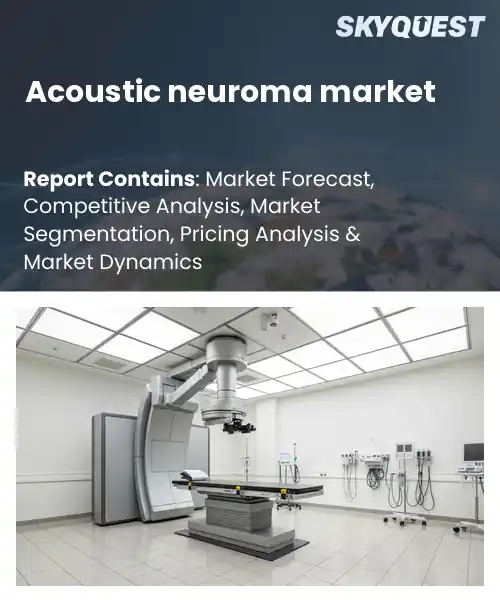
Acoustic neuroma market
Report ID: SQMIG35I3047
Report ID: SQMIG35I3047
[email protected]
USA +1 351-333-4748
Report ID:
SQMIG35I3047 |
Region:
Global |
Published Date: July, 2026
Pages:
157
|Tables:
179
|Figures:
79


Global Acoustic Neuroma Market size was valued at USD 1.2 Billion in 2024 and is poised to grow from USD 1.28 Billion in 2025 to USD 2.12 Billion by 2033, growing at a CAGR of 6.5% during the forecast period (2026-2033).
The global acoustic neuroma market consists of diagnostic imaging, surgical options and new radiosurgical technologies for benign vestibular schwannomas. This is important due to possible irreversible hearing loss, balance difficulties, and damage to the facial nerve that this condition can create, driving the need for timely precision treatment. Historically, microsurgical excision was the primary procedure in this market however; The use of high resolution MRI technology to identify cases early in the 1990s expanded the number of eligible patients for less invasive options. Recently, the development of radiosurgical options (e.g., Gamma Knife and CyberKnife) has changed the clinical pathways for patients, as evidenced by the additional number of non-surgical patients in Europe from 2022; expanding the market potential for stakeholders worldwide.
Another major factor affecting the market is the rapid acceptance of minimally invasive therapy, resulting in shorter hospital stays (i.e., higher quality of life) attracting public and private insurer reimbursement support for these procedures. This reimbursement support fuels investment in certain devices, such as surgical platforms; in 2023, the FDA approved a new navigation system has resulted in a 15% increase in total procedural volumes at some of the leading otology surgical centres in the USA. As a result, manufacturers are expanding their product portfolios, and clinicians will see lower complication rates leading hospitals to invest in an acoustic neuroma program.This virtuous cycle amplifies market growth and opens avenues for innovation across regions.
How is AI-driven Imaging Influencing The Acoustic Neuroma Diagnostic Market?
Deep learning algorithms powered by AI technology are improving how we analyze MRI and CT scans of patients with acoustic neuromas. The improved visibility of lesions based on improved image recognition will decrease variation in interpretation and allow for identification of lesions earlier so that clinicians can intervene before the tumor causes severe hearing impairment or balance disturbance. In addition to enabling earlier identification of lesions, AI imaging technologies will make the workflow more efficient, decrease time to review imaging scans, and better support accurate surgical planning.
These efficiencies are creating an investment opportunity for hospitals to adopt AI platforms and create an efficient diagnostic ecosystem that will drive and replenish investment and spur ancillary therapeutic devices’ growth. The emergence of imaging intelligence as an integral part of the clinical practice related to acoustic neuroma will continue to fuel growth in the acoustic neuroma marketplace. Medtronic plc's involvement in acoustic neuroma diagnostic improvements through its use of AI imaging will improve patient outcome and market efficiency.
Market snapshot - (2026-2033)
Global Market Size
USD 1.2 Billion
Largest Segment
Microsurgical Treatment
Fastest Growth
Watchful Waiting / Active Surveillance
Growth Rate
6.5% CAGR
To get more insights on this market click here to Request a Free Sample Report
Global acoustic neuroma market is segmented by treatment type, technology, application, end user, diagnosis type, treatment modality and region. Based on treatment type, the market is segmented into Microsurgical Treatment, Radiation Therapy, Watchful Waiting / Active Surveillance and Drug-based Supportive Therapy. Based on technology, the market is segmented into Gamma Knife Systems, Linear Accelerator (LINAC)-based Radiosurgery, Proton Therapy Systems, Intraoperative Neuromonitoring Systems and Surgical Navigation Systems. Based on application, the market is segmented into Unilateral Acoustic Neuroma, Bilateral Acoustic Neuroma (NF2-related), Small Tumors, Medium Tumors and Large Tumors. Based on end user, the market is segmented into Hospitals, Neurosurgery Centers, Radiation Oncology Centers and Academic & Research Institutes. Based on diagnosis type, the market is segmented into MRI-based Diagnosis, CT-based Diagnosis, Audiological Testing and Vestibular Function Testing. Based on treatment modality, the market is segmented into Surgery, Radiosurgery, Radiotherapy and Conservative Management. Based on region, the market is segmented into North America, Europe, Asia Pacific, Latin America and Middle East & Africa.
Microsurgery is the most common type of acoustic neuroma treatment. With microsurgery, surgeons can remove the tumor completely, which usually provides complete relief from all signs and symptoms for the patient. Because of their long history of success, most surgeons prefer to perform surgery when anatomical approaches are available to them. As such, hospitals are investing significant resources into creating specialized operating rooms and training programs for surgeons. This reinforces the ongoing demand for microsurgery through multiple clinical disciplines and allows for the development of multidisciplinary collaboration between neuro‑otology and neurosurgery departments.
In contrast, the fastest-growing segment of treatment is Watchful Waiting / Active Surveillance. Patients with small, asymptomatic tumors are increasingly choosing to have these tumors monitored non‑invasively due to recent advancements in imaging technology and a focus on personalized care. This trend has led to an expansion of the market by increasing the number of opportunities to use this method in outpatient clinics and promoting more development of long‑term follow‑up protocols.
The Gamma Knife Systems segment is the market leader due to its accurate and effective single-session radiosurgery method, which minimizes surrounding tissue damage while providing a high tumor control rate for patients with acoustic neuroma. The non-invasive method, shorter length of stay and quicker patient turnover have attracted considerable interest in this technology from clinicians. As a result of the popularity of Gamma Knife Systems, there is a significant push for expansion of the use of this technology in radiation oncology clinics. The reliability of this technology, along with its ease of integration into existing processes, continues to strengthen the market leadership position and provides continuous procurement opportunities within healthcare organizations while also creating greater opportunities for collaborative treatment planning between neurosurgeons and radiation oncologists.
Intraoperative Neuromonitoring Systems are experiencing the fastest growth in the marketplace due to the surgical benefit of real-time nerve monitoring, which improves surgical safety and decreases the risk of postoperative facial and auditory deficits in patients. The continuing improvements in technology and the ongoing demand for better outcomes in surgery have led to the increasing adoption of these systems by surgeons using microsurgical techniques. Additionally, the adoption of intraoperative neuromonitoring systems will create significant new revenue opportunities for the device manufacturers as hospitals are continuing to expand their capabilities for the use of advanced intraoperative techniques in the near future.
To get detailed segments analysis, Request a Free Sample Report
The acoustic neuroma market in North America is being led by the combination of a sophisticated healthcare delivery system, an expansive R&D capability, and a regulatory framework that allows for the rapid uptake of new treatments. The existence of top-tier academic medical institutions contributes to constant clinical advancement, while well-defined reimbursement frameworks provide patients with access to the latest diagnostic and treatment technologies. Collaborative relationships among industry, healthcare providers, and patient advocacy groups lead to rapid product launches and evidence development; furthermore, the regions well-educated consumer base contributes to early diagnosis and demand for minimally invasive treatment alternatives, establishing a model for future market evolution in other areas of the world as well.
The U.S. acoustic neuroma market benefits from the presence of an extensive number of specialized neurotology centers dedicated to providing interdisciplinary approaches to care and early intervention. There is a high level of clinical trial activity, as well as active engagement between some of the largest medical technology manufacturers and the neurotology specialty, accelerating the development and market entry of new imaged surgical instruments and surgical imaging. Reimbursement processes are well established leading to public and private payers approving advanced treatment methodology. Increased physician education and increased patient education are directly linked to continued high volume of referrals among practitioners, allowing for continued revisions to standard of care for the management of acoustic neuromas throughout the United States.
The publicly funded healthcare system in Canada drives the need to provide quality neurosurgical services to everyone equally, shaping the acoustic neuroma market. Provincial health authorities are spending money on creating diagnostic imaging facilities to help doctors quickly find vestibular schwannomas. Researchers at universities across Canada can work together with healthcare companies to study new treatment options. As cost‑effective treatments are being considered, there is an increasing emphasis on patient outcomes leading to greater use of minimally invasive techniques in Canada's healthcare setting.
The European acoustic neuroma market is growing quickly based on having similar rules for approving products in all of the member countries so that they can collaborate with each other more readily when providing health services. There is also an increasing emphasis in most governments to promote an environment for early detection of patients, and the use of minimally invasive surgical techniques through these types of programs will enable healthcare providers to offer cutting‑edge therapy options. Through strong research support networks and research alliances between universities and hospitals, researchers are generating strong evidence to support changes in clinical guidelines and reimbursement. In addition, raised patient awareness and the growth of telehealth and tele‑medicine will aid with increasing access to specialty care for patients and improve opportunities for market adoption across Europe.
Acoustic neuroma market in Germany is driven by a dense concentration of tertiary care hospitals equipped with state‑of‑the‑art imaging and surgical suites. The nation’s emphasis on precision medicine translates into widespread use of targeted radiosurgical techniques alongside conventional microsurgery. Public and private insurers provide comprehensive coverage for innovative interventions, encouraging clinicians to adopt emerging technologies. Collaborative research institutions continually evaluate outcomes, reinforcing Germany’s role as a leader in clinical excellence and market growth.
Acoustic neuroma market in United Kingdom is experiencing its fastest growth as a result of ambitious national health service reforms that promote rapid referral pathways and multidisciplinary clinics. Investment in high‑definition MRI capabilities enhances early detection, while the adoption of image‑guided surgical platforms reduces hospital stays and improves patient satisfaction. Academic centers actively participate in multinational clinical trials, positioning the United Kingdom as a testbed for novel therapeutic approaches. Patient advocacy groups further amplify demand for cutting‑edge care, accelerating market momentum.
Acoustic neuroma market in France is emerging steadily, buoyed by progressive health policies that support the integration of innovative diagnostic tools within public hospitals. Ongoing collaborations between French research institutes and biotech firms facilitate the assessment of next‑generation treatment options. Reimbursement frameworks are evolving to encompass minimally invasive procedures, encouraging clinicians to shift toward less invasive management. Growing public awareness campaigns highlight the importance of early diagnosis, contributing to a gradual increase in market activity across the country.
Asia Pacific is strengthening its position in the acoustic neuroma market through expanding healthcare infrastructure, rising investment in specialized neuro‑otology services, and an escalating focus on advanced imaging technologies. Governments across the region are prioritizing the development of tertiary care centers that offer comprehensive diagnostics and surgical expertise. Integration of artificial intelligence and robotics into neurosurgical practice enhances precision and reduces operative risk, fostering confidence among clinicians and patients alike. Partnerships between local manufacturers and multinational firms accelerate technology transfer, while growing medical tourism adds an additional catalyst for market advancement throughout the Pacific basin.
Acoustic neuroma market in Japan benefits from a highly organized health system that emphasizes early screening and utilization of cutting‑edge magnetic resonance imaging. National hospitals collaborate closely with research universities to refine microsurgical and radiosurgical techniques, ensuring high standards of care. Insurance coverage extends to innovative treatment modalities, encouraging widespread adoption. Cultural emphasis on quality of life drives demand for minimally invasive options, reinforcing Japan’s reputation as a hub for sophisticated acoustic neuroma management.
Acoustic neuroma market in South Korea is propelled by rapid adoption of digital health platforms and a strong emphasis on surgical innovation. Government incentives support the acquisition of high‑resolution imaging equipment and robotic assistance systems in major medical centers. Korean clinicians are actively engaged in international research consortia, facilitating the rapid diffusion of evidence‑based practices. Growing patient awareness and a competitive healthcare environment encourage the integration of less invasive therapies, positioning South Korea as an emerging leader in the regional acoustic neuroma landscape.
To know more about the market opportunities by region and country, click here to
Buy The Complete Report
Increasing Early Detection Programs
Advancements In Minimally Invasive Techniques
Limited Access To Specialized Centers
High Cost Of Advanced Treatments
Request Free Customization of this report to help us to meet your business objectives.
The acoustic neuroma market is shaped by intense competition among major pharmaceutical and medical‑device firms, with companies such as Amgen, Roche, Elekta, Pfizer and Siemens Healthcare leveraging strategic M&A, collaborative research agreements and advanced technology platforms to expand their therapeutic and diagnostic portfolios, driving market momentum through innovative treatment options and integrated care solutions.
SkyQuest’s ABIRAW (Advanced Business Intelligence, Research & Analysis Wing) is our Business Information Services team that Collects, Collates, Correlates, and Analyses the Data collected by means of Primary Exploratory Research backed by robust Secondary Desk research.
As per SkyQuest analysis the global acoustic neuroma market is projected to rise to $2.12 billion by 2033, driven first by expanding early‑detection programs that feed a larger patient pool into both surgical and radiosurgical pathways, while the rapid evolution of minimally invasive techniques fuels a second wave of growth by shortening recovery and improving outcomes. The microsurgical treatment segment remains the market’s backbone, providing definitive tumor removal and anchoring demand for specialized operating rooms. North America continues to dominate due to mature reimbursement structures and leading research centres. However, the premium price of advanced radiosurgical systems and specialized instruments acts as a restraint, limiting uptake in price‑sensitive settings.
| Report Metric | Details |
|---|---|
| Market size value in 2024 | USD 1.2 Billion |
| Market size value in 2033 | USD 2.12 Billion |
| Growth Rate | 6.5% |
| Base year | 2024 |
| Forecast period | (2026-2033) |
| Forecast Unit (Value) | USD Billion |
| Segments covered |
|
| Regions covered | North America (US, Canada), Europe (Germany, France, United Kingdom, Italy, Spain, Rest of Europe), Asia Pacific (China, India, Japan, Rest of Asia-Pacific), Latin America (Brazil, Rest of Latin America), Middle East & Africa (South Africa, GCC Countries, Rest of MEA) |
| Companies covered |
|
| Customization scope | Free report customization with purchase. Customization includes:-
|
To get a free trial access to our platform which is a one stop solution for all your data requirements for quicker decision making. This platform allows you to compare markets, competitors who are prominent in the market, and mega trends that are influencing the dynamics in the market. Also, get access to detailed SkyQuest exclusive matrix.
Table Of Content
Executive Summary
Market overview
Parent Market Analysis
Market overview
Market size
KEY MARKET INSIGHTS
COVID IMPACT
MARKET DYNAMICS & OUTLOOK
Market Size by Region
KEY COMPANY PROFILES
Methodology
For the Acoustic neuroma market, our research methodology involved a mixture of primary and secondary data sources. Key steps involved in the research process are listed below:
1. Information Procurement: This stage involved the procurement of Market data or related information via primary and secondary sources. The various secondary sources used included various company websites, annual reports, trade databases, and paid databases such as Hoover's, Bloomberg Business, Factiva, and Avention. Our team did 45 primary interactions Globally which included several stakeholders such as manufacturers, customers, key opinion leaders, etc. Overall, information procurement was one of the most extensive stages in our research process.
2. Information Analysis: This step involved triangulation of data through bottom-up and top-down approaches to estimate and validate the total size and future estimate of the Acoustic neuroma market.
3. Report Formulation: The final step entailed the placement of data points in appropriate Market spaces in an attempt to deduce viable conclusions.
4. Validation & Publishing: Validation is the most important step in the process. Validation & re-validation via an intricately designed process helped us finalize data points to be used for final calculations. The final Market estimates and forecasts were then aligned and sent to our panel of industry experts for validation of data. Once the validation was done the report was sent to our Quality Assurance team to ensure adherence to style guides, consistency & design.
Analyst Support
Customization Options
With the given market data, our dedicated team of analysts can offer you the following customization options are available for the Acoustic neuroma market:
Product Analysis: Product matrix, which offers a detailed comparison of the product portfolio of companies.
Regional Analysis: Further analysis of the Acoustic neuroma market for additional countries.
Competitive Analysis: Detailed analysis and profiling of additional Market players & comparative analysis of competitive products.
Go to Market Strategy: Find the high-growth channels to invest your marketing efforts and increase your customer base.
Innovation Mapping: Identify racial solutions and innovation, connected to deep ecosystems of innovators, start-ups, academics, and strategic partners.
Category Intelligence: Customized intelligence that is relevant to their supply Markets will enable them to make smarter sourcing decisions and improve their category management.
Public Company Transcript Analysis: To improve the investment performance by generating new alpha and making better-informed decisions.
Social Media Listening: To analyze the conversations and trends happening not just around your brand, but around your industry as a whole, and use those insights to make better Marketing decisions.
REQUEST FOR SAMPLE
 REQUEST FREE CUSTOMIZATION
Global Acoustic Neuroma Market size was valued at USD 1.2 Billion in 2024 and is poised to grow from USD 1.28 Billion in 2025 to USD 2.12 Billion by 2033, growing at a CAGR of 6.5% during the forecast period (2026-2033).
The acoustic neuroma market is shaped by intense competition among major pharmaceutical and medical‑device firms, with companies such as Amgen, Roche, Elekta, Pfizer and Siemens Healthcare leveraging strategic M&A, collaborative research agreements and advanced technology platforms to expand their therapeutic and diagnostic portfolios, driving market momentum through innovative treatment options and integrated care solutions. 'Elekta', 'Accuray', 'Varian Medical Systems', 'Brainlab', 'Carl Zeiss Meditec', 'Stryker', 'Medtronic', 'Integra LifeSciences', 'Natus Medical', 'Nihon Kohden', 'FUJIFILM Healthcare', 'GE HealthCare', 'Siemens Healthineers', 'Canon Medical Systems', 'IBA (Ion Beam Applications)', 'Hitachi', 'Mevion Medical Systems', 'Novocure', 'Leibinger Medical', 'Micromar'
Early identification of acoustic neuroma through routine imaging and screening initiatives expands the patient pool requiring timely intervention, thereby stimulating demand for surgical and radiosurgical solutions as well as supportive care services, which in turn encourages healthcare providers to adopt advanced technologies and invest in specialized training, ultimately accelerating market expansion across regions with emerging diagnostic infrastructure. The heightened awareness among clinicians also promotes multidisciplinary collaboration, fostering comprehensive treatment pathways that improve patient outcomes and reinforce confidence in therapeutic options, thereby reinforcing market momentum.
Precision Imaging Expansion: Advances in high‑resolution magnetic resonance and functional imaging are enabling earlier detection of acoustic neuromas and more accurate delineation of tumor boundaries. Clinicians increasingly rely on these technologies to tailor surgical planning and to monitor disease progression non‑invasively, reducing the need for repeated invasive procedures. This shift is driving demand for upgraded imaging equipment, specialized radiology expertise, and collaborative networks that integrate diagnostic data into multidisciplinary treatment pathways, thereby expanding the overall market for advanced diagnostic services and better outcomes.
Why does North America Dominate the Global Acoustic neuroma market? |@12


Want to customize this report? This report can be personalized according to your needs. Our analysts and industry experts will work directly with you to understand your requirements and provide you with customized data in a short amount of time. We offer $1000 worth of FREE customization at the time of purchase.
Feedback From Our Clients


 USA (+1) 351-333-4748

