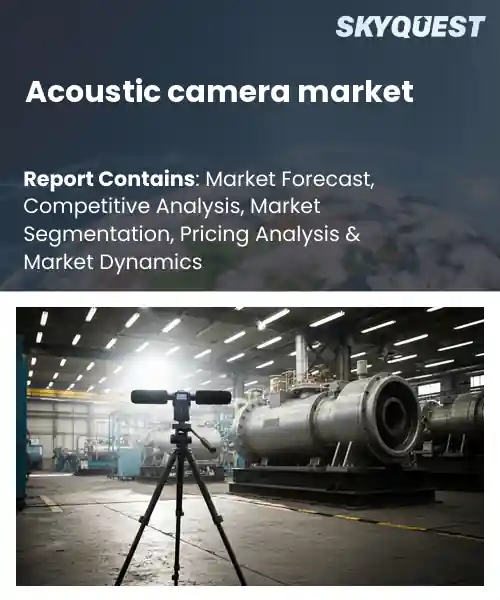
Acoustic Camera market
Report ID: SQMIG45K2305
Report ID: SQMIG45K2305
[email protected]
USA +1 351-333-4748
Report ID:
SQMIG45K2305 |
Region:
Global |
Published Date: June, 2026
Pages:
157
|Tables:
180
|Figures:
79


Global Acoustic Camera Market size was valued at USD 194.12 Million in 2024 and is poised to grow from USD 206.17 Million in 2025 to USD 333.86 Million by 2033, growing at a CAGR of 6.21% during the forecast period (2026-2033).
The acoustic camera market is based on combining an array of microphones with visual imaging to find the source of sound in space. Rising demand for accurate testing of sound in vehicles, aircraft and various types of manufacturing, in addition to external regulatory pressures and product performance require the measurement of vibration and acoustic issues as part of production and/or assembly; therefore, growth will occur as more companies seek out this technology. The development of digital processing technology and smaller sensor technology has transitioned acoustic cameras from prototypes developed in laboratories to products used in production facilities and on wind turbine blades within the last decade. For example, automotive manufacturers use acoustic cameras during the testing phase of a vehicle to identify noise, vibration and harshness (NVH) hotspots, speeding up the prototype process, which reduces warranty claims.
Another important trend affecting the acoustic camera market growth is the incorporation of artificial intelligence (AI)-based algorithms allowing real-time imaging of sound sources and automated identification of the source of the sound. With machine learning capabilities in use when analyzing the acoustic array data, the systems immediately can identify abnormal sound patterns, enabling users in smart cities to identify noise sources on roadways or in manufacturing facilities to trigger predictive maintenance notifications prior to equipment malfunction. By reducing inspection time and decreasing operating costs, the availability of this feature will lead to greater acceptance of acoustic cameras by industries that rely on traditional manual inspection to conduct sound measurements. Consequently, vendors are expanding product portfolios with cloud‑based analytics platforms, creating new revenue streams while meeting increasingly stringent environmental regulations.
How is AI Enhancing Acoustic Camera Performance For Industrial Noise Monitoring?
Artificial intelligence (AI) improves the performance and usability of acoustic cameras by combining advanced deep-learning algorithms with the ability to filter out ambient noise in a busy manufacturing environment and to isolate specific frequency signatures associated with industrial machinery. AI/Deep Learning-based neural networks are developed from extensive sound libraries, thus enabling an acoustic camera to differentiate between the sounds of machinery operating normally and sounds indicative of impending failure. The sound data from an acoustic camera can be visually mapped and displayed in real-time, which increases diagnostic accuracy and reduces reliance on manual interpretation by experts. Consequently, as the number of factories/industrial plants implementing predictive maintenance continues to grow, the demand for more sophisticated monitoring/risk assessment solutions grows, driving large investments in technology related to AI-driven hardware/software solutions to provide actionable insights from operating in harsh industrial environments.
In April 2024, Acoustic Camera Ltd released an AI-augmented acoustic imaging system that automatically identifies and highlights potential failures, while also shortening the length of time spent on inspections, thus enabling more rapid deployment of acoustic cameras in industrial facilities.
Market snapshot - (2026-2033)
Global Market Size
USD 194.12 Million
Largest Segment
Industrial Acoustic Cameras
Fastest Growth
UAV-mounted Acoustic Cameras
Growth Rate
6.21% CAGR
To get more insights on this market click here to Request a Free Sample Report
Global acoustic camera market is segmented by product type, technology, application, end-use industry, deployment, frequency range and region. Based on product type, the market is segmented into Handheld Acoustic Cameras, Fixed Acoustic Cameras, Portable Acoustic Imaging Systems, UAV-mounted Acoustic Cameras and Industrial Acoustic Cameras. Based on technology, the market is segmented into Beamforming Acoustic Cameras, MEMS Microphone Array Systems, Ultrasonic Acoustic Cameras and Real-time Acoustic Imaging Systems. Based on application, the market is segmented into Compressed Air Leak Detection, Partial Discharge Detection, Predictive Maintenance, Noise Source Localization, Automotive NVH Testing, Aerospace Testing and Research & Development. Based on end-use industry, the market is segmented into Manufacturing, Energy & Utilities, Automotive, Aerospace & Defense, Oil & Gas and Research Institutes. Based on deployment, the market is segmented into Portable Systems and Fixed Monitoring Systems. Based on frequency range, the market is segmented into Audible Range, Ultrasonic Range and Hybrid Acoustic Imaging. Based on region, the market is segmented into North America, Europe, Asia Pacific, Latin America and Middle East & Africa.
Due to their mobility, handheld acoustic cameras are leading the market by allowing fast and easy inspections at the job site, thus cutting downtime and labor expenses. The users can access the points of interest directly by easily relocating the portable device. This matches the market’s emphasis on fast leak detection and noisy source identification at all types of facilities. The use of intuitive user interfaces and battery operations have lowered the entry barrier for maintenance crews and small operators in industrialized regions by promoting broad acceptance of these tools.
As per acoustic camera market analysis, UAV-mounted acoustic cameras have the fastest growth potential due to their ability to image objects located in hard-to-reach places (for example, pipelines and turbine blades). The combination of integrated drone technology allows for quicker data collection from the asset, which meets the rising demand for asset monitoring and safety compliance, and creates opportunity for vendors.
Beamforming acoustic cameras provide high spatial resolution and real-time imaging, allowing precise positioning of sound sources in complex environments. Multiple microphone inputs produce detailed acoustic maps that can assist companies in determining leak points, partial discharge locations, or vibrations. Due to their proven reliability and compatibility with complementary measurement workflows, these cameras have reduced friction when it comes to integrating them into the maintenance engineering and research laboratories. This allows for widespread use of the technology by maintenance engineers and research laboratories all over the world, including academia.
As per acoustic camera market forecast, MEMS microphone array systems are growing quickly as an industry due to their combination of size and scalable array configurations, which makes them a cost-effective option for portable and embedded applications. In addition, their power consumption and output make them easier to integrate with IoT devices, which drives their adoption in predictive maintenance/factory initiatives, thus increasing the market potential for vendors.
To get detailed segments analysis, Request a Free Sample Report
The acoustic camera industry is developing rapidly in North America. North America is at the forefront of the acoustic camera industry because of its combination of established technical knowledge, well developed industrial/technical infrastructures, and a strong demand from the aerospace and defense industries and manufacturers. Research institutions are working with high technology companies to develop and improve the sensor resolution and real-time processing capabilities of their acoustic cameras. A robust supply chain provides users with quick access to the parts and support services necessary for their cameras. Users have an ongoing need for precise sound-source identification because of stringent Occupational Health and Safety (OHS) regulations. Increased investment in smart factory programs will further embed acoustic imaging (via cameras) within production monitoring and predictive maintenance systems. All of these factors combine to create a strong and stable demand for acoustic cameras, which will keep North America in a leadership position in the development of the industry. In addition, the North American Regions commitment to open standards and collaboration across industries will continue to promote innovation and enable more applications for acoustic cameras.
In the US, acoustic camera market growth is supported by a combination of large government defense contracts and successful commercial electronics that enable fast technology transfers. Extensive collaboration between university researchers, start-up developers and established manufacturing companies allows for highly efficient prototyping and field testing. Users from the automotive, construction and entertainment industries are utilizing acoustic imaging as a means to improve operational efficiency and comply with safety regulations; therefore making it possible for those companies to have access to an ever-growingstream of advanced solutions designed for difficult to analyze acoustic environments.
Because of an increased focus in Canada on reducing noise pollution in urban planning and workplace-safety issues, there is also an increase in the adoption of acoustic cameras throughout Canada. Open research centres and partnerships between universities located in provinces and companies within the aerospace and automotive industries are facilitating the creation of custom sensors that address the unique challenges created by cold climate acoustics. Public-sector transportation corridor and renewable energy projects are providing testing grounds for both partial and long-range acoustic solutions, while private-sector users in mining and oil and gas are using acoustics to provide highly accurate location data to enhance productivity.
Europe experiences a rapid expansion in the acoustic camera market as manufacturers and regulators converge on a shared agenda of noise reduction, safety improvement and advanced data analytics. Strong engineering traditions in key economies support the development of high‑resolution arrays and AI‑driven processing pipelines. Cross‑border collaboration within research consortia accelerates standardisation, while stringent environmental directives create compelling business cases for precise sound‑source monitoring in urban and industrial settings. Growing investment in smart‑city projects and sustainable manufacturing further fuels demand, prompting both established OEMs and agile start‑ups to introduce versatile solutions tailored to diverse application niches. This multifaceted momentum positions Europe as a hotbed of innovation and market activity. The region’s emphasis on interoperable platforms also encourages broader adoption across transportation, construction and public‑safety sectors.
Acoustic camera market implementation in Germany is anchored by its world‑class engineering firms and a robust automotive supply chain that demands precise acoustic diagnostics. Collaborative initiatives between research institutes and industrial partners drive the creation of high‑fidelity sensor arrays optimized for complex manufacturing environments. Government incentives for Industry 4.0 adoption encourage integration of acoustic imaging into predictive maintenance workflows, while strict occupational health legislation fuels continuous investment in noise‑source localization technologies.
Acoustic camera market growth in the United Kingdom is propelled by a mix of defense research programs and a thriving creative‑technology sector that explores sound‑visualisation concepts. Academic hubs collaborate closely with commercial enterprises to accelerate prototype validation and market entry. The nation’s focus on smart‑infrastructure and rail safety generates a strong appetite for real‑time acoustic monitoring, while regulatory emphasis on workplace noise control reinforces demand across manufacturing and construction domains.
Acoustic camera market activity in France is emerging through close ties between aerospace research centers and environmental agencies focused on urban noise mapping. Ventures benefit from incubators that nurture sensor miniaturisation and integration with platforms. Municipal initiatives to monitor traffic and construction sites create testing environments that showcase the value of acoustic imaging for assessments. This ecosystem expands the customer base beyond aerospace into transportation, heritage‑site preservation and smart‑city projects.
Asia Pacific is strengthening its position in the acoustic camera market by leveraging rapid technological adoption, growing industrial diversification and governmental focus on environmental noise mitigation. Nations across the region invest heavily in advanced sensor research, fostering collaborations between electronics manufacturers and academic laboratories that accelerate high‑frequency array development. The surge in smart‑factory initiatives and expanding renewable‑energy infrastructure creates a broad set of use cases for acoustic imaging, from machinery health monitoring to wind‑farm turbine noise analysis. Moreover, heightened awareness of urban sound‑pollution drives city‑level pilots that integrate acoustic cameras into traffic management and public‑safety systems. This combination of innovation, expanding application breadth and supportive policy frameworks propels Asia Pacific toward a more prominent global market role. Continued investment in AI‑enhanced processing is expected to further elevate the analytical capabilities of acoustic imaging across the region.
Acoustic camera market development in Japan is driven by its precision manufacturing sector and a strong emphasis on robotics and automation. Collaborative projects between leading electronics firms and research universities focus on ultra‑high‑resolution microphone arrays tailored for complex industrial environments. Government programmes that promote smart‑factory transformation encourage integration of acoustic imaging for predictive maintenance and quality‑control inspection. These concerted efforts position Japan as a hub for cutting‑edge acoustic sensing solutions.
Acoustic camera market activity in South Korea benefits from investment in semiconductor and sensor technologies with a start‑up ecosystem focused on audio analytics. Partnerships between electronics conglomerates and university labs accelerate creation of sensitive arrays for factory floors and smart‑city deployments. National initiatives that incentivise noise‑abatement in urban areas drive adoption across transportation, construction and safety sectors. This approach reinforces South Korea’s role as an emerging leader in acoustic imaging.
To know more about the market opportunities by region and country, click here to
Buy The Complete Report
Increasing Demand for Noise Monitoring
Advancements in Real‑Time Imaging
High Capital Investment Required
Complex Calibration and Maintenance
Request Free Customization of this report to help us to meet your business objectives.
The competitive landscape is shaped by intense rivalry among established acoustic‑camera manufacturers and emerging AI‑driven imaging firms, each leveraging strategic M&A, cross‑industry partnerships and rapid tech innovation to capture market share. Recent collaborations between sensor producers and software platforms have accelerated real‑time acoustic imaging capabilities, while acquisitions of niche partial‑discharge specialists are consolidating expertise and expanding product portfolios.
SkyQuest’s ABIRAW (Advanced Business Intelligence, Research & Analysis Wing) is our Business Information Services team that Collects, Collates, Correlates, and Analyses the Data collected by means of Primary Exploratory Research backed by robust Secondary Desk research.
As per SkyQuest analysis the acoustic camera market is propelled primarily by the rising demand for noise monitoring driven by stricter occupational and community regulations, while rapid advances in real‑time imaging that deliver higher resolution and faster data capture act as a second catalyst expanding use cases across automotive, aerospace and industrial maintenance. Handheld acoustic cameras dominate the segment due to their portability and ease of deployment, and North America remains the leading region due to its mature industrial base and strong regulatory push. The main restraint is the high capital investment required for premium sensor arrays and specialized software, which slows adoption among smaller firms.
| Report Metric | Details |
|---|---|
| Market size value in 2024 | USD 194.12 Million |
| Market size value in 2033 | USD 333.86 Million |
| Growth Rate | 6.21% |
| Base year | 2024 |
| Forecast period | (2026-2033) |
| Forecast Unit (Value) | USD Million |
| Segments covered |
|
| Regions covered | North America (US, Canada), Europe (Germany, France, United Kingdom, Italy, Spain, Rest of Europe), Asia Pacific (China, India, Japan, Rest of Asia-Pacific), Latin America (Brazil, Rest of Latin America), Middle East & Africa (South Africa, GCC Countries, Rest of MEA) |
| Companies covered |
|
| Customization scope | Free report customization with purchase. Customization includes:-
|
To get a free trial access to our platform which is a one stop solution for all your data requirements for quicker decision making. This platform allows you to compare markets, competitors who are prominent in the market, and mega trends that are influencing the dynamics in the market. Also, get access to detailed SkyQuest exclusive matrix.
Table Of Content
Executive Summary
Market overview
Parent Market Analysis
Market overview
Market size
KEY MARKET INSIGHTS
COVID IMPACT
MARKET DYNAMICS & OUTLOOK
Market Size by Region
KEY COMPANY PROFILES
Methodology
For the Acoustic Camera market, our research methodology involved a mixture of primary and secondary data sources. Key steps involved in the research process are listed below:
1. Information Procurement: This stage involved the procurement of Market data or related information via primary and secondary sources. The various secondary sources used included various company websites, annual reports, trade databases, and paid databases such as Hoover's, Bloomberg Business, Factiva, and Avention. Our team did 45 primary interactions Globally which included several stakeholders such as manufacturers, customers, key opinion leaders, etc. Overall, information procurement was one of the most extensive stages in our research process.
2. Information Analysis: This step involved triangulation of data through bottom-up and top-down approaches to estimate and validate the total size and future estimate of the Acoustic Camera market.
3. Report Formulation: The final step entailed the placement of data points in appropriate Market spaces in an attempt to deduce viable conclusions.
4. Validation & Publishing: Validation is the most important step in the process. Validation & re-validation via an intricately designed process helped us finalize data points to be used for final calculations. The final Market estimates and forecasts were then aligned and sent to our panel of industry experts for validation of data. Once the validation was done the report was sent to our Quality Assurance team to ensure adherence to style guides, consistency & design.
Analyst Support
Customization Options
With the given market data, our dedicated team of analysts can offer you the following customization options are available for the Acoustic Camera market:
Product Analysis: Product matrix, which offers a detailed comparison of the product portfolio of companies.
Regional Analysis: Further analysis of the Acoustic Camera market for additional countries.
Competitive Analysis: Detailed analysis and profiling of additional Market players & comparative analysis of competitive products.
Go to Market Strategy: Find the high-growth channels to invest your marketing efforts and increase your customer base.
Innovation Mapping: Identify racial solutions and innovation, connected to deep ecosystems of innovators, start-ups, academics, and strategic partners.
Category Intelligence: Customized intelligence that is relevant to their supply Markets will enable them to make smarter sourcing decisions and improve their category management.
Public Company Transcript Analysis: To improve the investment performance by generating new alpha and making better-informed decisions.
Social Media Listening: To analyze the conversations and trends happening not just around your brand, but around your industry as a whole, and use those insights to make better Marketing decisions.
REQUEST FOR SAMPLE
 REQUEST FREE CUSTOMIZATION
Global Acoustic Camera Market size was valued at USD 194.12 Million in 2024 and is poised to grow from USD 206.17 Million in 2025 to USD 333.86 Million by 2033, growing at a CAGR of 6.21% during the forecast period (2026-2033).
The competitive landscape is shaped by intense rivalry among established acoustic‑camera manufacturers and emerging AI‑driven imaging firms, each leveraging strategic M&A, cross‑industry partnerships and rapid tech innovation to capture market share. Recent collaborations between sensor producers and software platforms have accelerated real‑time acoustic imaging capabilities, while acquisitions of niche partial‑discharge specialists are consolidating expertise and expanding product portfolios. 'FLIR', 'Siemens Digital Industries Software', 'Distran', 'Norsonic', 'gfai tech', 'SM Instruments', 'CAE Software & Systems', 'Microflown Technologies', 'SINUS Messtechnik', 'NTi Audio', 'CRYSOUND', 'Müller-BBM VibroAkustik Systeme', 'Acoem', 'Sorama', 'KeyGo Technologies', 'Signal Interface Group', 'Noiseless Acoustics', 'Sorama BV', 'Metra Mess- und Frequenztechnik', 'Ziegler-Instruments'
The growing awareness of occupational safety and community noise regulations drives companies to adopt acoustic camera systems that can visualize sound sources quickly and accurately, enabling targeted mitigation strategies. By providing visual feedback, these devices facilitate faster decision‑making and reduce downtime associated with conventional acoustic analysis, which in turn encourages broader implementation across manufacturing plants, transportation hubs, and urban planning projects. Consequently, the demand for sophisticated acoustic imaging solutions expands as organizations seek to improve compliance and operational efficiency and cost reduction through enhanced predictive maintenance.
Integrated Ai Analytics: The convergence of artificial‑intelligence engines with acoustic‑camera hardware is transforming how operators detect, locate, and classify sound sources. Built‑in neural‑network models enable real‑time pattern recognition, eliminating manual waveform analysis and reducing response times across automotive, aerospace, and security domains. Seamless integration with existing IoT platforms permits centralized monitoring and automated alerting, while self‑learning algorithms continuously refine detection thresholds as environments evolve, driving broader adoption among enterprises seeking smarter, more autonomous acoustic surveillance solutions and operational resilience and cost.
Why does North America Dominate the Global Acoustic camera market? |@12


Want to customize this report? This report can be personalized according to your needs. Our analysts and industry experts will work directly with you to understand your requirements and provide you with customized data in a short amount of time. We offer $1000 worth of FREE customization at the time of purchase.
Feedback From Our Clients


 USA (+1) 351-333-4748

