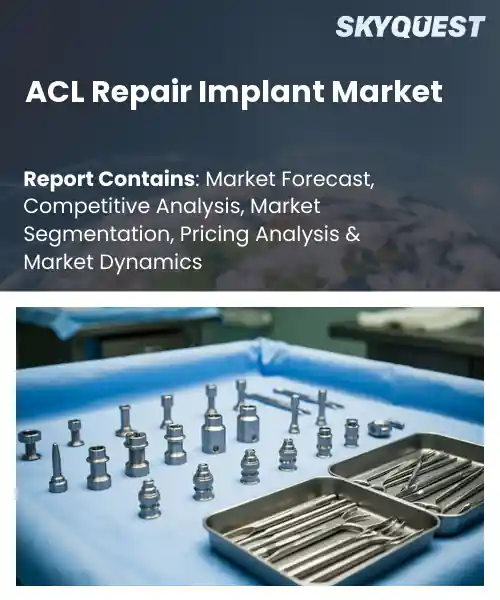
ACL Repair Implant Market
Report ID: SQMIG35A4450
Report ID: SQMIG35A4450
[email protected]
USA +1 351-333-4748
Report ID:
SQMIG35A4450 |
Region:
Global |
Published Date: August, 2026
Pages:
157
|Tables:
169
|Figures:
79


Global Acl Repair Implant Market size was valued at USD 1.27 Billion in 2024 and is poised to grow from USD 1.48 Billion in 2025 to USD 5.14 Billion by 2033, growing at a CAGR of 16.8% during the forecast period (2026-2033).
Bio-degradable polymer technology, as well as 3D printed customized scaffold implants, have reduced failures in patients, resulting in a preference from the surgeons for repairing the damaged ACL rather than reconstructing it in young athletes. This serves a key growth driver augmenting growth of the global ACL repair implant market. A football team in Europe has made use of a bio-engineered ligament, which helps the athletes get back to training within eight weeks, compared to the traditional graft that takes 16 weeks, thus halving the time period, and saving costs for the club. Approvals in the United States and Asia have made entry possible into these markets, hence increased competition and lower prices.
The global ACL repair implant market comprises synthetic scaffolds, bio-absorbable pins, and hybrid grafts, which provide the ability for surgeons to restore ligament strength without removing the patient's tendon tissue. The importance of this market can be attributed to decreased post-operative pain, quick return-to-sport, and decreased risk of osteoarthritis, driving the need for these products by patients and providers. A key factor influencing the growth of this market is the increase in high impact sports and the aging population, which results in a greater number of ACL tears. In the last two decades, the market has gone through changes, going from being autograft surgery dominant to allografts and then eventually to entirely synthetic/bioengineered solutions.
Market snapshot - 2026-2033
Global Market Size
USD 1.27 Billion
Largest Segment
Interference Screws
Fastest Growth
Suspensory Fixation Devices
Growth Rate
16.8% CAGR
To get more insights on this market click here to Request a Free Sample Report
Global acl repair implant market is segmented by product type, material, procedure, end user, patient group, distribution channel and region. Based on product type, the market is segmented into Interference Screws, Suspensory Fixation Devices and Others. Based on material, the market is segmented into Titanium, Bioabsorbable, PEEK and Others. Based on procedure, the market is segmented into Primary ACL Repair and Revision ACL Repair. Based on end user, the market is segmented into Hospitals, Orthopedic Clinics and Ambulatory Surgical Centers. Based on patient group, the market is segmented into Adult and Pediatric. Based on distribution channel, the market is segmented into Direct Sales and Distributors. Based on region, the market is segmented into North America, Europe, Asia Pacific, Latin America and Middle East & Africa.
Interference screws segment dominates because surgeons value the immediate mechanical stability they provide during ACL repair, allowing early mobilization and reliable graft fixation. Their straightforward insertion technique aligns with operating room efficiency, reducing procedure time and minimizing intra‑operative complications. Clinicians also trust the extensive clinical evidence supporting long‑term outcomes, reinforcing preference for this device type across diverse surgical settings. Consequently, demand remains consistently high, sustaining its leading market position.
However, suspensory fixation devices are witnessing the strongest growth momentum as minimally invasive techniques gain traction, offering adjustable tensioning and reduced hardware prominence. Innovations in loop‑type designs enhance graft integration, while surgeon enthusiasm for arthroscopic flexibility drives broader adoption, positioning this category as a key growth driver for future market expansion.
Titanium segment dominates because its biocompatibility and superior strength‑to‑weight ratio have made it the material of choice for load‑bearing ACL implants. The metal’s proven fatigue resistance assures surgeons of long‑term durability, while its ability to integrate with bone tissue minimizes loosening concerns. Established manufacturing processes and cost‑effective scalability further reinforce clinician confidence, ensuring titanium‑based devices retain a prominent foothold across both primary and revision procedures throughout clinical practice.
Meanwhile, bioabsorbable materials are emerging as the high‑growth area as they eliminate permanent hardware, reducing long‑term complications and patient anxiety. Advances in polymer science deliver improved strength and controlled degradation, aligning with surgeons’ pursuit of tissue‑friendly solutions. Growing patient preference for implants that resorb naturally fuels market uptake, positioning bioabsorbable options at the forefront of future ACL repair innovation.
To get detailed segments analysis, Request a Free Sample Report
North America is the dominant region in the global ACL repair implant market through advanced clinical infrastructure, efficient research environments, and effective reimbursement policies that help to adopt novel technologies. Medical device manufacturing companies have extensive R&D facilities and work closely with academic institutes, resulting in continual innovation of implants and surgical techniques. Moreover, high awareness levels among orthopedic surgeons and patients, along with the existence of efficient regulations, expedite market entry of new implants. The focus on value-based treatment and outcomes ensures that North America is the leader in terms of preference for innovative implants having better biomechanics and recovery profiles. In addition, the availability of big integrated healthcare delivery networks allows comprehensive data gathering to support evidence-based surgical practices.
ACL Repair Implant Market in United States benefits from a mature ecosystem of leading orthopaedic research hospitals and a concentration of pioneering device firms that prioritize translational innovation. Strong payer support and favorable coverage policies encourage clinicians to adopt next‑generation implants, while extensive continuing‑medical‑education programs keep surgical expertise at a high level. Collaborative networks between academia and industry accelerate validation of emerging technologies and reinforce market momentum through robust clinical trials.
ACL Repair Implant Market in Canada is shaped by a publicly funded health system that emphasizes equitable access to cutting‑edge orthopaedic solutions. Strong regulatory alignment with international standards facilitates swift market entry for innovative implants, while provincial health agencies prioritize cost‑effectiveness and patient outcomes. Close collaboration among leading research universities and device manufacturers nurtures a pipeline of locally developed technologies, reinforcing Canada’s reputation as a hub for evidence‑driven surgical advancement.
The market for the ACL repair implant segment in Europe is undergoing fast growth due to the synergistic effect created by clinical adoption, favorable reimbursement climate, and innovative ecosystem of the region. The leading orthopedic associations promote clinical guidelines based on solid evidence in favor of less invasive treatment and encourage practitioners to use modern implants. Public health authorities in major economies offer balanced reimbursement that rewards clinical effectiveness and cost containment, making the ground highly fertile for launching of new product offerings. Collaborations between academia, hospitals, and medical device companies boost the advancement of materials science and biointegration technologies. Additionally, patient-centered approach and early rehabilitation programs further increase the demand for implants providing better functionality results, thus making Europe an important driver of global market growth.
ACL Repair Implant Market in Germany stands as the dominant force within Europe, underpinned by a tradition of medical engineering excellence and a robust network of tertiary care centers. National health insurance frameworks provide coverage for advanced orthopedic procedures, fostering early adoption of innovative implants. Collaboration between leading research institutes and established device manufacturers refines implant biomechanics and integrates smart technologies. The regulatory environment emphasizes stringent safety and performance standards, ensuring confidence among surgeons and patients alike.
ACL Repair Implant Market in United Kingdom is accelerating rapidly, propelled by health policy reforms that prioritize early surgical intervention and streamlined patient pathways. Public and private providers are expanding access to minimally invasive repair techniques, driving demand for next‑generation implants. Academic centers collaborate closely with global device firms, fostering clinical evaluation of novel materials and fixation concepts. Reimbursement models increasingly reward recovery, encouraging surgeons to adopt implants that support quicker rehabilitation and sustained performance.
ACL Repair Implant Market in France is emerging as a notable segment, supported by national health initiatives that encourage adoption of evidence‑based orthopedic solutions. Investment in multidisciplinary research programs links leading universities with device innovators, fostering development of bio‑compatible implant materials. Reimbursement policies gradually expand to include advanced repair implants, especially in high‑volume sports medicine centers. Growing patient awareness of minimally invasive options further stimulates demand, positioning France as a promising growth frontier within Europe.
Asia Pacific is strengthening its position in the ACL repair implant market through a blend of expanding clinical capacity, rising participation in sports, and an accelerating shift toward advanced orthopedic technologies. Major metropolitan hospitals are adopting minimally invasive repair protocols, creating a demand for implants that offer enhanced fixation and rapid patient recovery. Governments across the region are implementing health‑care reforms that streamline approval processes and encourage domestic manufacturing of high‑quality medical devices. Collaborative ecosystems that unite academic research centers, biotechnology firms, and multinational implant producers foster innovation in biomaterials and smart fixation systems. Moreover, increasing awareness among athletes and active‑lifestyle consumers drives preference for solutions that enable early return to activity, reinforcing the region’s momentum as a key contributor to global market growth.
ACL Repair Implant Market in Japan benefits from a highly sophisticated healthcare system that emphasizes precision medicine and rigorous clinical validation. Leading orthopedic centers collaborate closely with domestic and international device manufacturers to evaluate novel implant designs, often integrating advanced imaging and navigation technologies. Reimbursement frameworks favor cost‑effective yet high‑performance solutions, encouraging adoption of implants that demonstrate superior biomechanical stability. Strong emphasis on research and development within university hospitals supports continuous improvement of fixation methods and bio‑integrative materials, reinforcing Japan’s reputation as a hub for cutting‑edge ACL repair technology.
The South Korea ACL Repair Implants market is driven by a combination of strong government support towards advancements in medical technology and a rapid increase in sports involvement culture. Top hospitals incorporate cutting-edge arthroscopy with novel implant concepts, and often utilize local production to minimize lead times. Reimbursement policies are adapting to cover high-value implants, which exhibit definite clinical value, prompting surgeons to adopt novel concepts of fixation. Academic institutes work closely with international companies for developing bio-resorbable as well as intelligent concepts of fixation, thereby ensuring South Korea's emergence as an upcoming force in the ACL repair segment.
To know more about the market opportunities by region and country, click here to
Buy The Complete Report
Increasing Sports Participation
Advancements in Implant Materials
High Cost of Devices
Limited Long-Term Clinical Data
Request Free Customization of this report to help us to meet your business objectives.
Intense competition drives rapid innovation in the ACL repair implant market, with incumbents leveraging M&A, strategic alliances, and advanced biomaterial technologies to protect market share. For example, Smith & Nephew acquired a bio‑resorbable scaffold firm in 2022, while Arthrex partnered with a digital imaging startup to integrate AI‑guided navigation into its implant systems, accelerating adoption among surgeons.
SkyQuest’s ABIRAW (Advanced Business Intelligence, Research & Analysis Wing) is our Business Information Services team that Collects, Collates, Correlates, and Analyses the Data collected by means of Primary Exploratory Research backed by robust Secondary Desk research.
As per SkyQuest analysis, the global ACL repair implant market is propelled primarily by rising sports participation that fuels more ACL injuries and drives demand for advanced implants, while ongoing advancements in implant materials such as bio‑absorbable polymers further boost adoption by offering better biocompatibility and strength. The market is restrained by the high cost of cutting‑edge devices, which limits uptake in budget‑constrained health systems. North America remains the dominant region thanks to its mature clinical infrastructure, strong reimbursement support and intensive R&D activity. Within the product landscape, interference screws lead the segment due to their reliable mechanical stability and procedural efficiency, positioning them as the top‑selling device type worldwide.
| Report Metric | Details |
|---|---|
| Market size value in 2024 | USD 1.27 Billion |
| Market size value in 2033 | USD 5.14 Billion |
| Growth Rate | 16.8% |
| Base year | 2024 |
| Forecast period | 2026-2033 |
| Forecast Unit (Value) | USD Billion |
| Segments covered |
|
| Regions covered | North America (US, Canada), Europe (Germany, France, United Kingdom, Italy, Spain, Rest of Europe), Asia Pacific (China, India, Japan, Rest of Asia-Pacific), Latin America (Brazil, Rest of Latin America), Middle East & Africa (South Africa, GCC Countries, Rest of MEA) |
| Companies covered |
|
| Customization scope | Free report customization with purchase. Customization includes:-
|
To get a free trial access to our platform which is a one stop solution for all your data requirements for quicker decision making. This platform allows you to compare markets, competitors who are prominent in the market, and mega trends that are influencing the dynamics in the market. Also, get access to detailed SkyQuest exclusive matrix.
Table Of Content
Executive Summary
Market overview
Parent Market Analysis
Market overview
Market size
KEY MARKET INSIGHTS
COVID IMPACT
MARKET DYNAMICS & OUTLOOK
Market Size by Region
KEY COMPANY PROFILES
Methodology
For the ACL Repair Implant Market, our research methodology involved a mixture of primary and secondary data sources. Key steps involved in the research process are listed below:
1. Information Procurement: This stage involved the procurement of Market data or related information via primary and secondary sources. The various secondary sources used included various company websites, annual reports, trade databases, and paid databases such as Hoover's, Bloomberg Business, Factiva, and Avention. Our team did 45 primary interactions Globally which included several stakeholders such as manufacturers, customers, key opinion leaders, etc. Overall, information procurement was one of the most extensive stages in our research process.
2. Information Analysis: This step involved triangulation of data through bottom-up and top-down approaches to estimate and validate the total size and future estimate of the ACL Repair Implant Market.
3. Report Formulation: The final step entailed the placement of data points in appropriate Market spaces in an attempt to deduce viable conclusions.
4. Validation & Publishing: Validation is the most important step in the process. Validation & re-validation via an intricately designed process helped us finalize data points to be used for final calculations. The final Market estimates and forecasts were then aligned and sent to our panel of industry experts for validation of data. Once the validation was done the report was sent to our Quality Assurance team to ensure adherence to style guides, consistency & design.
Analyst Support
Customization Options
With the given market data, our dedicated team of analysts can offer you the following customization options are available for the ACL Repair Implant Market:
Product Analysis: Product matrix, which offers a detailed comparison of the product portfolio of companies.
Regional Analysis: Further analysis of the ACL Repair Implant Market for additional countries.
Competitive Analysis: Detailed analysis and profiling of additional Market players & comparative analysis of competitive products.
Go to Market Strategy: Find the high-growth channels to invest your marketing efforts and increase your customer base.
Innovation Mapping: Identify racial solutions and innovation, connected to deep ecosystems of innovators, start-ups, academics, and strategic partners.
Category Intelligence: Customized intelligence that is relevant to their supply Markets will enable them to make smarter sourcing decisions and improve their category management.
Public Company Transcript Analysis: To improve the investment performance by generating new alpha and making better-informed decisions.
Social Media Listening: To analyze the conversations and trends happening not just around your brand, but around your industry as a whole, and use those insights to make better Marketing decisions.
REQUEST FOR SAMPLE
 REQUEST FREE CUSTOMIZATION
Global Acl Repair Implant Market size was valued at USD 1.27 Billion in 2024 and is poised to grow from USD 1.48 Billion in 2025 to USD 5.14 Billion by 2033, growing at a CAGR of 16.8% during the forecast period (2026-2033).
Intense competition drives rapid innovation in the ACL repair implant market, with incumbents leveraging M&A, strategic alliances, and advanced biomaterial technologies to protect market share. For example, Smith & Nephew acquired a bio‑resorbable scaffold firm in 2022, while Arthrex partnered with a digital imaging startup to integrate AI‑guided navigation into its implant systems, accelerating adoption among surgeons. 'Arthrex, Inc.', 'Smith & Nephew plc', 'Stryker Corporation', 'Johnson & Johnson', 'Zimmer Biomet Holdings, Inc.', 'CONMED Corporation', 'Medtronic plc', 'B. Braun SE', 'Parcus Medical, LLC', 'RTI Surgical Holdings, Inc.', 'LifeNet Health', 'AlloSource', 'Xiros Ltd.', 'Corin Group', 'Orthomed S.A.S.', 'FH Orthopedics', 'Tulpar Medical Solutions', 'Exactech, Inc.', 'Anika Therapeutics, Inc.', 'Integra LifeSciences Holdings Corporation'
Growing participation in high‑impact sports and recreational activities has increased the incidence of anterior cruciate ligament injuries, prompting a larger pool of patients seeking surgical repair. Surgeons respond by recommending contemporary implant solutions that offer improved stability and faster recovery, thereby expanding demand. This surge in clinical cases also drives heightened awareness among patients and caregivers, encouraging early intervention and elective procedures. Consequently, manufacturers experience heightened interest from healthcare providers, leading to broader adoption of advanced ACL repair implants across diverse treatment settings.
Minimally Invasive Technology Advances: The adoption of next‑generation arthroscopic tools and bio‑compatible fixation systems is reshaping ACL repair. Surgeons now favor procedures that reduce incision size, limit tissue disruption, and accelerate patient recovery. This shift is driven by growing clinical confidence in device reliability and by patient demand for faster return to activity. Manufacturers are prioritizing material science innovations that enhance implant flexibility while maintaining strength, fostering a market environment where minimally invasive solutions become the preferred standard of care for orthopedic teams worldwide today.
Why does North America Dominate the Global ACL Repair Implant Market? |@12


Want to customize this report? This report can be personalized according to your needs. Our analysts and industry experts will work directly with you to understand your requirements and provide you with customized data in a short amount of time. We offer $1000 worth of FREE customization at the time of purchase.
Feedback From Our Clients


 USA (+1) 351-333-4748

