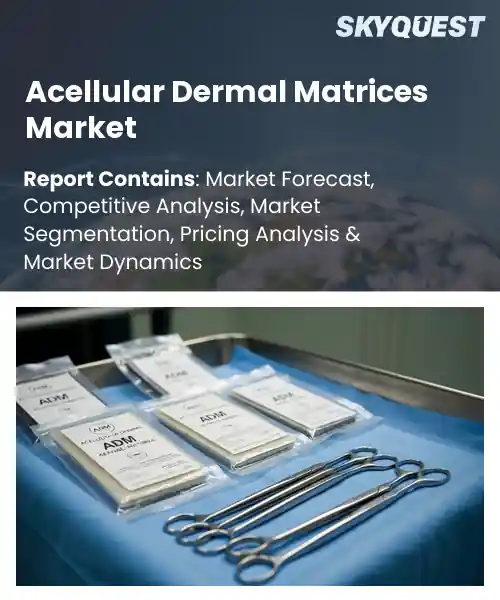
Acellular Dermal Matrices Market
Report ID: SQMIG35A4060
Report ID: SQMIG35A4060
[email protected]
USA +1 351-333-4748
Report ID:
SQMIG35A4060 |
Region:
Global |
Published Date: July, 2026
Pages:
157
|Tables:
177
|Figures:
79


Global Acellular Dermal Matrices Market size was valued at USD 11.60 Billion in 2024 and is poised to grow from USD 13.03 Billion in 2025 to USD 32.95 Billion by 2033, growing at a CAGR of 12.3% during the forecast period (2026-2033).
The acellular dermal matrices market trends comprises scaffolds of biological origin, which are used to support tissue regeneration in reconstructive surgery, wound care and ophthalmology. This is important because ADMs can offer structural support and remove cellular antigens that cause rejection, thereby broadening the therapeutic possibilities for patients with complex defects. Historically, porcine-derived products were dominant in the market in the early 2000s, but advances in decellularization techniques and regulatory acceptance have expanded the portfolio to include human and bovine sources. Landmark breast-reconstruction trials showing lower complication rates led to the evolution and hospitals began using ADMs as an adjunct.
The surge in demand for cosmetic procedures serves as a catalyst, triggering a ripple effect throughout supply chains and reimbursement models. As surgeons turn to these matrices for fat‑graft stabilization and facial soft‑tissue augmentation, owing to the matrices’ reduced resorption and improved aesthetic predictability, clinics are investing in procurement contracts for acellular dermal matrices market growth. This demand pushes manufacturers to speed up their matrix research and creates new market segments such as diabetic foot ulcer treatment in which clinical trials have demonstrated faster closure times. This results in collaborations between biotech companies and wound-care distributors which provide quicker access to the rapidly increasing wound prevalence economies.
How is AI-driven Automation Influencing Product Development in the Acellular Dermal Matrices Market?
Automation powered by AI is reshaping the development of acellular dermal matrices industry products by streamlining design, testing, and manufacturing processes. Machine-learning models analyze tissue-engineering data to predict scaffold performance, cutting down on the need for iterative physical prototypes. Automated bioreactors tightly regulate culture conditions to speed up the maturation of cell‑free matrix and provide consistency. The integration of robotic handling reduces the risk of contamination and cycle times, so developers can respond quicker to clinical feedback. These capabilities assist firms in addressing increasing demand for high‑quality grafts and facilitate wider adoption in reconstructive surgery, wound care and aesthetic procedures.
In June 2024, Integra LifeSciences reported the deployment of an AI‑controlled production line for its dermal regeneration template, reducing lead times and enhancing batch uniformity, which directly drives market growth and operational efficiency.
Market snapshot - (2026-2033)
Global Market Size
USD 11.6 Billion
Largest Segment
Porcine Acellular Dermal Matrices
Fastest Growth
Human Acellular Dermal Matrices
Growth Rate
12.3% CAGR
To get more insights on this market click here to Request a Free Sample Report
Global acellular dermal matrices market is segmented by product type, application, end user, material type, procedure type, distribution channel and region. Based on product type, the market is segmented into human acellular dermal matrices, porcine acellular dermal matrices, bovine acellular dermal matrices and others. Based on application, the market is segmented into breast reconstruction, hernia repair, chronic wound management, burn treatment, orthopedic soft tissue repair and others. Based on end user, the market is segmented into hospitals, ambulatory surgical centers, specialty clinics and burn care centers. Based on material type, the market is segmented into allograft-based matrices, xenograft-based matrices and hybrid/bioengineered matrices. Based on procedure type, the market is segmented into reconstructive surgery, cosmetic surgery, wound care procedures and soft tissue repair procedures. Based on distribution channel, the market is segmented into direct sales, distributors and hospital procurement channels. Based on region, the market is segmented into North America, Europe, Asia Pacific, Latin America and Middle East & Africa.
The human acellular dermal matrices segment is the leading segment due to its derivation from donor skin, which offers biocompatibility and structural integrity that closely match native tissue, resulting in a preference among surgeons for complex reconstructions. Their long clinical history, large body of evidence and regulatory acceptance are driving strong demand across multiple procedures, reinforcing their market position. The lower risk of immune reaction and the availability of processing protocols further establish its position as the preferred choice for surgeons.
However, the fastest expanding sector is the porcine acellular dermal matrices segment owing to recent improvements in decellularization techniques, which have enhanced its mechanical properties and safety, drawing in surgeons seeking cost-effective choices. Growing acceptance in new therapeutic areas and expanded manufacturing capacity are accelerating its market penetration and opening up new opportunities for product diversification.
Acellular dermal matrices provide scaffold support that integrates with host tissue, which is key to achieving aesthetic outcomes and minimizing complications in post-mastectomy procedures, making them segment leaders in breast reconstruction. Surgeons appreciate the material’s adaptability to variable anatomy, shorter operative time and improved patient satisfaction, which sustains preference and helps maintain market leadership. Robust clinical evidence underpinning lower capsular contracture rates and enhanced long-term durability further cement the segment’s preeminence within the overall market landscape and its adoption by reconstructive teams.
On the other hand, the chronic wound management segment is the key high-growth segment, as the clinicians are increasingly adopting acellular dermal matrices in order to accelerate tissue regeneration in difficult-to-heal ulcers. Innovations in matrix composition that improve angiogenesis and increased awareness of cost savings from reduced hospitalization are driving rapid uptake and broadening of the market therapeutic scope.
To get detailed segments analysis, Request a Free Sample Report
North America leads, supported by an established healthcare infrastructure, thriving research and development, and broad clinical acceptance of advanced wound-care products. The United States has a concentration of innovative manufacturers and academic institutions that speed up product development and regulatory approvals. Reimbursement structures are well defined and encourage hospitals and surgeons to incorporate acellular dermal matrices in reconstructive procedures. Canada’s collaborative public-private model further complements this environment by enabling technology transfer and access to cutting edge therapies. Combined, these factors create a strong demand pipeline, sustain high adoption rates and cement the region’s leadership in the global market. Regulatory agencies in the region have clear paths for reducing time to market. Professional societies are continually updating practice guidelines to include new matrix technologies, which further drives clinician confidence.
Acellular dermal matrices market regional outlook in United States benefits from a sophisticated reimbursement system that aligns with clinical outcomes, encouraging widespread procedural use. Strong collaboration between biotech firms and leading academic centers fuels continuous product innovation, while regulatory clarity accelerates market entry. High surgeon familiarity and patient awareness further reinforce adoption, creating a self‑reinforcing cycle of demand and advancement across reconstructive and cosmetic applications and supporting long‑term clinical success for patients.
Acellular dermal matrices market regional forecast in Canada thrives on strong government‑backed research initiatives that link academic expertise with industry capabilities. A unified national health system streamlines reimbursement processes, making advanced wound‑care solutions readily accessible in both public and private settings. Collaborative networks among surgeons, hospitals, and manufacturers promote knowledge exchange, while regulatory alignment with international standards reduces barriers to adoption, fostering consistent growth across diverse clinical specialties and improving patient outcomes.
The European acellular dermal matrices market is expected to witness fast growth driven by the combination of stringent clinical research, standardized regulatory landscape, and the increasing focus on minimally invasive reconstructive procedures. The region has a strong tradition of investing in public health, which leads to broad reimbursement schemes that help advanced tissue-engineered products in hospital networks. Collaborative ecosystems that connect research hospitals, biotech clusters and surgical societies accelerate knowledge transfer and continuous product refinement. Adoption is also driven by patient preference for solutions that reduce donor site morbidity and in line with healthcare policies that prioritize cost-effective outcomes. This momentum is also supported by the efficiency of distribution in the European Union through cross border trade, where manufacturers can reach multiple markets with standardized approvals. The involvement of professional bodies in embedding matrix technologies into clinical guidelines also enhances practitioner confidence and speeds market penetration.
Acellular dermal matrices market penetration in Germany is anchored by a regulated yet innovation‑friendly environment that encourages translation of laboratory breakthroughs into clinical practice. Strong university research programs collaborate closely with medical device firms, fostering a pipeline of matrix products. Comprehensive insurance coverage ensures clinicians have financial incentives to adopt these solutions, while national surgical societies actively promote evidence‑based guidelines that highlight the benefits of acellular dermal matrices across reconstructive disciplines.
Acellular dermal matrices market outlook in United Kingdom is propelled by a health‑technology assessment process that integrates therapies into the Health Service. Close ties between research hospitals and biotech start‑ups generate an ecosystem for product testing and clinical validation. Reimbursement pathways are supportive, allowing hospitals to adopt matrix solutions for breast reconstruction, abdominal wall repair, and wound management. Professional societies update surgical curricula, ensuring new entrants are versed in matrix applications.
Acellular dermal matrices market forecast in France is emerging amid growing clinical interest and reimbursement reforms that recognize the value of tissue‑engineered products. Collaborative initiatives between university hospitals and biotech firms nurture development and facilitate pilot studies. Health authorities prioritize solutions that reduce surgical morbidity, creating favorable conditions for matrix adoption in plastic and reconstructive surgery. Educational programs organized by national societies raise awareness and build practitioner confidence in these therapies.
Asia Pacific is gaining ground in the acellular dermal matrices market, thanks to rising clinical demand, expanding manufacturing capabilities and proactive regulatory adaptation. Hospitals are in search of innovative tissue-engineered solutions to address the challenges of rapid urbanization and the growing burden of chronic wounds. For example, Japan and South Korea have invested heavily in biotech infrastructure, developing home-grown manufacturers that benefit from low-cost production and local expertise. Regional regulatory agencies are opening the door to approval pathways, allowing advanced matrices to reach the market faster. Collaborative research programs between universities and medical device companies are accelerating clinical validation, while reimbursement schemes are slowly shifting to support high-value therapies. This ecosystem of demand, production, and policy advancement establishes the Asia Pacific region as an emerging hub of consumption and export of acellular dermal matrix technologies.
Acellular dermal matrices industry in Japan benefits from a mature regenerative medicine framework that encourages adoption of tissue‑engineered products across surgical specialties. Strong collaboration between leading research universities and domestic manufacturers accelerates product refinement and ensures alignment with local clinical guidelines. Government reimbursement programs increasingly cover matrix‑based procedures, enhancing patient accessibility. Professional societies provide continuous education, fostering surgeon confidence and driving integration of acellular dermal matrices into routine reconstructive practice.
Acellular dermal matrices industry outlook in South Korea is propelled by investment in bio‑fabrication technologies and a healthcare system that prioritizes advanced wound‑care solutions. Partnerships between universities and start‑ups accelerate translational research, delivering matrix products tailored to local surgical needs. Reimbursement policies are evolving to include regenerative therapies, improving physician willingness to adopt new technologies. Clinical training programs and professional network support drive broader acceptance across cosmetic and reconstructive surgery domains.
To know more about the market opportunities by region and country, click here to
Buy The Complete Report
Advances In Tissue Engineering Techniques
Rising Demand For Minimally Invasive Surgery
High Cost Of Production Processes
Regulatory Uncertainty Across Regions
Request Free Customization of this report to help us to meet your business objectives.
The global acellular dermal matrices market is characterized by strong competition among established regenerative medicine companies and tissue engineering specialists focused on expanding product portfolios through innovation, strategic collaborations, and clinical validation. Market participants are increasingly investing in advanced decellularization technologies, biologic scaffold development, and surgeon-focused education programs to strengthen their market positions. Strategic partnerships between biomaterials manufacturers, healthcare providers, and surgical device companies are accelerating product development, enhancing distribution capabilities, and supporting broader adoption of acellular dermal matrices across reconstructive surgery, wound care, and soft-tissue repair applications.
Top Player’s Company Profile
Recent Developments in the Acellular Dermal Matrices Market
SkyQuest’s ABIRAW (Advanced Business Intelligence, Research & Analysis Wing) is our Business Information Services team that Collects, Collates, Correlates, and Analyses the Data collected by means of Primary Exploratory Research backed by robust Secondary Desk research. As per SkyQuest analysis, the main factor driving the market is progress in tissue-engineering techniques that improve scaffold strength and biocompatibility. A second factor driving the market is the increase in minimally invasive surgeries that favor thin, flexible matrices for small-incision delivery. North America leads the market owing to its mature healthcare infrastructure, strong R&D capabilities and simplified reimbursement processes. Human acellular dermal matrices are the largest segment owing to their excellent biocompatibility and abundance of clinical validation. However, the high cost of production due to the sterile environment, specialized decellularization and rigorous quality testing is a restraint that may limit adoption, especially in cost sensitive markets.
| Report Metric | Details |
|---|---|
| Market size value in 2024 | USD 11.6 Billion |
| Market size value in 2033 | USD 32.95 Billion |
| Growth Rate | 12.3% |
| Base year | 2024 |
| Forecast period | (2026-2033) |
| Forecast Unit (Value) | USD Billion |
| Segments covered |
|
| Regions covered | North America (US, Canada), Europe (Germany, France, United Kingdom, Italy, Spain, Rest of Europe), Asia Pacific (China, India, Japan, Rest of Asia-Pacific), Latin America (Brazil, Rest of Latin America), Middle East & Africa (South Africa, GCC Countries, Rest of MEA) |
| Companies covered |
|
| Customization scope | Free report customization with purchase. Customization includes:-
|
To get a free trial access to our platform which is a one stop solution for all your data requirements for quicker decision making. This platform allows you to compare markets, competitors who are prominent in the market, and mega trends that are influencing the dynamics in the market. Also, get access to detailed SkyQuest exclusive matrix.
Table Of Content
Executive Summary
Market overview
Parent Market Analysis
Market overview
Market size
KEY MARKET INSIGHTS
COVID IMPACT
MARKET DYNAMICS & OUTLOOK
Market Size by Region
KEY COMPANY PROFILES
Methodology
For the Acellular Dermal Matrices Market, our research methodology involved a mixture of primary and secondary data sources. Key steps involved in the research process are listed below:
1. Information Procurement: This stage involved the procurement of Market data or related information via primary and secondary sources. The various secondary sources used included various company websites, annual reports, trade databases, and paid databases such as Hoover's, Bloomberg Business, Factiva, and Avention. Our team did 45 primary interactions Globally which included several stakeholders such as manufacturers, customers, key opinion leaders, etc. Overall, information procurement was one of the most extensive stages in our research process.
2. Information Analysis: This step involved triangulation of data through bottom-up and top-down approaches to estimate and validate the total size and future estimate of the Acellular Dermal Matrices Market.
3. Report Formulation: The final step entailed the placement of data points in appropriate Market spaces in an attempt to deduce viable conclusions.
4. Validation & Publishing: Validation is the most important step in the process. Validation & re-validation via an intricately designed process helped us finalize data points to be used for final calculations. The final Market estimates and forecasts were then aligned and sent to our panel of industry experts for validation of data. Once the validation was done the report was sent to our Quality Assurance team to ensure adherence to style guides, consistency & design.
Analyst Support
Customization Options
With the given market data, our dedicated team of analysts can offer you the following customization options are available for the Acellular Dermal Matrices Market:
Product Analysis: Product matrix, which offers a detailed comparison of the product portfolio of companies.
Regional Analysis: Further analysis of the Acellular Dermal Matrices Market for additional countries.
Competitive Analysis: Detailed analysis and profiling of additional Market players & comparative analysis of competitive products.
Go to Market Strategy: Find the high-growth channels to invest your marketing efforts and increase your customer base.
Innovation Mapping: Identify racial solutions and innovation, connected to deep ecosystems of innovators, start-ups, academics, and strategic partners.
Category Intelligence: Customized intelligence that is relevant to their supply Markets will enable them to make smarter sourcing decisions and improve their category management.
Public Company Transcript Analysis: To improve the investment performance by generating new alpha and making better-informed decisions.
Social Media Listening: To analyze the conversations and trends happening not just around your brand, but around your industry as a whole, and use those insights to make better Marketing decisions.
REQUEST FOR SAMPLE
 REQUEST FREE CUSTOMIZATION
Global Acellular Dermal Matrices Market size was valued at USD 11.6 Billion in 2024 and is poised to grow from USD 13.03 Billion in 2025 to USD 32.95 Billion by 2033, growing at a CAGR of 12.3% during the forecast period (2026-2033).
Intense competition in the acellular dermal matrices market drives firms to pursue mergers, strategic alliances, and advanced decellularization technologies, with recent collaborations between leading tissue‑engineering companies and surgical device manufacturers accelerating product innovation and expanding distribution networks. 'Integra LifeSciences Holdings Corporation', 'TELA Bio, Inc.', 'Aroa Biosurgery Limited', 'Organogenesis Holdings Inc.', 'MiMedx Group, Inc.', 'Vericel Corporation', 'RTI Surgical Holdings, Inc.', 'Cook Biotech Incorporated', 'Baxter International Inc.', 'Coloplast A/S', 'PolyNovo Limited', 'Gunze Limited', 'Axogen, Inc.', 'LifeNet Health', 'MTF Biologics', 'AlloSource', 'Surgenex LLC', 'BioLab Holdings, Inc.', 'Tissue Regenix Group plc', 'LeMaitre Vascular, Inc.'
Advances in tissue engineering techniques have enabled the creation of acellular dermal matrices with enhanced structural integrity and biocompatibility, fostering wider acceptance among surgeons. Improved scaffold fabrication processes allow precise control over pore size and degradation rates, which supports more predictable clinical outcomes. These innovations reduce intra‑operative complications and post‑operative recovery times, encouraging healthcare providers to prefer acellular dermal matrices over traditional autografts. Consequently, the growing confidence in product performance drives increased adoption across reconstructive and cosmetic procedures, stimulating market expansion.
Minimally Invasive Adoption Surge: The shift toward minimally invasive surgical techniques is driving greater demand for acellular dermal matrices that can be delivered through small incisions. Surgeons value products that integrate quickly, reduce operative time, and support faster patient recovery. Manufacturers are reformulating matrices to enhance pliability and handling characteristics, enabling seamless adoption in laparoscopic and endoscopic procedures across plastic, reconstructive, and orthopedic applications, thereby expanding market penetration and fostering new procedural standards. These advances also stimulate wider clinician training and interdisciplinary adoption globally.
Why does North America Dominate the Global Acellular Dermal Matrices Market? |@12


Want to customize this report? This report can be personalized according to your needs. Our analysts and industry experts will work directly with you to understand your requirements and provide you with customized data in a short amount of time. We offer $1000 worth of FREE customization at the time of purchase.
Feedback From Our Clients


 USA (+1) 351-333-4748

