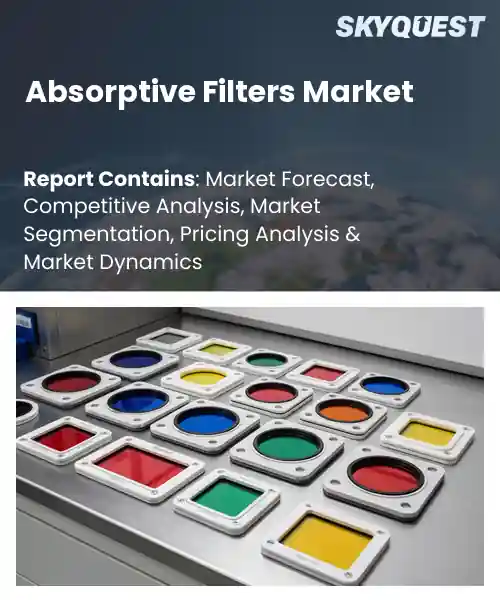
Absorptive Filters Market
Report ID: SQMIG45J2877
Report ID: SQMIG45J2877
[email protected]
USA +1 351-333-4748
Report ID:
SQMIG45J2877 |
Region:
Global |
Published Date: August, 2026
Pages:
157
|Tables:
173
|Figures:
79


Global Absorptive Filters Market size was valued at USD 694.3 Million in 2024 and is poised to grow from USD 735.96 Million in 2025 to USD 1173.01 Million by 2033, growing at a CAGR of 6.0% during the forecast period (2026-2033).
The global absorptive filters market comprises components that dissipate unwanted electromagnetic energy to protect electronic systems, and it has become essential as devices become more densely packed and transmission rates accelerate. The primary driver today is the rapid rollout of 5G networks combined with the expansion of Internet‑of‑Things endpoints, which generate higher frequency noise and stricter compliance standards. Historically, the market evolved from simple ceramic resonators used in early radios to sophisticated multilayer composites found in modern satellites. For instance, aerospace manufacturers now integrate high‑Q absorptive filters in avionics to meet both weight and reliability criteria, illustrating the sector’s maturation.
Building on that regulatory impetus, the next major growth catalyst lies in automotive electrification, where electric‑vehicle power‑train modules generate broadband interference that can impair safety‑critical sensors. As manufacturers adopt driver‑assistance systems, they must embed absorptive filters directly into wiring harnesses, a practice that reduces shielding costs while preserving signal integrity. Consequently, suppliers offering low‑profile ceramic composites are witnessing heightened demand from firms such as Bosch and Continental. Parallel opportunities arise in renewable‑energy installations, where inverters require filtering to maintain grid stability; technology is being repurposed for data‑center power‑distribution units, thereby expanding the market’s significant volume and reinforcing its long‑term upside.
How is AI-driven Automation Enhancing Performance And Adoption In The Absorptive Filters Market?
AI‑driven automation is reshaping the absorptive filters market by streamlining design, testing and production. Machine‑learning models predict material behavior, allowing engineers to fine‑tune pore structures for higher efficiency and longer life. Integrated robotics handle delicate coating processes, reducing human error and boosting throughput. Real‑time data analytics monitor filter performance in operation, enabling predictive maintenance that keeps systems running smoothly. These capabilities lower costs, shorten time‑to‑market and increase confidence among end users, encouraging broader adoption across industries that rely on high‑purity filtration.
Market snapshot - (2026-2033)
Global Market Size
USD 694.3 Million
Largest Segment
Activated Carbon Filters
Fastest Growth
Chemical Absorption Filters
Growth Rate
6.0% CAGR
To get more insights on this market click here to Request a Free Sample Report
Global absorptive filters market is segmented by filter type, application, end use industry, form, distribution channel, filter media and region. Based on filter type, the market is segmented into Activated Carbon Filters, Molecular Sieve Filters, Chemical Absorption Filters and Others. Based on application, the market is segmented into Air Filtration, Water Filtration, Gas Filtration and Others. Based on end use industry, the market is segmented into Healthcare, Industrial, Automotive and Others. Based on form, the market is segmented into Cartridge, Panel and Bag. Based on distribution channel, the market is segmented into Direct Sales and Distributors. Based on filter media, the market is segmented into Carbon, Zeolite and Others. Based on region, the market is segmented into North America, Europe, Asia Pacific, Latin America and Middle East & Africa.
Molecular sieve filters segment dominates because they provide high selectivity for gas phase contaminants, enabling efficient removal of VOCs and hazardous gases. Their crystalline porous structure ensures consistent performance under varying temperature and pressure, making them preferred for critical industrial applications. This reliability drives OEM adoption, reinforcing their leadership in the market. Manufacturers also benefit from the material’s regenerative capability, which reduces lifecycle costs and aligns with sustainability goals, further cementing its market position.
However, chemical absorption filters segment emerges as the most rapidly expanding area as new reactive media are being engineered to target emerging pollutants such as PFAS and ammonia. Their adaptability to diverse chemical threats fuels demand across water and air treatment sectors, opening new revenue streams and driving market growth.
Water filtration segment leads because it addresses the critical need for clean drinking water in both municipal and industrial contexts, prompting continuous investment in advanced absorptive technologies. The growing awareness of waterborne contaminants drives adoption of high performance filters, while stringent quality standards push manufacturers to enhance media efficiency. This sustained demand underpins its leadership in the market. Additionally, integration with smart monitoring systems improves operational reliability, further solidifying its market position.
On the other hand, gas filtration segment is witnessing the strongest growth momentum as industries adopt stricter emissions regulations and seek to capture volatile organic compounds. Innovative absorber cartridges tailored for high temperature gases expand usage in petrochemical and manufacturing plants, creating avenues for market expansion and spurring investment in filter designs.
To get detailed segments analysis, Request a Free Sample Report
Asia Pacific dominance stems from its robust manufacturing base, high adoption of advanced industrial processes, and strong emphasis on environmental compliance. Leading economies invest heavily in research and development of filtration technologies, driving continual innovation. The region benefits from extensive chemical and petrochemical complexes that demand high‑performance absorptive filters for emission control and product purity. Close collaboration between manufacturers and end‑use sectors accelerates product customization, while supportive regulatory frameworks encourage replacement of outdated filtration solutions. Additionally, a skilled engineering workforce and efficient supply chains reduce lead times, enhancing market responsiveness. This combination of demand intensity, technological capability, and policy support positions Asia Pacific as the primary engine of global absorptive filter activity.
Absorptive Filters Market Japan sees strong integration with precision engineering firms, fostering sophisticated filter designs tailored to high‑tech applications. The domestic automotive and electronics sectors demand stringent contaminant control, prompting continuous upgrades of filtration solutions. Collaborative research initiatives between universities and manufacturers accelerate material advancements, while a well‑established distribution network ensures rapid deployment across industrial sites. This ecosystem sustains a resilient demand for advanced absorptive technologies.
Absorptive Filters Market South Korea benefits from a vibrant heavy‑industry landscape, particularly in petrochemical and semiconductor manufacturing. Government incentives for clean‑technology adoption boost investment in high‑efficiency filtration systems. Local producers leverage advanced polymer science to create filters that meet rigorous performance criteria. Strong export orientation also drives the development of versatile products that comply with diverse international standards, reinforcing South Korea’s role as a key supplier in the regional supply chain.
North America’s rapid expansion is fueled by its focus on sustainability, stringent environmental regulations, and a mature industrial base that continually seeks performance‑enhancing solutions. The energy sector, especially renewable fuel processing, demands absorptive filters to maintain product integrity and reduce emissions. Specialized equipment manufacturers partner with end‑users to develop customized filtration products, accelerating adoption across aerospace, pharmaceutical, and food processing industries. Robust R&D ecosystems supported by leading universities and research institutes drive material innovations, while a well‑developed logistics network ensures timely delivery. Growing awareness of occupational health and safety further compels firms to replace legacy filtration with modern absorptive technologies, reinforcing market momentum throughout the region.
Absorptive Filters Market United States features a diverse industrial portfolio ranging from petrochemical refineries to high‑tech manufacturing, creating sustained demand for high‑efficiency filtration. Strong collaboration between major filter producers and research institutions fuels continuous product refinement. Emphasis on regulatory compliance and environmental stewardship encourages early adoption of advanced absorptive solutions. A mature distribution infrastructure and extensive technical support network enhance market penetration across multiple sectors, reinforcing the United States as a pivotal market hub.
Absorptive Filters Market Canada leverages its extensive natural resource processing sector, where stringent emission standards drive the need for reliable filtration. Collaboration between local manufacturers and global technology partners supports the introduction of innovative filter media. Environmental policies promote replacement of aging equipment with modern absorptive systems, particularly in oil sands operations and chemical plants. Well‑integrated supply chains and a focus on operational safety further strengthen market uptake across the Canadian industrial landscape.
Europe is strengthening its position through a blend of regulatory rigor, strong emphasis on circular economy principles, and deep expertise in advanced materials. Industrial clusters in western Europe prioritize high‑performance absorptive filters to meet strict emission limits and to support sustainable production processes. Collaborative innovation platforms bring together manufacturers, research institutes, and end‑users to co‑develop next‑generation filtration solutions. Investment in green technologies and incentives for energy‑efficient operations drive demand for filters that enable product recovery and waste minimization. Additionally, a well‑established standards framework facilitates market harmonization, allowing manufacturers to scale solutions across multiple countries, thereby enhancing Europe’s overall competitiveness in the absorptive filter arena.
Absorptive Filters Market Germany is anchored by a strong engineering tradition and a dense network of chemical and automotive manufacturers that require precise contaminant control. Close ties between industry and research universities foster rapid development of high‑performance filter media. Environmental legislation pushes firms toward adoption of efficient absorptive solutions to reduce emissions and improve product quality. A robust export orientation further propels German filter producers into broader European markets, reinforcing their leadership position.
Absorptive Filters Market United Kingdom benefits from a progressive regulatory landscape and vibrant life‑science sector, both of which demand reliable filtration for critical processes. Investment in green manufacturing initiatives stimulates interest in absorptive technologies that enhance material recovery and lower waste. Collaborative projects between academia and industry accelerate the rollout of novel filter designs. Established supply chains and a focus on compliance ensure that UK manufacturers remain at the forefront of adopting advanced filtration solutions.
Absorptive Filters Market France leverages its strong chemical and aerospace industries, where high‑purity standards drive continuous demand for superior filtration. Government support for environmental innovation encourages deployment of absorptive filters that improve process efficiency and reduce pollutants. Partnerships between leading research labs and industrial players enable rapid material advancements. A well‑aligned regulatory framework and sophisticated logistics infrastructure facilitate the distribution of cutting‑edge filter products across French manufacturing hubs, solidifying the country’s role in the European market.
To know more about the market opportunities by region and country, click here to
Buy The Complete Report
Increasing Industrial Automation
Regulatory Push For Cleaner Air
High Initial Capital Expenditure
Limited Availability Of Advanced Materials
Request Free Customization of this report to help us to meet your business objectives.
The absorptive filters market is shaped by intense competition among established manufacturers and emerging innovators, with rivalry driving accelerated product differentiation, strategic M&A, and collaborative R&D alliances; recent examples include Parker Hannifin’s acquisition of a niche nanofiber filter developer and Donaldson Company’s partnership with a university research center to co‑develop high‑efficiency acoustic‑absorbing media, both aimed at expanding market share and technology leadership.
SkyQuest’s ABIRAW (Advanced Business Intelligence, Research & Analysis Wing) is our Business Information Services team that Collects, Collates, Correlates, and Analyses the Data collected by means of Primary Exploratory Research backed by robust Secondary Desk research.
As per SkyQuest analysis, the global absorptive filters market is being propelled primarily by the rapid rollout of 5G and IoT which fuels demand for high‑frequency noise suppression, while stricter emissions regulations provide a second powerful driver by compelling industries to adopt cleaner filtration solutions. The market is still constrained by the high upfront capital needed to install advanced filter systems, which can deter smaller firms. Asia Pacific leads the landscape due to its dense manufacturing base and supportive policies, and within the product mix molecular sieve filters remain the dominant segment due to their selectivity and regenerative capability.
| Report Metric | Details |
|---|---|
| Market size value in 2024 | USD 694.3 Million |
| Market size value in 2033 | USD 1173.01 Million |
| Growth Rate | 6.0% |
| Base year | 2024 |
| Forecast period | (2026-2033) |
| Forecast Unit (Value) | USD Million |
| Segments covered |
|
| Regions covered | North America (US, Canada), Europe (Germany, France, United Kingdom, Italy, Spain, Rest of Europe), Asia Pacific (China, India, Japan, Rest of Asia-Pacific), Latin America (Brazil, Rest of Latin America), Middle East & Africa (South Africa, GCC Countries, Rest of MEA) |
| Companies covered |
|
| Customization scope | Free report customization with purchase. Customization includes:-
|
To get a free trial access to our platform which is a one stop solution for all your data requirements for quicker decision making. This platform allows you to compare markets, competitors who are prominent in the market, and mega trends that are influencing the dynamics in the market. Also, get access to detailed SkyQuest exclusive matrix.
Table Of Content
Executive Summary
Market overview
Parent Market Analysis
Market overview
Market size
KEY MARKET INSIGHTS
COVID IMPACT
MARKET DYNAMICS & OUTLOOK
Market Size by Region
KEY COMPANY PROFILES
Methodology
For the Absorptive Filters Market, our research methodology involved a mixture of primary and secondary data sources. Key steps involved in the research process are listed below:
1. Information Procurement: This stage involved the procurement of Market data or related information via primary and secondary sources. The various secondary sources used included various company websites, annual reports, trade databases, and paid databases such as Hoover's, Bloomberg Business, Factiva, and Avention. Our team did 45 primary interactions Globally which included several stakeholders such as manufacturers, customers, key opinion leaders, etc. Overall, information procurement was one of the most extensive stages in our research process.
2. Information Analysis: This step involved triangulation of data through bottom-up and top-down approaches to estimate and validate the total size and future estimate of the Absorptive Filters Market.
3. Report Formulation: The final step entailed the placement of data points in appropriate Market spaces in an attempt to deduce viable conclusions.
4. Validation & Publishing: Validation is the most important step in the process. Validation & re-validation via an intricately designed process helped us finalize data points to be used for final calculations. The final Market estimates and forecasts were then aligned and sent to our panel of industry experts for validation of data. Once the validation was done the report was sent to our Quality Assurance team to ensure adherence to style guides, consistency & design.
Analyst Support
Customization Options
With the given market data, our dedicated team of analysts can offer you the following customization options are available for the Absorptive Filters Market:
Product Analysis: Product matrix, which offers a detailed comparison of the product portfolio of companies.
Regional Analysis: Further analysis of the Absorptive Filters Market for additional countries.
Competitive Analysis: Detailed analysis and profiling of additional Market players & comparative analysis of competitive products.
Go to Market Strategy: Find the high-growth channels to invest your marketing efforts and increase your customer base.
Innovation Mapping: Identify racial solutions and innovation, connected to deep ecosystems of innovators, start-ups, academics, and strategic partners.
Category Intelligence: Customized intelligence that is relevant to their supply Markets will enable them to make smarter sourcing decisions and improve their category management.
Public Company Transcript Analysis: To improve the investment performance by generating new alpha and making better-informed decisions.
Social Media Listening: To analyze the conversations and trends happening not just around your brand, but around your industry as a whole, and use those insights to make better Marketing decisions.
REQUEST FOR SAMPLE
 REQUEST FREE CUSTOMIZATION
Global Absorptive Filters Market size was valued at USD 694.3 Million in 2024 and is poised to grow from USD 735.96 Million in 2025 to USD 1173.01 Million by 2033, growing at a CAGR of 6.0% during the forecast period (2026-2033).
The absorptive filters market is shaped by intense competition among established manufacturers and emerging innovators, with rivalry driving accelerated product differentiation, strategic M&A, and collaborative R&D alliances; recent examples include Parker Hannifin’s acquisition of a niche nanofiber filter developer and Donaldson Company’s partnership with a university research center to co‑develop high‑efficiency acoustic‑absorbing media, both aimed at expanding market share and technology leadership. 'Thorlabs, Inc.', 'Edmund Optics Inc.', 'Omega Optical LLC', 'Semrock (IDEX Health & Science)', 'Chroma Technology Corporation', 'Alluxa, Inc.', 'Iridian Spectral Technologies Ltd.', 'Asahi Spectra Co., Ltd.', 'Knight Optical Ltd.', 'Materion Corporation', 'OptoSigma Corporation', 'Delta Optical Thin Film A/S', 'ZEISS Group', 'Jenoptik AG', 'MKS Instruments, Inc.', 'Newport Corporation', 'Optics Balzers AG', 'Shanghai Optics Inc.', 'MidOpt', 'HORIBA, Ltd.'
The rise of automated manufacturing lines is increasing the generation of fine particulate matter and volatile compounds, prompting facilities to integrate absorptive filtration systems directly into production equipment. These filters provide continuous removal of contaminants, thereby protecting sensitive machinery, improving product quality, and extending operational uptime. As manufacturers seek to reduce downtime and maintenance costs, the value proposition of reliable absorptive filters becomes a critical component of automation strategy, directly supporting market expansion and aligning with sustainability goals while also meeting evolving industry standards.
Sustainable Materials Driving Demand: Automakers and equipment manufacturers are increasingly prioritizing environmentally friendly components, prompting a surge in demand for absorptive filters made from renewable or recycled polymers. Stringent emissions regulations and corporate sustainability pledges encourage supplier portfolios to incorporate bio‑based resins, natural fibers, and closed‑loop recycling processes. This shift not only reduces the carbon footprint of the final product but also opens new sourcing channels, strengthens brand equity, and aligns the market with broader circular‑economy initiatives across aerospace, automotive, and industrial sectors.
Why does Asia Pacific Dominate the Global Absorptive Filters Market? |@12


Want to customize this report? This report can be personalized according to your needs. Our analysts and industry experts will work directly with you to understand your requirements and provide you with customized data in a short amount of time. We offer $1000 worth of FREE customization at the time of purchase.
Feedback From Our Clients


 USA (+1) 351-333-4748

