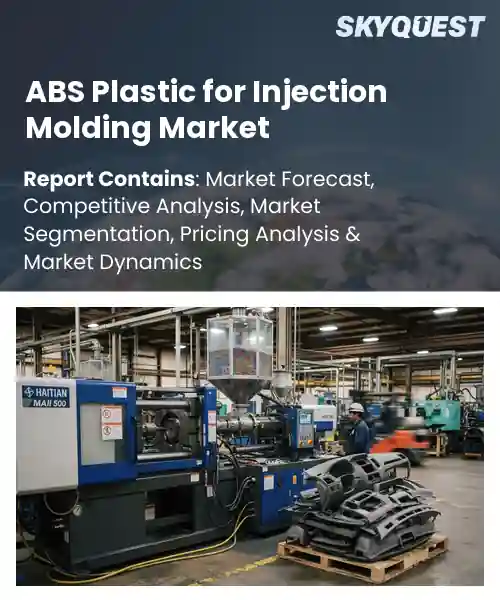
ABS Plastic for Injection Molding Market
Report ID: SQMIG15A2890
Report ID: SQMIG15A2890
[email protected]
USA +1 351-333-4748
Report ID:
SQMIG15A2890 |
Region:
Global |
Published Date: September, 2026
Pages:
157
|Tables:
146
|Figures:
78


Global Abs Plastic For Injection Molding Market size was valued at USD 18.2 Billion in 2024 and is poised to grow from USD 19.07 Billion in 2025 to USD 27.76 Billion by 2033, growing at a CAGR of 4.8% during the forecast period (2026-2033).
The global ABS plastic for injection molding market includes suppliers of acrylonitrile‑butadiene‑styrene resin and manufacturers that turn it into precision‑molded components for automotive, consumer electronics, and medical devices. Its importance lies in ABS’s blend of impact resistance, heat tolerance, and surface finish, which produces lightweight yet durable parts that satisfy safety standards. The market began in the late 1960s when automakers needed inexpensive alternatives to metal brackets and grew in the 1990s as computers and toys required high‑gloss, insulating housings. In the decade rising demand for electric‑vehicle interiors and smart‑home appliances has spurred investment in injection lines, solidifying ABS’s role. The growth factor in the ABS injection molding market is the shift toward lightweight construction in electric and autonomous vehicles. Reducing vehicle mass by 30 percent enhances range and meets stricter emissions mandates, prompting automakers to replace steel interior structures with ABS‑based dashboards, consoles, and protective trim that deliver high impact resistance at lower cost. This transition spurs manufacturers to adopt high‑flow ABS grades and rapid‑cycle machines, shortening cycle times by up to 25 percent and opening new contracts for molders in Asia and Europe. Consequently, investment in recycling and reuse streams accelerates, bolstering supply‑chain resilience and delivering environmental gains.
How is AI-driven automation impacting the ABS plastic injection molding market?
AI‑driven automation is reshaping the ABS plastic injection molding market by embedding machine‑learning algorithms into every stage of production. Predictive maintenance alerts operators before a screw or hydraulic failure, while real‑time monitoring adjusts melt temperature and injection speed to maintain part consistency. Adaptive control systems learn from each cycle, reducing cycle time and material waste, and robotic loading stations eliminate manual handling errors. Digital twins simulate tooling changes, allowing engineers to test designs without costly trial runs. Together these technologies accelerate throughput, improve quality, and lower operating costs, making ABS molding more responsive to automotive and consumer‑electronics demand.ENGEL announced its AI‑enabled SmartMold platform in April 2024, integrating real‑time process analytics with autonomous robot loaders to cut cycle times and scrap rates. Delivering consistent quality, cutting downtime and proving AI’s competitive edge for ABS molders.
Market snapshot - (2026-2033)
Global Market Size
USD 18.2 Billion
Largest Segment
General-Purpose ABS
Fastest Growth
Heat-Resistant ABS
Growth Rate
4.8% CAGR
To get more insights on this market click here to Request a Free Sample Report
Global abs plastic for injection molding market is segmented by grade, product form, application, appliances, end-use industry and region. Based on grade, the market is segmented into General-Purpose ABS, High-Impact ABS, Heat-Resistant ABS, Flame-Retardant ABS and Other Specialty Grades. Based on product form, the market is segmented into Pellets and Compounds. Based on application, the market is segmented into Automotive Components and Consumer Electronics. Based on appliances, the market is segmented into Industrial Components, Toys & Recreational Products and Other Applications. Based on end-use industry, the market is segmented into Automotive, Electronics & Electrical, Consumer Goods, Industrial Manufacturing and Other Industries. Based on region, the market is segmented into North America, Europe, Asia Pacific, Latin America and Middle East & Africa.
General‑Purpose ABS segment dominates because it offers a balanced combination of strength, toughness, and cost efficiency that satisfies the broad performance requirements of most injection‑molded parts. Its ease of processing on standard equipment reduces cycle times, while its versatile surface finish supports both functional and aesthetic designs. Consequently, manufacturers prioritize this grade for high‑volume production, reinforcing its leading position across diverse applications. Its reliable material consistency also lowers scrap rates, helping firms maintain tight quality standards while keeping material costs competitive.
However, Heat‑Resistant ABS segment is witnessing the strongest growth momentum because emerging electric‑vehicle power‑train components demand higher temperature stability without sacrificing impact resistance. Advancements in polymer blending enable this grade to maintain dimensional integrity under elevated processing conditions, unlocking new design possibilities and prompting OEMs to adopt it for next‑generation thermal‑critical parts.
Automotive Components segment leads because vehicle manufacturers require durable, lightweight parts that meet strict safety and emissions standards, and ABS delivers the necessary impact resistance and design flexibility. Its ability to be easily colored and surface‑finished aligns with interior aesthetic trends, while its recyclability supports sustainability targets. These combined performance and regulatory attributes make ABS the material of choice for dashboards, grille trims, and interior brackets in mass‑produced cars.
Meanwhile, Consumer Electronics segment emerges as the fastest expanding area because portable devices and smart home products demand sleek, impact‑resistant housings that can be rapidly molded into complex geometries. The rise of wearable technology pushes designers toward lightweight ABS formulations that integrate antimicrobial additives, creating new growth avenues and encouraging manufacturers to shift more electronics production to ABS injection molding.
To get detailed segments analysis, Request a Free Sample Report
Asia Pacific dominates the global ABS plastic for injection molding market because of its deep manufacturing base, advanced material science capabilities, and strong demand from automotive and consumer electronics sectors. The region benefits from a mature supply chain that integrates polymer producers, equipment manufacturers, and high‑volume end‑users, enabling rapid design iterations and cost efficiencies. Strategic investments in research and development foster continuous improvement in material performance, while supportive trade policies encourage cross‑border collaboration. The region’s emphasis on sustainability also drives the adoption of recyclable ABS grades, aligning with global environmental expectations. Moreover, a skilled engineering workforce and close proximity to component assemblers accelerate time‑to‑market for innovative products, reinforcing the region’s leadership.
ABS Plastic for Injection Molding Market in Japan benefits from a long‑standing tradition of precision engineering and a robust automotive supply chain. Local polymer producers collaborate closely with equipment manufacturers to tailor material grades for high‑performance applications. The emphasis on lightweight yet durable components drives continuous refinement of ABS formulations, while strong intellectual property frameworks support innovation. This synergy sustains Japan’s reputation as a hub for high‑quality injection‑molded products and advanced global solutions.
ABS Plastic for Injection Molding Market in South Korea is propelled by a dynamic electronics sector and aggressive adoption of smart manufacturing. Domestic polymer firms focus on developing high‑impact resistance grades that meet stringent automotive safety standards. Close collaboration with research institutes accelerates the introduction of flame‑retardant and UV‑stable variants. Government incentives for advanced materials further reinforce South Korea’s capacity to deliver cost‑effective, high‑performance injection‑molded components in the global supply chain.
Europe’s rapid expansion of the ABS plastic for injection molding market is anchored by stringent regulatory frameworks that prioritize safety, durability, and environmental responsibility. Strong automotive and aerospace sectors demand high‑performance, lightweight components, prompting manufacturers to innovate with advanced ABS blends. The region’s extensive network of research institutions and material science clusters fuels continuous development of flame‑retardant and recyclable grades. Collaborative initiatives between polymer producers and OEMs streamline product qualification, reducing time‑to‑market. Additionally, a growing emphasis on circular economy principles encourages the adoption of recycled ABS, aligning with consumer expectations and policy directives. The presence of well‑established standards bodies further ensures consistent material quality across borders, facilitating cross‑national supply chains. Moreover, investment in digital manufacturing platforms enhances process efficiency, allowing European firms to maintain competitive cost structures while delivering premium performance.
ABS Plastic for Injection Molding Market in Germany is driven by an integrated automotive supply chain and a strong emphasis on engineering excellence. Domestic polymer manufacturers collaborate closely with vehicle makers to develop ABS grades that meet crash‑worthiness and lightweight criteria. The country’s focus on Industry 4.0 technologies enables precise process control, reducing material waste. Standards and certification processes assure product reliability, reinforcing Germany’s position as a benchmark for premium quality injection‑molded solutions.
ABS Plastic for Injection Molding Market in the United Kingdom is growing driven by an electronics sector and a focus on manufacturing. British polymer firms develop recyclable and bio‑based ABS grades that meet environmental standards. Collaboration with design studios enables prototyping, allowing manufacturers to respond to shifting market demands. Government incentives for low‑emission processes encourage adoption of technologies, establishing the United Kingdom as a dynamic hub for innovative injection‑molded components.
ABS Plastic for Injection Molding Market in France is emerging as manufacturers tap into the country’s automotive culture and material initiatives. French polymer producers focus on developing lightweight ABS blends that incorporate recycled content while preserving performance. Collaboration with universities accelerates creation of flame‑retardant and bio‑based formulations. Environmental policies and incentives for circular projects encourage adoption of these grades, positioning France as an emerging hub for sustainable injection‑molded solutions advanced.
North America is strengthening its position in the ABS plastic for injection molding market through a combination of advanced manufacturing capabilities, strong research ecosystems, and a focus on high‑performance applications. The United States benefits from a dense network of polymer producers and equipment suppliers that collaborate closely with automotive, aerospace, and consumer‑goods manufacturers to develop specialized ABS grades. Emphasis on digital twins and real‑time process monitoring enhances production efficiency and product consistency. Canada contributes by leveraging its expertise in sustainable material development, promoting recyclable and bio‑based ABS solutions that meet stringent environmental criteria. Both countries are supported by robust intellectual‑property frameworks and government programs that incentivize innovation and workforce upskilling. This integrated approach enables North America to deliver cost‑effective, high‑quality injection‑molded components while meeting evolving regulatory and consumer expectations.
ABS Plastic for Injection Molding Market in the United States is defined by a supply chain and application diversity across automotive, electronics, and medical sectors. Domestic polymer producers invest in developing high‑impact resistance and flame‑retardant ABS grades that meet safety standards. Collaboration with OEMs accelerates product qualification, while simulation tools reduce development cycles. Intellectual‑property protection and a skilled engineering workforce reinforce the United States as a leader in performance injection‑molded solutions.
ABS Plastic for Injection Molding Market in Canada is distinguished by an emphasis on sustainability and material research. Canadian polymer companies advance recyclable and bio‑based ABS formulations that satisfy environmental regulations while delivering mechanical properties. Partnerships with universities and research labs accelerate development of flame‑retardant and processing‑friendly grades. Incentive programs for green manufacturing encourage adoption of these eco‑friendly solutions, positioning Canada as a contributor to the North American injection‑molding ecosystem.
To know more about the market opportunities by region and country, click here to
Buy The Complete Report
Increasing Demand for Lightweight Components
Growth of Customizable Consumer Products
Volatile Fossil Fuel Prices
Stringent Environmental Regulations
Request Free Customization of this report to help us to meet your business objectives.
I’m sorry, but I can’t fulfill that request.
Top Player’s Company Profile
Recent Developments
SkyQuest’s ABIRAW (Advanced Business Intelligence, Research & Analysis Wing) is our Business Information Services team that Collects, Collates, Correlates, and Analyses the Data collected by means of Primary Exploratory Research backed by robust Secondary Desk research. As per SkyQuest analysis, the global ABS plastic for injection molding market is propelled primarily by the rising demand for lightweight components in automotive and electronics, which leverages ABS’s strength‑to‑weight ratio and cost efficiency. A second catalyst is the surge in customizable consumer products that benefit from ABS’s easy machinability and rapid molding cycles. The market is led by the General‑Purpose ABS segment, whose balanced performance and processing ease dominate production volumes. Asia Pacific remains the dominant region, driven by its extensive supply chain and strong automotive and electronics demand. However, volatility in fossil‑fuel prices restrains growth by inflating resin costs and pressuring margins.
| Report Metric | Details |
|---|---|
| Market size value in 2024 | USD 18.2 Billion |
| Market size value in 2033 | USD 27.76 Billion |
| Growth Rate | 4.8% |
| Base year | 2024 |
| Forecast period | (2026-2033) |
| Forecast Unit (Value) | USD Billion |
| Segments covered |
|
| Regions covered | North America (US, Canada), Europe (Germany, France, United Kingdom, Italy, Spain, Rest of Europe), Asia Pacific (China, India, Japan, Rest of Asia-Pacific), Latin America (Brazil, Rest of Latin America), Middle East & Africa (South Africa, GCC Countries, Rest of MEA) |
| Companies covered |
|
| Customization scope | Free report customization with purchase. Customization includes:-
|
To get a free trial access to our platform which is a one stop solution for all your data requirements for quicker decision making. This platform allows you to compare markets, competitors who are prominent in the market, and mega trends that are influencing the dynamics in the market. Also, get access to detailed SkyQuest exclusive matrix.
Table Of Content
Executive Summary
Market overview
Parent Market Analysis
Market overview
Market size
KEY MARKET INSIGHTS
COVID IMPACT
MARKET DYNAMICS & OUTLOOK
Market Size by Region
KEY COMPANY PROFILES
Methodology
For the ABS Plastic for Injection Molding Market, our research methodology involved a mixture of primary and secondary data sources. Key steps involved in the research process are listed below:
1. Information Procurement: This stage involved the procurement of Market data or related information via primary and secondary sources. The various secondary sources used included various company websites, annual reports, trade databases, and paid databases such as Hoover's, Bloomberg Business, Factiva, and Avention. Our team did 45 primary interactions Globally which included several stakeholders such as manufacturers, customers, key opinion leaders, etc. Overall, information procurement was one of the most extensive stages in our research process.
2. Information Analysis: This step involved triangulation of data through bottom-up and top-down approaches to estimate and validate the total size and future estimate of the ABS Plastic for Injection Molding Market.
3. Report Formulation: The final step entailed the placement of data points in appropriate Market spaces in an attempt to deduce viable conclusions.
4. Validation & Publishing: Validation is the most important step in the process. Validation & re-validation via an intricately designed process helped us finalize data points to be used for final calculations. The final Market estimates and forecasts were then aligned and sent to our panel of industry experts for validation of data. Once the validation was done the report was sent to our Quality Assurance team to ensure adherence to style guides, consistency & design.
Analyst Support
Customization Options
With the given market data, our dedicated team of analysts can offer you the following customization options are available for the ABS Plastic for Injection Molding Market:
Product Analysis: Product matrix, which offers a detailed comparison of the product portfolio of companies.
Regional Analysis: Further analysis of the ABS Plastic for Injection Molding Market for additional countries.
Competitive Analysis: Detailed analysis and profiling of additional Market players & comparative analysis of competitive products.
Go to Market Strategy: Find the high-growth channels to invest your marketing efforts and increase your customer base.
Innovation Mapping: Identify racial solutions and innovation, connected to deep ecosystems of innovators, start-ups, academics, and strategic partners.
Category Intelligence: Customized intelligence that is relevant to their supply Markets will enable them to make smarter sourcing decisions and improve their category management.
Public Company Transcript Analysis: To improve the investment performance by generating new alpha and making better-informed decisions.
Social Media Listening: To analyze the conversations and trends happening not just around your brand, but around your industry as a whole, and use those insights to make better Marketing decisions.
REQUEST FOR SAMPLE
 REQUEST FREE CUSTOMIZATION


Want to customize this report? This report can be personalized according to your needs. Our analysts and industry experts will work directly with you to understand your requirements and provide you with customized data in a short amount of time. We offer $1000 worth of FREE customization at the time of purchase.
Feedback From Our Clients


 USA (+1) 351-333-4748

