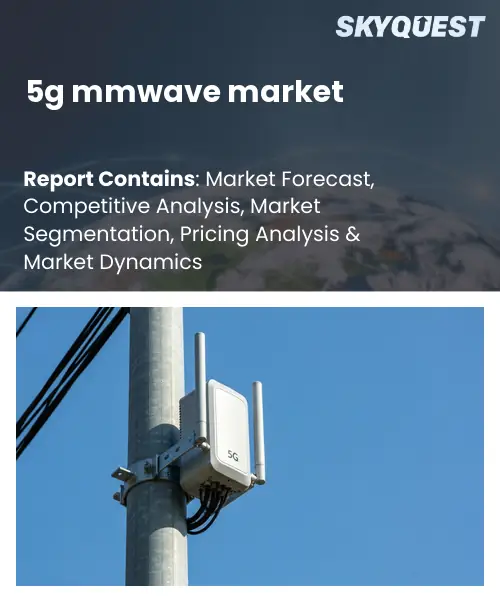
5g mmwave market
Report ID: SQMIG50C2074
Report ID: SQMIG50C2074
[email protected]
USA +1 351-333-4748
Report ID:
SQMIG50C2074 |
Region:
Global |
Published Date: July, 2026
Pages:
157
|Tables:
182
|Figures:
79


Global 5G Mmwave Market size was valued at USD 3.1 Billion in 2024 and is poised to grow from USD 4.13 Billion in 2025 to USD 40.92 Billion by 2033, growing at a CAGR of 33.2% during the forecast period (2026-2033).
The 5G millimeter‑wave (mmWave) market refers to the ecosystem of spectrum, infrastructure, and devices that exploit frequencies above 24 GHz to deliver multi‑gigabit speeds. Its primary driver is the insatiable demand for bandwidth‑intensive applications such as ultra‑high‑definition video, virtual reality, and massive IoT deployments. Early trials in 2018 across Seoul, New York, and London demonstrated that mmWave could sustain peak rates beyond 5 Gbps, prompting carriers to acquire licensed bands and invest in dense small‑cell networks. This rapid evolution from laboratory proof‑of‑concept to commercial rollouts underscores the technology’s strategic relevance for future digital economies. Thus, it has become a critical economic catalyst.
One of the key trend driving the global 5G mmWave sector is the rollout of urban smart‑city initiatives that require high‑capacity links for autonomous vehicles, augmented‑reality navigation, and real‑time surveillance. As municipalities allocate spectrum and subsidize fiber‑backhaul, operators can justify the expenditure for small‑cell clusters, which in turn improves coverage and reduces drop‑off, encouraging enterprises to adopt mmWave‑enabled edge computing platforms. For example, a pilot in Barcelona linked traffic cameras to an AI hub via mmWave, cutting incident response time by 40 percent and spurring deployments across Europe. This virtuous cycle amplifies revenue streams while accelerating standardization and device proliferation.
How is AI Enhancing Network Optimization in the 5G mmWave Market?
AI is reshaping how operators manage the high frequency challenges of 5G mmWave. By analyzing real time signal quality, AI algorithms can steer narrow beams toward users, fill coverage gaps, and allocate spectrum where demand spikes. Machine learning predicts traffic patterns, allowing the network to preempt congestion before it appears. AI also automates fault detection, so equipment failures are fixed with minimal human intervention. These capabilities turn the inherently fragile mmWave links into a more reliable backbone, encouraging carriers to expand capacity in dense urban zones and to launch new services that rely on ultra fast data rates.
In March 2025, Qualcomm Technologies unveiled the Qualcomm X85 5G Modem-RF, featuring a fifth-generation AI processor with a dedicated tensor accelerator to optimize 5G mmWave connectivity. The AI engine enhances beam management, traffic scheduling, spectrum efficiency, and power consumption, enabling faster, lower-latency performance for smartphones, fixed wireless access, and enterprise 5G applications.
Market snapshot - (2026-2033)
Global Market Size
USD 3.1 Billion
Largest Segment
Radio Access Network (RAN)
Fastest Growth
Small Cells
Growth Rate
33.2% CAGR
To get more insights on this market click here to Request a Free Sample Report
Global 5G mmWave market is segmented by component, frequency band, deployment type, application, end user, offering and region. Based on component, the market is segmented into radio access network (RAN), baseband units, antennas & beamforming systems, RF front-end modules, chipsets & modems, network testing & measurement equipment and small cells. Based on frequency band, the market is segmented into 24–29 GHz, 30–39 GHz and above 39 GHz. Based on deployment type, the market is segmented into macro cells, small cells, fixed wireless access (FWA) and private 5G networks. Based on application, the market is segmented into enhanced mobile broadband (eMBB), fixed wireless access, industrial automation, smart cities, connected vehicles, AR/VR & immersive applications and mission-critical communications. Based on end user, the market is segmented into telecom operators, enterprises, government & defense and industrial facilities. Based on offering, the market is segmented into infrastructure, semiconductor components, test & measurement solutions and network software. Based on region, the market is segmented into North America, Europe, Asia Pacific, Latin America and Middle East & Africa.
Based on the global 5G mmWave market growth, radio access network (RAN) segment dominates because it forms the backbone that connects mmWave radios to the core, enabling high‑capacity, low‑latency links essential for 5G services. Its integration of advanced digital processing, massive MIMO, and scalable architecture satisfies operator demand for dense coverage. Continuous innovation in software‑defined RAN and open interfaces further cements its centrality, driving adoption across all deployment models and reinforcing its market leadership within the broader ecosystem.
Meanwhile, small cells segment is witnessing the strongest growth momentum as operators densify networks to overcome mmWave propagation limits. Emerging form‑factor designs and integrated antenna‑beamforming modules lower deployment cost, while new business models for indoor and venue coverage accelerate rollouts. This expansion fuels broader ecosystem adoption and creates revenue streams.
Mid‑twenties GHz band dominates because it offers a balanced blend of bandwidth and manageable propagation, allowing operators to launch initial mmWave services with fewer site challenges. The availability of mature RF frontend components and relatively lower atmospheric absorption accelerates network rollouts. Consequently, equipment vendors prioritize this spectrum for early deployments, reinforcing its primacy and shaping ecosystem standards across diverse use cases and driving further innovation in antenna technologies and beam management.
Conversely, ultra‑high frequency band is emerging as the key high‑growth area as emerging use cases demand ultra‑wide channels for immersive AR/VR and high‑capacity backhaul. Breakthrough silicon‑germanium processes and antenna arrays are reducing power consumption, while industry collaborations unlock new licensing pathways. This momentum expands market scope and spurs fresh investment.
To get detailed segments analysis, Request a Free Sample Report
The dominance of North America in the 5G mmwave market stems from a confluence of strategic advantages. Leading mobile operators have committed extensive capital to dense network roll‑out, leveraging the region’s abundant spectrum allocations and robust regulatory framework. A mature ecosystem of device manufacturers and technology providers accelerates deployment, while high consumer demand for bandwidth‑intensive services fuels commercial viability. Strong collaboration between government agencies, industry consortia, and academic research centers fosters continuous innovation, positioning the United States and Canada as testbeds for advanced use cases such as immersive media, autonomous transportation, and edge‑cloud integration. Furthermore, the region’s emphasis on open‑architecture standards encourages interoperability across vendors, reducing barriers to scale and promoting a resilient deployment landscape.
5G mmwave market activity in the United States is anchored by spectrum auctions that ensure high‑frequency resources for carriers. Major operators prioritize dense urban deployments, aligning network densification with rising demand for ultra‑low latency applications. Collaborative research initiatives between leading universities and technology firms accelerate chipset innovation, while an ecosystem of device manufacturers enables commercialization of mmwave‑enabled smartphones and IoT solutions. This confluence of support, capital investment, and readiness sustains growth trajectory.
5G mmwave market development in Canada benefits from a coordinated regulatory approach that balances spectrum availability with public safety considerations. National carriers focus on extending coverage beyond major metropolitan hubs, fostering partnerships with regional providers to address sparsely populated areas. Innovation clusters in cities such as Toronto and Montreal drive collaborative projects on advanced antenna designs and edge‑computing integration. This emphasis on inclusive deployment and research collaboration reinforces the position of Canada as a resilient market for mmwave services.
Based on global 5G mmWave regional forecast, rapid expansion of the industry across Asia Pacific is propelled by a combination of ambitious governmental initiatives, dense urban landscapes, and a technology‑savvy consumer base. National policies prioritize high‑frequency spectrum allocation to accelerate nationwide roll‑outs, while metropolitan centers provide the necessary population density for viable economic models. Strong manufacturing capabilities in the region underpin a robust supply chain for antennas, integrated circuits, and consumer devices, reducing time‑to‑market for new solutions. Moreover, collaboration between telecom operators, academic institutions, and industry consortia fosters the development of innovative use cases such as smart manufacturing, immersive entertainment, and autonomous mobility. This ecosystem of policy support, industrial expertise, and market demand sustains a vigorous growth trajectory throughout the region.
5G mmWave market activity in Japan is marked by early adoption of high‑frequency spectrum and a focus on sophisticated manufacturing and media applications. Leading operators collaborate closely with domestic equipment manufacturers to refine antenna designs for dense cityscapes. Governmental frameworks encourage pilot projects that integrate mmwave connectivity with robotics and augmented reality, positioning Japan as a testbed for next‑generation industrial systems. The synergy between telecom providers, technology firms, and research universities accelerates commercialization of mmwave‑enabled services across the nation.
5G mmWave market momentum in South Korea is driven by a highly competitive operator landscape and strong government support for high‑frequency spectrum deployment. The country’s advanced semiconductor industry supplies cutting‑edge RF components, enabling rapid rollout of dense small‑cell networks in urban corridors. Collaborative initiatives between carriers, universities, and device makers focus on integrating mmwave capabilities with emerging services such as immersive gaming, telemedicine, and smart city infrastructure. This concerted effort consolidates the reputation of South Korea as a leader in applying mmwave technology to consumer and industrial domains.
As per global 5G mmWave regional outlook, Europe is strengthening its position in the industry through coordinated spectrum policies, collaborative research programs, and a focus on high‑value vertical applications. Regulatory bodies across the region have aligned allocation strategies to ensure sufficient high‑frequency bandwidth for urban and suburban deployments, facilitating a harmonized rollout that benefits equipment manufacturers and service providers alike. Significant investment in joint innovation labs brings together telcos, automotive firms, and academic institutions to explore uses such as connected mobility, immersive media, and industry automation. Moreover, the mature market environment prompts operators to prioritize quality of service and network robustness, fostering consumer confidence in mmwave offerings. This blend of policy coherence, cross‑industry collaboration, and emphasis on premium services propels Europe toward a more prominent role in the global mmwave ecosystem.
5G mmWave market expansion in Germany emphasizes dense urban coverage and integration with the strong automotive sector. Major carriers collaborate with domestic equipment suppliers to deploy advanced antenna arrays that support high‑capacity links in city centers. Joint initiatives with leading car manufacturers focus on vehicle‑to‑infrastructure connectivity, leveraging mmwave’s low latency to enable cooperative driving and real‑time traffic management. Research institutions in Berlin and Munich contribute to standards development and testing, ensuring interoperability across European networks. This coordinated effort strengthens the position of Germany as a hub for mmwave‑enabled transportation and smart‑city solutions.
5G mmWave market progression in the United Kingdom centers on enhancing connectivity for dense population hubs and fostering innovative digital services. Leading operators partner with British hardware firms to roll out compact small‑cell clusters that deliver high‑speed links across metropolitan corridors. Government‑backed pilots explore mmwave integration with sectors such as media broadcasting, remote healthcare, and autonomous logistics, driving ecosystem development. Academic research hubs in London and Manchester contribute expertise in antenna design and network virtualization, supporting rapid commercialization. This collaborative ecosystem positions the United Kingdom as a catalyst for sophisticated mmwave‑driven applications.
5G mmWave market development in France is anchored by ambitious urban densification strategies and strong collaboration between telecom operators and technology innovators. Carriers focus on deploying dense small‑cell networks in major cities to meet the demand for ultra‑high‑capacity services such as immersive entertainment and real‑time collaborative work. National research programs encourage joint projects that integrate mmwave connectivity with sectors like aerospace, renewable energy management, and smart transportation. Partnerships with French equipment manufacturers ensure the availability of advanced antenna solutions, while regulatory frameworks promote efficient spectrum utilization. This holistic approach solidifies the role of France as a leader in European mmwave adoption.
To know more about the market opportunities by region and country, click here to
Buy The Complete Report
Rising Demand For Ultra‑High Bandwidth
Expansion Of Smart City Initiatives
High Deployment Cost Challenges
Regulatory And Spectrum Allocation Issues
Request Free Customization of this report to help us to meet your business objectives.
The global 5G mmWave market outlook is shaped by aggressive competition as incumbents and newcomers vie for spectrum‑rich deployments; key drivers include the race to secure carrier‑grade contracts and to offer higher‑capacity backhaul solutions. Recent moves illustrate this intensity: Microamp secured strategic investment to scale its modular mmWave platforms, while Verana Networks closed a $28 million Series B to accelerate its beam‑forming chipset portfolio, underscoring a clear focus on partnership‑driven technology roll‑outs.
Top Player’s Company Profile
Recent Developments
SkyQuest’s ABIRAW (Advanced Business Intelligence, Research & Analysis Wing) is our Business Information Services team that Collects, Collates, Correlates, and Analyses the Data collected by means of Primary Exploratory Research backed by robust Secondary Desk research.
As per SkyQuest analysis, the global 5G mmWave industry is being propelled primarily by the rising demand for ultra‑high bandwidth services such as immersive VR and massive IoT, which fuels massive small‑cell deployments. A second strong catalyst is the rapid expansion of smart‑city projects that require high‑capacity, low‑latency links for autonomous vehicles and real‑time surveillance, further accelerating operator investment. The market faces a notable restraint in the high deployment cost of dense antenna arrays and extensive fiber backhaul, which can slow roll‑out in cost‑sensitive regions. North America currently dominates the global landscape thanks to abundant spectrum and strong carrier spend, while the Radio Access Network segment leads the ecosystem by providing the essential backbone for all mmWave services.
| Report Metric | Details |
|---|---|
| Market size value in 2024 | USD 3.1 Billion |
| Market size value in 2033 | USD 40.92 Billion |
| Growth Rate | 33.2% |
| Base year | 2024 |
| Forecast period | (2026-2033) |
| Forecast Unit (Value) | USD Billion |
| Segments covered |
|
| Regions covered | North America (US, Canada), Europe (Germany, France, United Kingdom, Italy, Spain, Rest of Europe), Asia Pacific (China, India, Japan, Rest of Asia-Pacific), Latin America (Brazil, Rest of Latin America), Middle East & Africa (South Africa, GCC Countries, Rest of MEA) |
| Companies covered |
|
| Customization scope | Free report customization with purchase. Customization includes:-
|
To get a free trial access to our platform which is a one stop solution for all your data requirements for quicker decision making. This platform allows you to compare markets, competitors who are prominent in the market, and mega trends that are influencing the dynamics in the market. Also, get access to detailed SkyQuest exclusive matrix.
Table Of Content
Executive Summary
Market overview
Parent Market Analysis
Market overview
Market size
KEY MARKET INSIGHTS
COVID IMPACT
MARKET DYNAMICS & OUTLOOK
Market Size by Region
KEY COMPANY PROFILES
Methodology
For the 5g mmwave market, our research methodology involved a mixture of primary and secondary data sources. Key steps involved in the research process are listed below:
1. Information Procurement: This stage involved the procurement of Market data or related information via primary and secondary sources. The various secondary sources used included various company websites, annual reports, trade databases, and paid databases such as Hoover's, Bloomberg Business, Factiva, and Avention. Our team did 45 primary interactions Globally which included several stakeholders such as manufacturers, customers, key opinion leaders, etc. Overall, information procurement was one of the most extensive stages in our research process.
2. Information Analysis: This step involved triangulation of data through bottom-up and top-down approaches to estimate and validate the total size and future estimate of the 5g mmwave market.
3. Report Formulation: The final step entailed the placement of data points in appropriate Market spaces in an attempt to deduce viable conclusions.
4. Validation & Publishing: Validation is the most important step in the process. Validation & re-validation via an intricately designed process helped us finalize data points to be used for final calculations. The final Market estimates and forecasts were then aligned and sent to our panel of industry experts for validation of data. Once the validation was done the report was sent to our Quality Assurance team to ensure adherence to style guides, consistency & design.
Analyst Support
Customization Options
With the given market data, our dedicated team of analysts can offer you the following customization options are available for the 5g mmwave market:
Product Analysis: Product matrix, which offers a detailed comparison of the product portfolio of companies.
Regional Analysis: Further analysis of the 5g mmwave market for additional countries.
Competitive Analysis: Detailed analysis and profiling of additional Market players & comparative analysis of competitive products.
Go to Market Strategy: Find the high-growth channels to invest your marketing efforts and increase your customer base.
Innovation Mapping: Identify racial solutions and innovation, connected to deep ecosystems of innovators, start-ups, academics, and strategic partners.
Category Intelligence: Customized intelligence that is relevant to their supply Markets will enable them to make smarter sourcing decisions and improve their category management.
Public Company Transcript Analysis: To improve the investment performance by generating new alpha and making better-informed decisions.
Social Media Listening: To analyze the conversations and trends happening not just around your brand, but around your industry as a whole, and use those insights to make better Marketing decisions.
REQUEST FOR SAMPLE
 REQUEST FREE CUSTOMIZATION
Global 5G Mmwave Market size was valued at USD 3.1 Billion in 2024 and is poised to grow from USD 4.13 Billion in 2025 to USD 40.92 Billion by 2033, growing at a CAGR of 33.2% during the forecast period (2026-2033).
The 5G mmWave market is shaped by aggressive competition as incumbents and newcomers vie for spectrum‑rich deployments; key drivers include the race to secure carrier‑grade contracts and to offer higher‑capacity backhaul solutions. Recent moves illustrate this intensity: Microamp secured strategic investment to scale its modular mmWave platforms, while Verana Networks closed a $28 million Series B to accelerate its beam‑forming chipset portfolio, underscoring a clear focus on partnership‑driven technology roll‑outs. 'Qualcomm', 'Samsung Electronics', 'Ericsson', 'Nokia', 'Huawei', 'ZTE', 'NEC Corporation', 'Fujitsu', 'MediaTek', 'Qorvo', 'Skyworks Solutions', 'Murata Manufacturing', 'Keysight Technologies', 'Anritsu', 'Movandi', 'Pivotal Commware', 'Peraso', 'Blu Wireless', 'Sivers Semiconductors', 'Airspan Networks'
Telecommunications operators are deploying 5G mmWave to enable services that require exceptionally high data rates, such as immersive virtual reality, real‑time cloud gaming, and massive sensor networks. This rising demand for ultra‑high bandwidth motivates significant investment in infrastructure, drives rapid rollout of dense small‑cell networks, and encourages ecosystem partners to develop compatible devices. As end‑users experience tangible performance improvements, market momentum builds, attracting further capital and fostering a virtuous cycle of innovation and adoption across multiple industry verticals globally today.
Enterprise Edge Integration: Enterprises are rapidly adopting edge computing architectures that leverage mmWave connectivity to deliver ultra‑low latency and high‑capacity links for mission‑critical applications such as real‑time analytics, autonomous robotics, and immersive collaboration. By situating processing power close to data sources, firms can off‑load bandwidth‑intensive workloads from central clouds, enhance data security, and achieve more responsive user experiences. The convergence of edge platforms with mmWave spectrum accelerates digital transformation initiatives, prompting vendors to prioritize integrated hardware‑software solutions that simplify deployment and management across heterogeneous environments.
Why does North America Dominate the Global 5g mmwave market? |@12


Want to customize this report? This report can be personalized according to your needs. Our analysts and industry experts will work directly with you to understand your requirements and provide you with customized data in a short amount of time. We offer $1000 worth of FREE customization at the time of purchase.
Feedback From Our Clients


 USA (+1) 351-333-4748

