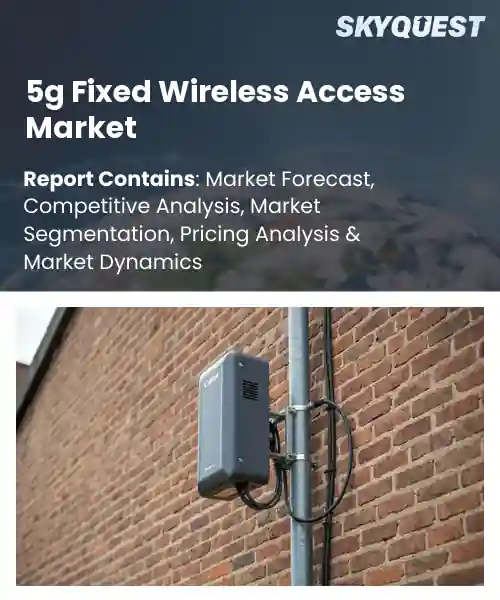
5g Fixed Wireless Access Market
Report ID: SQMIG45A2806
Report ID: SQMIG45A2806
[email protected]
USA +1 351-333-4748
Report ID:
SQMIG45A2806 |
Region:
Global |
Published Date: July, 2026
Pages:
157
|Tables:
145
|Figures:
78


Global 5G Fixed Wireless Access Market size was valued at USD 78.2 Billion in 2024 and is poised to grow from USD 111.44 Billion in 2025 to USD 1894.7 Billion by 2033, growing at a CAGR of 42.5% during the forecast period (2026-2033).
High demand for high-speed broadband connectivity, increasing deployment of 5G networks, rising digital transformation initiatives, expanding broadband access in underserved areas, and growing enterprise demand for reliable wireless connectivity are driving sales of 5G fixed wireless access.
Growing adoption 5G FWA solutions in residential, commercial and enterprise segments is also accelerating growth of the market. Growing investments in 5G spectrum, network infrastructure, edge computing and customer premises equipment are playing a crucial role in the expansion of the market. Further, the evolution of network performance, low-latency connectivity, carrier-grade wireless technologies, and cloud-based network management are enhancing quality of services and easier deployment. Moreover, increasing broadband connectivity in rural and underserved regions is propelling worldwide market growth. Increasing demand for high-speed internet services and cost-effective broadband deployment, coupled with rapid expansion of 5G infrastructure, is expected to primarily drive 5G fixed wireless access market growth
On the contrary, high infrastructure deployment costs, limited availability of 5G spectrum, network coverage challenges, and competition from fiber-optic broadband services are projected to hamper 5G fixed wireless access market penetration in the long run.
How is AI-driven Network Automation Shaping 5G Fixed Wireless Access Innovation?
Artificial intelligence is revolutionizing the 5G fixed wireless access sector by enhancing network automation, performance, and service availability. Machine learning techniques can continuously monitor network traffic to adapt spectrum management, balance loads, and dynamically allocate resources according to fluctuating requirements. AI-driven solutions facilitate automated fault detection, predictive maintenance and rapid connection setup, minimizing human involvement and streamlining operations. This allows providers to offer high-quality broadband connectivity at reduced costs.
Market snapshot - (2026-2033)
Global Market Size
USD 78.2 Billion
Largest Segment
Hardware
Fastest Growth
Services
Growth Rate
42.5% CAGR
To get more insights on this market click here to Request a Free Sample Report
Global 5G fixed wireless access market is segmented by offering, operating frequency, application, deployment type, end user, and region. Based on offering, the market is segmented into hardware and services. Based on operating frequency, the market is segmented into Sub-6 GHz, mmWave, and others. Based on application, the market is segmented into residential broadband, commercial, industrial, and government & public sector. Based on deployment type, the market is segmented into urban, semi-urban, and rural. Based on end user, the market is segmented into individual households, small & medium enterprises (SMEs), large enterprises, and public institutions. Based on region, the market is segmented into North America, Europe, Asia Pacific, Latin America, and Middle East & Africa.
The hardware segment is anticipated to lead the global 5G fixed wireless access market revenue generation across the study period. It lays the physical groundwork for 5G fixed wireless access to flourish. Operators need high-end antenna arrays, radio units and customer premises equipment to provide high-capacity, reliable links, while vendors have poured resources into integrated packages that ease rollout. This physical infrastructure raises the cost of new competitors entering the market but also encourages steady purchasing cycles, ensuring the physical equipment remains vital to industry growth.
However, the services segment is witnessing the strongest growth momentum as per this 5G fixed wireless access industry analysis, as operators move to managed connectivity services. Merchant customers are expecting bundled support, remote access and easy pricing commission is leading the way with Cloud native architectures and AI-based network orchestration. This adds value, hence pushes market growth further.
The Sub 6 GHz segment is forecasted to account for the highest global 5G fixed wireless access market share in the future. It provides wide coverage, resilient penetration through obstacles, mature device ecosystem for core fixed wireless access functions, and fulfilling the criteria of range vs capacity for cost effective deployment in different environments. Furthermore, the transponder regulatory familiarity and abundance of chipset support assure its predominance as back bone in the market by service providers looking for stable performance against different traffic loads and future proofing plans through various domains.
Meanwhile, mmWave is emerging as the key high growth subsegment as the need for ultra-high speed backhaul grows. Technologies like beamforming and massive MIMO paving the way for dense deployments that offer gigabit level throughput, targeting enterprise and content heavy users. This leap in technology is fueling further use cases, of course, bringing investment, and broadening the market.
To get detailed segments analysis, Request a Free Sample Report
Advanced network infrastructure, proactive regulatory frameworks, and robust consumer demand for high-speed connectivity are forecasted to help this region maintain its dominance. Major operators have directed aggressive investments into dense small cell deployments, fully exploiting the high density of urban areas for the benefit of coverage and capacity. The governments have put policies in place that back spectrum sharing and fast deployment, removing barriers for new entrants. The market also hosts a culture of early adopters, as businesses and consumers want wireless as a more seamless experience than wired connectivity. This happy ring of policy support, aggressive investments, and tech savvy end users, which is creating a virtuous spiral, firmly establishes Asia Pacific as a leader in 5G FWA.
5G fixed wireless access market in Japan is propelled by a strong emphasis on innovation and a collaborative approach between operators and technology vendors. The market focuses on delivering ultra‑reliable low‑latency connections to both residential and business segments, emphasizing smart city applications and industrial automation. Consumer preferences for flexible broadband solutions align with the rollout of dense urban networks, fostering rapid adoption across metropolitan corridors.
5G fixed wireless access market in South Korea benefits from a highly competitive telecom landscape that accelerates service enhancements and cost efficiencies. Faced with the country's demand for digital transformation, the market is rapidly integrating 5G FWA across myriad services including remote-work platforms, augmented reality, virtual reality (AR/VR), and 8k interactive entertainment. Consolidated support from the government as well as strategic spectrum management will bolster market performance amid rising demand for ultra-fast connectivity.
Consumer expectations for gigabit‑level speed, substantial carrier investment in network densification, and a regulatory environment that encourages open access are expected to boost sales of 5G fixed wireless access solutions in the region. Operators are leveraging the reach of 5G Fixed Wireless Access into underserved rural and other hard-to-reach areas where deploying fiber is economically unviable, thus opening new revenue streams. The proliferation of enterprise customers who need reliable low latency connectivity to facilitate cloud centric workflows and edge computing has also spurred high market growth. It is the convergence of demand by end users and the response of operators-and shifting policy environment-that has led to an open window for extended deployment.
5G fixed wireless access demand in the United States is shaped by extensive carrier initiatives to bridge the digital divide, particularly in suburban and rural locales. Market participants prioritize flexible deployment models that leverage existing tower assets, enabling swift service launches. The strong appetite for high‑quality home broadband and the surge in remote work drive adoption, while collaborative ecosystem efforts with equipment manufacturers enhance network performance and affordability.
5G fixed wireless access adoption in Canada reflects a strategic focus on extending high‑speed connectivity to remote and northern regions where traditional infrastructure faces logistical challenges. Telecom provider partnerships with Indigenous communities have led to culturally respectful deployments that focus on infrastructure dependability and coverage. The incentives offered by government to kick start broadband expansion have spurred additional investment, making FWA central to Canada's wider connectivity strategy.
Europe strengthens its position through coordinated policy harmonization, substantial public‑private partnerships, and an emphasis on sustainability within network deployment. Cross‑border initiatives simplify spectrum management, allowing operators to deliver consistent service quality across multiple markets. Investment in energy‑efficient infrastructure aligns with broader climate goals, while the integration of Fixed Wireless Access into smart city projects showcases its role in urban transformation. Moreover, the region’s mature telecom ecosystem fosters collaborative innovation, ensuring that service offerings evolve to meet the sophisticated demands of both consumers and enterprise users.
5G fixed wireless access market in Germany is driven by a deliberate push to complement existing fiber networks, especially in densely populated urban districts. Operators focus on delivering high‑capacity links that support industrial IoT applications and advanced manufacturing processes. Collaborative research initiatives with engineering institutes enhance technology readiness, while regulatory support for shared spectrum use encourages efficient rollout.
5G fixed wireless access market in the United Kingdom emphasizes rapid deployment in both metropolitan and rural settings, leveraging the country’s strong tower infrastructure. Service providers target residential broadband upgrades and enterprise connectivity solutions, aligning with national digital strategies that prioritize resilient, high‑speed networks. The market benefits from active competition that drives service quality and price competitiveness.
5G fixed wireless access market in France integrates with national broadband objectives that aim to provide universal high‑speed access. Operators concentrate on delivering seamless connectivity to historic city centers where trenching for fiber is complex. Partnerships with local municipalities support the placement of small‑cell sites, enhancing coverage while respecting urban aesthetics and sustainability goals.
To know more about the market opportunities by region and country, click here to
Buy The Complete Report
Rising Demand For High‑Speed Connectivity
Expansion Of 5G Infrastructure Deployments
High Capital Expenditure Requirements
Regulatory And Spectrum Allocation Challenges
Request Free Customization of this report to help us to meet your business objectives.
The competitive landscape of the global 5G Fixed Wireless Access market is shaped by aggressive moves from incumbents and emerging players targeting the high‑growth mid‑band segment; Ericsson is accelerating its mid‑band FWA portfolio through strategic OEM partnerships, while Aervivo leverages fresh capital to launch a fiber‑grade platform, exemplifying how M&A, alliances and tech innovation are being used to capture market share and differentiate offerings.
SkyQuest’s ABIRAW (Advanced Business Intelligence, Research & Analysis Wing) is our Business Information Services team that Collects, Collates, Correlates, and Analyses the Data collected by means of Primary Exploratory Research backed by robust Secondary Desk research.
As per SkyQuest analysis, increasing deployment of 5G networks, rising digital transformation initiatives, and expanding broadband access in underserved areas are anticipated to drive the demand for 5G fixed wireless access going forward. However, high infrastructure deployment costs and competition from fiber-optic broadband services are slated to slow down the adoption of 5G fixed wireless access in the future. North America is slated to spearhead the demand for 5G fixed wireless access owing to rapid 5G network deployment, strong investments in broadband infrastructure, supportive government initiatives, and the presence of leading telecommunications providers. AI-driven network automation and integration of intelligent network management platforms are anticipated to be key trends driving the 5G fixed wireless access sector in the long run.
| Report Metric | Details |
|---|---|
| Market size value in 2024 | USD 78.2 Billion |
| Market size value in 2033 | USD 1894.7 Billion |
| Growth Rate | 42.5% |
| Base year | 2024 |
| Forecast period | (2026-2033) |
| Forecast Unit (Value) | USD Billion |
| Segments covered |
|
| Regions covered | North America (US, Canada), Europe (Germany, France, United Kingdom, Italy, Spain, Rest of Europe), Asia Pacific (China, India, Japan, Rest of Asia-Pacific), Latin America (Brazil, Rest of Latin America), Middle East & Africa (South Africa, GCC Countries, Rest of MEA) |
| Companies covered |
|
| Customization scope | Free report customization with purchase. Customization includes:-
|
To get a free trial access to our platform which is a one stop solution for all your data requirements for quicker decision making. This platform allows you to compare markets, competitors who are prominent in the market, and mega trends that are influencing the dynamics in the market. Also, get access to detailed SkyQuest exclusive matrix.
Table Of Content
Executive Summary
Market overview
Parent Market Analysis
Market overview
Market size
KEY MARKET INSIGHTS
COVID IMPACT
MARKET DYNAMICS & OUTLOOK
Market Size by Region
KEY COMPANY PROFILES
Methodology
For the 5g Fixed Wireless Access Market, our research methodology involved a mixture of primary and secondary data sources. Key steps involved in the research process are listed below:
1. Information Procurement: This stage involved the procurement of Market data or related information via primary and secondary sources. The various secondary sources used included various company websites, annual reports, trade databases, and paid databases such as Hoover's, Bloomberg Business, Factiva, and Avention. Our team did 45 primary interactions Globally which included several stakeholders such as manufacturers, customers, key opinion leaders, etc. Overall, information procurement was one of the most extensive stages in our research process.
2. Information Analysis: This step involved triangulation of data through bottom-up and top-down approaches to estimate and validate the total size and future estimate of the 5g Fixed Wireless Access Market.
3. Report Formulation: The final step entailed the placement of data points in appropriate Market spaces in an attempt to deduce viable conclusions.
4. Validation & Publishing: Validation is the most important step in the process. Validation & re-validation via an intricately designed process helped us finalize data points to be used for final calculations. The final Market estimates and forecasts were then aligned and sent to our panel of industry experts for validation of data. Once the validation was done the report was sent to our Quality Assurance team to ensure adherence to style guides, consistency & design.
Analyst Support
Customization Options
With the given market data, our dedicated team of analysts can offer you the following customization options are available for the 5g Fixed Wireless Access Market:
Product Analysis: Product matrix, which offers a detailed comparison of the product portfolio of companies.
Regional Analysis: Further analysis of the 5g Fixed Wireless Access Market for additional countries.
Competitive Analysis: Detailed analysis and profiling of additional Market players & comparative analysis of competitive products.
Go to Market Strategy: Find the high-growth channels to invest your marketing efforts and increase your customer base.
Innovation Mapping: Identify racial solutions and innovation, connected to deep ecosystems of innovators, start-ups, academics, and strategic partners.
Category Intelligence: Customized intelligence that is relevant to their supply Markets will enable them to make smarter sourcing decisions and improve their category management.
Public Company Transcript Analysis: To improve the investment performance by generating new alpha and making better-informed decisions.
Social Media Listening: To analyze the conversations and trends happening not just around your brand, but around your industry as a whole, and use those insights to make better Marketing decisions.
REQUEST FOR SAMPLE
 REQUEST FREE CUSTOMIZATION
Global 5G Fixed Wireless Access Market size was valued at USD 78.2 Billion in 2024 and is poised to grow from USD 111.44 Billion in 2025 to USD 1894.7 Billion by 2033, growing at a CAGR of 42.5% during the forecast period (2026-2033).
The competitive landscape of the global 5G Fixed Wireless Access market is shaped by aggressive moves from incumbents and emerging players targeting the high‑growth mid‑band segment; Ericsson is accelerating its mid‑band FWA portfolio through strategic OEM partnerships, while Aervivo leverages fresh capital to launch a fiber‑grade platform, exemplifying how M&A, alliances and tech innovation are being used to capture market share and differentiate offerings. 'Nokia Corporation', 'Telefonaktiebolaget LM Ericsson', 'Huawei Technologies Co., Ltd.', 'ZTE Corporation', 'Samsung Electronics Co., Ltd.', 'Qualcomm Incorporated', 'Airspan Networks Holdings Inc.', 'Casa Systems, Inc.', 'Mimosa Networks, Inc.', 'Cambium Networks Corporation', 'Inseego Corp.', 'NETGEAR, Inc.', 'Arcadyan Technology Corporation', 'Sercomm Corporation', 'Wistron NeWeb Corporation', 'Askey Computer Corporation', 'Fibocom Wireless Inc.', 'Quectel Wireless Solutions Co., Ltd.', 'Telit Cinterion', 'CommScope Holding Company, Inc.'
The surge in demand for ultra‑high‑speed internet among residential users and businesses is prompting service providers to seek cost‑effective alternatives to traditional fiber deployments. Fixed wireless access leverages existing 5G radio infrastructure to deliver broadband speeds comparable to wired solutions, enabling rapid service roll‑outs in densely populated urban zones and underserved suburban areas. This demand-driven shift accelerates market growth by fostering broader consumer adoption, encouraging investment in network densification, and supporting the transition toward data‑intensive applications such as remote work, streaming, and cloud services.
Enterprise Network Consolidation: Enterprises are increasingly replacing legacy wired backhaul with 5G Fixed Wireless Access to simplify infrastructure, reduce site lease costs, and accelerate digital transformation initiatives. This shift enables rapid deployment of high‑capacity links for branch offices and remote sites, supporting unified communications, cloud‑based applications, and edge computing workloads without extensive cabling projects. As vendors deliver managed services and SLAs comparable to fiber, decision‑makers view FWA as a strategic enabler for resilient, scalable networks that can adapt to evolving business demands globally.
Why does Asia Pacific Dominate the Global 5g Fixed Wireless Access Market? |@12


Want to customize this report? This report can be personalized according to your needs. Our analysts and industry experts will work directly with you to understand your requirements and provide you with customized data in a short amount of time. We offer $1000 worth of FREE customization at the time of purchase.
Feedback From Our Clients


 USA (+1) 351-333-4748

