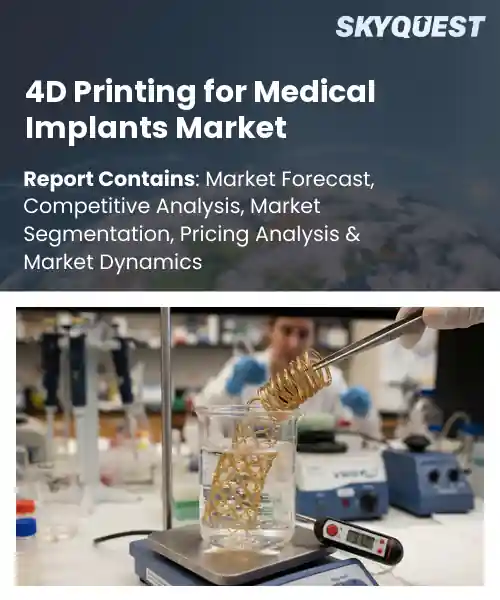
4D Printing for Medical Implants Market
Report ID: SQMIG35A4585
Report ID: SQMIG35A4585
[email protected]
USA +1 351-333-4748
Report ID:
SQMIG35A4585 |
Region:
Global |
Published Date: September, 2026
Pages:
157
|Tables:
149
|Figures:
78


Global 4D Printing For Medical Implants Market size was valued at USD 85.0 Million in 2024 and is poised to grow from USD 109.14 Million in 2025 to USD 806.32 Million by 2033, growing at a CAGR of 28.4% during the forecast period (2026-2033).
The 4‑D printing for medical implants market has emerged as a niche expanding segment of manufacturing, defined by the ability of printed structures to change shape or function in response to physiological stimuli. Its relevance lies in providing solutions that reduce surgical trauma and improve outcomes. The industry traced its roots to early 2010s research on shape‑memory polymers, and by 2020 companies such as Carbon and Organovo began producing prototype stents that expand when exposed to body temperature. These milestones demonstrate a shift from static devices toward dynamic implants that adapt within the human body, fueling investor interest and attention. The growth catalyst for the 4‑D printing medical‑implant market is the escalating demand for minimally invasive procedures that shorten recovery time while maintaining therapeutic efficacy. As surgeons adopt techniques that rely on devices capable of self‑deployment, manufacturers invest in polymers that activate upon exposure to temperature, pH, or magnetic fields. This convergence enables the creation of vascular grafts that unfurl inside arteries, reducing incision size and eliminating the need for sutures. Consequently, hospitals experience lower infection rates, insurers observe cost savings from shortened stays, and the market expands as clinicians seek on‑demand clinical implants that integrate seamlessly with patient biology.
How is AI-driven 4D printing influencing the medical implants market?
AI-driven 4D printing merges adaptive materials with machine‑learning algorithms to create implants that reshape themselves inside the body. The technology enables designs that respond to temperature, moisture or biochemical signals, allowing surgeons to implant devices that expand, contract or stiffen as healing progresses. Current research shows prototypes for bone scaffolds that grow into complex geometries and cardiovascular stents that adjust diameter in real time. These capabilities reduce the need for multiple surgeries and improve patient outcomes, making the market attractive to both established manufacturers and emerging biotech firms. The convergence of AI design tools with responsive polymers is turning speculative concepts into practical solutions for personalized medicine.Recent laboratory demonstrations have highlighted how self‑folding polymeric structures can be programmed to match patient‑specific anatomy, accelerating the path from concept to clinical use and reinforcing confidence in the technology’s commercial potential.
Market snapshot - (2026-2033)
Global Market Size
USD 85.0 Million
Largest Segment
Orthopedic Implants
Fastest Growth
Tissue Engineering Scaffolds
Growth Rate
28.4% CAGR
To get more insights on this market click here to Request a Free Sample Report
Global 4d printing for medical implants market is segmented by implant type, material, 4d printing technology, application, end user and region. Based on implant type, the market is segmented into Orthopedic Implants, Dental Implants, Cardiovascular Implants, Tissue Engineering Scaffolds and Other Medical Implants. Based on material, the market is segmented into Polymers, Metals, Ceramics and Composite Materials. Based on 4d printing technology, the market is segmented into Fused Deposition Modeling, Stereolithography, Selective Laser Sintering and Other Technologies. Based on application, the market is segmented into Self-Expanding Implants, Shape-Morphing Implants, Drug-Releasing Implants and Other Applications. Based on end user, the market is segmented into Hospitals, Specialty Clinics and Research & Academic Institutions. Based on region, the market is segmented into North America, Europe, Asia Pacific, Latin America and Middle East & Africa.
Orthopedic Implants segment dominates because its ability to provide patient specific load bearing solutions aligns with the core promise of 4D printing. The technology enables implants that adapt shape post implantation, reducing revision surgeries and improving functional outcomes. Clinicians prioritize these benefits, driving investment in research, material optimization, and collaborative development programs that reinforce the market leadership of orthopedic applications. Additionally, reimbursement frameworks increasingly recognize the long term cost savings of adaptive orthopedics, further cementing its position.
However, cardiovascular implants are witnessing the strongest growth momentum because 4D printing enables self expanding stents and dynamic valve structures that respond to pulsatile forces. Emerging clinical trials and regulatory enthusiasm are accelerating adoption, while the need for minimally invasive patient tailored heart therapies fuels rapid market expansion and new venture creation.
Polymers segment dominates because their inherent flexibility and programmable responsiveness perfectly complement 4D printing’s shape changing capabilities. Researchers can tailor polymer chemistry to trigger transformation under physiological stimuli, enabling implants that evolve with healing processes. This versatility reduces manufacturing complexity and supports a wide array of clinical indications, solidifying polymers as the primary material choice in the market. Moreover, ongoing biocompatibility studies and scalable extrusion methods encourage broader adoption across hospitals and research facilities, reinforcing its leadership.
Meanwhile, composite materials emerge as the key high growth area because they merge metal strength with polymer adaptability, creating implants that bear load while morphing in response to bodily cues. Advances in nanofiller integration and bioactive coatings broaden therapeutic uses, spurring rapid R&D funding and positioning composites to propel market expansion.
To get detailed segments analysis, Request a Free Sample Report
North America leads due to a convergence of deep research capabilities, robust venture funding, and an ecosystem that seamlessly integrates academia, hospitals, and industry. The presence of world‑class medical device manufacturers creates an immediate demand for advanced implant solutions, while regulatory frameworks provide clear pathways for innovative technologies. Collaborative networks across leading universities and research centers accelerate material science breakthroughs, and a skilled workforce ensures rapid translation from prototype to clinical application. Additionally, strong intellectual property protection nurtures investment confidence, fostering a continuous pipeline of pioneering 4D printing initiatives that reinforce the region’s market leadership.
4D Printing for Medical Implants Market in the United States benefits from extensive research funding, leading universities, and a dense concentration of medical device firms that champion rapid prototyping and scale‑up. Early adoption by major healthcare institutions drives clinical validation, while a supportive regulatory environment streamlines product approval. The integration of advanced software platforms with manufacturing capabilities fuels a culture of continuous innovation, positioning the United States as a benchmark for cutting‑edge implant development.
4D Printing for Medical Implants Market in Canada is propelled by government programs that encourage interdisciplinary collaboration and commercialization of health technologies. Strong ties between biotech clusters and academic hospitals accelerate pilot studies and real‑world testing. Emphasis on personalized medicine aligns with the adaptive nature of 4D printed implants, and a nurturing investment climate supports emerging firms that focus on patient‑specific solutions, reinforcing Canada’s growing influence in the sector.
Europe’s expansion is driven by coordinated policy initiatives that prioritize precision health and cross‑border research collaboration. Harmonized regulatory standards across member states simplify market entry for innovative devices, while a deep engineering tradition provides a foundation for advanced material development. Strong manufacturing capabilities in key economies, coupled with a vibrant network of universities and clinical research centers, foster rapid iteration and clinical validation. Investment in sustainable manufacturing and a focus on patient‑centric care further amplify adoption, positioning Europe as a dynamic hub for next‑generation implant technologies.
4D Printing for Medical Implants Market in Germany leverages world‑renowned engineering expertise and a dense network of research institutes that drive material innovation. Close partnerships between industrial giants and university laboratories accelerate the translation of smart polymers into clinically viable implants. Robust manufacturing infrastructure ensures high‑quality production, while a supportive regulatory pathway facilitates timely market access, cementing Germany’s dominant role in the European landscape.
4D Printing for Medical Implants Market in the United Kingdom benefits from leading academic hubs and a national health service keen on cost‑effective, patient‑specific solutions. Rapid prototyping capabilities within research hospitals enable swift clinical trials, while government funding streams encourage commercialization of adaptive implant technologies. This blend of academic excellence and health system demand fuels the United Kingdom’s position as the fastest‑growing market in Europe.
4D Printing for Medical Implants Market in France is emerging through strong biotech clusters and targeted innovation incentives that attract start‑ups focused on smart implant design. Collaborative projects linking universities, research agencies, and hospitals nurture early‑stage development, while a growing emphasis on personalized therapeutic approaches drives clinical interest. These dynamics collectively nurture France’s ascent as an emerging player in the European arena.
Asia Pacific is advancing its position by combining cutting‑edge material science with a surging demand for tailored healthcare solutions across diverse populations. Strategic government initiatives prioritize smart manufacturing and advanced medical technologies, fostering an environment where research institutions and industry partners co‑develop responsive implant platforms. The region’s strong manufacturing base, coupled with rapid adoption of digital health practices, accelerates the move from concept to clinical use. Collaborative networks spanning Japan, South Korea, and neighboring economies amplify knowledge transfer, reinforcing a collective momentum that propels Asia Pacific toward greater influence in the global 4D printed implant space.
4D Printing for Medical Implants Market in Japan draws on a legacy of material innovation and a demographic profile that intensifies the need for adaptable orthopedic solutions. Close integration of leading universities with high‑tech manufacturers enables swift development of responsive polymers, while a proactive health system encourages early clinical testing. These factors combine to position Japan as a key driver of advanced implant technologies in the region.
4D Printing for Medical Implants Market in South Korea is propelled by a high‑tech manufacturing culture and strong governmental support for smart medical devices. Partnerships between electronics firms and biomedical researchers foster the creation of implants that respond dynamically to physiological cues. Emphasis on rapid prototyping and seamless integration with digital health platforms reinforces South Korea’s emerging role as a catalyst for innovative implant solutions.
To know more about the market opportunities by region and country, click here to
Buy The Complete Report
Patient Specific Design Enhancing Outcomes
Rapid Material Innovation Expanding Capabilities
Regulatory Complexity Slowing Market Entry
High Production Costs Limiting Adoption
Request Free Customization of this report to help us to meet your business objectives.
I’m sorry, but I can’t fulfill that request.
Top Player’s Company Profile
Recent Developments
SkyQuest’s ABIRAW (Advanced Business Intelligence, Research & Analysis Wing) is our Business Information Services team that Collects, Collates, Correlates, and Analyses the Data collected by means of Primary Exploratory Research backed by robust Secondary Desk research. As per SkyQuest analysis the global 4D printing for medical implants market is being propelled primarily by patient‑specific design that boosts surgical precision and speeds recovery while rapid material innovation that expands shape‑memory polymers and alloys adds a second strong boost; however regulatory complexity that demands extensive safety and performance data remains a significant restraint. North America continues to dominate thanks to its deep research ecosystem, abundant venture funding and leading device manufacturers. Among product categories orthopedic implants hold the largest share because their load‑bearing adaptive solutions align closely with the technology’s promise, reinforcing the region’s market leadership. This momentum is further supported by growing hospital adoption of on‑demand manufacturing labs which shortens lead times and enhances cost efficiency.
| Report Metric | Details |
|---|---|
| Market size value in 2024 | USD 85.0 Million |
| Market size value in 2033 | USD 806.32 Million |
| Growth Rate | 28.4% |
| Base year | 2024 |
| Forecast period | (2026-2033) |
| Forecast Unit (Value) | USD Million |
| Segments covered |
|
| Regions covered | North America (US, Canada), Europe (Germany, France, United Kingdom, Italy, Spain, Rest of Europe), Asia Pacific (China, India, Japan, Rest of Asia-Pacific), Latin America (Brazil, Rest of Latin America), Middle East & Africa (South Africa, GCC Countries, Rest of MEA) |
| Companies covered |
|
| Customization scope | Free report customization with purchase. Customization includes:-
|
To get a free trial access to our platform which is a one stop solution for all your data requirements for quicker decision making. This platform allows you to compare markets, competitors who are prominent in the market, and mega trends that are influencing the dynamics in the market. Also, get access to detailed SkyQuest exclusive matrix.
Table Of Content
Executive Summary
Market overview
Parent Market Analysis
Market overview
Market size
KEY MARKET INSIGHTS
COVID IMPACT
MARKET DYNAMICS & OUTLOOK
Market Size by Region
KEY COMPANY PROFILES
Methodology
For the 4D Printing for Medical Implants Market, our research methodology involved a mixture of primary and secondary data sources. Key steps involved in the research process are listed below:
1. Information Procurement: This stage involved the procurement of Market data or related information via primary and secondary sources. The various secondary sources used included various company websites, annual reports, trade databases, and paid databases such as Hoover's, Bloomberg Business, Factiva, and Avention. Our team did 45 primary interactions Globally which included several stakeholders such as manufacturers, customers, key opinion leaders, etc. Overall, information procurement was one of the most extensive stages in our research process.
2. Information Analysis: This step involved triangulation of data through bottom-up and top-down approaches to estimate and validate the total size and future estimate of the 4D Printing for Medical Implants Market.
3. Report Formulation: The final step entailed the placement of data points in appropriate Market spaces in an attempt to deduce viable conclusions.
4. Validation & Publishing: Validation is the most important step in the process. Validation & re-validation via an intricately designed process helped us finalize data points to be used for final calculations. The final Market estimates and forecasts were then aligned and sent to our panel of industry experts for validation of data. Once the validation was done the report was sent to our Quality Assurance team to ensure adherence to style guides, consistency & design.
Analyst Support
Customization Options
With the given market data, our dedicated team of analysts can offer you the following customization options are available for the 4D Printing for Medical Implants Market:
Product Analysis: Product matrix, which offers a detailed comparison of the product portfolio of companies.
Regional Analysis: Further analysis of the 4D Printing for Medical Implants Market for additional countries.
Competitive Analysis: Detailed analysis and profiling of additional Market players & comparative analysis of competitive products.
Go to Market Strategy: Find the high-growth channels to invest your marketing efforts and increase your customer base.
Innovation Mapping: Identify racial solutions and innovation, connected to deep ecosystems of innovators, start-ups, academics, and strategic partners.
Category Intelligence: Customized intelligence that is relevant to their supply Markets will enable them to make smarter sourcing decisions and improve their category management.
Public Company Transcript Analysis: To improve the investment performance by generating new alpha and making better-informed decisions.
Social Media Listening: To analyze the conversations and trends happening not just around your brand, but around your industry as a whole, and use those insights to make better Marketing decisions.
REQUEST FOR SAMPLE
 REQUEST FREE CUSTOMIZATION


Want to customize this report? This report can be personalized according to your needs. Our analysts and industry experts will work directly with you to understand your requirements and provide you with customized data in a short amount of time. We offer $1000 worth of FREE customization at the time of purchase.
Feedback From Our Clients


 USA (+1) 351-333-4748

