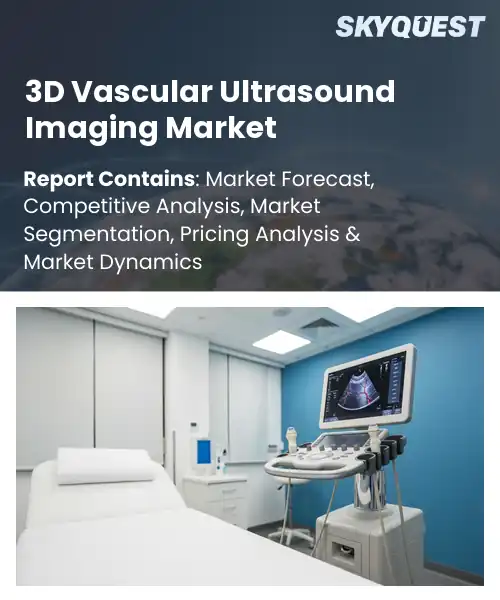
3D Vascular Ultrasound Imaging Market
Report ID: SQMIG20I2777
Report ID: SQMIG20I2777
[email protected]
USA +1 351-333-4748
Report ID:
SQMIG20I2777 |
Region:
Global |
Published Date: April, 2026
Pages:
157
|Tables:
117
|Figures:
77


Global 3D Vascular Ultrasound Imaging Market size was valued at USD 3.42 Billion in 2024 and is poised to grow from USD 3.81 Billion in 2025 to USD 3.4 Billion by 2033, growing at a CAGR of 11.4% during the forecast period (2026-2033).
The primary driver behind the 3D vascular ultrasound imaging market is the convergence of rising vascular disease burden and advances in imaging technology. This market comprises systems that capture volumetric blood vessel data to support diagnosis and intervention, and it matters because noninvasive, real time visualization reduces risks while improving surgical planning and monitoring. Historically the field evolved from planar Doppler studies to matrix array transducers and real time volumetric rendering, with contrast enhancement and fusion imaging accelerating adoption. For example, 3D carotid plaque assessment informs stroke risk stratification, and volumetric mapping guides peripheral artery revascularization, demonstrating clinical impact today.One pivotal factor driving global market expansion is the rapid integration of advanced software and machine learning into 3D vascular ultrasound platforms, because automated quantification reduces operator variability and shortens diagnostic time which encourages hospital adoption. Consequently clinicians can better stratify plaque vulnerability and plan endovascular repairs, producing fewer contrast related complications and reduced procedure duration. Furthermore increasing availability of lower cost portable systems and telemedicine workflows enables community based screening, which uncovers disease earlier and creates new revenue streams. These causal chains expand demand for interventional guidance, preventive programs and deployments across emerging markets with constrained imaging infrastructure globally.
How is AI improving diagnostic accuracy in the 3D vascular ultrasound imaging market?
AI is improving diagnostic accuracy in the 3D vascular ultrasound imaging market by automating image capture and advanced interpretation, which reduces operator variability and reveals subtle plaque morphology and complex flow patterns that are hard to see on 2D scans. Machine learning models now assist with segmentation, volumetric reconstruction and automated lesion highlighting, so clinicians receive standardized 3D visualizations and annotated findings that support clearer decision making and faster reporting. Vendors and clinical teams are adopting these AI driven workflows to improve consistency across sites and to integrate 3D vascular views into treatment planning and follow up.Sonaro, February 2026, introduced Vaso3D an AI driven platform that converts routine carotid sweeps into detailed 3D models and automated plaque analysis which reduces operator dependence and strengthens visualization. This real world innovation helps boost diagnostic confidence and accelerates adoption of 3D vascular ultrasound in clinical practice.
Market snapshot - (2026-2033)
Global Market Size
USD 3.42 Billion
Largest Segment
Cart-based 3D Ultrasound Systems
Fastest Growth
Compact/Portable 3D Vascular Devices
Growth Rate
11.4% CAGR
To get more insights on this market click here to Request a Free Sample Report
Global 3d vascular ultrasound imaging market is segmented by product type, clinical application, technology interface, end-user facility and region. Based on product type, the market is segmented into Cart-based 3D Ultrasound Systems and Compact/Portable 3D Vascular Devices. Based on clinical application, the market is segmented into Peripheral Vascular Disease (PVD), Deep Vein Thrombosis (DVT) Screening, Carotid Artery Imaging & Plaque Analysis and Abdominal Aortic Aneurysm (AAA). Based on technology interface, the market is segmented into Color Doppler 3D Imaging, Power Doppler & B-mode Integration and AI-automated Vessel Measurement. Based on end-user facility, the market is segmented into Hospitals & Cardiology Centers, Diagnostic Imaging Centers and Specialized Vascular Surgery Clinics. Based on region, the market is segmented into North America, Europe, Asia Pacific, Latin America and Middle East & Africa.
Color Doppler 3D Imaging segment dominates because it combines volumetric anatomy with real-time flow mapping to give clinicians richer hemodynamic context during vascular exams. This convergence reduces diagnostic ambiguity and fits existing Doppler workflows, prompting preference in equipment procurement. Vendors invest in color fidelity, probe design, and software ergonomics, reinforcing clinical trust and accelerating adoption across diagnostic and interventional vascular settings.
However, AI-automated Vessel Measurement is witnessing the strongest growth momentum because intelligent quantification tools standardize lumen and plaque metrics, cut exam time, and lower inter-operator variability. Growing clinical validation and vendor integration with imaging platforms boost clinician confidence, expand indications, and create new workflow efficiencies that drive broader uptake and stimulate further innovation in measurement-driven applications.
Compact/Portable 3D Vascular Devices segment dominates because mobility and simplified deployment extend advanced vascular imaging to bedside, clinics, and outreach settings, lowering access barriers and enabling rapid screening. Their lightweight form factor and streamlined interfaces align with clinician demand for point of care capability, prompting purchasing choices that favor portability and encouraging manufacturers to optimize battery life, connectivity, and probe miniaturization.
Meanwhile, Cart-based 3D Ultrasound Systems are witnessing the strongest growth momentum because institutional buyers seek high-fidelity imaging, advanced Doppler integration, and platform extensibility for complex vascular procedures. Their ability to host multi-probe workflows, larger displays, and modular software upgrades supports specialty practice requirements and long-term capital investment, creating opportunities for premium feature development and cross-platform clinical integration.
To get detailed segments analysis, Request a Free Sample Report
North America dominates due to a convergence of mature healthcare infrastructure, concentrated innovation, and supportive reimbursement and regulatory frameworks that favor adoption of advanced diagnostic modalities. A dense network of academic medical centers and specialist clinicians fosters early clinical evaluation and diffusion of three dimensional vascular ultrasound technologies, while leading manufacturers and research institutions drive continuous product refinement and evidence generation. Collaborative ecosystems between industry and clinical stakeholders facilitate training programs and pilot deployments, accelerating clinical acceptance. Strong private sector investment and centralized procurement by large health systems further amplify market penetration, and regulatory clarity around imaging device approvals and concentrated post market support also reduce adoption barriers and encourage continued investment in advanced ultrasound solutions.
3D Vascular Ultrasound Imaging Market in United States is characterized by early clinical adoption, intensive research activity, and a high concentration of device manufacturers and specialized vascular centers. Market momentum is driven by established reimbursement pathways, extensive clinical trial infrastructure, and strong partnerships between industry and academic hospitals that facilitate rapid product validation and clinician training. This environment fosters iterative innovation and integration of advanced vascular ultrasound into diagnostic workflows.
3D Vascular Ultrasound Imaging Market in Canada benefits from centralized healthcare delivery, coordinated procurement by public health authorities, and strong links between hospitals and research networks. Clinical adoption is supported by focused pilot programs, clinician education initiatives, and collaborations that prioritize accessibility and effective imaging solutions. A pragmatic approach to technology evaluation and integration promotes uptake across tertiary and community care settings while encouraging local adaptation of advanced ultrasound workflows.
Rapid expansion across Europe is propelled by a combination of health policy emphasis on cost efficient diagnostics, growing clinical acceptance of three dimensional vascular ultrasound, and strategic investments in imaging infrastructure. National healthcare systems prioritize diagnostic pathways that reduce invasive procedures, creating a receptive environment for advanced ultrasound as a non invasive alternative. Pan European collaboration among clinical societies and research consortia generates comparative evidence and best practice guidelines that support wider clinician adoption. Strong domestic manufacturing in key markets, active distribution networks, and targeted training initiatives help translate evidence into clinical practice. Additionally, centralized procurement frameworks and cross border knowledge exchange accelerate deployment in both tertiary and regional care settings, and regulatory alignment across markets reduces barriers to adoption.
3D Vascular Ultrasound Imaging Market in Germany is anchored by a robust medical device manufacturing base, advanced hospital infrastructure, and close collaboration between industry and clinical research centers. Early clinical validation and established integration pathways within large academic hospitals support rapid uptake. Strong clinician expertise in vascular imaging and structured continuing education programs ensure confident use of three dimensional techniques. Central procurement practices in tertiary care effectively consolidate market leadership.
3D Vascular Ultrasound Imaging Market in United Kingdom is experiencing rapid momentum driven by proactive adoption programs within national health services and specialty clinics. Strategic partnerships among developers, academic centers, and clinical networks accelerate evidence generation and deployment. Emphasis on digital integration and clinician upskilling enables application of three dimensional techniques. Procurement pilots and innovation hubs support rollouts, enhancing clinician confidence and patient access to advanced non invasive vascular imaging.
3D Vascular Ultrasound Imaging Market in France is emerging through targeted adoption in leading hospitals and regional clinical networks. National evaluation frameworks and hospital technology committees apply pragmatic assessments that favor demonstrable clinical value and efficiency. Collaborative initiatives among clinicians, manufacturers, and academic groups foster evidence generation and training. Emphasis on interoperable imaging systems and alignment with broader diagnostic pathways effectively supports scaling from tertiary centers into broader care settings.
Asia Pacific is strengthening its market position through coordinated enhancements in clinical capacity, domestic manufacturing, and targeted adoption strategies tailored to regional healthcare systems. Investment in hospital modernization and imaging infrastructure, alongside pragmatic regulatory pathways, enables faster device evaluation and uptake in advanced centers. Strategic partnerships between global vendors and local distributors facilitate market access and post market support, while focused training programs build clinician proficiency in three dimensional vascular imaging techniques. Growing emphasis on cost efficient, non invasive diagnostics drives adoption in both tertiary hospitals and emerging regional centers, and increasing clinical collaboration fosters localized evidence that supports broader integration across diverse care settings. Market dynamics also reflect growing patient demand for less invasive vascular assessment and expanding telehealth enabled workflows that incorporate advanced ultrasound imaging into multi modal diagnostic pathways.
3D Vascular Ultrasound Imaging Market in Japan is driven by advanced hospital infrastructure, strong domestic device development, and emphasis on precision diagnostics. Collaboration between manufacturers and academic centers supports iterative product refinement and robust clinical evaluation. Adoption is supported by focused clinician training programs and integration with broader imaging workflows in tertiary hospitals. Well established distribution networks and emphasis on interoperable, high quality ultrasound solutions broadly support market adoption.
3D Vascular Ultrasound Imaging Market in South Korea benefits from a vibrant medical technology sector, strong integration of advanced electronics expertise, and proactive hospital modernization initiatives. Collaboration between innovative device developers and leading clinical centers accelerates local validation and deployment. Emphasis on compact, high performance imaging systems aligns with demand across specialized vascular clinics and tertiary hospitals. Focused training programs and efficient distribution channels support clinician adoption and regional exports.
To know more about the market opportunities by region and country, click here to
Buy The Complete Report
Growing Clinical Adoption Of 3D Ultrasound
Technological Advancements In Imaging Platforms
High Equipment Acquisition And Maintenance Costs
Limited Availability Of Skilled Personnel
Request Free Customization of this report to help us to meet your business objectives.
Competitive landscape is defined by incumbent consolidation and startup driven volumetric and AI innovations, with M&A and strategic partnerships accelerating capability integration. Large vendors have acquired clinical AI assets and formed co development deals while startups pursue cloud based 3D reconstruction and hospital pilots. Examples include GE HealthCare’s acquisition of clinical AI, Butterfly Network’s AI gestational tool deployment, Vortex Imaging R&D awards, and VeinTech US expansion.
Top Player’s Company Profile
Recent Developments
SkyQuest’s ABIRAW (Advanced Business Intelligence, Research & Analysis Wing) is our Business Information Services team that Collects, Collates, Correlates, and Analyses the Data collected by means of Primary Exploratory Research backed by robust Secondary Desk research. As per SkyQuest analysis, the global 3D vascular ultrasound imaging market is propelled primarily by a rising vascular disease burden and parallel advances in imaging technology, while the rapid integration of AI and advanced software platforms is a second key driver that improves automated quantification and workflow efficiency. Adoption is tempered by high equipment acquisition and maintenance costs that limit purchases in smaller centers. North America remains the dominating region due to mature healthcare infrastructure, reimbursement support and concentrated innovation, and the Color Doppler 3D Imaging segment leads market share by combining volumetric anatomy with real-time flow mapping that aligns with existing clinical workflows and procurement preferences.
| Report Metric | Details |
|---|---|
| Market size value in 2024 | USD 3.42 Billion |
| Market size value in 2033 | USD 3.4 Billion |
| Growth Rate | 11.4% |
| Base year | 2024 |
| Forecast period | (2026-2033) |
| Forecast Unit (Value) | USD Billion |
| Segments covered |
|
| Regions covered | North America (US, Canada), Europe (Germany, France, United Kingdom, Italy, Spain, Rest of Europe), Asia Pacific (China, India, Japan, Rest of Asia-Pacific), Latin America (Brazil, Rest of Latin America), Middle East & Africa (South Africa, GCC Countries, Rest of MEA) |
| Companies covered |
|
| Customization scope | Free report customization with purchase. Customization includes:-
|
To get a free trial access to our platform which is a one stop solution for all your data requirements for quicker decision making. This platform allows you to compare markets, competitors who are prominent in the market, and mega trends that are influencing the dynamics in the market. Also, get access to detailed SkyQuest exclusive matrix.
Table Of Content
Executive Summary
Market overview
Parent Market Analysis
Market overview
Market size
KEY MARKET INSIGHTS
COVID IMPACT
MARKET DYNAMICS & OUTLOOK
Market Size by Region
KEY COMPANY PROFILES
Methodology
For the 3D Vascular Ultrasound Imaging Market, our research methodology involved a mixture of primary and secondary data sources. Key steps involved in the research process are listed below:
1. Information Procurement: This stage involved the procurement of Market data or related information via primary and secondary sources. The various secondary sources used included various company websites, annual reports, trade databases, and paid databases such as Hoover's, Bloomberg Business, Factiva, and Avention. Our team did 45 primary interactions Globally which included several stakeholders such as manufacturers, customers, key opinion leaders, etc. Overall, information procurement was one of the most extensive stages in our research process.
2. Information Analysis: This step involved triangulation of data through bottom-up and top-down approaches to estimate and validate the total size and future estimate of the 3D Vascular Ultrasound Imaging Market.
3. Report Formulation: The final step entailed the placement of data points in appropriate Market spaces in an attempt to deduce viable conclusions.
4. Validation & Publishing: Validation is the most important step in the process. Validation & re-validation via an intricately designed process helped us finalize data points to be used for final calculations. The final Market estimates and forecasts were then aligned and sent to our panel of industry experts for validation of data. Once the validation was done the report was sent to our Quality Assurance team to ensure adherence to style guides, consistency & design.
Analyst Support
Customization Options
With the given market data, our dedicated team of analysts can offer you the following customization options are available for the 3D Vascular Ultrasound Imaging Market:
Product Analysis: Product matrix, which offers a detailed comparison of the product portfolio of companies.
Regional Analysis: Further analysis of the 3D Vascular Ultrasound Imaging Market for additional countries.
Competitive Analysis: Detailed analysis and profiling of additional Market players & comparative analysis of competitive products.
Go to Market Strategy: Find the high-growth channels to invest your marketing efforts and increase your customer base.
Innovation Mapping: Identify racial solutions and innovation, connected to deep ecosystems of innovators, start-ups, academics, and strategic partners.
Category Intelligence: Customized intelligence that is relevant to their supply Markets will enable them to make smarter sourcing decisions and improve their category management.
Public Company Transcript Analysis: To improve the investment performance by generating new alpha and making better-informed decisions.
Social Media Listening: To analyze the conversations and trends happening not just around your brand, but around your industry as a whole, and use those insights to make better Marketing decisions.
REQUEST FOR SAMPLE
 REQUEST FREE CUSTOMIZATION


Want to customize this report? This report can be personalized according to your needs. Our analysts and industry experts will work directly with you to understand your requirements and provide you with customized data in a short amount of time. We offer $1000 worth of FREE customization at the time of purchase.
Feedback From Our Clients


 USA (+1) 351-333-4748

