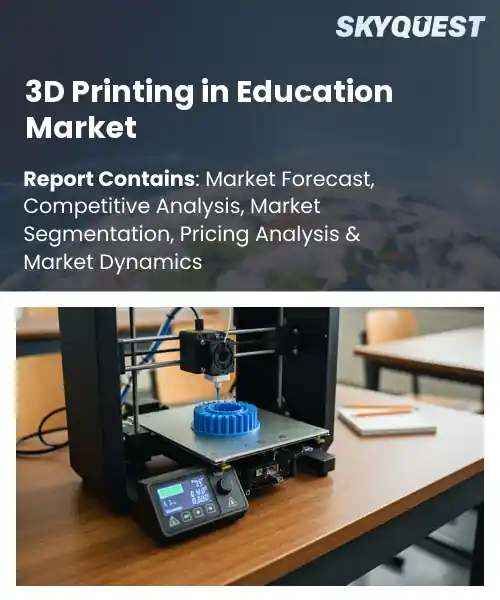
3D Printing in Education Market
Report ID: SQMIG20I2779
Report ID: SQMIG20I2779
[email protected]
USA +1 351-333-4748
Report ID:
SQMIG20I2779 |
Region:
Global |
Published Date: April, 2026
Pages:
157
|Tables:
119
|Figures:
77


Global 3D Printing In Education Market size was valued at USD 1.37 Billion in 2024 and is poised to grow from USD 1.57 Billion in 2025 to USD 1.3 Billion by 2033, growing at a CAGR of 14.8% during the forecast period (2026-2033).
The driver of 3D printing in the education market is the shift toward experiential STEM learning and vocational training that prioritizes hands on prototyping and design thinking to prepare students for advanced manufacturing roles. The market spans hardware, software, consumables, curricular content and training services across K to 12, and higher education, and it matters because tangible models accelerate comprehension, foster creativity and connect learning with industry practice. Development moved from costly industrial systems to desktop FDM printers and open source tools, and examples like medical schools using anatomical models and makerspaces illustrate how accessibility and curriculum integration have driven adoption.Building on widespread accessibility, the key factor driving global growth is the maturation of an integrated ecosystem of lower cost hardware, teacher focused curricula and cloud based design tools, because when schools can afford printers and receive pedagogical support they implement projects aligned to standards, workforce needs. Consequently districts reallocate budgets toward makerspaces, vendors scale education offerings and partnerships enable internships and certifications. Real world cases include medical programs using printed models to cut lab expenses and engineering classes that speed prototyping cycles, which produce measurable learning gains and open market opportunities for service providers, content developers and teacher training.
How is AI enhancing curriculum outcomes in the 3D printing in education market?
AI is improving curriculum outcomes in 3D printing education by automating routine tasks and making learning more adaptive. Key aspects are AI assisted design generation, automated print preparation, real time defect detection and personalized feedback that aligns projects to learning goals. Today many schools pair printers with smart software so teachers spend less time troubleshooting and more time coaching design thinking and interdisciplinary projects. Vendors are increasingly offering integrated hardware software ecosystems and ready made resources so classroom activities run more reliably. Examples include tools that suggest print orientation, flag likely failures before printing, and translate complex workflows into step by step guidance.Stratasys February 2026, introduced anatomically accurate 3D printed dental training models and linked simulation tools that replace cadavers in labs. When paired with AI driven simulation and automated print workflows this development helps educators deliver repeatable realistic practice, reduces resource burden and streamlines skills assessment for faster curriculum adoption.
Market snapshot - (2026-2033)
Global Market Size
USD 1.37 Billion
Largest Segment
3D Printers (Desktop/Industrial)
Fastest Growth
Educational Curriculum & Support Services
Growth Rate
14.8% CAGR
To get more insights on this market click here to Request a Free Sample Report
Global 3d printing in education market is segmented by offering component, process technology, educational level, application area and region. Based on offering component, the market is segmented into 3D Printers (Desktop/Industrial), 3D Printing Software (CAD/Slicing), Printing Materials (Polymers/Composites) and Educational Curriculum & Support Services. Based on process technology, the market is segmented into Material Extrusion (FDM/FFF), Vat Photopolymerization (SLA/DLP) and Powder Bed Fusion (SLS). Based on educational level, the market is segmented into K-12 Schools (STEM Education), Higher Education & Universities (R&D) and Vocational & Technical Training Centers. Based on application area, the market is segmented into Prototyping & Engineering Design, Medical & Biological Modeling and Art, Fashion & Creative Design Projects. Based on region, the market is segmented into North America, Europe, Asia Pacific, Latin America and Middle East & Africa.
3D Printers (Desktop/Industrial) segment dominates because these devices form the core tangible interface between learners and additive manufacturing concepts, providing hands-on prototyping and iterative design experiences that align with curricular learning objectives. Their broad appliance across classroom projects and institutional labs, coupled with increasingly accessible desktop models and robust industrial options for advanced research, drives institutional procurement, teacher adoption, and practical skill development that anchors market demand.
However, Educational Curriculum & Support Services is emerging as the fastest-growing area by delivering turnkey lesson plans, teacher training, and technical support that reduce implementation barriers. Emphasis on standardized STEM outcomes and vendor partnerships embedding curricular materials into classroom workflows accelerates adoption and creates sustained demand and further institutional investment.
Material Extrusion (FDM/FFF) segment dominates because its low-cost equipment, durable thermoplastic materials, and straightforward operation make it ideally suited for classroom environments where safety and repeatability matter. Teachers and technicians favor its minimal setup and predictable print outcomes, enabling rapid iterative prototyping, curriculum-aligned assignments, and broad maker activities that foster student engagement and foundational additive manufacturing skills, which in turn drives sustained institutional investment.
Meanwhile, Vat Photopolymerization (SLA/DLP) is rapidly expanding as accessible resin printers and finer resolution enable detailed models for medical, biological, and arts education. Improved resin safety and integrated workflow software broaden curricular applications, attracting specialized programs and generating higher-value educational use cases that stimulate demand for advanced training.
To get detailed segments analysis, Request a Free Sample Report
North America dominates due to a combination of mature educational infrastructure, a deep edtech ecosystem, and close alignment between industry and academic institutions. Established suppliers of printers, materials, and software maintain significant presence, supported by localized service networks and content providers that facilitate classroom adoption. Educator professional development, curriculum frameworks that emphasize hands on STEM learning, and widespread maker spaces enable practical deployment across multiple education tiers. Institutional procurement processes and collaborative research initiatives simplify integration, while workforce development priorities encourage adoption that ties classroom learning to applied manufacturing skills. Policy support and investment channels further reinforce vendor engagement and institutional readiness, making the region a hub for practical innovation and scalable implementation of additive manufacturing in education. Strong research networks amplify knowledge transfer and curriculum evolution.
3D Printing in Education Market in United States reflects deep integration of additive manufacturing across all education levels. Educators leverage practical lab work, interdisciplinary projects, and close industry collaborations to build technical and design skills. Extensive supplier presence, teacher development programs, and institutional procurement practices support scalable deployment. Emphasis on STEM learning and workforce readiness drives sustained interest from schools and colleges seeking experiential learning tools align with industry needs.
3D Printing in Education Market in Canada demonstrates coordinated adoption across school systems and postsecondary institutions, driven by provincial education strategies. Focus on experiential learning fosters maker spaces and curriculum modules that integrate design thinking and hands-on fabrication. Partnerships with local manufacturers and research centers enhance access to equipment and expertise, while teacher training initiatives help effectively embed additive manufacturing into lesson planning, preparing learners for technology rich educational environments.
Europe rapid expansion is driven by coordinated policy initiatives, strong vocational education traditions, and dense collaboration between industrial clusters and educational institutions. National and regional programs encourage the incorporation of additive manufacturing into technical training and project based learning, while robust networks of equipment suppliers and research centers facilitate pilot programs and knowledge sharing. Emphasis on applied skills in technical schools and universities aligns with employer needs, supporting curriculum modernization and teacher development. Cross border partnerships and public private cooperation enable scalable deployment and content localization. The market benefits from diversified vendor presence, focus on digital skills, and active engagement from industry consortia that help translate emerging technologies into classroom practice across diverse education systems. Strong emphasis on vocational pathways and apprenticeship models in several countries accelerates employer aligned adoption, while school modernization funding reduces barriers to trial and curricular adoption.
3D Printing in Education Market in Germany benefits from strong integration between manufacturing industry and vocational education, enabling practical training. Universities and vocational schools collaborate with local suppliers and research institutes to develop applied curricula and hands-on laboratories. Emphasis on apprenticeship models and industry aligned competencies supports adoption, while regional manufacturing clusters provide access to equipment and expertise. Institutional commitment to skills development ensures sustained incorporation into technical programs nationwide.
3D Printing in Education Market in United Kingdom is notable for rapid uptake driven by private sector and edtech startup engagement and curriculum initiatives. Schools and further education providers pilot innovative teaching models combining design, engineering, and digital fabrication. Industry partnerships and regional innovation hubs support teacher training and equipment access, while flexible procurement enables experimentation. Emphasis on employability and digital skills encourages integration into technical courses and maker programs.
3D Printing in Education Market in France is emerging through targeted initiatives that integrate additive manufacturing into STEAM education. National curriculum frameworks and regional pilot programs encourage experimentation in classrooms and labs, supported by research institutions and suppliers. Teacher training programs and content localization help overcome implementation barriers, while collaborations between education authorities and industry promote vocational alignment. Growing focus on practical design projects and curricular resources supports gradual expansion.
Asia Pacific is strengthening its role through strategic investments in STEM and technical education, growing domestic manufacturing capabilities, and targeted partnerships between industry and academic institutions. National strategies in several markets prioritize digital fabrication tools within vocational and higher education, supported by local vendors and research labs that adapt hardware and curricula to regional needs. Emphasis on precision engineering, robotics, and materials science aligns classroom learning with local industrial strengths. Educator training programs and regional innovation hubs facilitate hands on adoption, while collaborations with international suppliers accelerate access to best practice content. Urban education centers and technical colleges serve as deployment nodes, enabling broader replication and gradual diffusion of additive manufacturing into mainstream education pathways. Government supported pilot projects and industry funded labs foster localized curriculum development and teacher capacity building, supporting scalable integration across diverse education systems in the region.
3D Printing in Education Market in Japan leverages national engineering strengths and manufacturing ecosystem to integrate additive fabrication into technical education. Universities and research institutes collaborate with local vendors to tailor equipment and curricula for precision applications. Emphasis on robotics, materials research, and hands-on lab instruction supports advanced learning outcomes. Strong industry partnerships enable applied projects and internships, while educator training and innovation centers facilitate classroom adoption and curriculum alignment.
3D Printing in Education Market in South Korea advances through focused national initiatives, strong ties between electronics and materials industries, and technology-forward education policies. Schools, technical colleges, and universities incorporate additive fabrication into project-based learning and vocational tracks, supported by local manufacturers and research centers. Emphasis on digital literacy and practical skills drives adoption, while industry collaborations and educator training programs enable applied learning, internships and broader classroom access nationwide.
To know more about the market opportunities by region and country, click here to
Buy The Complete Report
Curriculum Integration Driving Adoption
Improved Affordability and Accessibility
Limited Teacher Expertise and Training
Health Safety and Compliance Concerns
Request Free Customization of this report to help us to meet your business objectives.
Competition in the global 3D printing education market centers on turnkey classroom solutions, curriculum integration and fleet management, prompting M&A and strategic partnerships to win institutional deals. Examples include Y Soft acquiring BE3D to build an education offer, Ultimaker’s scholarship tie up with the SME Foundation to expand school access, and product innovation from startups such as USEED’s voice activated printer.
Top Player’s Company Profile
Recent Developments
SkyQuest’s ABIRAW (Advanced Business Intelligence, Research & Analysis Wing) is our Business Information Services team that Collects, Collates, Correlates, and Analyses the Data collected by means of Primary Exploratory Research backed by robust Secondary Desk research. As per SkyQuest analysis, the global 3D printing in education market is driven by experiential STEM learning, which embeds hands-on prototyping and design thinking into curricula and accelerates institutional adoption. A second important driver is improved affordability and accessibility of desktop printers, software bundles and curricular resources that make pilots scalable. North America remains the dominating region due to mature edtech ecosystems, strong industry–academic ties and extensive teacher development programs, while the 3D Printers (Desktop/Industrial) segment dominates as the primary classroom interface for tangible learning. A key restraint is limited teacher expertise and training, which can hinder effective integration and undercut the pedagogical value of deployed systems.
| Report Metric | Details |
|---|---|
| Market size value in 2024 | USD 1.37 Billion |
| Market size value in 2033 | USD 1.3 Billion |
| Growth Rate | 14.8% |
| Base year | 2024 |
| Forecast period | (2026-2033) |
| Forecast Unit (Value) | USD Billion |
| Segments covered |
|
| Regions covered | North America (US, Canada), Europe (Germany, France, United Kingdom, Italy, Spain, Rest of Europe), Asia Pacific (China, India, Japan, Rest of Asia-Pacific), Latin America (Brazil, Rest of Latin America), Middle East & Africa (South Africa, GCC Countries, Rest of MEA) |
| Companies covered |
|
| Customization scope | Free report customization with purchase. Customization includes:-
|
To get a free trial access to our platform which is a one stop solution for all your data requirements for quicker decision making. This platform allows you to compare markets, competitors who are prominent in the market, and mega trends that are influencing the dynamics in the market. Also, get access to detailed SkyQuest exclusive matrix.
Table Of Content
Executive Summary
Market overview
Parent Market Analysis
Market overview
Market size
KEY MARKET INSIGHTS
COVID IMPACT
MARKET DYNAMICS & OUTLOOK
Market Size by Region
KEY COMPANY PROFILES
Methodology
For the 3D Printing in Education Market, our research methodology involved a mixture of primary and secondary data sources. Key steps involved in the research process are listed below:
1. Information Procurement: This stage involved the procurement of Market data or related information via primary and secondary sources. The various secondary sources used included various company websites, annual reports, trade databases, and paid databases such as Hoover's, Bloomberg Business, Factiva, and Avention. Our team did 45 primary interactions Globally which included several stakeholders such as manufacturers, customers, key opinion leaders, etc. Overall, information procurement was one of the most extensive stages in our research process.
2. Information Analysis: This step involved triangulation of data through bottom-up and top-down approaches to estimate and validate the total size and future estimate of the 3D Printing in Education Market.
3. Report Formulation: The final step entailed the placement of data points in appropriate Market spaces in an attempt to deduce viable conclusions.
4. Validation & Publishing: Validation is the most important step in the process. Validation & re-validation via an intricately designed process helped us finalize data points to be used for final calculations. The final Market estimates and forecasts were then aligned and sent to our panel of industry experts for validation of data. Once the validation was done the report was sent to our Quality Assurance team to ensure adherence to style guides, consistency & design.
Analyst Support
Customization Options
With the given market data, our dedicated team of analysts can offer you the following customization options are available for the 3D Printing in Education Market:
Product Analysis: Product matrix, which offers a detailed comparison of the product portfolio of companies.
Regional Analysis: Further analysis of the 3D Printing in Education Market for additional countries.
Competitive Analysis: Detailed analysis and profiling of additional Market players & comparative analysis of competitive products.
Go to Market Strategy: Find the high-growth channels to invest your marketing efforts and increase your customer base.
Innovation Mapping: Identify racial solutions and innovation, connected to deep ecosystems of innovators, start-ups, academics, and strategic partners.
Category Intelligence: Customized intelligence that is relevant to their supply Markets will enable them to make smarter sourcing decisions and improve their category management.
Public Company Transcript Analysis: To improve the investment performance by generating new alpha and making better-informed decisions.
Social Media Listening: To analyze the conversations and trends happening not just around your brand, but around your industry as a whole, and use those insights to make better Marketing decisions.
REQUEST FOR SAMPLE
 REQUEST FREE CUSTOMIZATION


Want to customize this report? This report can be personalized according to your needs. Our analysts and industry experts will work directly with you to understand your requirements and provide you with customized data in a short amount of time. We offer $1000 worth of FREE customization at the time of purchase.
Feedback From Our Clients


 USA (+1) 351-333-4748

