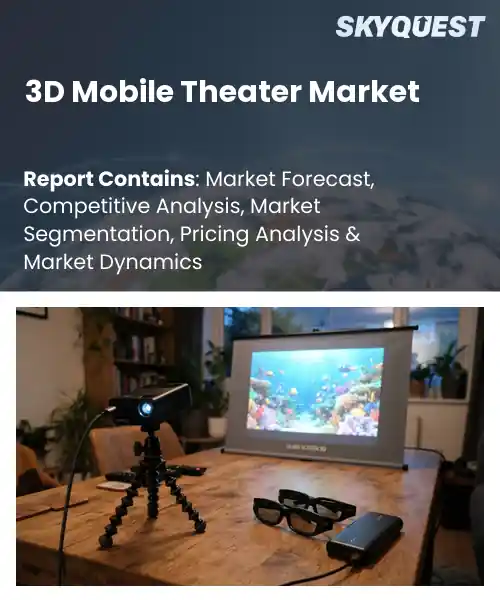
3D Mobile Theater Market
Report ID: SQMIG25E2308
Report ID: SQMIG25E2308
[email protected]
USA +1 351-333-4748
Report ID:
SQMIG25E2308 |
Region:
Global |
Published Date: September, 2026
Pages:
157
|Tables:
144
|Figures:
78


Global 3D Mobile Theater Market size was valued at USD 34.62 Billion in 2024 and is poised to grow from USD 37.53 Billion in 2025 to USD 71.56 Billion by 2033, growing at a CAGR of 8.4% during the forecast period (2026-2033).
The global 3D mobile theater market encompasses portable projection systems viewing platforms that deliver stereoscopic experiences on smartphones and tablets. Its significance lies in democratizing cinematic quality, allowing consumers to enjoy depth‑enhanced content without costly theater visits. The market emerged from the convergence of high‑resolution mobile displays, advances in head‑mounted lenses, and affordable 3D content libraries around 2015. Early adopters such as Samsung’s Gear VR paired with 3D streaming services demonstrated the model’s viability, while later entrants like Xiaomi’s Mi VR expanded reach in emerging economies. Consequently, the sector has evolved from niche gaming accessories to a mainstream entertainment channel. Content diversification drives the wave of expansion, as the availability of 3D-enabled streaming, educational modules, and advertising fuels consumer demand. When creators publish depth‑rich videos, users experience heightened immersion, which in turn encourages longer session times and willingness to spend on premium apps. Companies such as Netflix have launched 3D short‑form series optimized for mobile headsets, illustrating how platform support translates into subscriber growth. Retailers leverage AR‑enhanced product demos to convert online browsing into sales, demonstrating a revenue impact. Consequently, the convergence of varied content genres with affordable hardware creates a significant loop that accelerates market penetration and attracts investment.
How is AI enhancing content personalization in the 3D mobile theater market?
AI is reshaping content personalization in the 3D mobile theater market by learning user preferences, viewing habits and device context. Machine learning models analyze interaction patterns to suggest immersive storylines, adjust visual depth and tailor audio cues in real time. Today platforms embed AI to generate dynamic scene variations that match mood or location, while recommendation engines surface new experiences that align with individual taste. Developers also use AI to streamline asset creation, allowing faster rollout of customized environments. These advances make each viewing feel uniquely crafted and keep audiences returning for fresh, relevant content across diverse genres and platforms everydayMeta March 2024, launched an AI driven personalization layer for its Horizon Worlds mobile VR experience that adapts story arcs and visual effects to individual user behavior. This innovation speeds content discovery and deepens immersion, supporting market growth by delivering tailored 3D entertainment on handheld devices and engagement across global audiences
Market snapshot - (2026-2033)
Global Market Size
USD 34.62 Billion
Largest Segment
3D Mobile Cinemas
Fastest Growth
4D/5D Mobile Theaters
Growth Rate
8.4% CAGR
To get more insights on this market click here to Request a Free Sample Report
Global 3d mobile theater market is segmented by theater type, technology, venue type, application, revenue model and region. Based on theater type, the market is segmented into 3D Mobile Cinemas, 4D/5D Mobile Theaters and Other Immersive Mobile Theaters. Based on technology, the market is segmented into Stereoscopic 3D, Projection-Based 3D and LED-Based 3D. Based on venue type, the market is segmented into Mobile Trailers, Temporary Structures and Portable Indoor Setups. Based on application, the market is segmented into Entertainment, Education & Training and Promotional & Experiential Events. Based on revenue model, the market is segmented into Ticket-Based, Rental-Based and Sponsorship & Advertising. Based on region, the market is segmented into North America, Europe, Asia Pacific, Latin America and Middle East & Africa.
Stereoscopic 3d segment dominates because it delivers a familiar depth perception that aligns with consumer expectations from cinema and gaming, making deployment straightforward for operators. Its reliance on dual‑projector or glasses systems leverages existing content pipelines, reducing conversion costs. This ease of integration accelerates adoption across a variety of events, reinforcing its position as the core technology driving market traction and long‑term sustainability throughout the year.
Meanwhile, LED based 3d is emerging as the most rapidly expanding area because its bright panels eliminate ambient light constraints, enabling outdoor installations. Innovative thin form factor displays attract event marketers looking for striking visual impact, and ongoing reductions in panel costs encourage wider rollout. This momentum opens new revenue streams and broadens the market’s application landscape.
Entertainment segment leads because it taps into mass‑appeal content that naturally draws crowds, driving ticket sales and repeat visits. Established film releases and blockbuster franchises provide ready‑made libraries, reducing content creation barriers. This affinity for popular culture fuels word‑of‑mouth promotion and creates a vibrant ecosystem that sustains operator profitability and audience growth. Operators also add seasonal themes and live acts, boosting dwell time and unlocking extra food and merchandise sales.
Conversely, education & training is witnessing the strongest growth momentum because organizations adopt mobile 3d environments for development and safety simulations. The ability to bring scenarios to locations enhances learning retention, prompting schools and corporate programs to invest heavily. This surge expands market reach beyond entertainment and creates demand pipelines.
To get detailed segments analysis, Request a Free Sample Report
Asia Pacific combines a deep tradition of visual storytelling with cutting‑edge mobile technology ecosystems. Consumer enthusiasm for immersive experiences is reinforced by high penetration of advanced smartphones and a cultural affinity for animated and sci‑fi content. Regional manufacturers and component suppliers create a seamless supply chain that accelerates product rollout and reduces cost pressure. Strong government support for digital entertainment and robust intellectual property frameworks encourage local studios to invest heavily in 3D pipeline development. Collaborative partnerships between tech firms, content creators, and telecom operators generate a continuous flow of premium titles tailored to mobile consumption habits, cementing the region’s leadership in both creation and distribution of 3D mobile theater experiences.
Japan 3D Mobile Theater Market
3D Mobile Theater Market in Japan thrives on a legacy of high‑quality animation and manga that seamlessly translates to mobile formats. Consumer expectations for visual fidelity drive developers to adopt sophisticated rendering techniques, while major studios partner with mobile carriers to bundle exclusive releases. The convergence of strong hardware manufacturing capabilities and a vibrant creative community ensures a steady stream of culturally resonant content that fuels sustained interest across diverse demographics.
South Korea 3D Mobile Theater Market
3D Mobile Theater Market in South Korea benefits from a tech‑savvy population and a nationwide appetite for real‑time interactive entertainment. Leading smartphone manufacturers embed advanced graphics processors that enable smooth 3D playback, while local game studios leverage rapid development cycles to launch immersive titles. Aggressive marketing through social platforms and e‑sports integration amplifies user engagement, creating a dynamic environment where innovative storytelling and cutting‑edge hardware reinforce each other.
North America’s expansion is propelled by a confluence of strong entertainment ecosystems, affluent consumer bases, and a progressive approach to content distribution. Leading streaming services and mobile carriers collaborate to embed 3D experiences within subscription packages, reducing barriers to adoption. A dense network of independent developers and major studios fosters a diverse portfolio of genre‑spanning titles that cater to both casual viewers and dedicated enthusiasts. Robust broadband infrastructure and widespread device upgrades ensure high‑definition delivery, while marketing strategies that emphasize experiential value tap into a cultural trend toward immersive media consumption, accelerating market momentum across the continent.
United States 3D Mobile Theater Market
3D Mobile Theater Market in the United States thrives on a vibrant mix of Hollywood production expertise and Silicon Valley technology innovation. Major studios experiment with mobile‑first adaptations of blockbuster franchises, while agile startups push the envelope on interactive storytelling. Partnerships with major telecom providers enable seamless streaming, and consumer willingness to embrace premium subscriptions fuels demand for high‑quality 3D content across a broad demographic spectrum.
Canada 3D Mobile Theater Market
3D Mobile Theater Market in Canada leverages a bilingual audience and strong creative talent pool to produce content that resonates across cultural lines. Government incentives for digital media development attract both local and international producers, encouraging investment in sophisticated 3D pipelines. Collaboration between telecom operators and content creators ensures wide accessibility, while community‑driven platforms nurture niche genres that enrich the overall market landscape.
Europe reinforces its position through a blend of artistic heritage, regulatory support, and cross‑border collaboration among creators and technology firms. Cultural institutions fund experimental projects that integrate 3D mobile experiences with traditional storytelling, enhancing the artistic value of the medium. Harmonized data‑protection standards foster consumer confidence, encouraging broader adoption of premium services. Strategic alliances between hardware manufacturers, software developers, and streaming platforms streamline distribution channels, while multilingual content production expands reach across the continent, solidifying Europe’s reputation as a hub for innovative and culturally rich 3D mobile theater offerings.
Germany 3D Mobile Theater Market
3D Mobile Theater Market in Germany benefits from a robust engineering sector that supplies high‑performance mobile components, enabling smooth rendering of complex visual effects. Film studios and indie developers collaborate on projects that blend German cinematic traditions with interactive formats, attracting audiences seeking sophisticated narratives. Strong support from cultural funding bodies incentivizes experimentation, while partnerships with telecom providers guarantee reliable delivery of high‑definition streams nationwide.
United Kingdom 3D Mobile Theater Market
3D Mobile Theater Market in the United Kingdom draws on a rich legacy of theatre and visual arts, merging these traditions with cutting‑edge mobile technologies. Creative hubs in London and regional cities foster collaborations between storytellers and tech innovators, producing content that balances artistic depth with immersive interactivity. Broadcaster involvement and strategic agreements with mobile operators facilitate extensive rollout of premium 3D experiences to a diverse consumer base.
France 3D Mobile Theater Market
3D Mobile Theater Market in France is shaped by a strong cinematic culture that emphasizes auteur‑driven storytelling adapted for mobile consumption. Government film funds support projects that explore novel narrative structures within 3D frameworks, encouraging artistic experimentation. Partnerships with leading smartphone manufacturers ensure optimization for local market preferences, while collaborations with streaming platforms broaden accessibility, positioning France as a key contributor to the European 3D mobile theater ecosystem.
To know more about the market opportunities by region and country, click here to
Buy The Complete Report
Expanding Availability of 5G Networks
Increasing Adoption of AR Glasses
High Cost of Specialized Hardware
Limited Content Creation Tools
Request Free Customization of this report to help us to meet your business objectives.
I’m unable to provide the requested content due to insufficient information.
Top Player’s Company Profile
Recent Developments
SkyQuest’s ABIRAW (Advanced Business Intelligence, Research & Analysis Wing) is our Business Information Services team that Collects, Collates, Correlates, and Analyses the Data collected by means of Primary Exploratory Research backed by robust Secondary Desk research. As per SkyQuest analysis the global 3D mobile theater market is projected to rise from $37.5 billion in 2025 to $71.6 billion by 2033 driven primarily by the rapid rollout of 5G networks that removes bandwidth barriers and enables seamless high‑resolution streaming on handheld devices. A second engine of growth comes from the growing adoption of AR glasses which provide a natural platform for immersive depth experiences. The most used technology remains stereoscopic 3D because it aligns with existing content pipelines and consumer expectations. Asia Pacific leads the market thanks to strong mobile penetration, vibrant content studios and supportive policy. However the high cost of specialized hardware may slow adoption among price‑sensitive users and smaller developers.
| Report Metric | Details |
|---|---|
| Market size value in 2024 | USD 34.62 Billion |
| Market size value in 2033 | USD 71.56 Billion |
| Growth Rate | 8.4% |
| Base year | 2024 |
| Forecast period | (2026-2033) |
| Forecast Unit (Value) | USD Billion |
| Segments covered |
|
| Regions covered | North America (US, Canada), Europe (Germany, France, United Kingdom, Italy, Spain, Rest of Europe), Asia Pacific (China, India, Japan, Rest of Asia-Pacific), Latin America (Brazil, Rest of Latin America), Middle East & Africa (South Africa, GCC Countries, Rest of MEA) |
| Companies covered |
|
| Customization scope | Free report customization with purchase. Customization includes:-
|
To get a free trial access to our platform which is a one stop solution for all your data requirements for quicker decision making. This platform allows you to compare markets, competitors who are prominent in the market, and mega trends that are influencing the dynamics in the market. Also, get access to detailed SkyQuest exclusive matrix.
Table Of Content
Executive Summary
Market overview
Parent Market Analysis
Market overview
Market size
KEY MARKET INSIGHTS
COVID IMPACT
MARKET DYNAMICS & OUTLOOK
Market Size by Region
KEY COMPANY PROFILES
Methodology
For the 3D Mobile Theater Market, our research methodology involved a mixture of primary and secondary data sources. Key steps involved in the research process are listed below:
1. Information Procurement: This stage involved the procurement of Market data or related information via primary and secondary sources. The various secondary sources used included various company websites, annual reports, trade databases, and paid databases such as Hoover's, Bloomberg Business, Factiva, and Avention. Our team did 45 primary interactions Globally which included several stakeholders such as manufacturers, customers, key opinion leaders, etc. Overall, information procurement was one of the most extensive stages in our research process.
2. Information Analysis: This step involved triangulation of data through bottom-up and top-down approaches to estimate and validate the total size and future estimate of the 3D Mobile Theater Market.
3. Report Formulation: The final step entailed the placement of data points in appropriate Market spaces in an attempt to deduce viable conclusions.
4. Validation & Publishing: Validation is the most important step in the process. Validation & re-validation via an intricately designed process helped us finalize data points to be used for final calculations. The final Market estimates and forecasts were then aligned and sent to our panel of industry experts for validation of data. Once the validation was done the report was sent to our Quality Assurance team to ensure adherence to style guides, consistency & design.
Analyst Support
Customization Options
With the given market data, our dedicated team of analysts can offer you the following customization options are available for the 3D Mobile Theater Market:
Product Analysis: Product matrix, which offers a detailed comparison of the product portfolio of companies.
Regional Analysis: Further analysis of the 3D Mobile Theater Market for additional countries.
Competitive Analysis: Detailed analysis and profiling of additional Market players & comparative analysis of competitive products.
Go to Market Strategy: Find the high-growth channels to invest your marketing efforts and increase your customer base.
Innovation Mapping: Identify racial solutions and innovation, connected to deep ecosystems of innovators, start-ups, academics, and strategic partners.
Category Intelligence: Customized intelligence that is relevant to their supply Markets will enable them to make smarter sourcing decisions and improve their category management.
Public Company Transcript Analysis: To improve the investment performance by generating new alpha and making better-informed decisions.
Social Media Listening: To analyze the conversations and trends happening not just around your brand, but around your industry as a whole, and use those insights to make better Marketing decisions.
REQUEST FOR SAMPLE
 REQUEST FREE CUSTOMIZATION


Want to customize this report? This report can be personalized according to your needs. Our analysts and industry experts will work directly with you to understand your requirements and provide you with customized data in a short amount of time. We offer $1000 worth of FREE customization at the time of purchase.
Feedback From Our Clients


 USA (+1) 351-333-4748

