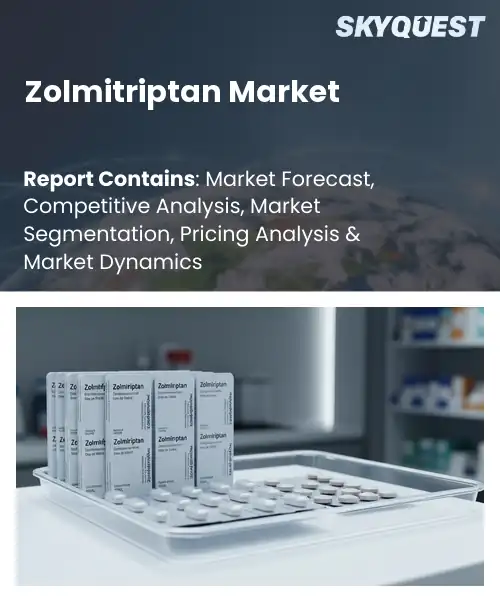
Zolmitriptan Market
Report ID: SQMIG35I2598
Report ID: SQMIG35I2598
[email protected]
USA +1 351-333-4748
Report ID:
SQMIG35I2598 |
Region:
Global |
Published Date: March, 2026
Pages:
157
|Tables:
145
|Figures:
78


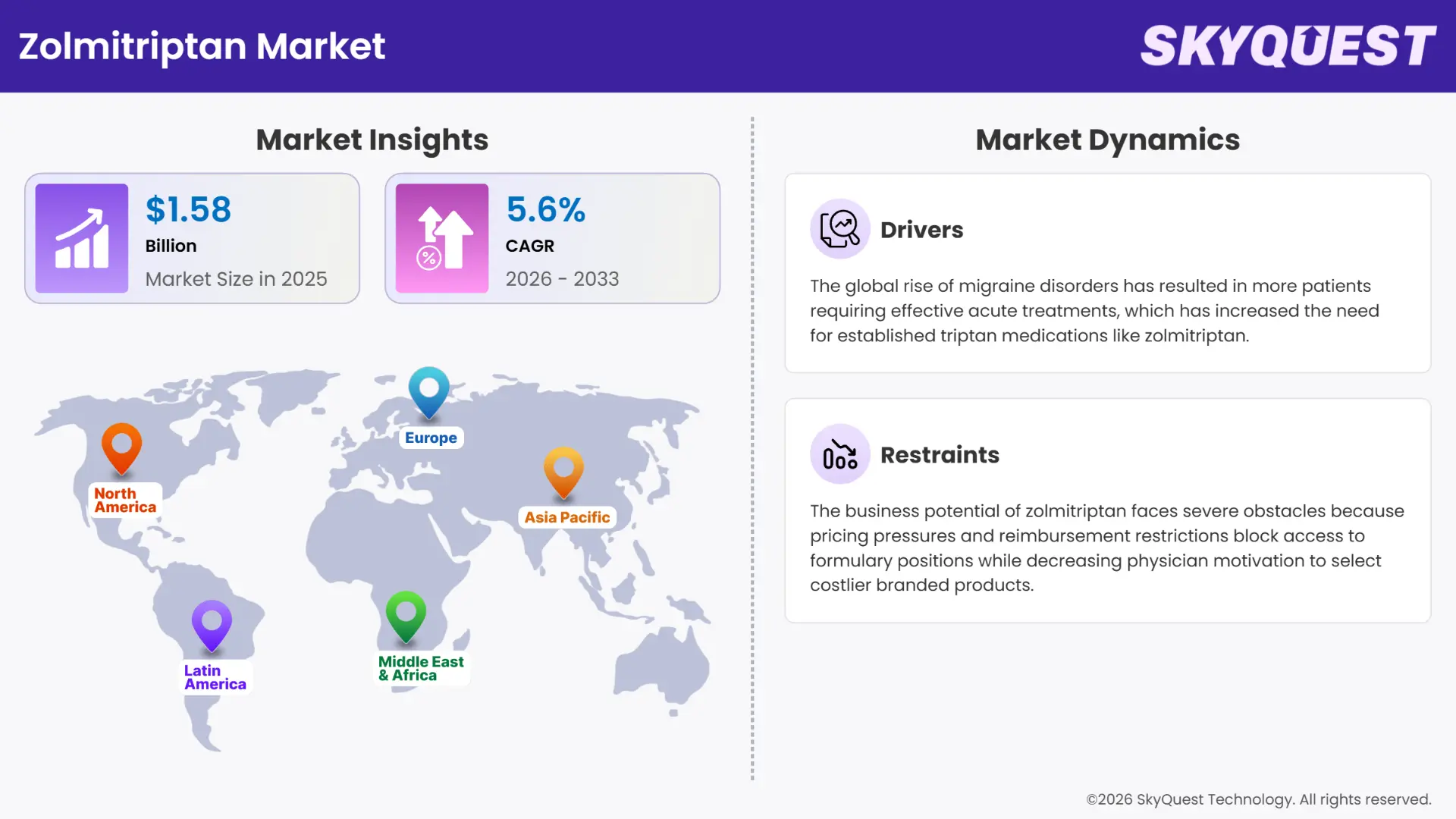
Global Zolmitriptan Market size was valued at USD 1.50 Billion in 2024 and is poised to grow from USD 1.58 Billion in 2025 to USD 2.45 Billion by 2033, growing at a CAGR of 5.6% during the forecast period (2026-2033).
Key Takeaways: Market Trends & Insights
The global zolmitriptan market growth is driven because two factors drive demand for triptan therapies, which are effective migraine treatments, as global migraine rates rise and specialty care becomes more accessible. Zolmitriptan market includes all branded and generic oral and orally disintegrating and nasal products which doctors use to treat acute migraine attacks, thus becoming essential for both neurology and primary care practices. The market provides essential benefits through improved productivity and fewer emergency room visits after successful acute treatment, but its development path started with branded products until it progressed to branded products after their patents expired.
North America's generic drug approvals led to decreased prices while making drug access more difficult for patients. Prescription volume increases through price-based payer adoption of generic products, which drive growth, while market success depends on product differentiation. The insurance companies show increased tendency to include zolmitriptan in their preferred drug lists, which results from lower-cost generics that decrease budget impact, thus causing doctors to prescribe this medication more frequently. The workplace shows improvements through increased working hours and decreased emergency visits, which lead companies to create new delivery systems, such as orally disintegrating tablets and nasal sprays, that achieve faster results. The diagnosis rate increase in emerging markets develops two effects, which expand patient bases and attract both manufacturing investment and distribution support.
How is AI reshaping the Zolmitriptan Market?
AI technology changes zolmitriptan market outlook by increasing product discovery speed and improving patient access to new products. Researchers design better nasal gels and patches through platforms that analyze formulation and delivery data. AI technology enables clinical development through its ability to model dosing and bioavailability, which improves accuracy. Organizations achieve operational advantages through predictive supply chain tools and advanced patient support systems that direct treatment decisions. The established zolmitriptan options gain market strength against new migraine treatments while novel delivery formats create new avenues for medical use.
Emergex December 2023 completed the NDA transfer of investigational zolmitriptan patch from previous Zosano ownership, which maintains future microneedle delivery product development. The development of AI-driven formulation and commercialization tools enables faster product launches, which improve patient access to medical products.
To get more insights on this market click here to Request a Free Sample Report
The global zolmitriptan market is segmented by dosage form, end user, route of administration, patient type, therapeutic area, and region. In terms of dosage form, the market is categorized into tablets, nasal sprays, injectables, and orally disintegrating tablets. Based on end users, it is segmented into hospitals, retail pharmacies, online pharmacies, and specialty clinics. By route of administration, the market includes oral, nasal, and parenteral delivery. In terms of patient type, the segmentation covers adults, pediatric patients, and geriatric patients. Based on therapeutic area, the market is divided into acute migraine treatment and cluster headache treatment. Geographically, the market is segmented into North America, Europe, Asia Pacific, Latin America, and the Middle East & Africa.
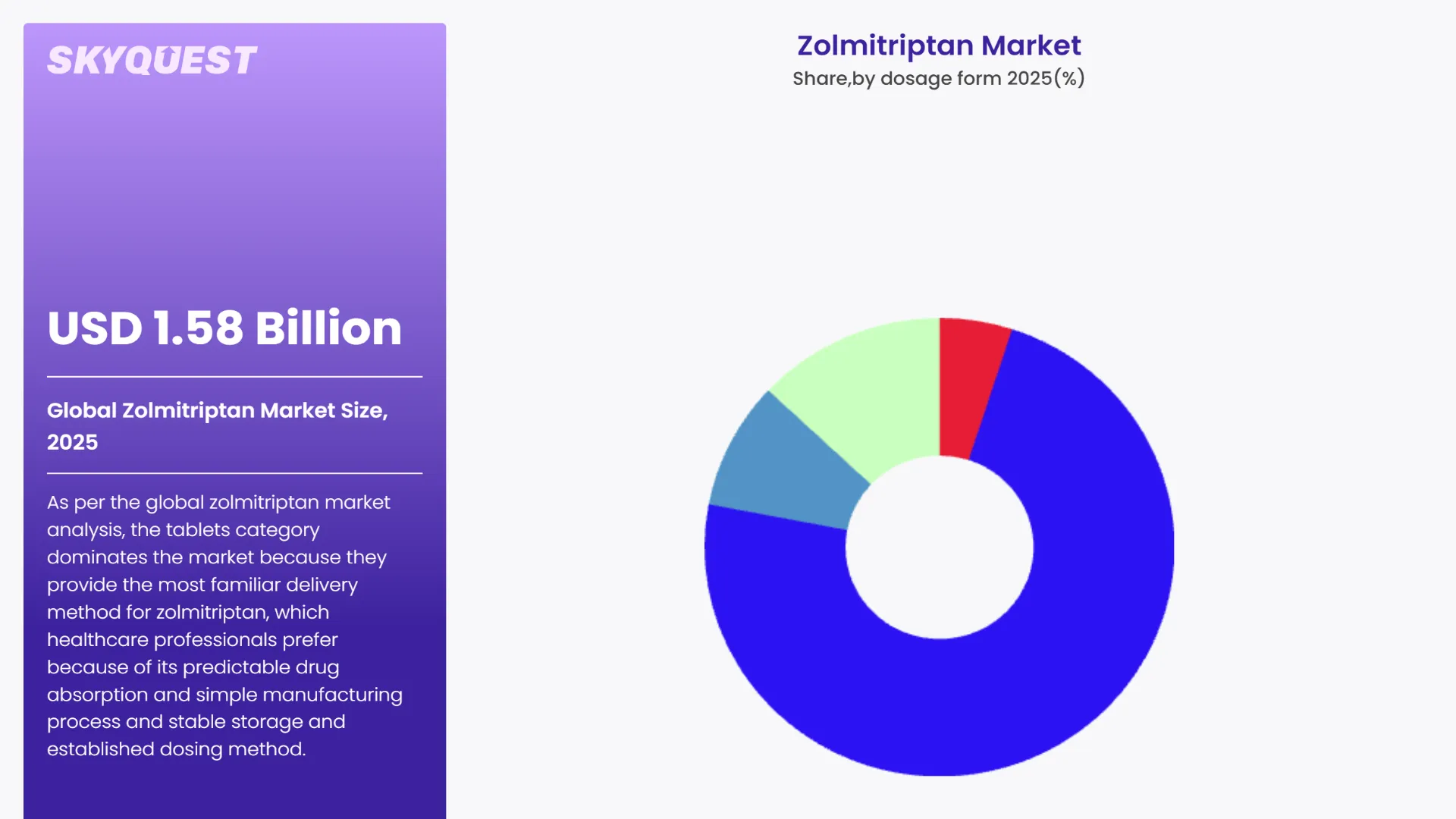
As per the global zolmitriptan market analysis, the tablets category dominates the market because they provide the most familiar delivery method for zolmitriptan, which healthcare professionals prefer because of its predictable drug absorption and simple manufacturing process and stable storage and established dosing method. The medication reaches patients through multiple channels, which include formularies and prescribing inertia, and this results in continuous product restocking through standard distribution methods and payer acceptance. The zolmitriptan market retains its leading status because clinician expertise and cost-effective production with dependable patient adherence generate demand for their continued market presence.
However, the orally disintegrating tablets now function as the most rapidly expanding area because they provide patients who experience nausea with their fast mucosal absorption ability and their ability to take the medicine without needing water. The product development process and market opportunities in zolmitriptan benefit from formulation improvements, which enhance the market partners' connections, between migraine sufferers and their caregivers who become prescriber customers.
According to the global zolmitriptan market forecast, the retail pharmacies segment leads because they represent the primary dispensing channel for zolmitriptan, which enables patient access through pharmacist consultation and reimbursement process streamlining for medication refills. The existing prescriber relationship and logistics capabilities enable them to establish formulary placement at retail outlets while maintaining steady inventory levels. The medical establishment shows steady demand for services through retail pharmacies, which deliver reliable access points and verified medical care, thus preserving their key role in zolmitriptan supply chain management.
Whereas the online pharmacy market currently establishes itself as the fastest expanding distribution network, which medical professionals discover through digital prescriptions that provide home delivery options, and patients who use telehealth services can access Zolmitriptan medication. Enhanced anonymous access to sensitive migraine treatment through subscription refill models and patient data-powered adherence programs, attracts new users who drive partnerships with manufacturers, which results in faster distribution-based business growth and patient engagement and zolmitriptan market penetration.
To get detailed segments analysis, Request a Free Sample Report
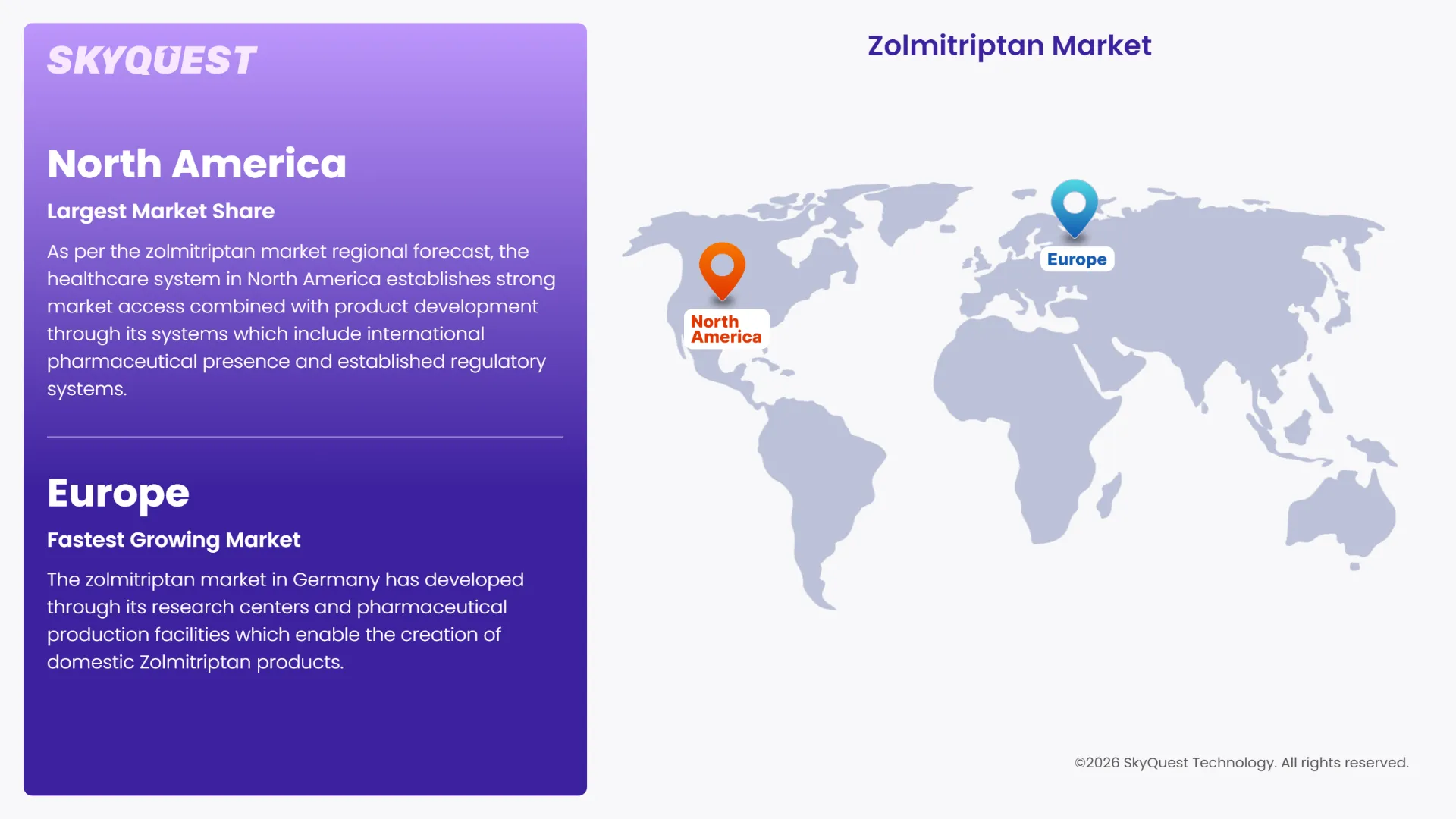
As per the zolmitriptan market regional forecast, the healthcare system in North America establishes strong market access combined with product development through its systems which include international pharmaceutical presence and established regulatory systems. The established distribution networks and clinical research activities create an environment which enables quick acceptance of new delivery methods and formulation systems. The specialized migraine treatment programs can become economically sustainable through payer contracts and the established reimbursement systems. Research resources and academic-industrial partnerships create an environment which speeds up development processes and product reformulation work. Most healthcare practitioners in this region support evidence-based prescribing because they receive ongoing medical training which enhances their understanding of available treatment options. The region maintains its position as the worldwide leader in zolmitriptan production through its combined strengths which create constant market requirements and competitive benefits.
The United States zolmitriptan sector consists of a clinical research environment which operates through specialized healthcare networks that treat migraines with innovative medical solutions. The partnership between innovation developers and healthcare organizations creates an efficient process for validating clinical results and bringing products to the market. The combination of multiple treatment delivery channels and advanced payer engagement processes creates a situation which enables patients to obtain access to specific medical treatments. The combination of physicians who understand triptan medications and the presence of patient advocates creates ongoing product requirements which leads to further product development work.
The zolmitriptan industry in Canada benefits from its cooperative healthcare system which supports evidence-based medicine practices to ensure proper migraine treatment. The clinical networks and provincial formularies work together to establish treatment guidelines throughout the healthcare system. The manufacturers and healthcare organizations work together to create effective access pathways which match patient requirements. The combination of clinical education programs and primary care system integration creates a diagnostic process which improves accuracy and patient treatment development for zolmitriptan prescription compliance.
European expansion occurs because clinical expertise and regulatory systems operate together with market access methods which create a favorable environment for using advanced migraine treatment solutions. The national health systems and clinical networks work together to distribute treatment protocols and best clinical practices throughout the system. When physicians invest in local clinical trials and healthcare systems to shift their focus towards patient-centered care, they will gain more trust in new healthcare delivery methods. Global pharmaceutical companies and local distributors establish strategic partnerships which improve their supply chain capabilities and market access in specific regions. Health technology assessment procedures and structured stakeholder dialogue systems enable evidence-based reimbursement talks to take place while patient advocacy groups work to increase public awareness about treatment requirements. The combination of these factors creates an environment which enables European nations to experience fast growth while establishing deeper market connections.
The zolmitriptan market in Germany has developed through its research centers and pharmaceutical production facilities which enable the creation of domestic Zolmitriptan products. The medical community uses reimbursement systems and clinician networks to drive therapeutic advancements into clinical applications. The partnership between academic institutions and business entities creates scientific proof which demonstrates the existence of unique product variations. Specialist pathways to care and physician participation create a system which guides precise prescribing while patient support programs help patients stay compliant with their treatment and learn about medicines through clinical education programs.
The United Kingdom zolmitriptan market share increases through its active regulatory processes and its financial backing of local migraine treatment centers which drive forward new therapy techniques. The healthcare system improvements through integrated care pathways and stronger primary care capabilities result in better patient diagnosis and referral to specialists. The regional groups and innovators work together to create specific access solutions. The combination of patient advocacy and targeted clinician education programs creates awareness which boosts prescribing confidence, thus allowing for faster treatment implementation and care delivery optimization.
The Zolmitriptan Market in France is developing through its clinical research partnerships and dedication to patient-centered care which enables the use of cutting-edge migraine treatment methods. The hospital networks and specialist neurologists work together to promote treatment according to established medical guidelines. The educational programs help clinicians to better understand the new delivery options through their partnership with local production facilities. The patient support programs and coordinated care pathways create a system which maintains treatment consistency while helping patients stick to their treatment plan for zolmitriptan.
Asia Pacific enhances its market position through establishment of clinical infrastructure, creation of strategic partnerships with local entities, and implementation of initiatives to enhance migraine treatment accessibility in various healthcare systems. The rising financial support for local clinical research and regulatory alignment projects enables the development of regional evidence which supports new drug formulations. The partnerships between international drug developers and domestic product manufacturers work to create adaptable supply chains which assist in price control efforts. The increase in specialized treatment centers together with educational programs advances the skills of medical professionals who treat migraine patients. Health authorities and payers in the healthcare system are adopting value-based assessment methods which enable them to assess treatment pathways that include treatments showing proven effectiveness. The combination of patient awareness programs with digital health systems creates pathways for people to discover treatment options, which results in expanded access to markets and strengthened regional positioning within the global zolmitriptan market.
The zolmitriptan market functions in Japan because the country maintains a legacy of pharmaceutical research and its regulatory framework which creates therapeutic option trust among medical professionals. Local research institutions collaborate with global developers to produce clinical evidence about new drug formulations. The establishment of specialized medical facilities together with precision medicine programs allows healthcare providers to make specific drug selections. Market development together with zolmitriptan clinical acceptance occurs through clinician education programs which help patients learn about migraine management methods.
The zolmitriptan market trends in South Korea develops through collaborative efforts which focus on conducting clinical studies to establish proof for new migraine treatments. Domestic manufacturers work with global suppliers to strengthen their supply chain operations while creating customized market entry plans. The development of specialized headache clinics together with clinician educational programs leads to improved diagnostic abilities. The combination of patient engagement initiatives with digital health solutions creates a system which helps patients follow treatment protocols while improving access to care, which leads to greater clinician confidence in using zolmitriptan treatment pathways.
To know more about the market opportunities by region and country, click here to
Buy The Complete Report
Rising Migraine Prevalence
Advances in Formulation Technology
Pricing and Reimbursement Constraints
Safety Concerns and Side Effects
Request Free Customization of this report to help us to meet your business objectives.
The zolmitriptan market competes through new delivery methods which companies use to create unique partnership strategies that help them win market share for acute migraine treatment. Zosano Pharma operates through its Qtrypta program which uses microneedles to deliver its product while working with EVERSANA to commercialize the technology. The company operates through three business areas, including technology development and regulatory resubmission, and commercial partner development.
SkyQuest’s ABIRAW (Advanced Business Intelligence, Research & Analysis Wing) is our Business Information Services team that Collects, Collates, Correlates, and Analyses the Data collected by means of Primary Exploratory Research backed by robust Secondary Desk research.
As per SkyQuest analysis, the global zolmitriptan market is expanding because more people now experience migraines while formulation technology develops new patient-friendly methods that provide faster onset times. The final two factors that drive demand include better migraine diagnosis and specialty medical treatment accessibility together with new delivery systems which include orally disintegrating tablets and nasal medication alternatives. The two market areas which restrict higher-priced branded products include pricing restrictions and reimbursement rules, which stop hospitals from providing those items. North America continues to be the leading region because of its active research and development efforts and its strong payer network combined with its extensive distribution system while tablets remain the leading product category because of their widespread recognition and their economical pricing and their prescriber popularity.
| Report Metric | Details |
|---|---|
| Market size value in 2024 | USD 1.50 Billion |
| Market size value in 2033 | USD 2.45 Billion |
| Growth Rate | 5.6% |
| Base year | 2024 |
| Forecast period | 2026-2033 |
| Forecast Unit (Value) | USD Billion |
| Segments covered |
|
| Regions covered | North America (US, Canada), Europe (Germany, France, United Kingdom, Italy, Spain, Rest of Europe), Asia Pacific (China, India, Japan, Rest of Asia-Pacific), Latin America (Brazil, Rest of Latin America), Middle East & Africa (South Africa, GCC Countries, Rest of MEA) |
| Companies covered |
|
| Customization scope | Free report customization with purchase. Customization includes:-
|
To get a free trial access to our platform which is a one stop solution for all your data requirements for quicker decision making. This platform allows you to compare markets, competitors who are prominent in the market, and mega trends that are influencing the dynamics in the market. Also, get access to detailed SkyQuest exclusive matrix.
Table Of Content
Executive Summary
Market overview
Parent Market Analysis
Market overview
Market size
KEY MARKET INSIGHTS
COVID IMPACT
MARKET DYNAMICS & OUTLOOK
Market Size by Region
KEY COMPANY PROFILES
Methodology
For the Zolmitriptan Market, our research methodology involved a mixture of primary and secondary data sources. Key steps involved in the research process are listed below:
1. Information Procurement: This stage involved the procurement of Market data or related information via primary and secondary sources. The various secondary sources used included various company websites, annual reports, trade databases, and paid databases such as Hoover's, Bloomberg Business, Factiva, and Avention. Our team did 45 primary interactions Globally which included several stakeholders such as manufacturers, customers, key opinion leaders, etc. Overall, information procurement was one of the most extensive stages in our research process.
2. Information Analysis: This step involved triangulation of data through bottom-up and top-down approaches to estimate and validate the total size and future estimate of the Zolmitriptan Market.
3. Report Formulation: The final step entailed the placement of data points in appropriate Market spaces in an attempt to deduce viable conclusions.
4. Validation & Publishing: Validation is the most important step in the process. Validation & re-validation via an intricately designed process helped us finalize data points to be used for final calculations. The final Market estimates and forecasts were then aligned and sent to our panel of industry experts for validation of data. Once the validation was done the report was sent to our Quality Assurance team to ensure adherence to style guides, consistency & design.
Analyst Support
Customization Options
With the given market data, our dedicated team of analysts can offer you the following customization options are available for the Zolmitriptan Market:
Product Analysis: Product matrix, which offers a detailed comparison of the product portfolio of companies.
Regional Analysis: Further analysis of the Zolmitriptan Market for additional countries.
Competitive Analysis: Detailed analysis and profiling of additional Market players & comparative analysis of competitive products.
Go to Market Strategy: Find the high-growth channels to invest your marketing efforts and increase your customer base.
Innovation Mapping: Identify racial solutions and innovation, connected to deep ecosystems of innovators, start-ups, academics, and strategic partners.
Category Intelligence: Customized intelligence that is relevant to their supply Markets will enable them to make smarter sourcing decisions and improve their category management.
Public Company Transcript Analysis: To improve the investment performance by generating new alpha and making better-informed decisions.
Social Media Listening: To analyze the conversations and trends happening not just around your brand, but around your industry as a whole, and use those insights to make better Marketing decisions.
REQUEST FOR SAMPLE
 REQUEST FREE CUSTOMIZATION
Global Zolmitriptan Market size was valued at USD 1.5 Billion in 2024 and is poised to grow from USD 1.58 Billion in 2025 to USD 2.45 Billion by 2033, growing at a CAGR of 5.6% during the forecast period (2026-2033).
Competitive landscape for zolmitriptan is driven by rapid on demand delivery innovation, with companies pursuing differentiated routes and partnerships to capture acute migraine share. Examples include Zosano’s microneedle Qtrypta program and its commercialization tie up with EVERSANA, Pfizer’s nasal CGRP zavegepant launch, and device entrants such as Theranica’s Nerivio wearable; strategies span tech innovation, regulatory resubmissions, and commercial partnerships. 'Sun Pharmaceutical Industries', 'Teva Pharmaceuticals', 'Venturepharm Group', 'Tiantaishan Pharmaceutical', 'Mylan N.V.', 'Hikma Pharmaceuticals', 'Apotex Inc.', 'Sandoz', 'Aurobindo Pharma', 'Cigna Pharmaceuticals', 'GSK (GlaxoSmithKline)', 'Novartis', 'Pfizer', 'Amgen', 'Merck & Co.', 'UCB Pharma', 'Celgene Corporation', 'Jazz Pharmaceuticals', 'Alkermes', 'Endo International'
An increasing global prevalence of migraine disorders has expanded the identifiable patient population seeking effective acute therapies, directly elevating demand for established triptan options such as zolmitriptan. Greater recognition of migraine symptoms by clinicians and patients encourages timely diagnosis and treatment initiation, fostering more frequent prescription cycles and sustained usage. Pharmaceutical companies respond by prioritizing supply continuity, formulation optimization, and targeted education efforts, reinforcing prescriber confidence and patient adherence, which together support steady market expansion for zolmitriptan products and improved access pathways.
Expanded Generic Adoption: Growing acceptance of generic zolmitriptan formulations is reshaping payer strategies, encouraging wider formulary inclusion and driving competition among manufacturers. This trend supports supply chain optimization, cost focused contracting and increased availability across markets, enabling broader patient access through pharmacy channels. Manufacturers are emphasizing efficient production, quality assurance and differentiated service offerings such as patient support programs to maintain market share despite price driven dynamics, thereby fostering sustainable volume growth and strategic partnerships with wholesalers and health systems globally expanding further.
North America Dominate the Global Zolmitriptan Market.
Tablets hold the largest share of the market due to their widespread availability, established clinical effectiveness, predictable absorption, cost-effectiveness, and strong physician preference.
The Nasal Spray segment is expected to witness the fastest growth because it offers rapid absorption and faster relief, particularly for migraine patients experiencing nausea or difficulty swallowing tablets.


Want to customize this report? This report can be personalized according to your needs. Our analysts and industry experts will work directly with you to understand your requirements and provide you with customized data in a short amount of time. We offer $1000 worth of FREE customization at the time of purchase.
Feedback From Our Clients


 USA (+1) 351-333-4748

