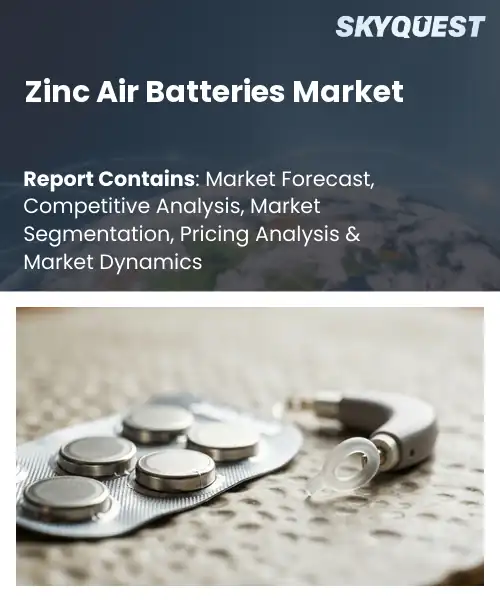
Zinc Air Batteries Market
Report ID: SQMIG20D2549
Report ID: SQMIG20D2549
[email protected]
USA +1 351-333-4748
Report ID:
SQMIG20D2549 |
Region:
Global |
Published Date: February, 2026
Pages:
157
|Tables:
153
|Figures:
78


Global Zinc Air Batteries Market size was valued at USD 134.2 Million in 2024 and is poised to grow from USD 141.85 Million in 2025 to USD 221.02 Million by 2033, growing at a CAGR of 5.7% during the forecast period (2026-2033).
High adoption of safe, low-cost, and high-energy-density energy storage solutions, increasing adoption of renewable energy systems, and rising need for reliable backup power are anticipated to drive the demand for zinc air batteries going forward.
Advances in technology related to air cathode catalysts, electrolyte, and cell designs are improving efficiency and life cycles, thus lowering the overall cost of ownership. These technologies are facilitating partial rechargeability and pilot-scale applications for telecom backup power, microgrid stabilization, and renewable energy storage. The shift towards renewable energy sources is consistent with the growing global emphasis on decarbonization and energy security. The progress in manufacturing technologies, as well as in the zinc industry’s supply chain, is also aiding in the growth of this technology, particularly in developing countries. Growing need for affordable and high-energy-density battery solutions is expected to primarily drive zinc air batteries market growth. In addition to this, regulatory pressure to eliminate lead-acid batteries and lithium supply chain volatility is also driving interest in zinc batteries. This growth in zinc batteries is also attracting investments in scaling capacity in commercial and industrial applications.
On the contrary, challenges such as limited rechargeability, lower cycle life compared to advanced battery chemistries, performance degradation, and strong competition from lithium-ion technologies are slated to hamper zinc air batteries market penetration over the coming years.
How does AI Improve Innovation Scope of Zinc Air Battery Developers?
AI is driving innovation in the zinc air batteries market. AI can help in the discovery of better catalysts and electrolytes, which can lead to more stable batteries. AI can also be used in the optimization of the battery management system, which can help in extending the life of the batteries. It can also be used in the optimization of the quality of the products in the market.
Market snapshot - (2026-2033)
Global Market Size
USD 134.2 Million
Largest Segment
Non-Rechargeable
Fastest Growth
Rechargeable
Growth Rate
5.7% CAGR
To get more insights on this market click here to Request a Free Sample Report
Global zinc air batteries market is segmented by battery type, form factor, capacity range, electrode material, application, and region. Based on battery type, the market is segmented into rechargeable and non-rechargeable. based on form factor, the market is segmented into button cells, coin cells, cylindrical cells, pouch cells, and prismatic cells. Based on capacity range, the market is segmented into 100 mAh, 100-500 mAh, 500-1000 mAh, 1000-2000 mAh, and > 2000 mAh. Based on electrode material, the market is segmented into zinc-manganese dioxide, zinc-iron oxide, zinc-nickel oxide, zinc-silver oxide, and other advanced electrodes. Based on application, the market is segmented into consumer electronics, medical devices, military defense, automotive, aerospace, industrial, and others. Based on region, the market is segmented into North America, Europe, Asia Pacific, Latin America, and Middle East & Africa.
The rechargeable segment is forecasted to account for the highest global zinc air batteries market share in the future. The capacity to provide repeated deep discharge and recharge cycles fits into the growing trend for sustainable and long-lasting power sources in zinc air technology. New developments in rechargeable zinc air technology cathode catalysts and electrolytes have minimized degradation, thus providing reuse in deep drain and cyclic recharge applications. This reliability is driving rechargeable zinc-air battery systems into applications where lifecycle cost savings are necessary.
However, non-rechargeable segment is slated to expand at a rapid CAGR as per this zinc air batteries industry analysis. High energy density and low upfront cost suit single-use consumer and medical devices that value reliability, which further generates new business scope. Further improvements in materials and packaging will enhance the products’ shelf life, thus increasing their use in hearing aids, diagnostics, and low-maintenance applications, which will create a new market in the aftermarket business.
The pouch cells segment is anticipated to spearhead the global zinc air batteries market revenue generation through 2033. Thin, flexible packaging of these cells enables designers to maximize volumetric energy and tailor cell geometry to diverse device architectures, which further cements its dominance. The malleable nature of laminate packaging reduces assembly difficulties and enhances thermal diffusion characteristics, thus minimizing system-level design challenges. This flexibility facilitates faster adoption in changing product categories and prompts OEMs to consider standardizing on pouch form factors for manufacturing ease and prototyping speed
On the other hand, coin cells are emerging as a fast-growing segment as their round shape and air intake design satisfy stringent miniaturization requirements for wearable electronics and implantable devices. Advances in electrode materials and closure techniques have enabled increased life, which has helped them find applications in portable sensing, medical, and low-power electronics.
To get detailed segments analysis, Request a Free Sample Report
Deep manufacturing capabilities, concentrated research capabilities, and aligned industrial policies that favor commercialization allow Asia Pacific to emerge as a leader in zinc air batteries demand. Materials engineering firms and own cell design engineers maintain a competitive edge through cooperative research networks and real-world pilot deployments that remove risk associated with entering the market. The reduced lead times from proximity to critical supply partners and the creation of market opportunities through portable medical devices and decentralized energy storage both create diverse pathways for end use. Policy and incentive structures supporting pilot production investing and recycling create a self-reinforcing virtuous cycle between innovation, localized manufacturing, and market adoption that support the continued growth of regional lead. Clusters of strong suppliers and competitive and thriving domestic markets accelerate the onset of commercialization and continue to create opportunities for cross-border partnerships that develop and enhance technological capability to bolster the dominance of this region through 2033.
Advanced materials research, precision manufacturing, and close collaboration between electronics firms and battery developers make Japan a key market for zinc air batteries companies. Recycling, as well as quality standards, also add to the reliability of products. Strategic partnerships can help in the optimization of cell chemistry. Emphasis on safety and performance throughout the lifecycle is in line with the needs of medical devices and portable electronics. The focus on supply chain integration in the domestic market, as well as pilot programs, can help in scaling up.
Robust electronics and automotive supply chains together with intensive materials R&D are supporting sales of zinc air batteries in South Korea. Collaborations between component suppliers, OEMs, and research centers drive improvements in cell design, with focus on performance, cost efficiency, and compatibility with existing battery ecosystems to support regional competitiveness. The scale and flexibility of the industry, combined with the manufacturing agility, support pilot to industrial transitions, while industrial policy promotes innovation and export orientation.
Presence of leading innovation ecosystems, strong project-level demand, and strategic investments in battery technology R&D are helping create new business scope in this region. A wide range of stakeholders, including startups, established manufacturers, utilities, and research organizations, work together to drive the translation of laboratory innovations into the field. The policy environment and procurement signals support low-risk energy storage, as well as niche applications, which provide a favorable environment. The interest in a domestic supply chain also contributes to localized manufacturing initiatives. The market pull from healthcare device manufacturers, as well as emerging applications in long-duration storage, provide a range of opportunities. The partnerships, as well as access to advanced testing facilities, drive the acceleration of development and remove barriers, providing a favorable environment in North America as a rapid expansion landscape for zinc air battery commercialization and industrialization. High venture capital availability as well as interest from defense and critical infrastructure operators ensures sustained sales of zinc air batteries in North America going forward.
A robust innovation ecosystem that connects national laboratories, universities, and private developers helps boost R&D and commercialization of zinc air batteries across the United States. Various end users, like healthcare, utilities, and industry, participate in demonstration activities, which provide a pathway to commercialization. The focus on supply chain resilience and domestic production has spurred partnerships and capacity building, while venture investment is helping to scale up zinc air technology.
Domestic access to base materials and a focus on resource sustainability help ensure consistent sales of zinc air batteries in Canada going forward. Partnerships between mining, manufacturing, foster value chain integration and position Canada for zinc air in the region. Research organizations and clean energy programs work with industry to develop trials for remote electrification and community resilience. The focus on recycling and circular economy design informs the recovery of materials.
High emphasis on sustainability, circularity, and technological standardization are shaping demand for zinc air batteries across Europe. Significant investments in both manufacturing/production capabilities and worker skillsets; along with the establishment of alignment around effective and agreed upon standards, will create an substantial environment for the maturation and commercialisation of Zinc air technologies for different end-uses. Public procurement programs, and targeted financing mechanisms, provide excellent support for the commercialization of early-stage projects while promoting local supply chain development. The automotive and energy industries are both represented strongly by existing companies, as well as material specialist companies; all working together to develop and produce new cell designs and systems integration. The emphasis placed upon recycling, product responsibility and integrating clean energy provides both the demand signals and the impetus for lifecycle focused innovation. The formation of international partnerships, along with the establishment of public and private sector initiatives, are also expected to boost revenue generation for market players focused on this region.
Deep engineering expertise and an integrated automotive and industrial supply chain are also driving steady demand for zinc air batteries in Germany. Emphasis is placed on quality, reliability, and manufacturing excellence to match the requirements of the automotive and stationary storage markets. There is also a focus on standards, skills, and circular economy to enhance competitiveness. Robust industrial collaboration between players to conduct pilot projects to validate novel zinc air batteries.
A vibrant research network that supports advanced materials development and system testing creates opportunities for zinc air battery developers in the United Kingdom. Skills development and pilot project strategies feed into technology readiness and market entry strategies and international collaboration. Collaborative programs connect universities, start-ups, and industrial partners to speed up prototype validation and commercialization routes. Adoption of zinc air batteries is high in medical devices and off-grid energy applications in the country.
Coordinated industrial policy, strong energy sector partnerships, and focused materials research are driving consistent sales of zinc air batteries in France. Energy companies and research centers cooperate on pilot projects to connect storage solutions to renewable power. Clusters and private sector efforts promote development and skills development in the manufacture of zinc-air batteries and accelerate their commercialization and deployment in European markets. Emphasis on lifecycle assessment, recycling, and sustainable raw materials is key in informing product development.
To know more about the market opportunities by region and country, click here to
Buy The Complete Report
Growing Demand For Portable Electronics
Zinc air batteries have high energy density per weight and simple design, which makes them highly suitable in meeting the growing need for lightweight and durable batteries in portable consumer electronics such as hearing aids, wearables, and handheld devices. This has encouraged manufacturers to invest in the development and expansion of zinc air batteries. This growing need by consumers to have their devices changed less frequently is expected to encourage the adoption and differentiation of zinc air batteries in the market.
Expansion Of Electric Mobility Applications
The adoption of electric mobility solutions in the overall micromobility segment and light electric vehicles has created interest in battery technologies that provide a trade-off between safety, cost-effectiveness, and power storage density. Zinc air batteries are seen as a viable alternative for certain applications. There is interest in solutions that provide cost advantages to vehicle manufacturers and fleet operators in terms of operation and thermal management. Pilot projects of reliable performance of zinc air batteries in certain vehicle categories have created confidence among suppliers for wider acceptance of the technology.
Limited Cycle Life and Rechargeability
Limitations in terms of the overall cycle life, as well as issues pertaining to the reliable recharging mechanism, have limited the zinc air batteries in terms of their appeal to mainstream consumer electronics and vehicular powertrains. The stakeholders, who are concerned with the maintenance and replacement issues, prefer to stick to the conventional rechargeable batteries, which has limited the overall rate of investment in zinc air batteries. The lack of clarity on the reliable and durable rechargeability mechanism has limited the overall appeal to the stakeholders, which has moderated the overall rate of investment in zinc air batteries.
Raw Material Supply Constraints
Unpredictable availability and sources of high purity zinc, as well as critical peripheral materials, have posed supply issues, which have affected the scaling up of zinc air battery production by manufacturers. The issues have raised perceptions of operational risks by producers and end users, who may prefer to use more conventional supply chains. In addition, quality, regulatory, and sustainability issues have posed supply chain selection risks, which have negatively affected the global zinc air batteries market outlook through 2033.
Request Free Customization of this report to help us to meet your business objectives.
The competitive landscape is consolidating as incumbents pursue targeted M&A and strategic capital partnerships while specialist developers push chemistry innovations to capture long-duration and safety-driven niches; for example Form Energy integrated air cathode technology via its NantEnergy acquisition and ZincFive secured a strategic capital partnership to accelerate commercial rollouts. These moves, plus industry consortia and recent funding rounds, are intensifying head-to-head technology and manufacturing plays.
SkyQuest’s ABIRAW (Advanced Business Intelligence, Research & Analysis Wing) is our Business Information Services team that Collects, Collates, Correlates, and Analyses the Data collected by means of Primary Exploratory Research backed by robust Secondary Desk research.
As per SkyQuest analysis, growing demand for safe, low-cost, and high-energy-density energy storage solutions, increasing focus on renewable energy integration, and rising need for reliable backup power are anticipated to drive the demand for zinc air batteries going forward. However, limited rechargeability, performance degradation issues, and strong competition from lithium-ion batteries are slated to slow down the adoption of zinc air batteries in the future. Asia Pacific is slated to spearhead the demand for zinc air batteries owing to robust manufacturing ecosystem and increasing deployment of cost-effective energy storage systems. Development of AI-driven battery management systems and integration of advanced material innovations are anticipated to be key trends driving the zinc air batteries industry in the future.
| Report Metric | Details |
|---|---|
| Market size value in 2024 | USD 134.2 Million |
| Market size value in 2033 | USD 221.02 Million |
| Growth Rate | 5.7% |
| Base year | 2024 |
| Forecast period | (2026-2033) |
| Forecast Unit (Value) | USD Million |
| Segments covered |
|
| Regions covered | North America (US, Canada), Europe (Germany, France, United Kingdom, Italy, Spain, Rest of Europe), Asia Pacific (China, India, Japan, Rest of Asia-Pacific), Latin America (Brazil, Rest of Latin America), Middle East & Africa (South Africa, GCC Countries, Rest of MEA) |
| Companies covered |
|
| Customization scope | Free report customization with purchase. Customization includes:-
|
To get a free trial access to our platform which is a one stop solution for all your data requirements for quicker decision making. This platform allows you to compare markets, competitors who are prominent in the market, and mega trends that are influencing the dynamics in the market. Also, get access to detailed SkyQuest exclusive matrix.
Table Of Content
Executive Summary
Market overview
Parent Market Analysis
Market overview
Market size
KEY MARKET INSIGHTS
COVID IMPACT
MARKET DYNAMICS & OUTLOOK
Market Size by Region
KEY COMPANY PROFILES
Methodology
For the Zinc Air Batteries Market, our research methodology involved a mixture of primary and secondary data sources. Key steps involved in the research process are listed below:
1. Information Procurement: This stage involved the procurement of Market data or related information via primary and secondary sources. The various secondary sources used included various company websites, annual reports, trade databases, and paid databases such as Hoover's, Bloomberg Business, Factiva, and Avention. Our team did 45 primary interactions Globally which included several stakeholders such as manufacturers, customers, key opinion leaders, etc. Overall, information procurement was one of the most extensive stages in our research process.
2. Information Analysis: This step involved triangulation of data through bottom-up and top-down approaches to estimate and validate the total size and future estimate of the Zinc Air Batteries Market.
3. Report Formulation: The final step entailed the placement of data points in appropriate Market spaces in an attempt to deduce viable conclusions.
4. Validation & Publishing: Validation is the most important step in the process. Validation & re-validation via an intricately designed process helped us finalize data points to be used for final calculations. The final Market estimates and forecasts were then aligned and sent to our panel of industry experts for validation of data. Once the validation was done the report was sent to our Quality Assurance team to ensure adherence to style guides, consistency & design.
Analyst Support
Customization Options
With the given market data, our dedicated team of analysts can offer you the following customization options are available for the Zinc Air Batteries Market:
Product Analysis: Product matrix, which offers a detailed comparison of the product portfolio of companies.
Regional Analysis: Further analysis of the Zinc Air Batteries Market for additional countries.
Competitive Analysis: Detailed analysis and profiling of additional Market players & comparative analysis of competitive products.
Go to Market Strategy: Find the high-growth channels to invest your marketing efforts and increase your customer base.
Innovation Mapping: Identify racial solutions and innovation, connected to deep ecosystems of innovators, start-ups, academics, and strategic partners.
Category Intelligence: Customized intelligence that is relevant to their supply Markets will enable them to make smarter sourcing decisions and improve their category management.
Public Company Transcript Analysis: To improve the investment performance by generating new alpha and making better-informed decisions.
Social Media Listening: To analyze the conversations and trends happening not just around your brand, but around your industry as a whole, and use those insights to make better Marketing decisions.
REQUEST FOR SAMPLE
 REQUEST FREE CUSTOMIZATION
Global Zinc Air Batteries Market size was valued at USD 134.2 Million in 2024 and is poised to grow from USD 141.85 Million in 2025 to USD 221.02 Million by 2033, growing at a CAGR of 5.7% during the forecast period (2026-2033).
The competitive landscape is consolidating as incumbents pursue targeted M&A and strategic capital partnerships while specialist developers push chemistry innovations to capture long-duration and safety-driven niches; for example Form Energy integrated air cathode technology via its NantEnergy acquisition and ZincFive secured a strategic capital partnership to accelerate commercial rollouts. These moves, plus industry consortia and recent funding rounds, are intensifying head-to-head technology and manufacturing plays. 'Duracell', 'Nantenergy', 'ZAF Energy System', 'Varta AG', 'Zinc8 Energy Solutions', 'Electric Fuel Battery Corporation', 'Thunderzee', 'Phinenergy', 'EnerSys', 'Mitsubishi Materials Corporation', 'GP Batteries', 'AZA Battery', 'Eos Energy Enterprises', 'Zinc Power', 'Vionx Energy', 'Zinc Air Battery Corporation', 'Ravoyac', 'Renata SA', 'PowerZinc', 'GP Batteries International'
Zinc air batteries offer high energy per weight and simple construction, which aligns strongly with rising demand for lightweight, long-lasting power sources in portable consumer electronics such as hearing aids, wearables, and handheld devices. Manufacturers prioritize solutions that extend device runtime while minimizing size and weight, prompting investment in zinc air technology development and supply chain expansion. Growing consumer expectations for convenience and longer intervals between battery changes support increased adoption, encourage product differentiation, and stimulate manufacturer efforts to integrate zinc air options across device portfolios.
Wearables And Iot Adoption: Zinc air chemistry offers thin, lightweight, compact form factors, stable low drain discharge, and inherent safety advantages that align with wearable and IoT device requirements. Manufacturers are exploring flexible packaging, micro form factors, and integration with printed electronics to extend life of sensors, medical patches, and consumer accessories. Emphasis on safety, manufacturability, and low power compatibility drives industry partnerships that expand product categories and allow designers to prioritize longevity and user centered design without sacrificing reliability.
Deep manufacturing capabilities, concentrated research capabilities, and aligned industrial policies that favor commercialization allow Asia Pacific to emerge as a leader in zinc air batteries demand.


Want to customize this report? This report can be personalized according to your needs. Our analysts and industry experts will work directly with you to understand your requirements and provide you with customized data in a short amount of time. We offer $1000 worth of FREE customization at the time of purchase.
Feedback From Our Clients


 USA (+1) 351-333-4748

