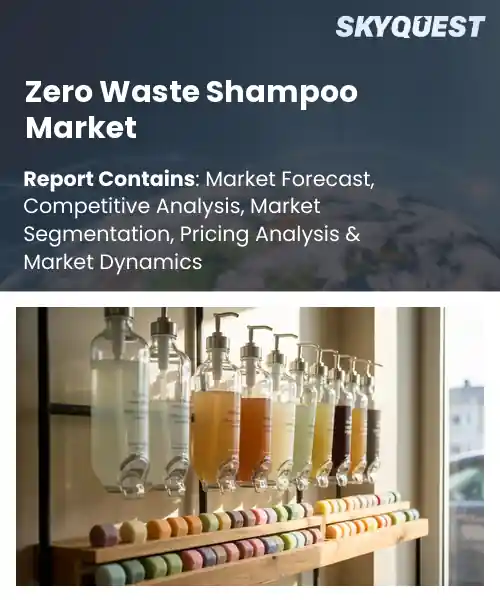
Zero Waste Shampoo Market
Report ID: SQMIG30L2387
Report ID: SQMIG30L2387
[email protected]
USA +1 351-333-4748
Report ID:
SQMIG30L2387 |
Region:
Global |
Published Date: May, 2026
Pages:
157
|Tables:
211
|Figures:
80


Global Zero Waste Shampoo Market size was valued at USD 178.4 Million in 2024 and is poised to grow from USD 188.75 Million in 2025 to USD 296.32 Million by 2033, growing at a CAGR of 5.8% during the forecast period (2026-2033).
The driving force behind the zero waste shampoo industry is the increasing awareness of environmental issues coupled with increased regulatory scrutiny on single-use plastics, creating an elevated level of consumer demand. The zero waste shampoo industry consists of solid shampoo bars, refill pouches, concentrated shampoos without any packaging, and salon refill stations, which help avoid the need for single-use plastic bottles. It is important since the hair care industry generates some amount of packaging waste and consumers today prefer those products that are sustainable and aligned with the principles of circular economics. Innovations in recent years by companies like Lush and Ethique have fueled this trend.
From that demand that has now matured, one factor pushing the growth in the global zero waste shampoo market is the legal crackdown on single use plastics which compelled the brands to come up with different forms of products, such as the introduction of solid shampoo formulas and refill systems. With the reduction in the amount of bottles containing shampoo due to legislative actions, dispensers were set up in stores and the feasibility and reduced costs of packaging made these models more attractive. At the same time, consumer appetite for paying for sustainability alongside developments in biodegradable surfactants have led to scale efficiencies and better margins.
How is AI Optimizing Supply Chain Efficiency in the Zero Waste Shampoo Market?
AI streamlines efficiency within the zero waste shampoo supply chain through optimized demand forecasting, inventory planning, sourcing, traceability, and distribution. It helps brands schedule more efficient production in tune with consumer uptake of the solid bar and refill systems. AI also tracks ingredients and risks of the suppliers, facilitating ethical and low waste sourcing. Finally, logistics and distribution becomemore efficient due to better route management and dynamic distribution. All of these help the circular economy and refill model become economically feasible. In March 2026, Afresh expanded its grocery AI technology to cover health and beauty products, including shampoo, which makes it easier for retailers to manage purchasing and replenishing at multiple stores and distribution points.
Market snapshot - (2026-2033)
Global Market Size
USD 178.4 Million
Largest Segment
Shampoo Bars
Fastest Growth
Shampoo Bars
Growth Rate
5.8% CAGR
To get more insights on this market click here to Request a Free Sample Report
Global zero waste shampoo market is segmented by product type, ingredient type, hair type, packaging type, distribution channel, end user, price range and region. Based on product type, the market is segmented into Shampoo Bars, Powder Shampoo, Liquid Zero Waste Shampoo, Shampoo Concentrates & Refills, Dry Shampoo and Others. Based on ingredient type, the market is segmented into Organic/Natural, Vegan, Sulfate-Free, Paraben-Free, Fragrance-Free/Hypoallergenic and Others. Based on hair type, the market is segmented into Dry Hair, Oily Hair, Normal Hair, Curly/Textured Hair, Damaged/Color-Treated Hair and Sensitive Scalp. Based on packaging type, the market is segmented into Plastic-Free Packaging, Compostable Packaging, Recyclable Packaging and Refillable Packaging. Based on distribution channel, the market is segmented into Online Retail, Supermarkets & Hypermarkets, Specialty Beauty Stores, Organic & Natural Product Stores, Pharmacies & Drug Stores and Others. Based on end user, the market is segmented into Individual Consumers, Salons & Professional Users and Hospitality & Wellness Sector. Based on price range, the market is segmented into Mass Market, Premium and Luxury. Based on region, the market is segmented into North America, Europe, Asia Pacific, Latin America and Middle East & Africa.
Shampoo Bars segment is leading since consumers associate the solid format with little to no packaging waste and easily verifiable sustainability aspects that help brands gain traction both mainstream and niche retailers. The easy transportability and shelf placement of such products lead formulators and retailers to favor them. Also, product stability, as well as compatibility with natural and sulfate-free formulas, make for a barrier-less approach to formulation and easier supplies.
On the other hand, the segment of shampoo concentrates & refills is growing fast due to consumer interest in lighter packaging materials, concentrated dosing technologies, and emerging retailing refilling practices. Such aspects allow for more purchase frequency and efficient logistic processes.
The Refillable Packaging segment leads because refillable dispensing helps eliminate single-use waste for products from their lifecycle, reflecting consumer demands and retail sustainability initiatives. Companies can use refill packs to build deeper connections with consumers through their loyalty and subscription programs and save on costs associated with packaging in the long run. Easier handling of standard refill packs and their ability to be used with different formulas make them more attractive for companies and retailers.
At the same time, Compostable Packaging is the fastest-growing segment because compostable materials allow meeting consumer requirements for a plastic-free way of disposing of them and substantiatinggreen claims better. Improvements in materials' performance and expanded capacities of suppliers will allow for greater versatility of their application in various formats.
To get detailed segments analysis, Request a Free Sample Report
Dominance in Europe’s Zero Waste Shampoo Market stems from strong sustainable practices, regulation supporting reduced packaging, and the presence of a mature ecosystem of manufacturers, distributors, and refilling stations. Preferences towards transparency, organic ingredients and verified claims push companies to explore new products like solid shampoos, refill bottles and compostable containers. Cooperation with supply chain partners including raw material suppliers, salons, and specialty shops facilitates rapid product availability and endorsements from professionals. Initiatives on circular economy, visible retail activities, as well as marketing efforts by NGOs and industries contribute to the heightened consciousness among consumers. The ability to access skilled formulators and proven distribution networks assures quality and wide reach of the product offerings, and consumer activism further boosts its dominance.
The Zero-Waste Shampoo Market in Germany has a highly environmentally conscious consumer base, well-developed regulations to encourage reduction in packaging, and a lively scene consisting of local suppliers and refilling options. The retail sector focuses on sustainable ingredients, while professional haircare products collaborate with brands to test loose and solid products. Consumers prefer brands whose formulas are certified as natural, and who use circularity methods in their manufacturing and recycling processes.
The UK Zero Waste Shampoo market indicates a high level of consumer demand for reusable bottles, shampoo bars, and less packaging. Companies tell stories around their ingredients and sustainable sourcing practices, while salons experiment with refilling services and package-free products. Government policy dialogues and NGO activism play an important role in shaping public perception and stimulating the uptake of such products among ordinary consumers and innovation among local brands.
Market Structure of Zero Waste Shampoo in France is determined by the influence of artisanal cosmetics heritage, the French love of natural perfumes, and the proliferation of refill stores and minimalist packaging. Retailers work alongside perfume manufacturers in conjunction with independent cosmetic producers to come up with innovative solid products as well as elegant refills. Salon usage and local sourcing of ingredients are two factors contributing to brand messaging around quality.
The growth in North America is fueled by the confluence of increased awareness about the environment on the part of consumers, significant venture and brand investment in sustainability in the personal care sector, and cutting-edge approaches to retailing and ecommerce that enable trial and subsequent repurchase of zero waste options. Mainstream brands, as well as independent brands, are launching their refillable products, solid bars, and concentrated products into mainstream distribution channels, while partnerships with salons and professional endorsement add to the credibility of the format. Companies' sustainability initiatives, along with take-back schemes by retailers, also fuel adoption, alongside education initiatives targeted at consumers and influencer marketing that highlights the product benefits.
Zero Waste Shampoo Market in the US reflects entrepreneurial spirit, innovative distribution testing, and great exposure via lifestyle media channels and influencer collaborations that speed mainstream adoption. DTC brands and traditional beauty and hygiene firms roll out refills and solid formulations as part of marketing education efforts. Salon systems and retail concepts act as validation of the claims, while business sustainability objectives and retail promotions drive supply chain activity and consumer confidence.
The Zero Waste Shampoo Market in Canada is driven by consumers’ interest in natural and locally sourced products and retailers’ focus on sustainability, making it possible to have shampoo in solid and refills form available. In-store refills and innovative packaging are provided together by independent brands and chain stores, and hair salons play an important role in educating clients and recommending the product.
The Asia Pacific is gaining prominence in the Zero Waste Shampoo market owing to quick innovation of products, an increase in consumer awareness about sustainability, and concerted attempts by brands to align with regional trends regarding the format. The focus in the region is on small solid bars, concentrates that can be conveniently used even when traveling, and biodegradable packaging that takes regional logistics into consideration. Retailers adopt unique business concepts such as the introduction of refills and experiential shopping. The combination of advancements by beauty technology firms and conventional manufacturers in partnership with local suppliers has resulted in high-performance products. Beauty culture in the Asia Pacific is another significant factor that is aiding market growth. Additionally, policies, industry-level discourse, and the expansion of the e-commerce platform are other contributing factors.
Japan’s Zero Waste Shampoo Market is unique due to the combination of high-quality personal care products and rising awareness about waste-free packaging. Companies emphasize the creation of finely engineered solids and mild surfactants that satisfy consumers’ high expectations, while shops choose high-end minimalistic packaging brands. Textures that have been praised by beauty experts are encouraged, which adds to the appeal and effectiveness.
Zero Waste Shampoo Market in South Korea operates through cultural dynamics of innovation in products and processes, alongside consumer appetite for newness. Brands leverage cutting-edge formulation technologies in tandem with eco-packaging, while beauty outlets ensure their products contain offerings that are either reusable or solid in form. Beauty editors as well as social media contribute to the creation of trends and awareness around the market.
To know more about the market opportunities by region and country, click here to
Buy The Complete Report
Rising Consumer Environmental Awareness
Increased awareness of the environment by consumers leads to increased purchases of zero waste shampoos, as they look for items that minimize waste and negative effects on the environment. This trend drives retailers and producers to allocate more shelf space and work on creating innovative zero waste products. Increased consumer interest is indicative of the stability and profitability of the market, which in turn attracts new businesses and existing companies that are interested in producing sustainable items.
Expansion of Sustainable Packaging
Manufacturers’ use of sustainable packaging makes the adoption of zero waste shampoo more appealing and removes potential obstacles in its use. Efforts toward developing packaging materials that can be recycled, reused, or repurposed into refills indicate a willingness to adopt sustainability principles, thus prompting customers to try and purchase the product repeatedly. In response, suppliers and marketers make an effort to invest in the development and promotion of sustainable packaging. As a result, it is made more available and increases the chance for market entry through the support of retailers.
Higher Production Costs
The high costs involved in the manufacture of zero waste shampoos may affect market penetration as this may result in low profit margins and high retail prices for the products. This will affect small and medium-sized firms that may find it hard to afford the cost of purchasing equipment used in the manufacture of the zero waste products. Retailers might be reluctant to reserve shelf space for the higher-priced product, hindering their availability in the markets.
Limited Consumer Awareness in Some Regions
In places where there is limited knowledge about the benefits of zero waste shampoos, market expansion could become difficult due to lower consumer interest and lack of investment by retailers. In locations where consumers have no idea what solid shampoos, refills, and concentrates all about are, they may view it as inconvenient and ineffective. As a result, it becomes hard for manufacturers to invest further into marketing and distribution channels until awareness of these shampoos improves, and their effectiveness becomes evident.
Request Free Customization of this report to help us to meet your business objectives.
The level of competition in this sector has risen due to large-scale initiatives by consumer goods companies and retailers into reusable and refilling models, making a strong case for adoption of zero waste solutions. Some key strategies used include collaboration between brands like Unilever and P&G with TerraCycle Loop, retailer partnerships, as seen between Ulta and TerraCycle Loop, and formulation innovations in waterless solid products.
Circular Supply Chain Integration: There are efforts being made between brands, ingredient suppliers and refill platforms for development of such systems that ensure minimal wastage in packaging and also promote reusability. Traceability, product return schemes and use of modular formats make for more robust connections between brands and consumers and ensure lifecycle consideration. These changes push brands towards innovation in their formulation capabilities to be compatible with the refill systems in place. There is also increased focus on sustainability credentials of such products which can impactretail collaborations and consumer loyalty.
Personalization Through Refill Experiences: Consumers are looking for customized sensory, scent, and performance benefits that can be provided through refills or concentrated products, which would allow them to customize their choices in an environmentally friendly way. Brands use modular formulas and subscription-based business models to cater to the unique requirements and lifestyle of consumers while ensuring that there is no waste involved. This enables increased consumer participation by providing experiential retail and digital experiences that facilitate product selection and refills.
SkyQuest’s ABIRAW (Advanced Business Intelligence, Research & Analysis Wing) is our Business Information Services team that Collects, Collates, Correlates, and Analyses the Data collected by means ofPrimary Exploratory Research backed by robust Secondary Desk research.
As per SkyQuest analysis, the global zero waste shampoo market is driven by two primary factors: firstly, increased environmental consciousness on the part of consumers, and secondly, regulation that restricts single-use plastic and drives the adoption of the solid and refilling shampoo types. Some of the barriers include increased costs associated with manufacturing and sustainable packaging. The dominating region is still Europe, owing to the high levels of sustainability consciousness as well as favorable regulatory environment and already established refilling infrastructure. Shampoo bars dominate the segment in terms of popularity, owing to consumer preference for solid shampoos.
| Report Metric | Details |
|---|---|
| Market size value in 2024 | USD 178.4 Million |
| Market size value in 2033 | USD 296.32 Million |
| Growth Rate | 5.8% |
| Base year | 2024 |
| Forecast period | (2026-2033) |
| Forecast Unit (Value) | USD Million |
| Segments covered |
|
| Regions covered | North America (US, Canada), Europe (Germany, France, United Kingdom, Italy, Spain, Rest of Europe), Asia Pacific (China, India, Japan, Rest of Asia-Pacific), Latin America (Brazil, Rest of Latin America), Middle East & Africa (South Africa, GCC Countries, Rest of MEA) |
| Companies covered |
|
| Customization scope | Free report customization with purchase. Customization includes:-
|
To get a free trial access to our platform which is a one stop solution for all your data requirements for quicker decision making. This platform allows you to compare markets, competitors who are prominent in the market, and mega trends that are influencing the dynamics in the market. Also, get access to detailed SkyQuest exclusive matrix.
Table Of Content
Executive Summary
Market overview
Parent Market Analysis
Market overview
Market size
KEY MARKET INSIGHTS
COVID IMPACT
MARKET DYNAMICS & OUTLOOK
Market Size by Region
KEY COMPANY PROFILES
Methodology
For the Zero Waste Shampoo Market, our research methodology involved a mixture of primary and secondary data sources. Key steps involved in the research process are listed below:
1. Information Procurement: This stage involved the procurement of Market data or related information via primary and secondary sources. The various secondary sources used included various company websites, annual reports, trade databases, and paid databases such as Hoover's, Bloomberg Business, Factiva, and Avention. Our team did 45 primary interactions Globally which included several stakeholders such as manufacturers, customers, key opinion leaders, etc. Overall, information procurement was one of the most extensive stages in our research process.
2. Information Analysis: This step involved triangulation of data through bottom-up and top-down approaches to estimate and validate the total size and future estimate of the Zero Waste Shampoo Market.
3. Report Formulation: The final step entailed the placement of data points in appropriate Market spaces in an attempt to deduce viable conclusions.
4. Validation & Publishing: Validation is the most important step in the process. Validation & re-validation via an intricately designed process helped us finalize data points to be used for final calculations. The final Market estimates and forecasts were then aligned and sent to our panel of industry experts for validation of data. Once the validation was done the report was sent to our Quality Assurance team to ensure adherence to style guides, consistency & design.
Analyst Support
Customization Options
With the given market data, our dedicated team of analysts can offer you the following customization options are available for the Zero Waste Shampoo Market:
Product Analysis: Product matrix, which offers a detailed comparison of the product portfolio of companies.
Regional Analysis: Further analysis of the Zero Waste Shampoo Market for additional countries.
Competitive Analysis: Detailed analysis and profiling of additional Market players & comparative analysis of competitive products.
Go to Market Strategy: Find the high-growth channels to invest your marketing efforts and increase your customer base.
Innovation Mapping: Identify racial solutions and innovation, connected to deep ecosystems of innovators, start-ups, academics, and strategic partners.
Category Intelligence: Customized intelligence that is relevant to their supply Markets will enable them to make smarter sourcing decisions and improve their category management.
Public Company Transcript Analysis: To improve the investment performance by generating new alpha and making better-informed decisions.
Social Media Listening: To analyze the conversations and trends happening not just around your brand, but around your industry as a whole, and use those insights to make better Marketing decisions.
REQUEST FOR SAMPLE
 REQUEST FREE CUSTOMIZATION
Global Zero Waste Shampoo Market size was valued at USD 178.4 Million in 2024 and is poised to grow from USD 188.75 Million in 2025 to USD 296.32 Million by 2033, growing at a CAGR of 5.8% during the forecast period (2026-2033).
Competition is intensifying as major CPGs and retailers scale reuse and refill programs, driving demand for zero waste formats. Strategic moves include partnerships with reuse platforms TerraCycle Loop by brands such as Unilever and P&G, retailer collaborations exemplified by Ulta working with Loop, and product innovation in waterless solid formulations. Consolidation and venture investment are accelerating market entry for specialist startups. 'Ethique', 'Plaine Products', 'HiBAR', 'The Earthling Co.', 'Lush Cosmetics', 'J.R. Liggett Ltd.', 'Dip', 'Viori Beauty', 'Brixy', 'Superzero', 'Friendly Soap Ltd.', 'Beauty and the Bees', 'Seed Phytonutrients', 'Unwrapped Life', 'Notice Hair Co.', 'The Solid Bar Company', 'Soapbox Soaps', 'Kitsch LLC', 'Attitude Living', 'Wildland Organics'
Rising environmental consciousness among consumers motivates purchase of zero waste shampoo, as individuals actively seek products that reduce packaging waste and environmental impact. This preference encourages retailers and brands to expand shelf space and invest in product development for refillable formats, solid bars, and concentrated formulas. Heightened consumer demand signals stable market opportunity, prompting new entrants and established manufacturers to prioritize sustainable offerings. As awareness spreads through media and community advocacy, purchasing decisions increasingly favor zero waste options, reinforcing market growth and accelerating innovation within the category.
Circular Supply Chain Integration: Brands are collaborating with ingredient suppliers and refill platforms to design end to end systems that minimize packaging waste and encourage reuse. Emphasis on traceability, take back programs and modular formats creates stronger brand to consumer relationships and extends lifecycle thinking. This shift drives innovation in formulation compatibility with refill systems and strengthens sustainability credentials that influence retail partnerships and loyalty. The market values transparent provenance and interoperable packaging solutions that support circularity while reducing environmental footprint across journeys holistically.
Why does Europe Dominate the Global Zero Waste Shampoo Market? |@12


Want to customize this report? This report can be personalized according to your needs. Our analysts and industry experts will work directly with you to understand your requirements and provide you with customized data in a short amount of time. We offer $1000 worth of FREE customization at the time of purchase.
Feedback From Our Clients


 USA (+1) 351-333-4748

