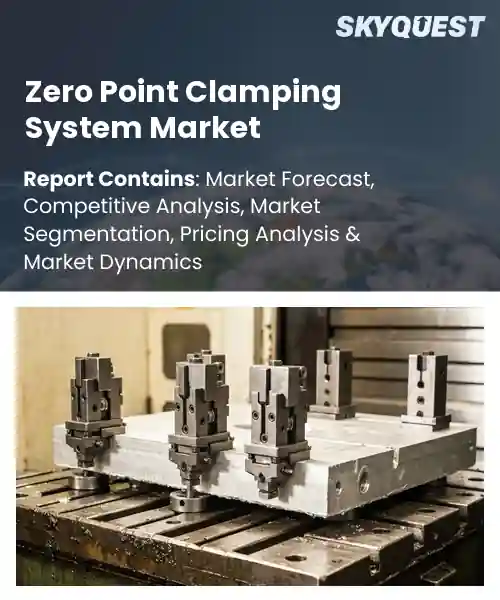
Zero Point Clamping System Market
Report ID: SQMIG20I3124
Report ID: SQMIG20I3124
[email protected]
USA +1 351-333-4748
Report ID:
SQMIG20I3124 |
Region:
Global |
Published Date: June, 2026
Pages:
157
|Tables:
122
|Figures:
77


Global Zero Point Clamping System Market size was valued at USD 1.35 Billion in 2024 and is poised to grow from USD 1.43 Billion in 2025 to USD 2.22 Billion by 2033, growing at a CAGR of 5.7% during the forecast period (2026-2033).
Zero-point clamps have become one of the most popular forms of clamping a workpiece without any mechanical contact, and they are critical for achieving high precision in high-tech industries such as aerospace, semiconductor and medical device manufacturing. The main benefit of zero-point clamping technology is that it can prevent deformation while securing parts to within micron tolerance levels. This will help manufacturers reduce scrap levels and improve yields.
The zero-point clamping market began to develop in the early 2000s when manufacturers started looking for alternatives to conventional fixturing methods. The market growth has accelerated since the introduction of magnetic-based clamps that provide manufacturers with the ability to quickly switch their tooling through rapid changeovers. A major provider to the Aerospace industry has documented a 15% reduction in cycle time after replacing hydraulically actuated clamps with zero-point clamping technology, illustrating the very real productivity benefits that have been driving global market growth.
Another important factor that is shaping the global zero-point clamping market is the dramatic increase in the adoption of Industry 4.0 technologies. This trend will increase the demand for flexible sensor-integrated fixtures that are designed to communicate with digital twins. As more factories begin to automate, tool-change and quality control processes will drive manufacturers to utilize zero-point clamps equipped with IoT modules because they can provide real-time force feedback and maintenance notifications. An example of this is a semiconductor fab in Germany that installed magnetic clamps with vibration sensors and achieved a 12% decrease in unplanned downtime and a 7% increase in first-pass yield. This cause‑effect relationship drives growth and opens opportunities in turbine assembly, where zero‑point technology secures large components without compromising alignment.
How is AI-driven Automation Influencing The Adoption Of Zero Point Clamping Systems In Manufacturing?
AI-driven automation is changing the way manufacturers choose and use zero-point clamping systems. Machine-learning algorithms analyze part geometry and provide data to robotic arms to position clamps with very little human involvement. Using real-time sensors to test for pressure, the end result is that pressure is adjusted as needed to provide precision while predictive models identify tool wear and provide optimal configuration recommendations for the clamps. As a result of these capabilities, set-up cycles are reduced, scrap is decreased, and operators can be used for higher value work.
As factories pursue Industry 4.0, there will be more demand for intelligent clamping solutions, and zero-point systems will become a major part of smart production lines. When zero-point clamping systems are combined with CNC controllers, machining operations can be coordinated seamlessly and cloud-based analytics provide an ongoing basis for improvement.
In April 2026, AI-enabled predictive alignment will start to be incorporated into zero-point clamping solutions, leading to greater adoption and greater production efficiencies in both automotive and aerospace production environments. Pilots have demonstrated the ability of machine learning to improve set-up times by minutes and improve repeatability, indicating positive momentum for intelligent clamping technologies in the market.
Market snapshot - (2026-2033)
Global Market Size
USD 1.35 Billion
Largest Segment
Pneumatic Clamping
Fastest Growth
Hydraulic Clamping
Growth Rate
5.7% CAGR
To get more insights on this market click here to Request a Free Sample Report
Global zero point clamping system market is segmented by type, retention force capability, application, end user and region. Based on type, the market is segmented into Pneumatic Clamping, Hydraulic Clamping and Manual Clamping. Based on retention force capability, the market is segmented into 30 kN Retention Force, 60 kN Retention Force, 90 kN Retention Force and Above 90 kN Retention Force. Based on application, the market is segmented into Parts Processing, Machinery Manufacturing, Automotive Assembly Line Setup, Aerospace Component Machining, Electronics Housing Fabrication, Medical Implant Precision Manufacturing and Others. Based on end user, the market is segmented into Manufacturing Sector, Industrial Workshop Facilities and Others. Based on region, the market is segmented into North America, Europe, Asia Pacific, Latin America and Middle East & Africa.
Due to the ease in which pneumatic clamp segments can be integrated into high-volume production environments and their low maintenance requirements, they dominate the market for zero-point clamping systems. Additionally, pneumatic systems provide the highest level of actuation speed and repeatability, which significantly reduce cycle times and improve part quality. Furthermore, pneumatic systems can easily integrate with existing air systems within the shop, thus lowering barriers to entry and encouraging widespread adoption across many different industries. In addition, the modular design of pneumatic systems allows for quick reconfiguration for different fixture layouts, thereby supporting flexible manufacturing systems.
While pneumatic clamping systems dominate the zero-point clamping system market, hydraulic clamping systems are the fastest-growing segment of this same market. The higher force control and ability to support large loads make hydraulic clamping systems attractive to those industries with a need for precise positioning and high clamping forces. The increasing demand for sophisticated machining centers is driving the growth of hydraulic clamping technology and providing opportunities for continued expansion of the market.
The aerospace component machining industry is leading the properties of ultra precision in fixturing due to their precision tolerances to achieve 또는 ultra precision fixturing solutions. The aerospace industry is rigorously measuring its components based on repeatability of a fixture using a zero point clamping solution, allowing to have repeatable placement and highly repeatable positioning for complex composite components and safety critical components. The highly stringent quality standards of the aerospace components and their continuing push for new, lightweight products, will continue to rely on zero point clamping technology. Therefore, this mechanical engineering sector will continue to lead this market.
On the other hand, electronic housing fabrication is the segment that is seeing the highest growth in the zero point clamping segment. The growth of the miniaturization of electronic consumer devices, along with the growing requirement for an accurate assembly of light and fragile electronic enclosures, is increasing the need for a reliable zero point clamping solution. The propensity for this new application is creating new sources of revenue and stimulating the development of new clamping technologies.
To get detailed segments analysis, Request a Free Sample Report
The North American region is at the top of the global market as it has an established industrial environment that allows for the coexistence of high-mix, low-volume production processes alongside mass produced goods, which in turn creates a very conducive environment for precision tooling development. With leading companies in aerospace, automotive and medical device industries, the R&D (Research & Development) systems continually push the limits of repeatability and accuracy. The robust supply chain combined with the established skilled labour base (not just engineers but control systems and automation specialists) ensure that new and innovative clamping solutions can be rapidly introduced into the marketplace. Proactive standardization organizations as well as collaborative affiliates further enhance the region's leadership/competitive advantage by standardizing zero point technology throughout a variety of production systems.
The Zero Point Clamping System Market in the United States has been created from the combination of the sophisticated aerospace assembly process and mass volume automotive manufacturing, wherein consistency and speed of product placement are paramount. Therefore, the large OEM's (Original Equipment Manufacturers) work tightly with end-users to integrate a zero point system into a smart factory framework using their enormous digital capabilities. In addition, the United States is the leading example for lean operations efficiency and rapid product changeover; therefore, it is considered the benchmark for precision and efficiency in the zero point clamping system market.
The Canadian Zero Point Clamping System Industry is also receiving support from an emphasis on the manufacturing of aerospace components and precision engineering used in renewable energy. Collaborative research institutions are combining with industrial companies to develop tailored zero point solutions for challenging geometries and high-quality specifications. This emphasis on advanced manufacturing initiatives and incentives for including new technologies is stimulating the ongoing growth of Canada as a leading participant in the North American zero point clamping system market.
In Europe, the convergence of engineering expertise from longstanding heritage engineering as well as a proactive digital transformation commitment is fostering rapid growth within the zero point clamping systems market. Well-established precision machining abilities throughout Europe result in a inherent demand for repeatable set-up systems, while sustainability requirements continue to drive manufacturers towards efficient and waste reduced processes. Effective collaboration between research institutions, suppliers of zero point clamping systems, and consumers is accelerating innovation; further solidifying Canada as a valuable contributor to the overall North America zero point clamping system marketplace.
Zero Point Clamping System Market in Germany is anchored by its world‑renowned mechanical engineering sector, where high‑precision tooling underpins automotive and industrial machine production. Close cooperation between OEMs and technology providers enables customized zero point solutions that meet stringent tolerances. The country’s focus on Industry 4.0 integration ensures these clamping systems are embedded within smart, interconnected manufacturing cells, reinforcing Germany’s position as a dominant force in the European market.
Zero Point Clamping System Market in United Kingdom experiences fast growth fueled by a vibrant aerospace and specialist engineering landscape. Companies prioritize agility and rapid changeover, driving adoption of zero point technology to shorten set‑up times and enhance repeatability. Government initiatives supporting advanced manufacturing and a thriving ecosystem of innovation hubs accelerate the diffusion of these systems across both traditional and emerging high‑tech sectors.
Zero Point Clamping System Market in France is emerging as a strategic focus within its aerospace and precision equipment industries. Collaborative projects between research universities and manufacturing firms aim to adapt zero point solutions to complex, low‑volume production runs. The nation’s emphasis on quality craftsmanship and increasingly digitized factories encourages gradual but steady integration of these technologies, positioning France as an upcoming player in the European zero point arena.
Asia Pacific is strengthening its position through aggressive adoption of automation and a strategic emphasis on high‑tech manufacturing hubs. Nations within the region are investing heavily in smart factory initiatives that prioritize precision and repeatability, making zero point clamping an essential component of modern production lines. The rapid expansion of electronics, automotive, and medical device sectors creates a broad base of demand, while close collaboration between equipment manufacturers and local industries accelerates technology transfer and customization. This dynamic environment cultivates a growing ecosystem where zero point solutions are integral to achieving competitive advantage.
Zero Point Clamping System Market in Japan benefits from an entrenched culture of meticulous craftsmanship combined with cutting‑edge robotics integration. Leading manufacturers in automotive and precision instrument sectors seek zero point technology to enhance repeatability and reduce waste, aligning with the nation’s continuous improvement philosophy. Strong ties between research institutes and equipment suppliers foster rapid prototyping and deployment, ensuring that zero point solutions remain central to Japan’s high‑quality production standards.
Zero Point Clamping System Market in South Korea is propelled by its robust electronics and semiconductor manufacturing base, where exacting tolerance control is critical. The country’s aggressive push toward smart factory adoption encourages manufacturers to embed zero point clamping within highly automated cells, improving efficiency and consistency. Collaborative innovation between local conglomerates and technology providers accelerates the development of tailored solutions, reinforcing South Korea’s emerging leadership in the regional zero point landscape.
To know more about the market opportunities by region and country, click here to
Buy The Complete Report
Adopting Advanced Sensors
Increasing Demand for Efficiency
High Initial Capital Costs
Stringent Regulatory Compliance
Request Free Customization of this report to help us to meet your business objectives.
The Zero Point Clamping System market is intensely competitive, with firms racing to embed automation and precision engineering into their offerings. Leaders such as AMF have launched advanced zero‑point technology to differentiate, while manufacturers are expanding quick‑zero‑point product lines to capture CNC users. These innovation‑driven moves, coupled with strategic product rollouts, intensify rivalry and fuel market growth.
SkyQuest’s ABIRAW (Advanced Business Intelligence, Research & Analysis Wing) is our Business Information Services team that Collects, Collates, Correlates, and Analyses the Data collected by means of Primary Exploratory Research backed by robust Secondary Desk research.
As per SkyQuest analysis, the global zero‑point clamping system market is propelled primarily by the widespread adoption of advanced sensors that enable real‑time force monitoring and tighter integration with automated production lines, while a secondary boost comes from Industry 4.0 initiatives that embed AI‑driven optimization and IoT connectivity into clamps, enhancing setup speed and yield. The market is led by North America, where mature manufacturing ecosystems and strong R&D support rapid uptake, and pneumatic clamping dominates due to its ease of integration, low maintenance and fast actuation. However, high upfront capital costs remain a significant restraint, slowing adoption especially among smaller firms.
| Report Metric | Details |
|---|---|
| Market size value in 2024 | USD 1.35 Billion |
| Market size value in 2033 | USD 2.22 Billion |
| Growth Rate | 5.7% |
| Base year | 2024 |
| Forecast period | (2026-2033) |
| Forecast Unit (Value) | USD Billion |
| Segments covered |
|
| Regions covered | North America (US, Canada), Europe (Germany, France, United Kingdom, Italy, Spain, Rest of Europe), Asia Pacific (China, India, Japan, Rest of Asia-Pacific), Latin America (Brazil, Rest of Latin America), Middle East & Africa (South Africa, GCC Countries, Rest of MEA) |
| Companies covered |
|
| Customization scope | Free report customization with purchase. Customization includes:-
|
To get a free trial access to our platform which is a one stop solution for all your data requirements for quicker decision making. This platform allows you to compare markets, competitors who are prominent in the market, and mega trends that are influencing the dynamics in the market. Also, get access to detailed SkyQuest exclusive matrix.
Table Of Content
Executive Summary
Market overview
Parent Market Analysis
Market overview
Market size
KEY MARKET INSIGHTS
COVID IMPACT
MARKET DYNAMICS & OUTLOOK
Market Size by Region
KEY COMPANY PROFILES
Methodology
For the Zero Point Clamping System Market, our research methodology involved a mixture of primary and secondary data sources. Key steps involved in the research process are listed below:
1. Information Procurement: This stage involved the procurement of Market data or related information via primary and secondary sources. The various secondary sources used included various company websites, annual reports, trade databases, and paid databases such as Hoover's, Bloomberg Business, Factiva, and Avention. Our team did 45 primary interactions Globally which included several stakeholders such as manufacturers, customers, key opinion leaders, etc. Overall, information procurement was one of the most extensive stages in our research process.
2. Information Analysis: This step involved triangulation of data through bottom-up and top-down approaches to estimate and validate the total size and future estimate of the Zero Point Clamping System Market.
3. Report Formulation: The final step entailed the placement of data points in appropriate Market spaces in an attempt to deduce viable conclusions.
4. Validation & Publishing: Validation is the most important step in the process. Validation & re-validation via an intricately designed process helped us finalize data points to be used for final calculations. The final Market estimates and forecasts were then aligned and sent to our panel of industry experts for validation of data. Once the validation was done the report was sent to our Quality Assurance team to ensure adherence to style guides, consistency & design.
Analyst Support
Customization Options
With the given market data, our dedicated team of analysts can offer you the following customization options are available for the Zero Point Clamping System Market:
Product Analysis: Product matrix, which offers a detailed comparison of the product portfolio of companies.
Regional Analysis: Further analysis of the Zero Point Clamping System Market for additional countries.
Competitive Analysis: Detailed analysis and profiling of additional Market players & comparative analysis of competitive products.
Go to Market Strategy: Find the high-growth channels to invest your marketing efforts and increase your customer base.
Innovation Mapping: Identify racial solutions and innovation, connected to deep ecosystems of innovators, start-ups, academics, and strategic partners.
Category Intelligence: Customized intelligence that is relevant to their supply Markets will enable them to make smarter sourcing decisions and improve their category management.
Public Company Transcript Analysis: To improve the investment performance by generating new alpha and making better-informed decisions.
Social Media Listening: To analyze the conversations and trends happening not just around your brand, but around your industry as a whole, and use those insights to make better Marketing decisions.
REQUEST FOR SAMPLE
 REQUEST FREE CUSTOMIZATION
Global Zero Point Clamping System Market size was valued at USD 1.35 Billion in 2024 and is poised to grow from USD 1.43 Billion in 2025 to USD 2.22 Billion by 2033, growing at a CAGR of 5.7% during the forecast period (2026-2033).
The Zero‑Point Clamping System market is intensely competitive, with firms racing to embed automation and precision engineering into their offerings. Leaders such as AMF have launched advanced zero‑point technology to differentiate, while manufacturers are expanding quick‑zero‑point product lines to capture CNC users. These innovation‑driven moves, coupled with strategic product rollouts, intensify rivalry and fuel market growth. 'Schunk GmbH & Co. KG', 'Emuge Franken', 'Roemheld GmbH', 'Andreas Maier GmbH & Co. KG', 'Stark Spannsysteme GmbH', 'ZeroClamp GmbH', 'Lang Technik GmbH', 'Kipp GmbH & Co. KG', 'SMW Autoblok', 'Jergens Inc.', 'Carr Lane Manufacturing Co.', 'TE-CO Workholding Inc.', 'Enerpac Tool Group Corp.', 'Pascal Corporation', 'Kosmek Ltd.', 'Kitagawa Corporation', 'Unitech Workholding Systems Private Limited', 'Norelem Normelemente GmbH', 'Lenzkes Clamping Tools Inc.', 'Triag International AG'
The industry is increasingly adopting advanced sensors that provide real‑time monitoring of voltage and current fluctuations, enabling precise clamp control. This technological enhancement improves system reliability, reduces downtime, and supports seamless integration with automated manufacturing lines. As a result, manufacturers perceive greater value in zero point clamping solutions, fostering broader acceptance and encouraging suppliers to expand product portfolios. The qualitative benefits of enhanced safety and operational insight act as strong incentives for investment, thereby driving market expansion across global industries and in multiple sectors.
Smart Manufacturing Integration: Adoption of smart manufacturing technologies is reshaping how zero‑point clamping systems are designed, produced, and serviced. Real‑time data collection, predictive analytics, and AI‑driven optimization enable manufacturers to reduce setup times, improve repeatability, and extend equipment lifespan. By embedding sensors directly into clamp mechanisms, operators gain visibility into force distribution and wear patterns, fostering proactive maintenance. This digital overlay not only enhances productivity but also aligns the market with broader Industry 4.0 initiatives, accelerating customer demand for integrated, data‑rich solutions across markets
Why does North America Dominate the Global Zero Point Clamping System Market? |@12


Want to customize this report? This report can be personalized according to your needs. Our analysts and industry experts will work directly with you to understand your requirements and provide you with customized data in a short amount of time. We offer $1000 worth of FREE customization at the time of purchase.
Feedback From Our Clients


 USA (+1) 351-333-4748

