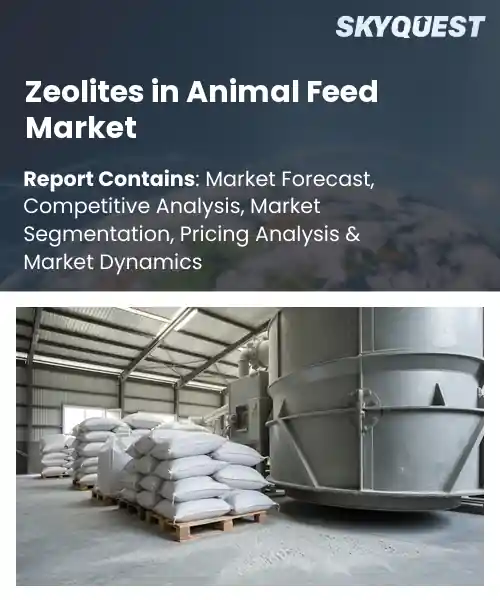
Zeolites in Animal Feed Market
Report ID: SQMIG15J2161
Report ID: SQMIG15J2161
[email protected]
USA +1 351-333-4748
Report ID:
SQMIG15J2161 |
Region:
Global |
Published Date: February, 2026
Pages:
157
|Tables:
116
|Figures:
77


Global Zeolites in Animal Feed Market size was valued at USD 375.2 Million in 2024 and is poised to grow from USD 401.84 Million in 2025 to USD 695.61 Million by 2033, growing at a CAGR of 7.1% during the forecast period (2026-2033).
The use of zeolites in animal feeding has created a unique mineral additive market that utilizes the zeolite to bind mycotoxins, increase nutrient absorption, and decrease ammonia emissions from livestock; hence, the market is important to livestock production and food safety of livestock. The outbreak of mycotoxin contamination can have a significant and direct impact on a producer's bottom line, and overall public health.
Clinoptilolite is being used as part of poultry and swine feed formulations to decrease the effect that aflatoxins have on growth and health. The demand for natural zeolite, primarily as a feed additive, has grown from natural deposits in Eastern Europe to now using synthetically produced forms with processing; thus, the market has expanded throughout Asia and the Americas, with its current rapid growth rate attributable to the advent of intensive farming and rapid adoption of stricter regulatory requirements.
The more zeolites are used as feed additives, the more feed formulators are aware that their risk of liability is increased as regulatory requirements become more stringent, and as farming becomes larger; this results in increased feed formulators' demand for the use of zeolites, as well as increased innovation, based solely upon economics. When producers use clinoptilolite as part of their feed formulations it aids in decreasing ammonia levels and binding aflatoxins, resulting in decreased respiratory issues and improved feed efficiency; improved herd health results in decreased veterinary costs and increased production from herds, thereby leading mills to formulate premixes and coated feed additives for both poultry and swine.
How can AI Optimize Zeolite in Animal Feed Market?The use of AI to optimize zeolite formulation in animal nutrition entails linking properties of zeolite materials to desired outcomes in the animals consuming them, using predictive models and iterative learning. Some of the key components include the identification of the correct zeolite mineral and particle size distribution, an understanding of how zeolite will interact with nutrients and toxins and formulating zeolite blends specifically for the types of diets required by individual animal species.
AI accelerates screening of potential zeolite products, determines how stable zeolite formulations will be when combined with different types of animal feeds, and provides cover formulators with information to help prioritize additional trial studies so that all producers can meet changing consumer requirements for natural additive products at a cost-effective and compliant price point. A recent real-world example of the continuing evolution of the zeolite feed products market was the USA Antimony Corporation’s (July 2024) introduction of CattleMax, a clinoptilolite-based feed additive, which illustrates the acceleration of the zeolite feed product market through AI-assisted optimization and accelerated screening of clinoptilolite products, resulting in shorter product development timelines and improved product formulations for improved animal performance and improved market acceptance.
Market snapshot - (2026-2033)
Global Market Size
USD 0.85 Billion
Largest Segment
Natural Zeolites
Fastest Growth
Synthetic Zeolites
Growth Rate
9.8% CAGR
To get more insights on this market click here to Request a Free Sample Report
Global zeolites in animal feed market is segmented into type of zeolites, livestock type, formulation type, application method and region. Based on type of zeolites, the market is segmented into natural zeolites and synthetic zeolites. Based on livestock type, the market is segmented into poultry, swine, ruminants and others. Based on formulation type, the market is segmented into mineral supplements and nutritional additives. Based on application method, the market is segmented into pelleted feed, liquid feed and others. Based on region, the market is segmented into North America, Europe, Asia Pacific, Latin America and Middle East & Africa.
As per zeolites in animal feed market outlook, natural zeolites segment dominates because producers and formulators prefer naturally sourced aluminosilicates for their broad-spectrum mycotoxin adsorption, moisture control and ammonia binding properties, which translate into improved animal health and feed stability. Natural zeolite has proven itself to be readily available and low-cost raw materials, making it easy for producers and formulators to incorporate into their current processes. These companies are then able to create a supply chain, which helps reinforce the purchase of natural zeolites for regular use within various diets for livestock. As per zeolites in animal feed market forecast, synthetic zeolites segment is the fastest growing in the market due to engineered pore designs and purities that allow formulator's to specifically target toxins and control nutrient releases, therefore enabling the possibility of developing specialty additives to support the production of premium feed products. The advances made in synthesis methods have provided formulators with the ability to produce consistent products which are compliant with regulations, thus further supporting the growth of synthetic zeolites and the establishment of additional value-added product opportunities that will support the ongoing zeolites in animal feed market growth.
Pelleted feed segments have the largest zeolites in animal feed market share because pelletization creates the mechanical and thermal conditions necessary to integrate zeolite particles uniformly into finished rations. This uniformity results in a consistent dosage, less dust, and improved storage and transportation stability. Furthermore, the compatibility of zeolites with existing feed manufacturing systems makes it easy for producers to include zeolite materials in their processes and provides reliable benefits associated with using zeolite products for adsorbing toxins and controlling moisture in feeds, thereby making them a preferred alternative for feed formulators when adding zeolite products to their standard production processes.
As per zeolites in animal feed market analysis, liquid feed segment is the fastest growing in the market because they offer a uniform distribution of zeolite products and precise, automated dosages, making it easy to target specific toxins and provide nutrients directly to the animal. As a result of improvements in stability, compatibility with additives, and increased interest in custom feeding strategies, feed formulators are developing zeolite products compatible with liquid feeds, which will help to accelerate product development and market growth.
To get detailed segments analysis, Request a Free Sample Report
As per zeolites in animal feed industry analysis, Asia Pacific has a competitive position due to several factors, including structural supply advantages; strong demand from the feed industry; an active research and development community that supports the practical application of their research. There is a strong presence of intensive livestock production throughout the region, along with an increase in aquaculture activities; due in part to increased emphasis on feed safety and improved environmental performance, which creates continual demand for additives for control of mycotoxins, management of ammonia, and enhancement of nutrient retention.
The zeolites in animal feed market in Japan are driven by well-established feed formulation practices, a strong focus on feed safety regulations, and close working relationships between research institutions and feed suppliers. Also, producers prefer to use additives that enhance nutrient retention and reduce ammonia emissions and receive technical assistance in validating products.
South Korea is characterized by a very active livestock industry; a high standard of environmental and feed safety requirements; and collaboration between feed manufacturers and research institutes. Domestic suppliers and researchers can provide technical assistance and reliable supplies of zeolites to the feeding industry, thus facilitating their use for meat and aquacultural operations. Emphasis is placed on product performance relative to feed efficiency, waste management, and mycotoxin control, which are contributing to their continued adoption. In addition, the existence of certified and traceable zeolite products is supporting increased commercial acceptance and/or differentiation among competing products.
As per zeolites in animal feed regional market outlook, North America experiences rapid growth; the livestock sector continues to thrive. This is due to three main factors: there is a significant amount of livestock being produced commercially; the feed industry has developed a well-established manufacturing base; and research that shows the inherent benefits of using zeolites as an additive in maintaining and improving farm operations has been actively conducted throughout the region. The industry is actively looking for natural additives that provide farmers with several benefits including improved nutrient utilization, reduced risk of mycotoxins in feed, improved management of ammonia emissions and manure management concerns, and alternatives to conventional growth promoters. The availability of clear regulatory processes for the use of zeolites in animal feed and mature distribution systems has reduced the barriers to market entry for zeolites in animal feed. Both cooperative extension services and industry tests provide practical evidence of the benefits of using zeolites in animal feed, which will support expanded adoption. The commitment to sustainability made by both meat producers and retailers further encourages the development of products that meet the sustainability objectives of both producers and retailers, resulting in many ingredient suppliers, feed mills, and livestock producers working together to incorporate zeolite solutions into mainstream feeding and management practices.
The benefits of the use of zeolites in animal feed are enhanced by the wide variety of animal species raised in the United States for food production, a significant and well-established feed manufacturing infrastructure, and a history of cooperation between research organizations and animal agriculture. The feed suppliers and livestock producers are increasingly using zeolite additives in animal feeds to reduce the risk of mycotoxin contamination in animal feeds and to reduce the emission of ammonia into the environment. The establishment of established distribution channels and technical support services can assist with the evaluation of zeolite additives and facilitate broader commercial distribution of zeolite additive products to poultry, swine, and ruminant producers.
Canada market is focused on feed safety, environmental stewardship, and efficiency within the dairy, poultry, and beef industries. There is collaboration between feed mills and suppliers and researchers to validate benefits of using zeolite technologies to reduce ammonia emissions, bind mycotoxins, and improve nutrient retention in the feed and manure produced by livestock. Regulatory and certification requirements support traceability and ensure quality assurance for users of zeolite technologies. Additionally, strong collaborative relationships between producers and feed advisors support practical ways to implement and integrate zeolite technologies using regionally specific feed formulations and manure management practices.
As per zeolites in animal feed regional market forecast, Europe is using a combination of regulatory rigor, sustainability priorities, and applied research to strengthen its position in the market. These policies are intended to support the larger adoption of zeolite technologies through the reduction of antibiotic use in livestock production (due to their effectiveness as natural feed additives) and by lowering the negative environmental impacts caused by livestock production. National technical centers, university collaborations, and industry associations work together to coordinate field trials of zeolite technologies and transfer knowledge from those trials between the different markets using these technologies. Certification and traceability requirements will also help build confidence of buyers interested in using zeolite technologies. Existing feed manufacturing networks and specialized ingredient suppliers will facilitate the manufacture of zeolite formulas that are specific to the species of livestock for which the feed is intended.
The Germany has a well-established infrastructure for zeolite production, as well as strong collaboration between zeolite producers and feed manufacturers. For example, there are numerous research institutions dedicated to studying zeolite applications, such as the German Institute for Animal Feed Research (IFTS) and many universities.
In the UK, zeolite imports play a significant role in meeting the demand for animal feed. There are many academic institutions engaged in research related to zeolites for animal feed production. Certification schemes and retailer requirements influence uptake of validated additives, while established technical support and distribution networks help feed formulators and farms integrate zeolites into nutrition and management programs.
France is another prominent importer of zeolites for animal feed production. The primary supply source for zeolites used in animal feeds in France is using local producers. Due to the large number of livestock produced on farms throughout the country, zeolite imports will continue to be significant for meeting the demand for animal feeds. Overall, the overall outlook for zeolites is promising due to ongoing demand for animal feeds worldwide, as well as continued developments in zeolite processes and technology.
To know more about the market opportunities by region and country, click here to
Buy The Complete Report
Increasing Demand for Feed Efficiency
As more livestock producers incorporate zeolites into their rations because zeolites adsorb many harmful substances, it stabilizes the gut and binds harmful substance in the gut leading to the better absorption of nutrients and improved efficiency of feed use. There is a push towards using alternative feed ingredients that can help producers reduce production inputs and maximize performance. Zeolites can aid in improving feed conversion efficiencies and achieving consistent producer goals through the mineral structure of zeolites with their unique ability to help regulate water content. Through demonstrated efficiencies, zeolites are being used more in feed formulations in different animal species. The feed industry considers the use of zeolites as a very scalable option to increase efficiencies throughout their operation.
Growing Attention to Animal Health
With the increased emphasis on animal health, formulators have begun to use functional feed ingredients to support a healthy digestive system and promote the integrity of the gastrointestinal tract (GIT) by reducing the number of harmful substances the animal is exposed to. By absorbing toxins, reducing the moisture of feed and bedding, and helping to maintain cleaner housing conditions, zeolites contribute to a lower bacterial load on the animal and create a safe environment for animals to grow. Improving gut barrier function and reducing the need for medical treatments coincides with producer's objectives for their production livestock to maintain good health and welfare; therefore, zeolites will be included in a greater number of producers' preventative health programs and used more across multiple production systems.
Regulatory Uncertainty for Feed Additives
Variable regulatory frameworks and evolving approvals create uncertainty for feed additive manufacturers and feed formulators. Uncertainty in the regulatory process can delay product introductions, limiting investment in zeolite-based solutions. Differences across jurisdictions in the safety assessment process, permitted claims and registration timelines have caused operating firms to adopt a conservative approach by using established ingredients and known supply chains. This conservative approach dampens the market growth of zeolite-based feed additives by limiting the number of new formulations developed and applied to feed, while creating an environment that encourages incremental rather than widespread use of zeolites until greater regulatory clarity and harmonized standards are in place.
Supply Chain Constraints Affecting Distribution
Challenges with having consistent access to raw materials and disruptions in logistics inhibit reliable deliveries of zeolites to feed manufacturers and subsequently impactfeed formulation stability and the farmer’s ability to have confidence in feeding zeolites to their livestock. Additionally, the lack of consistent quality in minerals, challenges associated with transport and storage, and the variability of mineral availability create challenges for firms to use zeolites as ingredients in their formulations resulting in a tendency for firms to utilize more secure sources of supply. Consequently, this has reduced the amount of large-scale purchases and long-term contracts for suppliers of zeolites and inhibited market growth through supply chain fragility that limits the speed and scale at which zeolites are adopted across multiple market regions.
Request Free Customization of this report to help us to meet your business objectives.
The market is transforming due to acquisitions of ingredient leaders who are integrating technologies and supply chains into their businesses. The largest suppliers of feed and feed ingredients have made acquisitions, merged with other companies, and purchased process technologies to secure sources of high purity zeolite feed ingredients and to acquire the knowledge to effectively use zeolytes. At the same time, mining companies that extract zeolites and other specialty minerals have been introducing new types of feeds that contain natural mycotoxin binders and gut health additives to better serve the growing demand for these products by livestock producers worldwide.
Precision Nutrition Integration: Increasingly, zeolites are being incorporated into targeted precision nutrition strategies by feed formulators and producers as an option for improving gut health, nutrient utilization and mycotoxin mitigation for the entire livestock and aquaculture chain. As such, there is a trend towards designing zeolite inclusion rates to be specific to the species and animal's needs, as well as considering compatibility with probiotics and enzyme supplementation programs and conducting trials to determine beneficial outcomes as opposed to blanket additions. The primary motivation for the zeolites in animal feed market trend is the desire for consistent performance on the part of feed producers, desire to reduce reliance on antibiotics, and desire for differentiation through proof of animal health benefits, which has led to suppliers providing guidance and support for application integration partnerships with nutrition and feed manufacturers.
Focus on Sustainability and Circularity: The focus on environmentally responsible practices makes zeolites a valuable feed component because they have the potential to help reduce waste, reduce greenhouse gas emissions, and support resource-efficient feeding practices. Feed buyers are increasingly interested in inputs that can be included in a sustainable supply chain; are sourced in a socially responsible manner; and can help producers meet the goals of regenerative agriculture. At the same time, as individual consumers' preferences and corporate sustainability goals come together, feed producers and feed companies are requiring their manufacturers to provide documentation on the source of their materials, provide circular sourcing options and provide complete lifecycle information. This need is driving the development of traceability systems, sustainability claims, and collaborative programs that will help improve market access, brand differentiation, and resilience.
SkyQuest’s ABIRAW (Advanced Business Intelligence, Research & Analysis Wing) is our Business Information Services team that Collects, Collates, Correlates, and Analyses the Data collected by means of Primary Exploratory Research backed by robust Secondary Desk research.
As per SkyQuest analysis, the global market is growing due to a rising need for more feed efficient and greater emphasis on animal health. Natural zeolites will continue to dominate this market, and Asia-Pacific will continue to be the leading region for zeolite use/master companies and suppliers. Most producers will focus on using clinoptilolite to bind mycotoxins in feed, manage ammonia, and make it more cost effective when integrated into pelleted feeds; producers continue to create new products and promote their use in pre-mixed feeds. Regulatory uncertainty concerning the approval of feed additives and inconsistency in the standards required to meet different jurisdictions will slow the pace of commercializing engineered and synthetic zeolites, as well as the speed of investment in engineered and synthetic zeolites. The level of continued focus on verification of feed additive use, consistency in feed supply, and on creating custom formulations for each customer will determine how quickly synthetic engineered and engineered zeolites will be able to penetrate the higher-end premium segments and support sustainability and measurable on-farm benefits.
| Report Metric | Details |
|---|---|
| Market size value in 2024 | USD 0.85 Billion |
| Market size value in 2033 | USD 1.97 Billion |
| Growth Rate | 9.8% |
| Base year | 2024 |
| Forecast period | (2026-2033) |
| Forecast Unit (Value) | USD Billion |
| Segments covered |
|
| Regions covered | North America (US, Canada), Europe (Germany, France, United Kingdom, Italy, Spain, Rest of Europe), Asia Pacific (China, India, Japan, Rest of Asia-Pacific), Latin America (Brazil, Rest of Latin America), Middle East & Africa (South Africa, GCC Countries, Rest of MEA) |
| Companies covered |
|
| Customization scope | Free report customization with purchase. Customization includes:-
|
To get a free trial access to our platform which is a one stop solution for all your data requirements for quicker decision making. This platform allows you to compare markets, competitors who are prominent in the market, and mega trends that are influencing the dynamics in the market. Also, get access to detailed SkyQuest exclusive matrix.
Table Of Content
Executive Summary
Market overview
Parent Market Analysis
Market overview
Market size
KEY MARKET INSIGHTS
COVID IMPACT
MARKET DYNAMICS & OUTLOOK
Market Size by Region
KEY COMPANY PROFILES
Methodology
For the Zeolites in Animal Feed Market, our research methodology involved a mixture of primary and secondary data sources. Key steps involved in the research process are listed below:
1. Information Procurement: This stage involved the procurement of Market data or related information via primary and secondary sources. The various secondary sources used included various company websites, annual reports, trade databases, and paid databases such as Hoover's, Bloomberg Business, Factiva, and Avention. Our team did 45 primary interactions Globally which included several stakeholders such as manufacturers, customers, key opinion leaders, etc. Overall, information procurement was one of the most extensive stages in our research process.
2. Information Analysis: This step involved triangulation of data through bottom-up and top-down approaches to estimate and validate the total size and future estimate of the Zeolites in Animal Feed Market.
3. Report Formulation: The final step entailed the placement of data points in appropriate Market spaces in an attempt to deduce viable conclusions.
4. Validation & Publishing: Validation is the most important step in the process. Validation & re-validation via an intricately designed process helped us finalize data points to be used for final calculations. The final Market estimates and forecasts were then aligned and sent to our panel of industry experts for validation of data. Once the validation was done the report was sent to our Quality Assurance team to ensure adherence to style guides, consistency & design.
Analyst Support
Customization Options
With the given market data, our dedicated team of analysts can offer you the following customization options are available for the Zeolites in Animal Feed Market:
Product Analysis: Product matrix, which offers a detailed comparison of the product portfolio of companies.
Regional Analysis: Further analysis of the Zeolites in Animal Feed Market for additional countries.
Competitive Analysis: Detailed analysis and profiling of additional Market players & comparative analysis of competitive products.
Go to Market Strategy: Find the high-growth channels to invest your marketing efforts and increase your customer base.
Innovation Mapping: Identify racial solutions and innovation, connected to deep ecosystems of innovators, start-ups, academics, and strategic partners.
Category Intelligence: Customized intelligence that is relevant to their supply Markets will enable them to make smarter sourcing decisions and improve their category management.
Public Company Transcript Analysis: To improve the investment performance by generating new alpha and making better-informed decisions.
Social Media Listening: To analyze the conversations and trends happening not just around your brand, but around your industry as a whole, and use those insights to make better Marketing decisions.
REQUEST FOR SAMPLE
 REQUEST FREE CUSTOMIZATION
Global Zeolites In Animal Feed Market size was valued at USD 0.85 Billion in 2024 and is poised to grow from USD 0.93 Billion in 2025 to USD 1.97 Billion by 2033, growing at a CAGR of 9.8% during the forecast period (2026-2033).
Competitive landscape in zeolites for animal feed is defined by ingredient incumbents consolidating and technology acquisitions that shift supply chains and product capabilities. Large feed and ingredient firms have pursued mergers, acquisitions and process technology buys to secure high purity zeolite supply and application knowhow, while mining and specialty mineral players launched tailored feed lines to capture demand for natural mycotoxin binders and gut health additives. 'Zeotech Corp', 'CEC Mining Systems', 'Clariant AG', 'BASF SE', 'Natural Minerals', 'Dicalite Management Group', 'The Ankerpoort', 'Huber Engineered Materials', 'Tolaram Group', 'EP Minerals LLC', 'Natrochem Inc.', 'Aegean Zeolite', 'Sorbead India', 'Kemin Industries', 'Zeolite Solutions', 'American Zeolite', 'NDSU Zeolite Research', 'Sigma Minerals Ltd.', 'KATY Zeolites', 'Mil-Spec Industries'
Zeolites are increasingly integrated into animal diets because their adsorptive properties help stabilize gut environments and bind harmful compounds, which supports improved nutrient availability and more efficient feed utilization. Producers seeking to lower input costs and optimize performance favor ingredients that enhance feed conversion and support consistent growth outcomes, and zeolites offer a practical route to these goals through mineral structure and water regulation properties. This perceived efficiency benefit encourages broader adoption across feed formulations and species. Industry stakeholders view this as a scalable solution across operations.
Precision Nutrition Integration: Feed formulators and producers increasingly incorporate zeolites into targeted precision nutrition strategies to improve gut health, nutrient utilization and mycotoxin mitigation across livestock and aquaculture systems. This trend emphasizes tailored inclusion rates, compatibility with probiotic and enzyme programs, and trials focused on outcomes rather than blanket additions. Adoption is driven by demand for consistent performance, reduced reliance on antibiotics, and differentiation through documented animal health benefits, prompting suppliers to offer application guidelines, support and integration partnerships with nutritionists and manufacturers.
As per zeolites in animal feed industry analysis, Asia Pacific has a competitive position due to several factors, including structural supply advantages; strong demand from the feed industry; an active research and development community that supports the practical application of their research.


Want to customize this report? This report can be personalized according to your needs. Our analysts and industry experts will work directly with you to understand your requirements and provide you with customized data in a short amount of time. We offer $1000 worth of FREE customization at the time of purchase.
Feedback From Our Clients


 USA (+1) 351-333-4748

