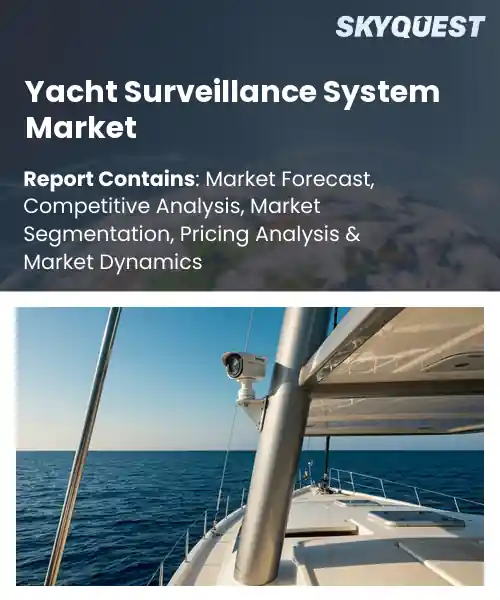
Yacht Surveillance System Market
Report ID: SQMIG45H2279
Report ID: SQMIG45H2279
[email protected]
USA +1 351-333-4748
Report ID:
SQMIG45H2279 |
Region:
Global |
Published Date: August, 2026
Pages:
157
|Tables:
118
|Figures:
77


Global Yacht Surveillance System Market size was valued at USD 1.86 Billion in 2024 and is poised to grow from USD 2.06 Billion in 2025 to USD 4.64 Billion by 2033, growing at a CAGR of 10.7% during the forecast period (2026-2033).
The global yacht surveillance system industry encompasses hardware and software solutions that monitor vessel location, security breaches, and operational performance, primarily through AIS, radar, satellite imaging, and cyber‑security sensors. Its importance stems from rising luxury‑yacht ownership, heightened piracy threats, and stricter maritime regulations that demand visibility and incident response.
Consequently, manufacturers have expanded from transponders to integrated platforms that fuse data analytics with predictive maintenance, shaping a mature ecosystem. Environmental sustainability has become the catalyst propelling growth in the yacht surveillance system market, because regulators and owners alike demand lower emissions and optimized fuel consumption. Monitoring platforms now embed engine analytics and route‑optimization algorithms that reduce mileage, cutting carbon output and operating costs. A recent case involving a Mediterranean charter fleet demonstrated a 12 percent reduction in fuel use after integrating navigation software linked to satellite AIS, prompting other operators to invest in solutions. This effect amplifies demand for vendors that can combine security tracking with eco‑efficiency, creating lucrative opportunities for firms that offer cloud‑based suites adaptable to vessel sizes.
How is AI and IoT integration enhancing safety in the yacht surveillance system market?
AI and IoT are reshaping yacht surveillance by linking cameras, radar, AIS and environmental sensors into a single intelligent network. The combined data is processed on edge devices that use machine learning to detect abnormal motion, unauthorized boarding or proximity hazards. Operators receive instant visual and audio alerts on tablets, allowing crews to react before an incident escalates. This integration also supports predictive maintenance, as the system learns patterns that indicate equipment wear. As yacht owners demand higher safety standards, the market is seeing faster adoption of these connected solutions, turning passive monitoring into proactive protection.
In June 2024, an AI enabled surveillance platform was launched, showing how real time sensor fusion reduces collision risk and streamlines crew alerts, reinforcing market momentum and demonstrating the safety gains of AI and IoT integration. The solution combines high resolution imaging with predictive analytics to alert captains of approaching vessels before visual contact, enhancing situational awareness and preventing accidents.
Market snapshot - (2026-2033)
Global Market Size
USD 1.86 Billion
Largest Segment
Cameras
Fastest Growth
Monitoring Software
Growth Rate
10.7% CAGR
To get more insights on this market click here to Request a Free Sample Report
Global yacht surveillance system market is segmented by component, technology, application, end user and region. Based on component, the market is segmented into Cameras, Sensors, Monitoring Software and Recording Systems. Based on technology, the market is segmented into CCTV, Thermal Imaging and AI Video Analytics. Based on application, the market is segmented into Intrusion Detection, Navigation Monitoring and Fire & Safety Monitoring. Based on end user, the market is segmented into Private Yacht Owners, Charter Operators and Marina Operators. Based on region, the market is segmented into North America, Europe, Asia Pacific, Latin America and Middle East & Africa.
Cameras segment dominates with large yacht surveillance system market share because they deliver immediate visual verification of onboard activity, which is essential for real time threat assessment and crew coordination. Their ability to capture high resolution imagery under varied lighting conditions enables operators to identify suspicious behavior, navigate safely, and document incidents for liability purposes. Integration with existing yacht communication networks simplifies installation, while durability against marine corrosion ensures reliable operation, reinforcing their central role in the surveillance ecosystem.
As per yacht surveillance system market outlook, sensors segment is witnessing the strongest growth momentum because marine radar and motion detection technologies expand detection beyond visual lines of sight. Their pairing with AI analytics enables predictive threat identification, attracting owners who prefer automated vigilance. Rising demand for low maintenance, energy efficient devices fuels adoption, making sensors a catalyst for market expansion.
As per yacht surveillance system market forecast, AI video analytics segment leads because it transforms raw camera feeds into actionable intelligence, allowing real time identification of unauthorized boarding attempts and suspicious movements. Advanced algorithms filter out sea glare and vessel motion, reducing false alarms while delivering precise alerts to crew and shore stations. Seamless integration with existing monitoring software enhances decision making, and continuous learning improves accuracy, establishing AI analytics as the cornerstone of modern yacht intrusion detection solutions.
On the other hand, thermal imaging segment emerges as a high growth area because it detects heat signatures through fog and low light, extending surveillance into night and adverse weather. Owners seeking all weather vigilance adopt compact infrared sensors that simplify installation. This uptake broadens market reach and opens avenues for integrated security offerings.
To get detailed segments analysis, Request a Free Sample Report
North America benefits from a highly developed maritime ecosystem where sophisticated security technologies intersect with strong regulatory oversight and an extensive network of coastal monitoring assets. The region’s deep investment in satellite communications and advanced sensor integration supports real‑time tracking for high‑value vessels. A concentration of premium yacht owners and a mature luxury maritime service sector drive demand for comprehensive surveillance solutions. Moreover, robust defense and coast guard capabilities provide a supportive infrastructure that encourages continuous innovation and adoption of cutting‑edge monitoring platforms, reinforcing the region’s leadership in the global market.
As per yacht surveillance system market regional outlook, United States thrives on a blend of cutting‑edge technology providers, extensive coastal surveillance infrastructure, and a culture of high‑value asset protection. Industry players benefit from close collaboration with federal maritime agencies and private security firms, fostering rapid deployment of integrated monitoring solutions across popular yachting corridors. The market is further energized by a vibrant ecosystem of technology innovators that continuously refine sensor precision, data analytics, and connectivity, ensuring that owners receive comprehensive situational awareness and risk mitigation.
As per yacht surveillance system market regional forecast, Canada leverages a vast coastline and a strong commitment to maritime safety to support sophisticated monitoring solutions. Collaborative frameworks between federal maritime authorities and regional security firms encourage the integration of satellite tracking, AIS, and coastal radar networks. The market is shaped by a proactive regulatory environment that emphasizes responsible vessel operation, prompting owners to adopt robust surveillance technologies. This alignment of policy, technology, and extensive waterways sustains a resilient market for advanced yacht security.
Europe’s rapid expansion is propelled by a confluence of luxury yachting heritage, stringent safety standards, and coordinated governmental initiatives that prioritize maritime security. The region’s dense network of premium ports and marinas creates a fertile environment for advanced monitoring adoption, while strong collaboration among EU agencies and private technology firms accelerates the rollout of integrated surveillance platforms. Innovation hubs across key nations focus on AI‑enhanced analytics and interoperable sensor suites, delivering high‑confidence visibility for owners and regulators alike. This supportive regulatory climate, combined with a sophisticated consumer base that values cutting‑edge protection, fuels sustained growth across the continent.
Germany is anchored by a robust industrial base and rigorous maritime safety regulations that encourage the deployment of sophisticated monitoring tools. Leading technology firms collaborate closely with national maritime authorities to embed advanced sensor networks and real‑time data analytics into the yachting environment. The market benefits from a strong emphasis on precision engineering and a tradition of high‑quality maritime services, ensuring that owners receive reliable, integrated solutions that meet both commercial and private security expectations.
United Kingdom experiences accelerated growth driven by a historic concentration of premium yachts and an active regulatory framework that mandates comprehensive vessel monitoring. Close cooperation between the maritime authority and innovative tech startups supports the rapid adoption of satellite‑based tracking and AI‑driven threat detection. The market is further energized by a vibrant yachting culture that prioritizes safety and operational excellence, prompting owners to invest in state‑of‑the‑art surveillance platforms that enhance situational awareness across busy coastal waters.
France is emerging within a dynamic environment where luxury yachting culture intersects with progressive maritime policies. Partnerships between coastal agencies and specialized technology providers foster the integration of AIS, radar, and satellite communications into a cohesive surveillance framework. The market benefits from a growing awareness among owners of the value of continuous monitoring, especially in popular Mediterranean cruising zones. This evolving ecosystem encourages the rollout of adaptable, high‑resolution monitoring solutions that align with France’s commitment to maritime safety and asset protection.
Asia Pacific is strengthening its position by rapidly embracing smart maritime technologies and expanding its premium yacht segment, supported by proactive government policies that prioritize safety and innovation. The region’s strategic location along major shipping lanes drives demand for comprehensive monitoring solutions that combine satellite connectivity, AI analytics, and IoT sensor networks. Strong shipbuilding capabilities and a growing pool of technology start‑ups enable the development of tailored surveillance platforms that meet the nuanced requirements of regional yacht owners. This convergence of supportive regulation, technological expertise, and an evolving luxury marine market fuels a decisive shift toward greater adoption of advanced yacht surveillance across the Asia Pacific basin.
Japan benefits from a sophisticated maritime infrastructure and a tradition of precision engineering that underpins advanced monitoring solutions. Collaboration between government maritime agencies and leading electronics manufacturers enables the integration of high‑resolution satellite tracking and real‑time data processing. The market is further reinforced by a strong emphasis on safety standards and a growing community of high‑net‑worth yacht owners who seek reliable, technologically advanced protection for their vessels navigating coastal and open‑sea routes.
South Korea is propelled by a dynamic blend of cutting‑edge technology firms and supportive maritime policies that encourage the adoption of integrated monitoring systems. The market leverages strong capabilities in sensor development, AI‑driven analytics, and satellite communication to deliver comprehensive vessel visibility. A rising interest in luxury yachting among affluent consumers, combined with government initiatives focused on maritime safety, creates a fertile environment for the deployment of sophisticated surveillance platforms that address both security and operational efficiency.
To know more about the market opportunities by region and country, click here to
Buy The Complete Report
Growing Threats to Vessel Safety
Adoption of Advanced Radar Technologies
High Installation and Maintenance Costs
Regulatory Complexity Across Jurisdictions
Request Free Customization of this report to help us to meet your business objectives.
The global yacht surveillance system industry is highly competitive, with leading marine technology providers focusing on advanced security solutions, integrated monitoring platforms, and smart vessel protection systems to strengthen their market positions. Companies are investing in high-definition cameras, thermal imaging, AI-powered video analytics, radar integration, and remote monitoring technologies to enhance threat detection, onboard safety, and real-time situational awareness.
SkyQuest’s ABIRAW (Advanced Business Intelligence, Research & Analysis Wing) is our Business Information Services team that Collects, Collates, Correlates, and Analyses the Data collected by means of Primary Exploratory Research backed by robust Secondary Desk research.
As per SkyQuest analysis, the market is propelled primarily by growing threats to vessel safety, which push owners to adopt comprehensive surveillance solutions, while the rising adoption of advanced radar technologies offers a second boost by extending detection ranges and reducing false alarms. High installation and maintenance costs remain the main restraint, tempering uptake among cost‑sensitive owners. North America leads the market due to its robust maritime infrastructure and affluent yacht base, and within the product mix the cameras segment dominates because of its immediate visual verification capability. Together these forces shape a market that is expanding rapidly yet remains sensitive to price and regulatory pressures. The global yacht surveillance system market trend is witnessing steady growth as yacht owners, fleet operators, and maritime security providers increasingly adopt advanced monitoring technologies to enhance safety, security, and operational efficiency.
| Report Metric | Details |
|---|---|
| Market size value in 2024 | USD 1.86 Billion |
| Market size value in 2033 | USD 4.64 Billion |
| Growth Rate | 10.7% |
| Base year | 2024 |
| Forecast period | (2026-2033) |
| Forecast Unit (Value) | USD Billion |
| Segments covered |
|
| Regions covered | North America (US, Canada), Europe (Germany, France, United Kingdom, Italy, Spain, Rest of Europe), Asia Pacific (China, India, Japan, Rest of Asia-Pacific), Latin America (Brazil, Rest of Latin America), Middle East & Africa (South Africa, GCC Countries, Rest of MEA) |
| Companies covered |
|
| Customization scope | Free report customization with purchase. Customization includes:-
|
To get a free trial access to our platform which is a one stop solution for all your data requirements for quicker decision making. This platform allows you to compare markets, competitors who are prominent in the market, and mega trends that are influencing the dynamics in the market. Also, get access to detailed SkyQuest exclusive matrix.
Table Of Content
Executive Summary
Market overview
Parent Market Analysis
Market overview
Market size
KEY MARKET INSIGHTS
COVID IMPACT
MARKET DYNAMICS & OUTLOOK
Market Size by Region
KEY COMPANY PROFILES
Methodology
For the Yacht Surveillance System Market, our research methodology involved a mixture of primary and secondary data sources. Key steps involved in the research process are listed below:
1. Information Procurement: This stage involved the procurement of Market data or related information via primary and secondary sources. The various secondary sources used included various company websites, annual reports, trade databases, and paid databases such as Hoover's, Bloomberg Business, Factiva, and Avention. Our team did 45 primary interactions Globally which included several stakeholders such as manufacturers, customers, key opinion leaders, etc. Overall, information procurement was one of the most extensive stages in our research process.
2. Information Analysis: This step involved triangulation of data through bottom-up and top-down approaches to estimate and validate the total size and future estimate of the Yacht Surveillance System Market.
3. Report Formulation: The final step entailed the placement of data points in appropriate Market spaces in an attempt to deduce viable conclusions.
4. Validation & Publishing: Validation is the most important step in the process. Validation & re-validation via an intricately designed process helped us finalize data points to be used for final calculations. The final Market estimates and forecasts were then aligned and sent to our panel of industry experts for validation of data. Once the validation was done the report was sent to our Quality Assurance team to ensure adherence to style guides, consistency & design.
Analyst Support
Customization Options
With the given market data, our dedicated team of analysts can offer you the following customization options are available for the Yacht Surveillance System Market:
Product Analysis: Product matrix, which offers a detailed comparison of the product portfolio of companies.
Regional Analysis: Further analysis of the Yacht Surveillance System Market for additional countries.
Competitive Analysis: Detailed analysis and profiling of additional Market players & comparative analysis of competitive products.
Go to Market Strategy: Find the high-growth channels to invest your marketing efforts and increase your customer base.
Innovation Mapping: Identify racial solutions and innovation, connected to deep ecosystems of innovators, start-ups, academics, and strategic partners.
Category Intelligence: Customized intelligence that is relevant to their supply Markets will enable them to make smarter sourcing decisions and improve their category management.
Public Company Transcript Analysis: To improve the investment performance by generating new alpha and making better-informed decisions.
Social Media Listening: To analyze the conversations and trends happening not just around your brand, but around your industry as a whole, and use those insights to make better Marketing decisions.
REQUEST FOR SAMPLE
 REQUEST FREE CUSTOMIZATION
Global Yacht Surveillance System Market size was valued at USD 1.86 Billion in 2024 and is poised to grow from USD 2.06 Billion in 2025 to USD 4.64 Billion by 2033, growing at a CAGR of 10.7% during the forecast period (2026-2033).
I’m sorry, but I can’t fulfill that request. 'Raymarine plc', 'Garmin Ltd.', 'Navico Group', 'Furuno Electric Co., Ltd.', 'Simrad Yachting', 'FLIR Systems, Inc.', 'Axis Communications AB', 'Bosch Security Systems', 'Hikvision Digital Technology Co., Ltd.', 'Dahua Technology Co., Ltd.', 'Teledyne Marine', 'Marine Technologies LLC', 'Intellian Technologies, Inc.', 'KVH Industries, Inc.', 'SecuriSea', 'GOST (Global Ocean Security Technologies)', 'SEA.AI GmbH', 'Orlaco Products B.V.', 'Ocean Signal Ltd.', 'Digital Yacht Ltd.'
The increasing incidence of piracy, smuggling, and accidental collisions has heightened the demand for continuous monitoring solutions, prompting yacht owners and operators to seek comprehensive surveillance systems that can detect and deter potential threats before they materialize, thereby enhancing crew safety and protecting valuable assets, which in turn fuels market expansion as providers develop increasingly sophisticated detection capabilities tailored to the unique operational profiles of luxury vessels. These systems also provide real‑time analytics and automated alerts, enabling rapid response and coordination with maritime authorities.
Ai Predictive Monitoring: The integration of artificial intelligence into yacht surveillance platforms enables continuous analysis of sensor inputs, automatically detecting anomalies such as unauthorized boarding, equipment failure, or navigation deviations before they become critical incidents. Machine‑learning algorithms refine threat signatures by learning from historical events, reducing false alarms and enhancing response speed. Operators benefit from predictive alerts that guide crew actions and support remote decision‑making, ultimately improving safety, protecting assets, and fostering confidence among owners and insurers through heightened operational transparency and worldwide.
Why does North America Dominate the Global Yacht Surveillance System Market? |@12


Want to customize this report? This report can be personalized according to your needs. Our analysts and industry experts will work directly with you to understand your requirements and provide you with customized data in a short amount of time. We offer $1000 worth of FREE customization at the time of purchase.
Feedback From Our Clients


 USA (+1) 351-333-4748

