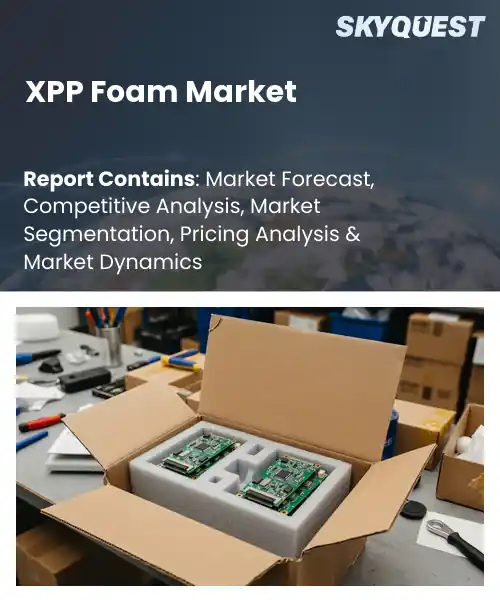
XPP Foam Market
Report ID: SQMIG25K2160
Report ID: SQMIG25K2160
[email protected]
USA +1 351-333-4748
Report ID:
SQMIG25K2160 |
Region:
Global |
Published Date: March, 2026
Pages:
157
|Tables:
153
|Figures:
78


Global XPP Foam Market size was valued at USD 2.7 Billion in 2024 and is poised to grow from USD 2.91 Billion in 2025 to USD 5.26 Billion by 2033, growing at a CAGR of 7.7% during the forecast period (2026-2033).
The global XPP foam industry is focused on a lightweight, resilient polymer with multiple properties that include cushioning, insulation and recyclability. XPP is continuing to gain importance in several industries, such as automotive, packaging, sports and building construction.
The regulatory and original equipment manufacturer (OEM) pressures to reduce vehicle mass while increasing occupant safety and protection have mainly driven these XPP foam market trends. As a result, the automotive, aerospace, and marine manufacturers have adopted XPP in bumpers, energy collision absorbing components, and lightweight trim components. The production techniques for this material have become more advanced, and investments in the production of expanded polypropylene have reduced the cost of producing it. XPP has moved from being primarily used in niche applications (home, work, and sport) to being widely used for other industrial applications as well.
In addition, advances in the development of new nucleating agents and improvements in continuous extrusion processes have increased cell size uniformity, thus allowing manufacturers to scale up their production and create a consistent product with predictable performance. The demand for XPP is very high, prompting suppliers to expand their production capabilities and incorporate recycled XPP into their offerings to meet the OEM’s sustainability goals.
The decline in XPP's unit price due to the increased investment in production has created new applications for this material, such as battery pack housings that are thermally buffered and impact-absorbing safety structures for pedestrian protection without adding additional weight to the structure. The packaging industry has also adapted to the demand for XPP by using it as a substitute for expanded polystyrene in the shipping of major appliances; thus, reducing their waste stream while meeting the sustainability metrics of retailers on a global basis.
How is AI Improving Quality Control in the XPP Foam Market?
The XPP foam industry has many new advancements in AI technologies, mainly focused on increasing production quality through the use of camera vision, sensor integration, and analytics. Manufacturers are beginning to shift away from slower manual production check methods, using inline AI-based inspection technology instead. This enables manufacturers to detect defects in real time and provides much quicker data retrieval and analysis for root causes of abnormalities in the production process. This is extremely important, especially when XPP components will be used as cushioning materials in automobiles and other applications that require consistent energy absorption and surface appearance.
By providing a method by which XPP manufacturers can evaluate current product types and quickly develop and evaluate new product types through practical application and using existing vendor applications. Companies in the XPP foam industry are continuing to see an increase in production efficiency and validated testing results for both speed and continuity.
Market snapshot - (2026-2033)
Global Market Size
USD 2.7 Billion
Largest Segment
XPP Foam Sheets
Fastest Growth
Custom XPP Foam Components
Growth Rate
7.7% CAGR
To get more insights on this market click here to Request a Free Sample Report
Global XPP foam market is segmented intoproduct type, density grade, application, end-use industry, distribution channel and region. Based on product type, the market is segmented into XPP foam sheets, XPP foam rolls, XPP foam rods & profiles and custom XPP foam components. Based on density grade, the market is segmented into low density, medium density and high density. Based on application, the market is segmented into automotive components, packaging & protective materials, construction & insulation, sports & leisure, electrical & electronics, consumer goods and other applications. Based on end-use industry, the market is segmented into automotive, industrial manufacturing, packaging, construction, consumer products and electrical & electronics. Based on distribution channel, the market is segmented into direct OEM sales, distributors & dealers, retail / hardware stores and online sales. Based on region, the market is segmented into North America, Europe, Asia Pacific, Latin America and Middle East & Africa.
The XPP foam sheets segment represents the largest XPP foam market share, as their flat and uniform shape allows for high-throughput cutting, thermoforming, and lamination, meeting the requirements of a diverse range of end-users, and making it a pre-determined choice of OEMs and converters. The efficiency of the production process produces minimal waste, simplifies the management of inventory, and the sheet format can be easily integrated into packaging, automotive interiors, and insulation processes.
As per XPP foam market analysis, XPP foam rolls segment is the fastest growing in the market. The increased usage of the product will be driven by the increased demand for continuous lengths of foam material which minimize seams, allow for high-speed automated processing, and provide converters with lower costs associated with the handling of the product. This has led to greater flexibility in terms of producing custom widths and thicknesses and has increased the potential for new applications, resulting in suppliers making more investments in scalable manufacturing processes.
As per XPP foam market outlook, the construction & insulation segment is the largest segment due to thermally insulating XPP foam’s high levels of thermal resistance, cyclic resistance, compressive strength, and long-term dimensional stability. XPP foam’s excellent performance when subjected to cyclic loading and how well it bonds with the most common types of adhesives/ membranes substantially Reduce lifecycle maintenance costs while complying with codes. This makes XPP Foam the optimal choice of material for energy efficiency and resilience & is therefore a key factor influencing procurement decisions.
As per XPP foam market forecast, packaging and protective materials segment is the fastest growing due to increased demand for lightweight, impact-absorbing cushioning materials used to ship e-commerce products. Innovative Designs of cushioning materials, new recyclable formulations used in constructing cushioning materials, and customized die-cut designs or configurations of cushioning materials will provide additional use cases for XPP Foam and encourage manufacturers to produce new, specialized formulations of XPP Foam for use in growing their distribution/ OEM partnerships.
To get detailed segments analysis, Request a Free Sample Report
As per XPP foam market regional outlook, Asia Pacific comprises the major production region for XPP foam, due to advantages of large manufacturing base size, significant volume of manufacturing demands from key application sectors, and the concentration of suppliers and processors in the region. The automotive and electronics manufacturers in the region form clusters that provide a sustained demand for engineered foams for light-weighting, vibration control, and thermal insulation. Close proximity to raw material sources, in addition to integrated supply chains, creates a competitive cost structure for producing foam and enables rapid development cycles between compounders and converters.
As per XPP foam market regional forecast, Japan is characterized by cutting-edge materials research and collaborations of manufacturers with automotive and electronics OEMs. Demand for specialty grade products and unique processing techniques is driven by increasing emphasis on performance, safety, and component integration. Advanced tooling and precision manufacturing techniques enable quality control of products, accommodating the more demanding application requirements.
Collaboration between material producers and automotive or electronic manufacturers is a key driver for the XPP foam market in South Korea. This collaboration helps manufacturers replace old or outdated foam technology with new, advanced solutions and provides OEMs with ways to create new products that are lighter, protect against impact and vibration, and have other desirable features. Automated manufacturing facilities and supplier networks help provide scalability for these product solutions, while research collaborations with trade organizations increase opportunities to develop new foam formulations.
The rapid growth of the XPP foam industry in Europe is driven by several factors, including the increasing demand for electrified vehicles, energy efficient buildings, and consumer products that use lightweight, durable, and recyclable materials. Well established tiers of suppliers and systems integrators facilitate more rapid qualification cycle times and customization at local levels. In addition, regional centres of expertise (R&D and technical assistance programmes) create concentrations of formulation and processing expertiseacross Europe. The availability of specialized compounding services, in addition to the regional proximity of automotive and building products, provides manufacturers with the opportunity to design and develop tailored grades of XPP foams for the specific needs of their respective markets. Cross-border collaboration and coordinated procurement strategies among major manufacturers have also accelerated the growth of XPP foam manufacturing in Europe by increasing the pace of scaling up operations and improving overall regional supply chain integration.
As per XPP foam industry analysis, Germany market is positioned well due to the concentration of manufacturers in the automobile manufacturing and engineering industry within Germany’s industrial base. Close collaboration between material supply sources and automobile manufacturer customers, along with rigorous qualification processes for safety, comfort, and performance materials, fosters quality manufacturing. Focused on high-quality testing and production techniques allow Germany manufacturers to produce foams that are used in greater volumes. The supplier ecosystem and service providers create tailored solutions for specific, demanding applications to solidify Germany’s reputation as a premier European manufacturing and innovation centre.
The rising momentum of the XPP foam market in the UK can be attributed to increased research and service networks in materials and the need for lightweight, strong parts in the automotive and rail sectors. Manufacturers who focus on sustainable sources of materials and recyclable products influence both how materials will be formulated and which end uses will be made from those materials. Processing facilities and technology incubators that help develop new products and will assist companies in bringing them to market produce demand pathways for suppliers. Collaborative efforts between universities and industry are essential to expedite application-testing processes as well as to facilitateincorporation of foams into system design.
The XPP foam market growth in France has been aided by a growing emphasis on sustainability, circular economy concepts, and innovation change within material development. There are opportunities for increased use of versatile foams to support construction retrofit programs and in connection with the mobility and consumer goods industry. Research institutes and industrial partners work together to improve the development of foam which can be recycled, along with better processing techniques to recycle foams. Local manufacturing capabilities and procurement practices will assist with the use of these products and create a diversified application for them.
North America XPP foam market is being significantly restructured as a result of collaborative efforts on manufacturing capability investment, strategic alliances, and supply chain resiliency focus. As automotive and transportation manufacturers globally require lighter and more durable materials for their applications, locally manufactured engineered foams continue to generate significant demand opportunities across all industries.
The United States XPP foam market continues to grow with increased manufacturing capacity, working collaboratively with OEM's engineering teams to increase the rate of qualification, and investing in compound and processing technologies. Additionally, significant efforts are currently being applied to develop lightweight and impact-resistant components because of the significant demand for these types of materials in the mobility and consumer sectors. Furthermore, the push towards recyclable materials continues to shape the development of new formulations used in engineered foams. Manufacturers have a variety of testing facilities available to assist them with validating new products; collaboration between material suppliers and contract manufacturers is driving scaled production of engineered foams throughout the United States.
The Canadian XPP foam market is experiencing substantial growth due to specialty material development and collaboration between research and development centres and industry partners. Demand for engineered foams from packaging, insulation for cold climates, and mobility applications are fueling considerable demand for foams that offer an optimal combination of thermal performance and strength. Manufacturers and developers are in regional manufacturing centres focused on value added compounding and incorporation of sustainable feedstocks. Various innovation programs and cross-sector partnerships are advancing labs and pilot facilities to convert engineered foams into scalable and recyclable products, improving the region's overall supply chain capability and resilience.
To know more about the market opportunities by region and country, click here to
Buy The Complete Report
Rising Demand in Construction
There is an increasing focus on buildings that consume less energy, and there is also a need for lightweight but durable insulation materials. These two factors have resulted in the increased use of XPP foam by builders and architects in all areas of construction because they want to use materials that improve thermal performance, reduce structural loads, and provide long-lasting service lives. As a result of this demand, XPP foam is being specified by many architects and builders as they are also able to utilize the same materials (roofing, walls, and floors), have excellent manufacturing capabilities, and perform well in many environments.
Expansion in Automotive Applications
The focus on lightweight vehicles, occupant safety, and acoustic comfort has led to increased interest in using XPP foams for automotive interiors and structural components. Designers and engineers appreciate the combination of low density, impact resistance, and the ability to manufacture complex shapes and integrate into the design of door panels, seating, as well as energy-absorbing structures. These benefits allow OEMs to use XPP as part of their overall manufacturing processes, providing them with an opportunity to save weight without compromising durability, and providing manufacturers with an opportunity to create additional collaborations with the supply chain.
Environmental Regulatory Pressure
Manufacturers and users of XPP foam face challenges in meeting tightening environmental regulations and changing standards regarding the composition of materials, the emissions generated during the manufacturing process and the disposal of products once they reach the end of their useful life. In addition, demonstrating reduced environmental impact, receiving the necessary certifications and modifying formulations to comply with regional standards can delay product launch and increase development cycles. Manufacturers may also experience significantly longer timelines for obtaining approvals and higher costs for reformulating or validating sustainable alternatives, that may limit rapid expansion into new markets and discourage smaller suppliers from investing in new grades of foam without regulatory certainty.
Volatility in the Supply of Raw Materials
Reliance on a small number of chemical feedstocks and a limited number of suppliers for those feedstocks can limit the reliable supply of XPP raw materials needed for production and create interruptions that delay ramping up production to meet demand. Additionally, demand for similar feedstocks may compete; therefore, when feedstocks are limited and logistic bottlenecks create obstacles to shipping raw materials, manufacturers may choose to fulfill their current contracts rather than invest in expanding their production capacities. As a result, manufacturers may resist expanding rapidly; this restricts long-term planning processors and end-users, who will now shift their focus to supply chain resiliency instead of aggressively pursuing market share.
Request Free Customization of this report to help us to meet your business objectives.
The XPP foam market faces competitive challenges from innovation in material, re-direction of feedstocks and strategic upstream alliances allowing for changing supply economics and recyclability. Companies are employing targeted strategies, such as Spur’s Hardex XPP launch of recyclable sandwich cores, recyclers and resin innovators forming licensingand offtake agreements, and ABB partnering with bio-PP developers to create a low carbon supply of polypropylene for foam converters.
Circular Product Integration: As part of an effort to create the most comprehensive supply and production chains of products with the lowest environmental impact possible, manufacturers are redesigning XPP (expanded polypropylene) foam materials for recyclability and material recovery. By focusing on creating a closed-loop manufacturing process, OEMs can provide durable and sustainable products. The collaboration between design specialists, converters, and waste management specialists promotes the establishment of standardized methods of collecting and processing foam, so that it maintains its original performance characteristics. The creation of modular designs and compatibility with existing recycling infrastructures allows for the introduction of new service models and aftermarket sales strategies. These efforts create an improved brand identity, decrease environmental impacts over the lifecycle of the product and establish long-term relationships with customers by taking into consideration the end-of-life options during product design and commercial sales.
Advanced Functional Foams Applications: The research and development of formulations and the processing of XPP foams enable additional functions beyond the standard form of foam, therefore enabling thermal, acoustical and mechanical properties to be specifically tailored for a wide variety of final uses of the foam. Enhanced foams can be incorporated into intelligent assemblies, consolidated components and simplified designs, all of which are attractive to both OEMs and building specifications. System-level solutions together with fast-tracked applications specific to foams will increase the momentum of the specification phase to the market adoption phase. Customization and differentiation in product performance will help develop new premium product segments for manufacturers, thereby increasing profitability of the manufacturer and building greater customer relationships by providing engineered solutions and lifetime services; all factors leading to more environmentally responsible products.
SkyQuest’s ABIRAW (Advanced Business Intelligence, Research & Analysis Wing) is our Business Information Services team that Collects, Collates, Correlates, and Analyses the Data collected by means of Primary Exploratory Research backed by robust Secondary Desk research.
As per SkyQuest analysis, the global XPP foam industry is propelled primarily by automotive lightweighting as OEMs adopt XPP for energy absorption and weight reduction, while rising demand in construction for thermal and durable insulation serves as a secondary growth driver. Growth is tempered by tightening environmental regulations that increase reformulation and compliance costs. Asia Pacific remains in the dominating region due to deep manufacturing capacity and dense end-use clusters. Within product types, XPP foam sheets continue to dominate due to production efficiency and design flexibility, even as rolls and custom components gain traction. Suppliers who align recyclability, process scale,and OEM partnerships will capture the strongest opportunities.
| Report Metric | Details |
|---|---|
| Market size value in 2024 | USD 2.7 Billion |
| Market size value in 2033 | USD 5.26 Billion |
| Growth Rate | 7.7% |
| Base year | 2024 |
| Forecast period | (2026-2033) |
| Forecast Unit (Value) | USD Billion |
| Segments covered |
|
| Regions covered | North America (US, Canada), Europe (Germany, France, United Kingdom, Italy, Spain, Rest of Europe), Asia Pacific (China, India, Japan, Rest of Asia-Pacific), Latin America (Brazil, Rest of Latin America), Middle East & Africa (South Africa, GCC Countries, Rest of MEA) |
| Companies covered |
|
| Customization scope | Free report customization with purchase. Customization includes:-
|
To get a free trial access to our platform which is a one stop solution for all your data requirements for quicker decision making. This platform allows you to compare markets, competitors who are prominent in the market, and mega trends that are influencing the dynamics in the market. Also, get access to detailed SkyQuest exclusive matrix.
Table Of Content
Executive Summary
Market overview
Parent Market Analysis
Market overview
Market size
KEY MARKET INSIGHTS
COVID IMPACT
MARKET DYNAMICS & OUTLOOK
Market Size by Region
KEY COMPANY PROFILES
Methodology
For the XPP Foam Market, our research methodology involved a mixture of primary and secondary data sources. Key steps involved in the research process are listed below:
1. Information Procurement: This stage involved the procurement of Market data or related information via primary and secondary sources. The various secondary sources used included various company websites, annual reports, trade databases, and paid databases such as Hoover's, Bloomberg Business, Factiva, and Avention. Our team did 45 primary interactions Globally which included several stakeholders such as manufacturers, customers, key opinion leaders, etc. Overall, information procurement was one of the most extensive stages in our research process.
2. Information Analysis: This step involved triangulation of data through bottom-up and top-down approaches to estimate and validate the total size and future estimate of the XPP Foam Market.
3. Report Formulation: The final step entailed the placement of data points in appropriate Market spaces in an attempt to deduce viable conclusions.
4. Validation & Publishing: Validation is the most important step in the process. Validation & re-validation via an intricately designed process helped us finalize data points to be used for final calculations. The final Market estimates and forecasts were then aligned and sent to our panel of industry experts for validation of data. Once the validation was done the report was sent to our Quality Assurance team to ensure adherence to style guides, consistency & design.
Analyst Support
Customization Options
With the given market data, our dedicated team of analysts can offer you the following customization options are available for the XPP Foam Market:
Product Analysis: Product matrix, which offers a detailed comparison of the product portfolio of companies.
Regional Analysis: Further analysis of the XPP Foam Market for additional countries.
Competitive Analysis: Detailed analysis and profiling of additional Market players & comparative analysis of competitive products.
Go to Market Strategy: Find the high-growth channels to invest your marketing efforts and increase your customer base.
Innovation Mapping: Identify racial solutions and innovation, connected to deep ecosystems of innovators, start-ups, academics, and strategic partners.
Category Intelligence: Customized intelligence that is relevant to their supply Markets will enable them to make smarter sourcing decisions and improve their category management.
Public Company Transcript Analysis: To improve the investment performance by generating new alpha and making better-informed decisions.
Social Media Listening: To analyze the conversations and trends happening not just around your brand, but around your industry as a whole, and use those insights to make better Marketing decisions.
REQUEST FOR SAMPLE
 REQUEST FREE CUSTOMIZATION
Global Xpp Foam Market size was valued at USD 2.7 Billion in 2024 and is poised to grow from USD 2.91 Billion in 2025 to USD 5.26 Billion by 2033, growing at a CAGR of 7.7% during the forecast period (2026-2033).
The competitive landscape for the global XPP foam market is defined by material innovation, feedstock repositioning, and strategic upstream partnerships that change supply economics and recyclability. Firms are executing targeted strategies such as Spur’s Hardex XPP commercial launch for recyclable sandwich cores, recyclers and resin innovators forming licensing and offtake ties, and ABB partnering with bio‑PP developers to secure low carbon polypropylene supply for foam converters. 'BASF SE', 'Huntsman Corporation', 'Celanese Corporation', 'DuPont de Nemours, Inc.', '3M Company', 'Covestro AG', 'ARMACELL International S.A.', 'Sekisui Chemical Co., Ltd.', 'Zotefoams PLC', 'Knauf Insulation', 'Saint-Gobain', 'Alveo AG', 'Owens Corning', 'Recticel S.A.', 'UFP Technologies, Inc.', 'DOW Inc.', 'Evonik Industries AG', 'Kingspan Group PLC', 'Nitto Denko Corporation', 'Flexible Foam Products, Inc.'
The increasing focus on energy-efficient buildings and the need for lightweight, durable insulation materials drive the adoption of XPP foam across construction segments. Architects and builders prefer materials that enhance thermal performance, reduce structural load, and offer long service life, which promotes specification of XPP foam. Its versatility for roofing, wall, and flooring applications, combined with ease of fabrication and reliable performance in diverse climates, supports broader integration into construction projects and encourages manufacturers to expand capacity and application-specific product offerings.
Circular Product Integration: Manufacturers are increasingly designing XPP foam for recyclability and material recovery, enabling closed-loop supply chains and stronger value propositions for OEMs seeking durable, sustainable components. Collaboration among designers, converters, and waste managers encourages standardized collection and reprocessing that preserves performance attributes. Prioritizing modular designs and compatibility with recycling infrastructure supports new service models and aftermarket strategies. These initiatives enhance brand differentiation, reduce lifecycle environmental impact, and create long-term customer relationships by integrating end-of-life considerations into product development and commercial offerings.
Why does Asia Pacific Dominate the Global XPP Foam Market? |@12


Want to customize this report? This report can be personalized according to your needs. Our analysts and industry experts will work directly with you to understand your requirements and provide you with customized data in a short amount of time. We offer $1000 worth of FREE customization at the time of purchase.
Feedback From Our Clients


 USA (+1) 351-333-4748

