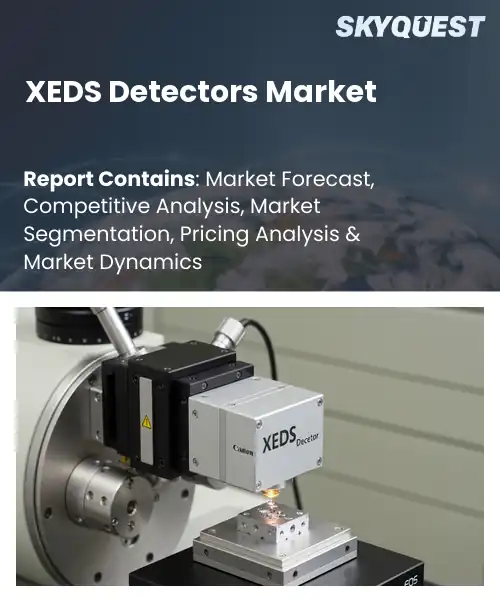
XEDS Detectors Market
Report ID: SQMIG20G2109
Report ID: SQMIG20G2109
[email protected]
USA +1 351-333-4748
Report ID:
SQMIG20G2109 |
Region:
Global |
Published Date: February, 2026
Pages:
157
|Tables:
123
|Figures:
77


Global XEDS Detectors Market size was valued at USD 1.04 Billion in 2024 and is poised to grow from USD 1.11 Billion in 2025 to USD 1.88 Billion by 2033, growing at a CAGR of 6.8% during the forecast period (2026-2033).
The global XEDS detector market growth is driven from increasing demand for precise elemental and chemical analysis because materials become more complex and devices shrink. Engineers need localized compositional data to establish their design requirements and quality control requirements for their work. XEDS detectors installed on electron microscopes and microprobes provide engineers with essential tools for their work in semiconductor manufacturing and battery development and aerospace failure analysis. The market progressed over several decades from proportional counters to high-resolution silicon drift detectors and compact systems with built-in advanced analytics. The semiconductor industry adopted EDS for its root-cause investigation purpose while battery researchers utilized elemental mapping to enhance their battery performance.
Moreover, the global XEDS detectors industry experiences its primary growth through rapid technological advancements which results in better detection performance and decreased operational expenses. Improved detectors enable higher production rates and better resolution, which leads to wider industrial applications. Silicon drift detectors and multi-element arrays shortened acquisition times, so semiconductor fabs integrated EDS into inline failure analysis, which boosted yield and prompted instrument purchases. Faster elemental mapping methods led to faster development of battery materials which resulted in OEMs developing their own analytical capabilities.
The implementation of AI-based spectral deconvolution which automates report generation together with retrofitting requirements for old microscopes and market expansion in emerging economies that need better quality control and manufacturing capacity for new products creates more business opportunities.
How is AI Improving Detection Accuracy in the XEDS Detectors Market?
XEDS detectors identify elements by measuring characteristic X rays emitted under an electron beam. The essential elements for assessment include spectral fidelity along with peak separation and mapping speed. Artificial intelligence enhances detection performance through its ability to learn spectral patterns while it automates peak deconvolution and background noise reduction and unwanted line separation. Instrument manufacturers develop machine learning capabilities for their analysis software to create automated workflows which decrease operator variability.
Practical instances include AI driven spectral deconvolution and live EDS confirmation during particle and contamination screening. A DualBeam FIB SEM system which Thermo Fisher Scientific introduced in July 2025 uses machine learning to control automation processes which optimize EDS recipes and elemental identification. The system helps to enhance detection precision and laboratory efficiency because it enables XEDS systems to operate at higher productivity levels.
Market snapshot - (2026-2033)
Global Market Size
USD 1.04 Billion
Largest Segment
Silicon Drift Detector (SDD)
Fastest Growth
Silicon Drift Detector (SDD)
Growth Rate
6.8% CAGR
To get more insights on this market click here to Request a Free Sample Report
The global XEDS detectors market is segmented into product type, application, end user, distribution channel, and region. Based on product type, the market is classified into Silicon Drift Detector (SDD), Silicon Lithium Detector (Si(Li)), PIN Diode Detectors, and Other Detection Technologies. Based on application, the market is segmented into Materials Science, Industrial Analysis, Life Sciences & Biotech, Electronics & Semiconductor Testing, and Forensics & Environmental Testing.
Based on end user, the market is segmented into Academic & Research Institutes, Industrial Laboratories, OEMs, Government Agencies and Healthcare & Medical Research. Based on distribution channel, the market is segmented into Direct OEM Sales, Distributors & Dealers, Online Sales, and Service & Support Providers. Based on region, the market is segmented into North America, Europe, Asia Pacific, Latin America, and Middle East & Africa.
According to the global XEDS detectors market analysis, the silicon drift detector segment leads the market because it provides excellent energy resolution and rapid throughput and durable performance for various XEDS analytical applications. Instrument manufacturers and research laboratories prefer advanced charge collection systems because they produce less electronic noise, which enables researchers to identify elemental components with greater accuracy. The system achieves a reduction in operational difficulty through its integration of compact spectrometers and streamlined cooling systems which creates an adoption cycle that leads to supplier investment back into the system which further establishes its market leadership position.
The fastest developing section in the market uses silicon lithium detectors which improved because of better cryogenic technology and specially built detectors for environments with extreme counting demands. The current manufacturing and refurbishing operations enable users to save expenses while solving technical difficulties which leads to greater usage of specialized equipment and new product development in markets which need longwave detection capabilities.
As per the global XEDS detectors market forecast, the life sciences and biotech sector leads all other market segments because its operations need exact elemental mapping and precise trace metal measurement and biomaterials identification. The need to correlate chemical composition with biological structures incentivizes instrument manufacturers to prioritize detector sensitivity and spatial resolution which cascades into procurement preferences and R&D investment. The continuous demand for reproducibility in regulatory requirements together with translational research needs of academic scientists leads to ongoing product usage and performance upgrades.
Portable XEDS analysis faces increasing demand because contamination and trace evidence detection has become more important to forensic and environmental testing. Ruggedized detector designs and simplified workflows enable reliable on-site measurements, which leads to greater acceptance among investigative and monitoring organizations while new commercial services and software-driven analytical solutions emerge.
To get detailed segments analysis, Request a Free Sample Report
As per the XEDS detectors market regional forecast, North America holds the top position in the market because its institutional strengths combined with its market conditions enable fast adoption of new analytical technologies. Research universities national laboratories and private research facilities maintain continuous demand for high performance detectors which semiconductor companies and aerospace businesses and medical device manufacturers develop into specific applications and large-scale purchasing. The domestic manufacturing industry of original equipment manufacturers, together with specialized instrument vendors, enables companies to work together on new product development and customer service systems. Laboratories use their strong technical service networks which support early technology adoption to speed up technology adoption.
The United States XEDS detectors market penetration relies on the extensive research university system and national laboratory network and advanced technology firm presence to create steady demand for high performance detectors. The product development process accelerates when instrument makers and end users work together. Service providers and calibration networks enable businesses to deploy their products safely in semiconductor life science and materials research sectors, which results in ongoing development and high purchase trust from buyers and suppliers worldwide.
The XEDS detectors market in Canada depends on its research clusters which university laboratories and industry partners use to develop cutting-edge analytical instruments. The procurement processes concentrate on materials which contain specialized expertise about materials characterization together with energy applications. Technology hubs and service providers from nearby locations create better access to advanced detector solutions. Users at institutions start using the system because of its dependable operation along with its dedicated application support and technical assistance services.
The XEDS detectors sector in Europe expands rapidly because industry demands research activities and supplier development work together to create local innovation. Manufacturing sectors which include automotive and precision engineering use elemental analysis tools to protect product quality and conduct failure investigations which leads to broad industry adoption. The instrument manufacturers who operate in different regions together with technical service teams create an environment where businesses can tailor their products according to regional requirements.
The university laboratories together with public research organizations use their materials science programs to create demand while their collaborative procurement methods and joint projects lead to technology transfer. The regulatory system demands material verification and traceability which drives XEDS detector use in product validation processes, thus establishing Europe as a thriving market for advanced analytical instruments.
Germany benefits from its manufacturing industry and its instrument manufacturers who create products with high precision and strong durability. The automotive sector needs inspectors who work in aerospace and advanced materials to provide regular demand for high performance detectors which automotive and aerospace sectors require. The close research partnership between applied research institutes and the industry sector creates development of specialized solutions which meet specific application requirements. The service ecosystem provides all required components for maintenance and calibration activities. German procurement practices focus on vendor dependability which leads to long-term partnerships that maintain Germany's top market position.
The United Kingdom XEDS detectors market share develops through its active technology commercialization system which supports academic research activities. University spinouts and specialized startups develop detector systems based on their patented detector technologies which industrial users and analytical laboratories use to test materials and conduct failure investigations. The contracts of research organizations and technical service providers create networks which help increase technology adoption. The deployment of procurement methods and cross-sector collaborative partnerships leads to faster deployment, which results in new innovative applications.
The XEDS Detectors Market in France contains advanced research institutions which worked to develop new industrial materials analysis methods. The national laboratories together with university centers need specialized detector solutions for their work in energy and aerospace research. The collaboration between instrument suppliers and research groups leads to new applications which researchers use in their work. France has become an emerging market for XEDS detector adoption because its customers require dedicated technical support and operators need systems to work with existing microscopy systems.
Asia Pacific improves its XEDS detectors market position through joint scientific infrastructure investments and its increasing local production capabilities and its specific market needs which match the requirements of advanced materials and electronics industries. The domestic production capacity of instrument manufacturers and component vendors needs to reach competitive levels so they can develop detector systems which match their current capabilities. The research institutions in the region, which focus on specific applications, now create programs for energy storage and semiconductor and battery technology development. The industry consortia together with government bodies create partnerships to conduct research and transfer technology, which enables them to establish local supply networks with their respective support services.
The market growth receives support from three factors which include cost-effective solutions and fast technology adoption by industrial customers and the various upgrades to technical service networks. The combination of these elements produces a regional ecosystem which develops its own functions while international suppliers maintain their operations, and the system encourages local businesses to create innovations.
The Japan XEDS detectors market exists because precision manufacturing and advanced electronics industries need reliable analytical tools to operate their production processes. Instrument makers create integrated systems which combine microscopy platforms with detectors to fulfill customer requirements for top performance and premium quality systems. Research labs and academic centers work together to create innovative applications through their partnership. Japan operates as a premium market for XEDS detector solutions because its supplier network delivers maintenance and calibration services to all customer segments.
The South Korea XEDS detectors market benefits from its thriving electronics and semiconductor ecosystem, which drives demand for advanced analytical detectors. The manufacturing sector and battery development teams need essential analysis to perform their quality control and research work. The domestic market needs customized detector features which instrument manufacturers and research consortia provide to their customers. South Korea enhances its technological capabilities through rapid integration practices while technical support services and supply chain responsiveness establish its position as a key market.
To know more about the market opportunities by region and country, click here to
Buy The Complete Report
Advancements In Detector Sensitivity
The device sensitivity advancements enable detectors to detect extremely weak signals and tiny hidden problems, which boosts their usability in various domains and improves user trust. The advanced sensitivity of the system decreases false negative results while it helps achieve earlier detection during complicated research and medical and security operations. The manufacturing sector can sell high-performance products, which enables them to charge premium prices while they invest in product development. The market sees higher demand for detectors because organizations reduce their technical barriers through sensitivity improvements, which drives demand and leads to new product development from vendors.
Integration With Advanced Analytics
Detectors provide actionable insights through their advanced platform integration, which raises their value perception, and drives broader market acceptance. Organizations achieve operational intelligence through analytics pipelines, which enable them to improve decision-making and resource distribution. The capability draws interest from multiple industries because it enables organizations to execute preventive maintenance activities while they prioritize threats and enhance their work processes. Vendors develop their analytics solutions to create competitive advantages which increase their investment and partnership activities that help expand the market.
High Manufacturing Complexity and Cost
Manufacturing operations face higher costs and complex processes, which create two obstacles that prevent market growth by increasing product costs, which makes it difficult for budget-conscious customers to buy products. Manufacturers face extended production schedules and higher equipment expenses because they need skilled workers to produce precise components and specialized materials. The production requirements force smaller businesses to defer their production plans which will result in less supplier diversity and innovation. Price-sensitive customers respond by delaying their purchases or choosing lower-quality products which results in slower market development and reduced investor interest.
Regulatory Approval Timelines are Lengthy
The lengthy regulatory approval process extends detector technology development timelines, which creates uncertainties for both developers and investors in the new technologies. Lengthy evaluation processes demand sustained documentation compliance resources and iterative testing which diverts funding from commercialization and slows product launches. Established suppliers who possess regulatory expertise succeed in this environment because they can control market access while they cripple the growth of small new companies. The delayed product availability together with reduced selection of devices will decrease user interest, which leads to slower technology adoption in markets that would normally experience rapid expansion.
Request Free Customization of this report to help us to meet your business objectives.
The global XEDS detectors market experiences competitive dynamics through its technological product variations and existing supply chain mergers, as companies employ M&A activities and OEM asset acquisitions and partnership integration methods to obtain detector development plans and distribution networks. The acquisition of Prismatic Sensors by GE enables photon counting through their acquisition while recent supplier asset agreements and OEM integration deals help distributors to speed up SDD and photon counting implementation as vendors introduce AI signal processing for market differentiation.
SkyQuest’s ABIRAW (Advanced Business Intelligence, Research & Analysis Wing) is our Business Information Services team that Collects, Collates, Correlates, and Analyses the Data collected by means of Primary Exploratory Research backed by robust Secondary Desk research.
As per SkyQuest analysis, demand for accurate elemental analysis of small electronic components and complex materials drives the XEDS detectors market because semiconductor and battery research requires this precise elemental analysis and the latest detector technologies with AI-enabled spectral optimization enhance operational efficiency while decreasing operating expenses. The production process to manufacture these items requires complicated steps, which results in high costs that limit production and make the items more expensive. North America leads the market because its research institutions and industry sectors strongly support the region while silicon drift detectors dominate the product segment because they provide exceptional resolution and fast performance and durable design.
| Report Metric | Details |
|---|---|
| Market size value in 2024 | USD 1.04 Billion |
| Market size value in 2033 | USD 1.88 Billion |
| Growth Rate | 6.8% |
| Base year | 2024 |
| Forecast period | (2026-2033) |
| Forecast Unit (Value) | USD Billion |
| Segments covered |
|
| Regions covered | North America (US, Canada), Europe (Germany, France, United Kingdom, Italy, Spain, Rest of Europe), Asia Pacific (China, India, Japan, Rest of Asia-Pacific), Latin America (Brazil, Rest of Latin America), Middle East & Africa (South Africa, GCC Countries, Rest of MEA) |
| Companies covered |
|
| Customization scope | Free report customization with purchase. Customization includes:-
|
To get a free trial access to our platform which is a one stop solution for all your data requirements for quicker decision making. This platform allows you to compare markets, competitors who are prominent in the market, and mega trends that are influencing the dynamics in the market. Also, get access to detailed SkyQuest exclusive matrix.
Table Of Content
Executive Summary
Market overview
Parent Market Analysis
Market overview
Market size
KEY MARKET INSIGHTS
COVID IMPACT
MARKET DYNAMICS & OUTLOOK
Market Size by Region
KEY COMPANY PROFILES
Methodology
For the XEDS Detectors Market, our research methodology involved a mixture of primary and secondary data sources. Key steps involved in the research process are listed below:
1. Information Procurement: This stage involved the procurement of Market data or related information via primary and secondary sources. The various secondary sources used included various company websites, annual reports, trade databases, and paid databases such as Hoover's, Bloomberg Business, Factiva, and Avention. Our team did 45 primary interactions Globally which included several stakeholders such as manufacturers, customers, key opinion leaders, etc. Overall, information procurement was one of the most extensive stages in our research process.
2. Information Analysis: This step involved triangulation of data through bottom-up and top-down approaches to estimate and validate the total size and future estimate of the XEDS Detectors Market.
3. Report Formulation: The final step entailed the placement of data points in appropriate Market spaces in an attempt to deduce viable conclusions.
4. Validation & Publishing: Validation is the most important step in the process. Validation & re-validation via an intricately designed process helped us finalize data points to be used for final calculations. The final Market estimates and forecasts were then aligned and sent to our panel of industry experts for validation of data. Once the validation was done the report was sent to our Quality Assurance team to ensure adherence to style guides, consistency & design.
Analyst Support
Customization Options
With the given market data, our dedicated team of analysts can offer you the following customization options are available for the XEDS Detectors Market:
Product Analysis: Product matrix, which offers a detailed comparison of the product portfolio of companies.
Regional Analysis: Further analysis of the XEDS Detectors Market for additional countries.
Competitive Analysis: Detailed analysis and profiling of additional Market players & comparative analysis of competitive products.
Go to Market Strategy: Find the high-growth channels to invest your marketing efforts and increase your customer base.
Innovation Mapping: Identify racial solutions and innovation, connected to deep ecosystems of innovators, start-ups, academics, and strategic partners.
Category Intelligence: Customized intelligence that is relevant to their supply Markets will enable them to make smarter sourcing decisions and improve their category management.
Public Company Transcript Analysis: To improve the investment performance by generating new alpha and making better-informed decisions.
Social Media Listening: To analyze the conversations and trends happening not just around your brand, but around your industry as a whole, and use those insights to make better Marketing decisions.
REQUEST FOR SAMPLE
 REQUEST FREE CUSTOMIZATION
Global Xeds Detectors Market size was valued at USD 1.04 Billion in 2024 and is poised to grow from USD 1.11 Billion in 2025 to USD 1.88 Billion by 2033, growing at a CAGR of 6.8% during the forecast period (2026-2033).
Competition in the global XEDS detectors market is defined by technological differentiation and supply consolidation, with rivals using M&A, OEM asset purchases, and integration partnerships to secure detector roadmaps and channel access. Examples include GE’s acquisition of Prismatic Sensors for photon counting capability and recent supplier asset deals and OEM integrations that accelerate SDD and photon-counting deployment while vendors add AI signal processing to differentiate offerings. 'Thermo Fisher Scientific', 'Oxford Instruments', 'EDAX', 'Bruker', 'JEOL', 'Hitachi High-Technologies', 'FEI Company', 'Ametek', 'Varian Semiconductor Equipment Associates', 'Horiba', 'Gatan', 'KLA Corporation', 'Zeiss', 'Micromeritics Instrument Corporation', 'Sciex', 'Cameca', 'Roper Technologies', 'Rigaku', 'Nanoscience Instruments', 'TESCAN'
Miniaturization And Field Integration: Compact XEDS detectors are enabling portable and handheld elemental analysis instruments used in field inspections, mining exploration, and on site quality control. Shrinking form factors combined with integrated electronics and simplified user interfaces allow non specialists to perform rapid diagnostics outside centralized labs. This trend drives partnerships between detector manufacturers and instrument integrators, accelerates adoption in remote and regulated environments, and reshapes sales channels toward service models that emphasize mobility, rapid deployment, and decision support and enable automated reporting workflows.
As per the XEDS detectors market regional forecast, North America holds the top position in the market because its institutional strengths combined with its market conditions enable fast adoption of new analytical technologies.


Want to customize this report? This report can be personalized according to your needs. Our analysts and industry experts will work directly with you to understand your requirements and provide you with customized data in a short amount of time. We offer $1000 worth of FREE customization at the time of purchase.
Feedback From Our Clients


 USA (+1) 351-333-4748

