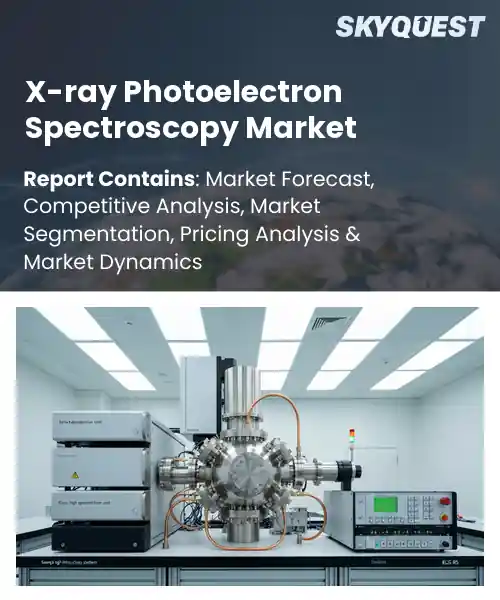
X-ray Photoelectron Spectroscopy Market
Report ID: SQMIG35J2372
Report ID: SQMIG35J2372
[email protected]
USA +1 351-333-4748
Report ID:
SQMIG35J2372 |
Region:
Global |
Published Date: June, 2026
Pages:
157
|Tables:
143
|Figures:
78


Global X-Ray Photoelectron Spectroscopy Market size was valued at USD 682.5 Million in 2024 and is poised to grow from USD 731.84 Million in 2025 to USD 1285.4 Million by 2033, growing at a CAGR of 7.23% during the forecast period (2026-2033).
The primary driver of the X-ray photoelectron spectroscopy industry is the accelerating need for precise surface and interface characterization across materials industries. XPS enables chemical state analysis at nanometer depths, which matters because device performance and regulatory compliance increasingly depend on controlled surface chemistry. Historically XPS evolved from academic vacuum science into an industrial metrology tool as semiconductors, thin films and battery research demanded molecular level insight; for example leading foundries adopted XPS for contamination control while researchers used it to understand solid electrolyte interphase chemistry in lithium ion batteries. Such maturation underpins steady market expansion and adoption globally.
A dominant growth factor is continuous improvement in instrument sensitivity, automation and data analytics which transforms XPS from a slow characterization technique into a scalable production tool. As detectors and sources detect lower concentrations and software interprets complex spectra, engineers can identify trace contamination or subtle oxidation states that formerly escaped notice, causing yield losses in semiconductor fabrication to be reduced through targeted process changes. Consequently manufacturers invest in inline or pod based XPS systems for contamination control and battery electrode validation, which creates opportunities for suppliers to offer turnkey solutions, service contracts, and cloud analytics that monetize operational improvements.
How is AI improving data analysis and interpretation in the X-ray photoelectron spectroscopy market?
AI is improving data analysis and interpretation in X ray photoelectron spectroscopy by automating core tasks and raising confidence in results. Key aspects include smarter peak deconvolution noise suppression and automated component identification that reduce operator bias. Current tools integrate machine learning into workflows so samples are analyzed faster and with more consistent labeling. In the market this means labs in materials science battery research and semiconductors can scale throughput and focus on higher value interpretation. Examples include AI guided baseline correction and transfer learning models that adapt to new materials and instrument settings to make spectral interpretation more robust.
a.s.ist in Inc April 2026, released AutoStatSpectra which applies white box AI to automate XPS spectral analysis. This innovation shortens manual peak fitting and improves reproducibility so vendors and labs can increase efficiency and support faster decision making in research and production.
Market snapshot - (2026-2033)
Global Market Size
USD 682.5 Million
Largest Segment
Instruments
Fastest Growth
Software
Growth Rate
7.23% CAGR
To get more insights on this market click here to Request a Free Sample Report
Global x-ray photoelectron spectroscopy market is segmented by product, type, application, end-user, distribution and region. Based on product, the market is segmented into Instruments, Accessories & Consumables and Software. Based on type, the market is segmented into Lab-Based XPS and Portable XPS. Based on application, the market is segmented into Material Science, Semiconductor Industry, Pharmaceutical and Nanotechnology. Based on end-user, the market is segmented into Research Institutes, Semiconductor Companies and Pharmaceutical Companies. Based on distribution, the market is segmented into Direct Sales and Distributors. Based on region, the market is segmented into North America, Europe, Asia Pacific, Latin America and Middle East & Africa.
Instruments segment dominates with large x-ray photoelectron spectroscopy market share because manufacturers of core XPS hardware provide the precision, stability and modularity required for high-fidelity surface chemistry analysis, forming the backbone of laboratory and industrial installations. Their continued engineering improvements in sources, analyzers and detectors reduce measurement uncertainty and enable complex experiments, driving buyer preference toward complete systems. Strong OEM support, service networks and customization options reinforce procurement decisions and sustain large capital investments across research and quality control environments.
As per x-ray photoelectron spectroscopy market outlook, software segment is experiencing rapid expansion as advanced data processing, multivariate analysis and machine learning enhance spectral interpretation and throughput, lowering the technical barrier for new users. Cloud-enabled analytics, automated workflows and modular licensing models attract laboratories and industrial users seeking actionable insights, enabling service-based revenue streams and accelerating adoption in multidisciplinary applications.
As per x-ray photoelectron spectroscopy market forecast, lab-based XPS segment dominates because centralized instruments deliver superior energy resolution, broader analytical capabilities and controlled environmental conditions that meet rigorous research and industrial characterization requirements. Their ability to handle complex sample preparation, integrate complementary techniques and support reproducible, high-sensitivity measurements drives preference among advanced users. The concentration of skilled operators, established validation protocols and institutional investment cycles preserves lab-based platforms as the default choice for demanding surface and interface studies.
As per x-ray photoelectron spectroscopy market analysis, portable XPS segment is emerging as the fastest growing area due to miniaturization, faster turn-around and capability for in situ, on-site diagnostics that unlock new field and industrial workflows. Advances in battery operation, ruggedization and simplified user interfaces broaden adoption beyond specialized labs, creating fresh application opportunities in maintenance, quality assurance and rapid failure analysis.
To get detailed segments analysis, Request a Free Sample Report
North America dominates the x-ray photoelectron spectroscopy market due to the presence of advanced research institutes, high industrial demand from semiconductor, materials and life sciences industries and an established ecosystem of instrument makers and service providers. Deep technical experience, existing calibration and standards infrastructure, and proximity to large end customers help speed adoption of high-end analytical equipment. Collaboration networks between academics and industry promote application development and workflow integration, while comprehensive aftersales support and training programs reduce barriers to the use of new techniques. Strong intellectual property activity and investment in instrumentation innovation also help sustain leadership, as manufacturers are able to improve system performance and develop solutions for complicated surface-chemistry and thin-film characterization requirements. Specialized service labs and customized training curricula are further boosting the market dynamics by reducing learning curves for new users and encouraging wider usage in research and industrial quality control.
As per x-ray photoelectron spectroscopy market regional outlook, United States benefits from a concentration of advanced research institutes, national laboratories and equipment makers that drive method innovation and application breadth. Strong industry-academia collaboration is key to accelerate the translation of breakthrough surface analysis techniques to production environment. A wide network of technical support and dedicated service providers promotes adoption in semiconductor, materials and life science applications, providing consistent high quality analysis and fast troubleshooting for complicated characterization problems.
As per x-ray photoelectron spectroscopy industry analysis, Canada benefits from a conducive research climate, collaborative university-industry linkages and specialized analytical service facilities to broaden application utility of the market. The emphasis on advanced materials research and environmental monitoring drives the demand for surface-sensitive techniques and customized analytical workflows. With strong after-sale service, professional technical training programs and regional service centers, laboratories can have analytical confidence, enabling researchers and manufacturers to incorporate advanced surface characterization into product development and quality assurance procedures.
Asia Pacific region is witnessing fast growth in the market owing to the surge in research, booming manufacturing of electronics and sophisticated materials, and strategic investments in analytical infrastructure. The regional concentration of high technology production generates a steady demand for surface and interface analysis, while increasing use by contract testing and service providers expands access for smaller research organizations. The number of qualified analysts is expanding, collaboration between instrument vendors and local research institutes is becoming more common and there is an emphasis on providing application-specific solutions that speed up market penetration. In addition, regional suppliers and distributors provide improved availability and aftersales support, assisting laboratories to surmount impediments to adoption of modern techniques and to varied use by business, academia and government research programmes. Policy focus on research infrastructure and incentives for technology transfer further support localized capacity building and foster long term collaborations that increase market maturity across the region.
Japan benefits from a highly advanced electronics and materials research base, with close ties between OEMs and analytical instrument vendors that accelerate method customization. Strong focus on semiconductor and precision materials drives demand for high performance surface characterization, while dense technical training networks and well established service laboratories support rapid adoption. Local R&D priorities and industry consortia promote application development and rigorous quality assurance practices consistently.
South Korea is propelled by strong semiconductor and display manufacturing clusters that demand precise surface and interface analysis. Close collaboration between industrial research centers and universities fosters rapid application refinement, while local distributors and service laboratories provide tailored support. Emphasis on process control and yield optimization encourages integration of advanced spectroscopy into production workflows, and focused training initiatives build analytical expertise across research and manufacturing teams.
Europe is reinforcing its stance in the industry through strategic investments in research infrastructure, transnational collaboration and strong manufacturing experience in analytical instrumentation. Regional excellence centers and collaborative research consortia promote application driven innovation and a dense network of specialist service laboratories improves access to advanced surface analysis. Emphasize standardization, rigorous quality standards and skill development of the staff for accurate analytical results. Manufacturers and distributors in the region are focused on customization for local industry demands, notably in materials science and industrial quality assurance, and close links between academics and industry speed up technological transfer and adoption of applications across a number of end markets. Strong regulatory framework and funding schemes promote unified protocols and ease instrument qualification. Collaborations with industry fuel development of solutions for quality control and research applications. Increases the user base and promotes consistency of performance across laboratories Emphasizes skill development and cross border training programs.
Germany benefits from a strong precision instrumentation industry, collaborative industrial research institutes and a deep materials science base. Emphasis on engineering integration and process analytics drives adoption in manufacturing quality control and research applications. A network of specialized service providers and training centers enhances laboratory capabilities, while close links between equipment manufacturers and end users promote application focused innovation and implementation of complex surface analysis workflows.
United Kingdom is based on leading academic research centres, Strong chemical sciences basis and industrial R&D to drive method development. Collaborative projects between academia and industry help translate into materials characterization and innovative production techniques. Well established technical service providers and training programs support wider access, while instrument vendors adjust solutions to local regulatory and quality frameworks, allowing for trustworthy surface analysis for research and industrial applications.
France has a robust university network and research institutes focusing on materials and surface science. Through industry alliances and dedicated test laboratories, we expand access to sophisticated spectroscopy for research environments and industrial quality control. Laboratories can produce reproducible results by focusing on standardizing methods and educating operators, and providing technical support. Instrument suppliers are also working with end customers to tailor systems to specific analytical processes and regulatory needs.
To know more about the market opportunities by region and country, click here to
Buy The Complete Report
Expansion of Materials Research
Advancements In Detector Technology
High Cost Of Instrument Ownership
Limited Skilled Workforce Availability
Request Free Customization of this report to help us to meet your business objectives.
The competitive landscape of the X-ray photoelectron spectroscopy market is characterized by the presence of established analytical instrumentation companies focusing on technological innovation, high-resolution surface analysis capabilities, and expansion of material characterization applications across semiconductors, nanotechnology, energy storage, and life sciences.
SkyQuest’s ABIRAW (Advanced Business Intelligence, Research & Analysis Wing) is our Business Information Services team that Collects, Collates, Correlates, and Analyses the Data collected by means of Primary Exploratory Research backed by robust Secondary Desk research.
As per SkyQuest analysis, the global X-ray photoelectron spectroscopy market growth is poised for steady expansion driven by the accelerating need for precise surface and interface characterization and further boosted by continuous improvements in instrument sensitivity, automation and data analytics. A key driver is adoption across semiconductor and materials research while a second driver is AI and machine learning that speed spectral interpretation and scale throughput. A restraint remains the high cost of instrument ownership which limits uptake among smaller labs. North America is the dominating region due to concentrated research and manufacturing ecosystems and the instruments segment remains the dominating segment due to OEM support, service networks and integrated systems.
| Report Metric | Details |
|---|---|
| Market size value in 2024 | USD 682.5 Million |
| Market size value in 2033 | USD 1285.4 Million |
| Growth Rate | 7.23% |
| Base year | 2024 |
| Forecast period | (2026-2033) |
| Forecast Unit (Value) | USD Million |
| Segments covered |
|
| Regions covered | North America (US, Canada), Europe (Germany, France, United Kingdom, Italy, Spain, Rest of Europe), Asia Pacific (China, India, Japan, Rest of Asia-Pacific), Latin America (Brazil, Rest of Latin America), Middle East & Africa (South Africa, GCC Countries, Rest of MEA) |
| Companies covered |
|
| Customization scope | Free report customization with purchase. Customization includes:-
|
To get a free trial access to our platform which is a one stop solution for all your data requirements for quicker decision making. This platform allows you to compare markets, competitors who are prominent in the market, and mega trends that are influencing the dynamics in the market. Also, get access to detailed SkyQuest exclusive matrix.
Table Of Content
Executive Summary
Market overview
Parent Market Analysis
Market overview
Market size
KEY MARKET INSIGHTS
COVID IMPACT
MARKET DYNAMICS & OUTLOOK
Market Size by Region
KEY COMPANY PROFILES
Methodology
For the X-ray Photoelectron Spectroscopy Market, our research methodology involved a mixture of primary and secondary data sources. Key steps involved in the research process are listed below:
1. Information Procurement: This stage involved the procurement of Market data or related information via primary and secondary sources. The various secondary sources used included various company websites, annual reports, trade databases, and paid databases such as Hoover's, Bloomberg Business, Factiva, and Avention. Our team did 45 primary interactions Globally which included several stakeholders such as manufacturers, customers, key opinion leaders, etc. Overall, information procurement was one of the most extensive stages in our research process.
2. Information Analysis: This step involved triangulation of data through bottom-up and top-down approaches to estimate and validate the total size and future estimate of the X-ray Photoelectron Spectroscopy Market.
3. Report Formulation: The final step entailed the placement of data points in appropriate Market spaces in an attempt to deduce viable conclusions.
4. Validation & Publishing: Validation is the most important step in the process. Validation & re-validation via an intricately designed process helped us finalize data points to be used for final calculations. The final Market estimates and forecasts were then aligned and sent to our panel of industry experts for validation of data. Once the validation was done the report was sent to our Quality Assurance team to ensure adherence to style guides, consistency & design.
Analyst Support
Customization Options
With the given market data, our dedicated team of analysts can offer you the following customization options are available for the X-ray Photoelectron Spectroscopy Market:
Product Analysis: Product matrix, which offers a detailed comparison of the product portfolio of companies.
Regional Analysis: Further analysis of the X-ray Photoelectron Spectroscopy Market for additional countries.
Competitive Analysis: Detailed analysis and profiling of additional Market players & comparative analysis of competitive products.
Go to Market Strategy: Find the high-growth channels to invest your marketing efforts and increase your customer base.
Innovation Mapping: Identify racial solutions and innovation, connected to deep ecosystems of innovators, start-ups, academics, and strategic partners.
Category Intelligence: Customized intelligence that is relevant to their supply Markets will enable them to make smarter sourcing decisions and improve their category management.
Public Company Transcript Analysis: To improve the investment performance by generating new alpha and making better-informed decisions.
Social Media Listening: To analyze the conversations and trends happening not just around your brand, but around your industry as a whole, and use those insights to make better Marketing decisions.
REQUEST FOR SAMPLE
 REQUEST FREE CUSTOMIZATION
Global X-Ray Photoelectron Spectroscopy Market size was valued at USD 682.5 Million in 2024 and is poised to grow from USD 731.84 Million in 2025 to USD 1285.4 Million by 2033, growing at a CAGR of 7.23% during the forecast period (2026-2033).
Do you want the two startups to be strictly XPS instrument vendors, or may I include verified startups in adjacent surface analysis or compact electron spectroscopy founded in 2019 or later? 'Thermo Fisher Scientific (K-Alpha)', 'Kratos Analytical (Shimadzu)', 'ULVAC-PHI Inc.', 'JEOL Ltd.', 'Bruker Corporation', 'Sigma-Aldrich (Merck)', 'Scienta Omicron', 'Focus GmbH', 'Prevac Sp. z o.o.', 'SPECS GmbH', 'Omicron NanoTechnology', 'XPS International', 'ReVera Incorporated', 'Applied Materials', 'Lam Research', 'Rigaku Corporation', 'Anton Paar', 'Park Systems', 'Oxford Instruments', 'Horiba Scientific'
XPS instruments have become central to advanced materials research where precise surface chemical information guides development of novel coatings, catalysts, and electronic materials. As research programs emphasize interface control and surface modification, laboratories prioritize tools that reveal elemental composition and chemical states at surfaces and thin films. This focus drives acquisition of high resolution analyzers and maintenance services, encourages suppliers to refine system usability, and promotes collaborations between academia and industry that further embed XPS capabilities into experimental workflows, reinforcing market demand and product development.
In-Situ Operando Adoption: Growing emphasis on real-time surface chemical monitoring is driving adoption of in-situ and operando XPS workflows across materials, energy storage, and catalysis sectors. Users increasingly seek dynamic measurements that capture transient states during reactions or device operation, prompting instrument makers to develop environmental cells, spectrum acquisition, and integration with reaction chambers. This trend enhances understanding of interfacial chemistry under realistic conditions, accelerates translational research, and fosters collaboration between instrument providers and application-focused researchers seeking actionable surface insights throughout development cycles.
Why does North America Dominate the Global X-ray Photoelectron Spectroscopy Market? |@12


Want to customize this report? This report can be personalized according to your needs. Our analysts and industry experts will work directly with you to understand your requirements and provide you with customized data in a short amount of time. We offer $1000 worth of FREE customization at the time of purchase.
Feedback From Our Clients


 USA (+1) 351-333-4748

