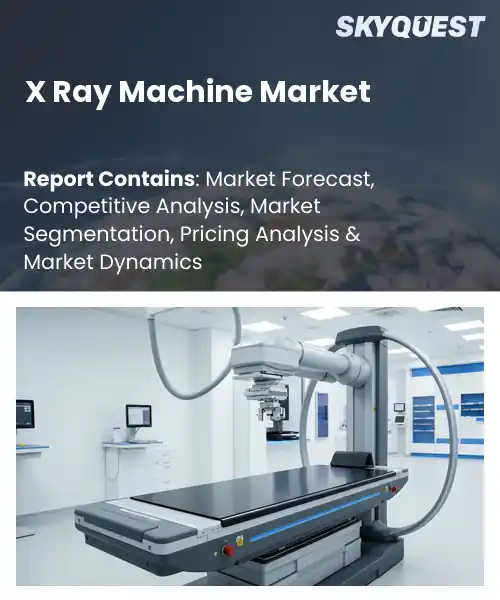
X Ray Machine Market
Report ID: SQMIG35A4216
Report ID: SQMIG35A4216
[email protected]
USA +1 351-333-4748
Report ID:
SQMIG35A4216 |
Region:
Global |
Published Date: July, 2026
Pages:
157
|Tables:
117
|Figures:
77


Global X Ray Machine Market size was valued at USD 17.3 Billion in 2024 and is poised to grow from USD 18.07 Billion in 2025 to USD 25.58 Billion by 2033, growing at a CAGR of 4.44% during the forecast period (2026-2033).
Surge in prevalence of chronic diseases, rising demand for diagnostic imaging, increasing adoption of digital radiography systems, advancements in portable X-ray technologies, and expanding healthcare infrastructure are driving sales of X-ray machines.
Rising incidence of chronic diseases and increasing demand for advanced diagnostic imaging among healthcare providers around the world coupled with rising investments in healthcare infrastructure are expected to primarily drive X-ray machine market growth. The growing aging population and increasing number of diagnostic procedures are also promoting the adoption of digital X-ray systems across hospitals, diagnostic centers, and outpatient facilities. Rapid advancements in digital radiography, portable X-ray units, AI-enhanced image processing, and low-dose imaging technologies have significantly improved diagnostic accuracy, workflow efficiency, and patient safety while encouraging healthcare providers to replace conventional film-based systems. Growing regulatory emphasis on radiation dose reduction and increasing adoption of point-of-care imaging are further accelerating demand for compact, cloud-connected X-ray systems equipped with AI-powered image analysis and automated quality control. Rising deployment of portable X-ray systems in emergency care, trauma centers, and rural healthcare facilities is also expected to create new growth opportunities for market participants worldwide.
On the contrary, high costs of advanced X-ray systems, stringent regulatory approval requirements, shortage of skilled radiology professionals, and maintenance and calibration challenges are anticipated to slow down X-ray machine market penetration through 2033.
Market snapshot - (2026-2033)
Global Market Size
USD 17.3 Billion
Largest Segment
Stationary Fixed X-Ray Systems
Fastest Growth
Mobile Portable X-Ray Units
Growth Rate
4.44% CAGR
To get more insights on this market click here to Request a Free Sample Report
Global x ray machine market is segmented by modality design, technology platform, clinical application, end-user, and region. Based on modality design, the market is segmented into Stationary Fixed X-Ray Systems and Mobile Portable X-Ray Units. Based on technology platform, the market is segmented into digital radiography systems, computed radiography systems, and analog X-ray systems. Based on clinical application, the market is segmented into general medical diagnostics, dental imaging, mammography screening, and image-guided interventional procedures. Based on end-user, the market is segmented into general speciality hospitals, diagnostic radiology centers, and urgent care clinics. Based on region, the market is segmented into North America, Europe, Asia Pacific, Latin America, and Middle East & Africa.
The digital radiography systems segment is anticipated to lead the global X-ray machine market revenue generation in the long run. It offers immediate image acquisition without requiring chemical processing, which decreases the amount of time spent on processing images. This feature meets the needs of hospitals in terms of providing a quick diagnosis and increasing patient turnover. Besides, the smooth integration into the electronic health record system improves information management. Reliability and low total cost of ownership make it even more attractive.
However, computed radiography systems segment is witnessing the strongest growth momentum due to its cost-effective nature when serving as a transition from film to digital for those moving away from the film-based imaging process. Being reusable in addition to being compatible with already existing X-Ray machines makes this technology very easy to use widely across new clinics.
The general medical diagnostics segment is slated to account for the highest global X-ray machine market share going forward. It is at the base of most imaging procedures done in hospitals and clinics. The wide application of this technology in cases of trauma, infections, and internal disease assessment makes the demand for these X Ray machines steady. The quickness and reliability that comes from using these machines make them attractive to clinicians, contributing to their high usage rates and generating stable revenues.
On the other hand, image guided interventional procedures emerges as the key high growth subsegment as per this X-ray machine market forecast, as minimal invasion surgery depends more on real-time X-ray visualization. Improvements in fluoroscopy technology and growing confidence among surgeons are leading to greater use in cardiology and orthopedic surgeries, thus generating new sales opportunities for equipment manufacturers.
To get detailed segments analysis, Request a Free Sample Report
North America dominates the global X-ray machine demand owing to its highly developed health-care infrastructure that combines advanced medical imaging technology with an extensive network of diagnostic facilities. North America enjoys robust funding for research and development, allowing it to quickly adopt new technology that is more efficient and minimizes exposure to radiation. Reimbursement policies make it worthwhile for hospitals and imaging centers to invest in better technology, and strict regulations ensure that the products are of high quality and safe to use. Moreover, focused expertise in manufacturing and servicing helps maintain this virtuous circle of innovation and support.
X ray machine market in the United States thrives on a robust ecosystem of large hospital systems and specialty clinics that prioritize high‑resolution imaging for comprehensive patient care. Collaborative partnerships between manufacturers and research institutions accelerate the introduction of next‑generation modalities, while insurance structures that reward quality outcomes facilitate steady equipment renewal. The emphasis on precision diagnostics and stringent safety standards fuels continuous demand for sophisticated solutions across a diverse range of clinical settings.
X ray machine demand in Canada is shaped by a publicly funded health-care model that values uniform access to modern diagnostic tools across provinces. Government purchasing approaches concentrate on long-term service contracts and standardization of technology, which result in consistent upgrade of digital as well as low-dose machines. Guidelines for clinical practice favoring early detection and prevention lead to adoption of imaging technologies not only in urban hospitals but also in rural health centers through cooperation with research centers.
Europe has a growth pattern characterized by a synchronized regulatory framework, which fosters the spread of technology across borders as well as standardization of safety and performance regulations. A high degree of interest in preventive healthcare and early disease detection spurs the demand at both public and private institutions. Research partnerships and adequate financing foster innovations in high-definition and low-dose imaging, while sustainability initiatives contribute to the development of energy-saving devices. The maturity of the European market is additionally aided by a developed infrastructure of services and digital workflow integration.
X ray machine market in Germany benefits from a dense network of university hospitals and specialized clinics that prioritize precision imaging for complex diagnostics. Close collaboration between industry leaders and research institutions accelerates technology transfer, ensuring rapid deployment of advanced digital solutions. Reimbursement policies that link funding to clinical outcomes incentivize the adoption of high‑performance systems, while stringent quality standards reinforce confidence in equipment reliability across the health‑care continuum.
X Ray Machine Market in the United Kingdom is characterized by an accelerated rollout of next‑generation imaging within both NHS facilities and private providers. Policy initiatives that promote digital transformation and patient‑centred care drive investment in low‑dose, high‑throughput systems. Strong academic partnerships and a vibrant start‑up ecosystem foster continuous innovation, while procurement frameworks that emphasize value‑based purchasing enable faster integration of cutting‑edge technology into routine clinical practice.
X Ray Machine Market in France is emerging through strategic investments that align with national health priorities focused on early detection and chronic disease management. Collaborative programs between governmental health agencies and technology firms support the deployment of modern digital platforms in regional hospitals. Emphasis on patient safety and environmental sustainability guides procurement toward energy‑efficient, low‑exposure equipment, fostering a gradual yet steady expansion of advanced imaging capabilities across the country.
Asia Pacific is building its strength in X-ray machine innovation by utilizing the rapid development of the health-care infrastructure along with increasing requirements for advanced diagnosis among emerging and developed nations. There is an increased focus on universal health care coverage, coupled with modernization of the medical institutions, providing ideal conditions for the deployment of innovative digital and portable imaging devices. Local manufacturers are making substantial efforts to develop their research, leading to effective innovations that meet local demands. International cooperation, in addition to expertise in radiology, contributes to the transfer of knowledge, while a focus on training and services ensures market penetration.
X ray machine market in Japan is anchored by a sophisticated health‑care system that emphasizes high‑precision diagnostics and technological refinement. Strong collaboration between leading manufacturers and academic hospitals accelerates the introduction of ultra‑high‑resolution and low‑dose imaging solutions. Government initiatives that encourage digital integration and equipment upgrades reinforce a culture of continual improvement, ensuring that both urban centers and specialized clinics maintain cutting‑edge diagnostic capabilities.
X ray machine market in South Korea thrives on a dynamic blend of rapid technological adoption and supportive health‑care policies that encourage modern equipment rollout. Digital technology investments and emphasis on portability and efficiency in device design allow for the wide distribution throughout metropolitan hospitals and regional health facilities. Strong cooperation between industrial designers and medical researchers ensures quick exchange of feedback and further development of imaging solutions that fit the needs of the Korean health care environment.
To know more about the market opportunities by region and country, click here to
Buy The Complete Report
Increasing Demand for Early Detection
Advancements in Digital Imaging Technology
High Initial Capital Investment
Regulatory Compliance and Safety Standards
Request Free Customization of this report to help us to meet your business objectives.
The global X‑ray machine market is shaped by intense rivalry among established leaders such as Siemens Healthineers, GE Healthcare and Philips, each leveraging strategic M&A, partnerships and technology innovation. GE’s acquisition of a digital imaging firm, Siemens’ joint venture with regional hospital networks, and Philips’ rollout of AI‑enhanced X‑ray platforms illustrate how competitive pressures drive product differentiation, market consolidation and accelerated adoption of advanced imaging solutions.
SkyQuest’s ABIRAW (Advanced Business Intelligence, Research & Analysis Wing) is our Business Information Services team that Collects, Collates, Correlates, and Analyses the Data collected by means of Primary Exploratory Research backed by robust Secondary Desk research.
As per SkyQuest analysis, increasing demand for diagnostic imaging, and rising adoption of digital radiography systems are anticipated to drive the demand for X-ray machines going forward. However, high equipment costs, stringent regulatory requirements, and shortage of skilled radiology professionals are slated to slow down the adoption of X-ray machines in the future. North America is slated to spearhead the demand for X-ray machines owing to advanced healthcare infrastructure, high healthcare spending, and early adoption of innovative medical imaging technologies. Development of AI-powered image analysis, portable digital X-ray systems, and cloud-integrated imaging platforms are anticipated to be key trends driving the X-ray machine market through 2033 and beyond.
| Report Metric | Details |
|---|---|
| Market size value in 2024 | USD 17.3 Billion |
| Market size value in 2033 | USD 25.58 Billion |
| Growth Rate | 4.44% |
| Base year | 2024 |
| Forecast period | (2026-2033) |
| Forecast Unit (Value) | USD Billion |
| Segments covered |
|
| Regions covered | North America (US, Canada), Europe (Germany, France, United Kingdom, Italy, Spain, Rest of Europe), Asia Pacific (China, India, Japan, Rest of Asia-Pacific), Latin America (Brazil, Rest of Latin America), Middle East & Africa (South Africa, GCC Countries, Rest of MEA) |
| Companies covered |
|
| Customization scope | Free report customization with purchase. Customization includes:-
|
To get a free trial access to our platform which is a one stop solution for all your data requirements for quicker decision making. This platform allows you to compare markets, competitors who are prominent in the market, and mega trends that are influencing the dynamics in the market. Also, get access to detailed SkyQuest exclusive matrix.
Table Of Content
Executive Summary
Market overview
Parent Market Analysis
Market overview
Market size
KEY MARKET INSIGHTS
COVID IMPACT
MARKET DYNAMICS & OUTLOOK
Market Size by Region
KEY COMPANY PROFILES
Methodology
For the X Ray Machine Market, our research methodology involved a mixture of primary and secondary data sources. Key steps involved in the research process are listed below:
1. Information Procurement: This stage involved the procurement of Market data or related information via primary and secondary sources. The various secondary sources used included various company websites, annual reports, trade databases, and paid databases such as Hoover's, Bloomberg Business, Factiva, and Avention. Our team did 45 primary interactions Globally which included several stakeholders such as manufacturers, customers, key opinion leaders, etc. Overall, information procurement was one of the most extensive stages in our research process.
2. Information Analysis: This step involved triangulation of data through bottom-up and top-down approaches to estimate and validate the total size and future estimate of the X Ray Machine Market.
3. Report Formulation: The final step entailed the placement of data points in appropriate Market spaces in an attempt to deduce viable conclusions.
4. Validation & Publishing: Validation is the most important step in the process. Validation & re-validation via an intricately designed process helped us finalize data points to be used for final calculations. The final Market estimates and forecasts were then aligned and sent to our panel of industry experts for validation of data. Once the validation was done the report was sent to our Quality Assurance team to ensure adherence to style guides, consistency & design.
Analyst Support
Customization Options
With the given market data, our dedicated team of analysts can offer you the following customization options are available for the X Ray Machine Market:
Product Analysis: Product matrix, which offers a detailed comparison of the product portfolio of companies.
Regional Analysis: Further analysis of the X Ray Machine Market for additional countries.
Competitive Analysis: Detailed analysis and profiling of additional Market players & comparative analysis of competitive products.
Go to Market Strategy: Find the high-growth channels to invest your marketing efforts and increase your customer base.
Innovation Mapping: Identify racial solutions and innovation, connected to deep ecosystems of innovators, start-ups, academics, and strategic partners.
Category Intelligence: Customized intelligence that is relevant to their supply Markets will enable them to make smarter sourcing decisions and improve their category management.
Public Company Transcript Analysis: To improve the investment performance by generating new alpha and making better-informed decisions.
Social Media Listening: To analyze the conversations and trends happening not just around your brand, but around your industry as a whole, and use those insights to make better Marketing decisions.
REQUEST FOR SAMPLE
 REQUEST FREE CUSTOMIZATION
Global X Ray Machine Market size was valued at USD 17.3 Billion in 2024 and is poised to grow from USD 18.07 Billion in 2025 to USD 25.58 Billion by 2033, growing at a CAGR of 4.44% during the forecast period (2026-2033).
The global X‑ray machine market is shaped by intense rivalry among established leaders such as Siemens Healthineers, GE Healthcare and Philips, each leveraging strategic M&A, partnerships and technology innovation. GE’s acquisition of a digital imaging firm, Siemens’ joint venture with regional hospital networks, and Philips’ rollout of AI‑enhanced X‑ray platforms illustrate how competitive pressures drive product differentiation, market consolidation and accelerated adoption of advanced imaging solutions. 'General Electric', 'Siemens Energy', 'Philips', 'Canon', 'Fujifilm Holdings', 'Hitachi', 'Shimadzu Corporation', 'Carestream Health', 'Agfa-Gevaert Group', 'Konica Minolta', 'Varex Imaging', 'Hologic', 'Dentsply Sirona', 'Planmeca Oy', 'Midmark Corporation', 'Acteon Group', 'Teledyne Technologies', 'Vieworks', 'Rayence', 'Trixell'
Healthcare providers are prioritizing preventive care, and the ability of X‑ray machines to quickly identify abnormalities supports early diagnosis. This focus drives hospitals and clinics to invest in modern imaging equipment, replacing older units to enhance diagnostic accuracy. As clinicians recognize the role of timely imaging in improving patient outcomes, procurement budgets allocate resources toward advanced X‑ray systems, thereby expanding market demand and fostering sustained growth across both developed and emerging outpatient centers and diagnostic imaging centers that seek to broaden service portfolios.
Ai-Driven Diagnostic Imaging: Healthcare providers are increasingly integrating artificial intelligence into X‑ray workflows to enhance image quality, reduce repeat scans, and accelerate clinical decision‑making. AI algorithms can automatically adjust exposure settings, detect subtle abnormalities, and prioritize urgent cases for radiologists. This capability improves patient throughput and experience while supporting clinicians with more accurate interpretations. As AI continues to mature, hospitals are adopting smart imaging platforms that combine hardware and software, positioning X‑ray technology as a pivotal component of next‑generation diagnostic ecosystems in healthcare.
Why does North America Dominate the Global X Ray Machine Market? |@12


Want to customize this report? This report can be personalized according to your needs. Our analysts and industry experts will work directly with you to understand your requirements and provide you with customized data in a short amount of time. We offer $1000 worth of FREE customization at the time of purchase.
Feedback From Our Clients


 USA (+1) 351-333-4748

