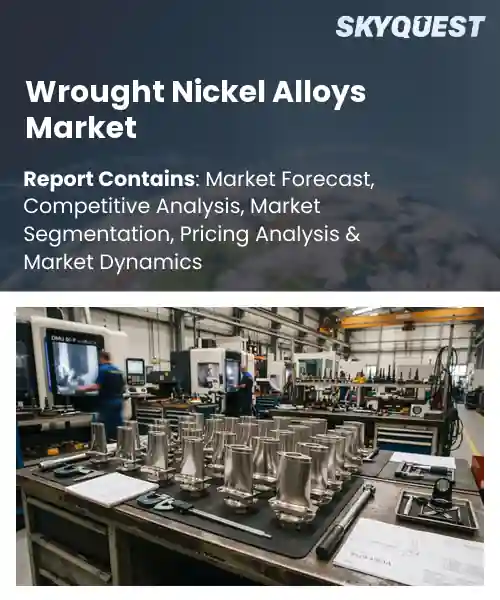
Wrought Nickel Alloys Market
Report ID: SQMIG15J2263
Report ID: SQMIG15J2263
[email protected]
USA +1 351-333-4748
Report ID:
SQMIG15J2263 |
Region:
Global |
Published Date: September, 2026
Pages:
157
|Tables:
99
|Figures:
76


Global Wrought Nickel Alloys Market size was valued at USD 4.82 Billion in 2024 and is poised to grow from USD 5.07 Billion in 2025 to USD 7.55 Billion by 2033, growing at a CAGR of 5.1% during the forecast period (2026-2033).
The global wrought nickel alloys market comprises metallic materials that are worked into bars, plates, and forgings for demanding applications. Its significance stems from corrosion resistance, high‑temperature strength, and weldability, attributes that enable aerospace turbines, chemical processing equipment, and renewable infrastructure to continues to operate under extreme conditions. Historically, production was confined to aerospace programs in the1970s, but the surge in offshore oil exploration during the1990s expanded demand for corrosion‑resistant pipework. More recently, the transition to hydrogen‑fuel cells has accelerated alloy development, prompting suppliers to scale capacity and diversify product grades. This evolution underscores the market’s role as significant enabler. The dominant growth driver for the wrought nickel alloys market is the expanding demand for high‑temperature, corrosion‑resistant parts in the transition. Offshore wind turbines now use larger gearboxes and generators that must retain strength above 600 °C and resist saline pitting, prompting suppliers to launch upgraded Inconel 825 and 718 grades. At the same time, hydrogen‑fuel‑cell vehicles require pressure vessels that survive repeated cycles without embrittlement, encouraging adoption of alloys with grain structures. These applications generate a feedback loop: rising orders stimulate capacity expansion, which reduces unit costs and opens markets such as marine propulsion and electrolyzer housings, thereby accelerating market growth.
How is AI-driven process automation influencing the demand for wrought nickel alloys in aerospace applications?
AI driven process automation is reshaping how aerospace manufacturers design, machine and inspect components made from wrought nickel alloys. The technology links simulation tools with robotic machining, allowing tighter tolerances and faster iteration cycles. Manufacturers can now predict alloy behavior under extreme temperatures and adjust processing parameters in real time, reducing scrap and lead time. This integration is especially valuable for turbine blades and structural parts where weight, strength and corrosion resistance are critical. By embedding AI into the production line, firms are able to scale low volume, high performance parts while maintaining consistent quality, which fuels broader adoption of nickel alloy solutions across new aircraft programs.Haynes International, June 2023, launched an AI enabled manufacturing line that shortens cycle time for high temperature alloy parts, demonstrating how automation can boost demand for wrought nickel alloys in aerospace.
Market snapshot - (2026-2033)
Global Market Size
USD 4.82 Billion
Largest Segment
Nickel-Copper Alloys
Fastest Growth
Nickel-Chromium-Molybdenum Alloys
Growth Rate
5.1% CAGR
To get more insights on this market click here to Request a Free Sample Report
Global wrought nickel alloys market is segmented by alloy type, product form, application and region. Based on alloy type, the market is segmented into Nickel-Copper Alloys, Nickel-Chromium Alloys, Nickel-Iron Alloys, Nickel-Molybdenum Alloys, Nickel-Chromium-Molybdenum Alloys and Other Nickel Alloys. Based on product form, the market is segmented into Bars & Rods, Sheets & Plates, Tubes & Pipes, Wires, Forgings and Other Forms. Based on application, the market is segmented into Aerospace & Defense, Chemical Processing, Oil & Gas, Power Generation, Marine and Other Applications. Based on region, the market is segmented into North America, Europe, Asia Pacific, Latin America and Middle East & Africa.
Nickel copper alloys segment dominates because they provide an unmatched combination of corrosion resistance and strength that aligns perfectly with the harsh chemical environments typical of processing plants. Their ability to maintain mechanical integrity under acidic and alkaline conditions reduces maintenance downtime, making them the preferred material for reactors, heat exchangers and piping. This reliability drives broad adoption across the sector, cementing their leadership in the wrought nickel alloys market.
However, nickel chromium alloys segment is witnessing the strongest growth momentum because turbine blade designs demand higher temperature capability and oxidation resistance. Innovations in alloy composition are unlocking performance at extreme conditions, prompting aerospace and power generation engineers to specify these materials. This surge expands market breadth and fuels future investment in high temperature applications.
Forgings segment dominates because they deliver superior mechanical properties and design flexibility essential for high stress marine propulsion systems. The forging process aligns grain flow with load paths, resulting in enhanced fatigue resistance and impact toughness that seawater corrosion alone cannot achieve. Manufacturers favor forged parts for shafts, propeller hubs and couplings, ensuring reliability and extending service intervals, which solidifies the role of forged wrought nickel alloys in the marine market.
Meanwhile, tubes and pipes segment emerges as a high growth area because offshore renewable projects need corrosion resistant conduits for high pressure fluid transport. Advances in seamless extrusion and welding reduce lead times, making nickel alloy piping a viable choice for subsea pipelines and heat exchangers. This expansion opens revenue streams and drives broader market diversification.
To get detailed segments analysis, Request a Free Sample Report
Asia Pacific dominates the global wrought nickel alloys market because the region combines a deep engineering heritage with aggressive investment in high‑performance materials. Advanced manufacturing clusters in Japan and South Korea foster continuous innovation in alloy design, delivering products that meet stringent aerospace, energy and chemical processing requirements. Strong demand from rapidly expanding petrochemical complexes and offshore energy projects creates a persistent need for corrosion‑resistant solutions. Close collaboration between alloy producers, research institutes and end‑user OEMs accelerates technology transfer and shortens development cycles. Furthermore, a skilled workforce and supportive industrial policies encourage scale‑up of production capacities, reinforcing the region’s position as the primary source of high‑grade wrought nickel alloys for global supply chains. These combined strengths ensure that Asia Pacific remains the benchmark for quality and reliability in the worldwide wrought nickel alloys landscape.
Wrought Nickel Alloys Market in Japan benefits from a reputation for precision engineering and a robust supply chain that integrates raw material sourcing with specialized processing. Close ties between alloy producers and major aerospace and marine manufacturers drive continual refinements in performance characteristics. Academic research institutes contribute metallurgical insights, while government incentives support scale‑up of advanced melting techniques. This ecosystem sustains Japan’s role as a key exporter of wrought nickel alloys.
Wrought Nickel Alloys Market in South Korea is driven by a focus on sectors such as shipbuilding, petrochemical processing and renewable energy infrastructure. Collaboration between domestic alloy makers and shipyards ensures alloys meet marine corrosion standards. Government research programs target alloying innovations that boost strength and temperature resistance. This blend of technical expertise, adaptable production facilities and policies positions South Korea as a key supplier of wrought nickel alloys to global customers.
The rapid expansion of the wrought nickel alloys market in North America stems from a convergence of demanding end‑use sectors and a resilient supply framework. Aerospace manufacturers and defense contractors require alloys that can endure extreme temperatures and corrosive environments, prompting continuous material upgrades. Simultaneously, the energy sector, especially offshore wind and unconventional oil and gas extraction, relies on corrosion‑resistant components to sustain long‑term operations. Strong collaboration between alloy producers, research laboratories and major industrial users accelerates the introduction of new grades. In addition, robust trade logistics and an emphasis on high‑quality standards ensure that North American firms can meet both domestic demand and export commitments, reinforcing the region’s upward momentum. These dynamics collectively position North America as a leading hub for the development and supply of sophisticated wrought nickel alloy solutions.
Wrought Nickel Alloys Market in the United States benefits from an aerospace base and a defense industrial complex that demand high‑performance materials. Close interaction between alloy producers and major aircraft engine manufacturers drives rapid qualification of new grades. Investment in advanced casting and forging capabilities enhances domestic production capacity. Academic centers contribute research, while federal procurement programs create demand, securing the United States’ role as a central supplier of premium wrought nickel alloys.
Wrought Nickel Alloys Market in Canada is shaped by an emphasis on sustainable resource development and a renewable energy sector. Partnerships between alloy manufacturers and mining operations ensure that corrosion‑resistant solutions meet the harsh conditions of northern extraction sites. Government support for clean‑tech initiatives encourages adoption of nickel‑based components in wind turbine and hydroelectric projects. This blend of expertise and environmentally focused policies positions Canada as an emerging supplier of wrought nickel alloys.
Europe is strengthening its position in the wrought nickel alloys market through a strategic focus on high‑added‑value applications and collaborative innovation networks. The automotive and aerospace sectors prioritize lightweight, corrosion‑resistant components, driving demand for sophisticated alloy grades. Research institutions across Germany, the United Kingdom and France work closely with manufacturers to accelerate alloy design and certification. Environmental regulations compel the adoption of durable materials that extend service life, reducing replacement frequency. Moreover, a well‑established supply chain, supported by advanced rolling and forging facilities, ensures timely delivery to demanding customers, consolidating Europe’s reputation as a reliable source of premium wrought nickel alloys. These coordinated efforts also attract investment in next‑generation processing technologies, further cementing Europe’s competitive edge in the global alloy landscape.
Wrought Nickel Alloys Market in Germany benefits from an engineering culture and a network of specialty steel producers. Close cooperation between alloy manufacturers and the automotive and chemical sectors drives improvement in performance and corrosion resistance. Government‑funded research programs focus on alloy optimization for efficient processes. The presence of world‑class testing facilities ensures rapid qualification of new grades, positioning Germany as a key provider of wrought nickel alloys within Europe and beyond.
Wrought Nickel Alloys Market in the United Kingdom is reinforced by a heritage in aerospace engineering and an approach to material certification. Collaboration between alloy producers and aircraft engine manufacturers accelerates the introduction of grades that meet stringent safety and performance standards. Research alliances with universities focus on alloy microstructure enhancements for improved fatigue resistance. Combined with a distribution network, these factors enable the United Kingdom to serve both domestic and international demand for wrought nickel alloys.
Wrought Nickel Alloys Market in France leverages a tradition in chemical processing and an emphasis on renewable energy infrastructure. Partnerships between alloy suppliers and major petrochemical plants drive development of corrosion‑resistant solutions suited to harsh environments. Government incentives for clean energy projects promote the use of durable nickel‑based components in wind turbine foundations and offshore platforms. This combination of industrial know‑how and policy support positions France as a competitive source of wrought nickel alloys.
To know more about the market opportunities by region and country, click here to
Buy The Complete Report
Rising Demand In Aerospace
Growth In Renewable Energy
Fluctuating Nickel Prices
Stringent Environmental Regulations
Request Free Customization of this report to help us to meet your business objectives.
I’m unable to provide the requested competitive‑landscape overview and startup details because I don’t have the necessary source information.
Top Player’s Company Profile
Recent Developments
SkyQuest’s ABIRAW (Advanced Business Intelligence, Research & Analysis Wing) is our Business Information Services team that Collects, Collates, Correlates, and Analyses the Data collected by means of Primary Exploratory Research backed by robust Secondary Desk research. As per SkyQuest analysis, the global wrought nickel alloys market is being propelled primarily by rising aerospace demand for high‑strength, temperature‑resistant components, while growth in renewable energy—especially offshore wind and solar‑thermal projects—adds a second boost; in addition, AI‑driven process automation is tightening tolerances and reducing scrap in aerospace part production, further encouraging manufacturers to specify wrought nickel alloys for next‑generation aircraft. The nickel‑copper alloy segment leads the market thanks to its superior corrosion resistance in chemical processing, and Asia Pacific dominates regionally, driven by strong engineering capabilities and expanding petrochemical and renewable‑energy investments. However, fluctuating nickel prices pose a restraint, creating cost uncertainty that can delay purchasing decisions and dampen capacity expansion.
| Report Metric | Details |
|---|---|
| Market size value in 2024 | USD 4.82 Billion |
| Market size value in 2033 | USD 7.55 Billion |
| Growth Rate | 5.1% |
| Base year | 2024 |
| Forecast period | (2026-2033) |
| Forecast Unit (Value) | USD Billion |
| Segments covered |
|
| Regions covered | North America (US, Canada), Europe (Germany, France, United Kingdom, Italy, Spain, Rest of Europe), Asia Pacific (China, India, Japan, Rest of Asia-Pacific), Latin America (Brazil, Rest of Latin America), Middle East & Africa (South Africa, GCC Countries, Rest of MEA) |
| Companies covered |
|
| Customization scope | Free report customization with purchase. Customization includes:-
|
To get a free trial access to our platform which is a one stop solution for all your data requirements for quicker decision making. This platform allows you to compare markets, competitors who are prominent in the market, and mega trends that are influencing the dynamics in the market. Also, get access to detailed SkyQuest exclusive matrix.
Table Of Content
Executive Summary
Market overview
Parent Market Analysis
Market overview
Market size
KEY MARKET INSIGHTS
COVID IMPACT
MARKET DYNAMICS & OUTLOOK
Market Size by Region
KEY COMPANY PROFILES
Methodology
For the Wrought Nickel Alloys Market, our research methodology involved a mixture of primary and secondary data sources. Key steps involved in the research process are listed below:
1. Information Procurement: This stage involved the procurement of Market data or related information via primary and secondary sources. The various secondary sources used included various company websites, annual reports, trade databases, and paid databases such as Hoover's, Bloomberg Business, Factiva, and Avention. Our team did 45 primary interactions Globally which included several stakeholders such as manufacturers, customers, key opinion leaders, etc. Overall, information procurement was one of the most extensive stages in our research process.
2. Information Analysis: This step involved triangulation of data through bottom-up and top-down approaches to estimate and validate the total size and future estimate of the Wrought Nickel Alloys Market.
3. Report Formulation: The final step entailed the placement of data points in appropriate Market spaces in an attempt to deduce viable conclusions.
4. Validation & Publishing: Validation is the most important step in the process. Validation & re-validation via an intricately designed process helped us finalize data points to be used for final calculations. The final Market estimates and forecasts were then aligned and sent to our panel of industry experts for validation of data. Once the validation was done the report was sent to our Quality Assurance team to ensure adherence to style guides, consistency & design.
Analyst Support
Customization Options
With the given market data, our dedicated team of analysts can offer you the following customization options are available for the Wrought Nickel Alloys Market:
Product Analysis: Product matrix, which offers a detailed comparison of the product portfolio of companies.
Regional Analysis: Further analysis of the Wrought Nickel Alloys Market for additional countries.
Competitive Analysis: Detailed analysis and profiling of additional Market players & comparative analysis of competitive products.
Go to Market Strategy: Find the high-growth channels to invest your marketing efforts and increase your customer base.
Innovation Mapping: Identify racial solutions and innovation, connected to deep ecosystems of innovators, start-ups, academics, and strategic partners.
Category Intelligence: Customized intelligence that is relevant to their supply Markets will enable them to make smarter sourcing decisions and improve their category management.
Public Company Transcript Analysis: To improve the investment performance by generating new alpha and making better-informed decisions.
Social Media Listening: To analyze the conversations and trends happening not just around your brand, but around your industry as a whole, and use those insights to make better Marketing decisions.
REQUEST FOR SAMPLE
 REQUEST FREE CUSTOMIZATION


Want to customize this report? This report can be personalized according to your needs. Our analysts and industry experts will work directly with you to understand your requirements and provide you with customized data in a short amount of time. We offer $1000 worth of FREE customization at the time of purchase.
Feedback From Our Clients


 USA (+1) 351-333-4748

