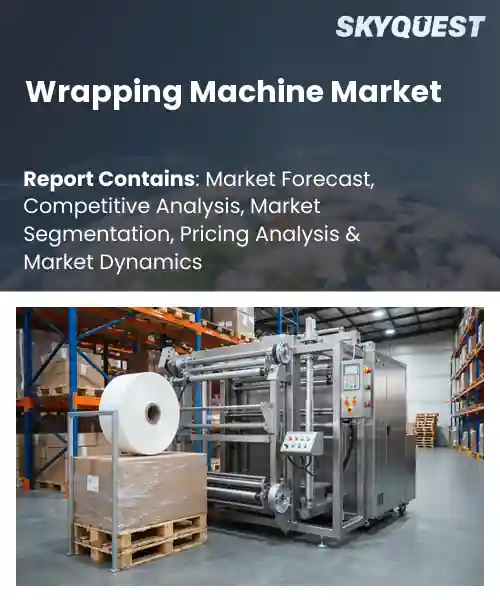
Wrapping Machine Market
Report ID: SQMIG20I3031
Report ID: SQMIG20I3031
[email protected]
USA +1 351-333-4748
Report ID:
SQMIG20I3031 |
Region:
Global |
Published Date: May, 2026
Pages:
157
|Tables:
152
|Figures:
78


Global Wrapping Machine Market size was valued at USD 3.40 Billion in 2024 and is poised to grow from USD 3.56 Billion in 2025 to USD 5.14 Billion by 2033, growing at a CAGR of 4.7% during the forecast period (2026-2033).
The expansion of e-commerce and the increasing demand for faster supply chains are driving the wrapping machine market growth. Wrapping machines automate the application of protective film and secondary packaging on products and pallets. The machines are important because they help to reduce material waste, improve throughput (i.e. number of times an item has been packed), and protect items during shipping. The market has made a transition from using manual and semi-automated heat-shrink or stretch wrappers to using fully automated servo-driven systems that incorporate robotics and vision inspection. For instance, many manufacturers now use high-speed flow wrappers and robotic palletizers to pack consumer goods and fulfill parcel orders. The trend is continuing to exert pressure to reduce the cost of shipping individual parcels while also decreasing the rate of damage during shipping. Additionally, the growth of e-commerce, rising labour costs, the use of sustainable packaging materials, and a desire for real-time visibility into the supply chain have all spurred the adoption of wrapping machinery.
Many manufacturers are focused on developing designs that require less film, developing servo-controlled equipment, and developing equipment with IoT connectivity. Companies are installing automated pallet wrapping machines and robotic case packing machines to reduce the number of employees needed and increase throughput because labour is scarce. This trend is most evident in grocery distribution centres. Because of the regulatory pressure to reduce the usage of single-use plastics, suppliers are focused on providing thinner or recyclable films and providing accurate applications of film. Therefore, there will be opportunities for converting existing machines to accept thinner films, and for converting to machine-mounted and hand-held cannisters as most wrapping machines will be equipped with both a film and a carrier, so they can be retrofitted with other films or carriers. The ability to use connectivity to obtain predictive maintenance can lead to less downtime and a lower total cost of ownership, which will increase adoption of wrapping machinery in mid-sized businesses.
How is AI Enhancing Efficiency in the Global Wrapping Machine Market?
Changes in wrapping machine market trends benefiting from AI technology improvements are occurring through 3 areas: sensing, decision-making, and coordination of processes. The three features include vision based inspection for identifying miswrapped or missing seals; predictive maintenance that eliminates unplanned stops; adaptive control to optimize film use and cycle profiles. New applications of AI software are being combined with robotics and Autonomous Mobile Robots (AMR) to build more intelligent end of line systems. The combinations of such technologies create greater throughput and reduce waste as well as simplify the reconfiguration of lines for various products. Recent packaging type shows real world demonstrations of AI vision combined with AMR on linked wrappers transitioning from pilot stages to commercial manufacturing.
In February 2026 Lantech launched AMR integrated stretch wrapping solutions that combine autonomous mobile robots with intelligent controls, demonstrating how AI enabled coordination reduces downtime and manual labor while improving film efficiency, changeover speed, and overall production line versatility.
Market snapshot - (2026-2033)
Global Market Size
USD 3.4 Billion
Largest Segment
Pallet Wrapping Machines
Fastest Growth
Pallet Wrapping Machines
Growth Rate
4.7% CAGR
To get more insights on this market click here to Request a Free Sample Report
Global wrapping machine market is segmented by machine type, automation type, material type, end-use industry, operating mode and region. Based on machine type, the market is segmented into stretch wrapping machines, shrink wrapping machines, flow wrapping machines, banding & bundling wrapping machines, vacuum wrapping machines and pallet wrapping machines. Based on automation type, the market is segmented into manual, semi-automatic and fully automatic. Based on material type, the market is segmented into plastic films, paper-based wrapping materials, foil-based wrapping materials and biodegradable & sustainable films. Based on end-use industry, the market is segmented into food & beverage, pharmaceuticals, consumer goods, e-commerce & logistics, industrial & manufacturing, personal care & cosmetics, electronics and others. Based on operating mode, the market is segmented into standalone machines and integrated packaging line systems. Based on region, the market is segmented into North America, Europe, Asia Pacific, Latin America and Middle East & Africa.
Pallet wrapping machines dominate this segment because they provide an effective method to secure the final mile load stability of pallets and meet shipping requirements for handling pallets by carriers. Pallet wrapping machines accomplish this by providing a simple solution for the fast and consistent containment of a wide variety of pallet profiles. In addition, the machine is designed for easy integration with conveyors and fork trucks, and reduces the need to rework or damage products through a high level of compatibility with both manual and automated processes as well as film types and stretch wrap systems. Adoption of pallet focused equipment within the distribution and manufacturing sectors is driven by a strong commitment to operational continuity and labor productivity.
However, shrink wrapping machines are emerging as the most rapidly expanding area due to their suitability for high clarity consumer packaging and tamper evident applications. Rising retail presentation demands and need for compact sealed units drive adoption, while technological improvements in tunnel efficiency and material optimization accelerate application opportunities for manufacturers and brand owners.
The plastic films segment leads the industry due to its unique combination of flexibility, strength, and ability to work with current wrapping machines and help fulfill core operational requirements in many industries. Additionally, the ability to quickly adjust to machine tensioning and heat settings has helped lower cycle complexity and the availability of many types of suppliers has led to a steady supply of materials at predictable costs. All of these practical features contribute to reducing barriers to integration, are critical in providing consistent performance when containing products, and are key factors for the broad acceptance of net throughput and existing packing operations among manufacturers who base their purchasing decisions on dependable operational execution.
Meanwhile, biodegradable & sustainable films are emerging as the fastest growing material area driven by regulatory pressure, brand sustainability commitments and shifting consumer preferences. Innovations in compostable blends and compatibility with existing wrapping equipment reduce switching friction, opening premium applications and creating opportunities for equipment suppliers and converters to develop eco friendly wrapping solutions.
To get detailed segments analysis, Request a Free Sample Report
The Asia Pacific region has become a dominant force in the global packaging industry due to a combination of well established manufacturing systems, large consumer markets (food, beverage, pharmaceutical, and consumer electronics) and the presence of a large number of domestic manufacturers who are committed to automation and reliability in Machine building. Manufacturers in this region are able to provide cost effective solutions at the same time that they rapidly develop new products to satisfy the wide range of needs of their customers. The availability of a large number of suppliers and integrated supply chains allows manufacturers to quickly implement new products into production, as well as to provide aftermarket support. Demand for faster processing speeds, rapidly changing packaging requirements, and production facilities that are designed to maximize space utilization have all contributed to making Asia Pacific region the leading market for both standard and high-end wrapping machines. The emphasis on custom packaging solutions, integrated control systems with ease of use, and training for service technicians will further enhance end-user confidence; while the ability of manufacturers in this region to export their machines will extend their influence into neighbouring markets.
Wrapping machine market share in Japan is characterized by advanced precision engineering and a focus on automation that aligns with high standards in pharmaceuticals and electronics packaging. Domestic manufacturers emphasize reliability, compact designs and tight process integration, while system integrators deliver tailored solutions and strong aftersales support. Demand favors machines that enable cleanroom compatibility, fine control and seamless data connectivity, creating a market environment that prioritizes quality, innovation and vendor partnerships worldwide.
Wrapping machine market forecast in South Korea is influenced by a variety of dynamic manufacturing ecosystems, as well as the need for highly customizable packaging solutions in the fast-paced industries of electronics and consumer products. Local machine builders are focusing on creating compact footprints with quick-change technology and robust controls that can be used for contract manufacture as well as export.The emphasis on cooperative automation, service responsiveness and partnerships with original equipment manufacturers (OEMs) creates an environment in which customization, energy-efficient designs, and seamless plant integration are major procurement criteria.
North America expansion is propelled by shifts in consumer behavior, a strong focus on flexible packaging formats and the need for higher throughput and line efficiency across food and personal care industries. Manufacturers and brand owners prioritize machines that enable rapid product changeover, integration with upstream and downstream lines and clear traceability features to meet compliance and retail requirements. Service availability, modular upgrade paths and strong OEM support reduce adoption friction, while interest in energy efficient and low waste solutions aligns equipment investment with corporate sustainability commitments. Cross industry collaboration with system integrators, and the importance of retrofitable platforms to extend plant life further accelerate adoption and market depth in the region. E-commerce growth and the prevalence of contract packers amplify demand for adaptable, compact wrapping systems supported by responsive local service and spare parts ecosystems, reinforcing market momentum.
Wrapping machine market outlook in United States will see significant changes over the upcoming years due to its large base of end-user markets; food and beverage manufacturers at scale and custom contract packagers that require high degrees of flexibility in machine use and rapid changeover. As a result, there are many manufacturers that are creating modular platforms to allow for extensive service networks and integration of the packaging machinery into plant automation and traceability systems. Many customers will also want to retrofit existing machinery to provide energy-efficient operation and achieve supply chain transparency; this can be achieved through the development of a partnership between an original equipment manufacturer (OEM) and a system integrator thus allowing tailored solutions to be implemented, along with aftercare support.
Wrapping machine market regional outlook in Canada reflects a mix of large processors and growing craft brands that require versatile, space efficient wrapping systems. Operators prioritize food safety compliance, ease of sanitation and reliable remote support for plants in dispersed locations. Vendors respond with compact, energy conscious machines, adaptable automation options and service agreements. Collaborative relationships between manufacturers and local integrators enable tailored installations suited to regional supply chains and seasonal operational patterns.
European nations are increasing their respective positions by providing technical solutions that will meet strict regulatory guidelines, environmental guidelines, and the creation of a culture of joint collaboration between Original Equipment Manufacturers (OEMs), converters and brand owners. Investments in energy-efficient designs, using recyclable materials that will work with these designs, and the creation of equipment that will allow for quick and effective cleaning and compliance are in response to customer requests and requests for new regulatory mandates. Specialized suppliers and system integrators are able to quickly customize equipment for niche applications, while also focusing on aftersale networks and providing modular, serviceable products to reduce total cost of ownership. Regional support of the use of digital connectivity, predictive maintenance and the interoperability of factory IT systems (IT) creates a competitive advantage and allows equipment to be utilized across manufacturing segments (food, pharma and consumer durable). The creation and establishment of standards, testing and certification requirements, as well as the strong technical expertise of engineering support, will help provide the equipment that manufacturers require in order to produce the highest quality and performance wrapping machinery for some of the most demanding industrial applications, for both domestic and export markets.
Wrapping machine market regional forecast in Germany is driven by engineering led OEMs known for robust, highly automated systems suited to demanding pharmaceutical, automotive component and premium food applications. Demand centers on precision control, durability and easy servicing, with integrators delivering tailored line layouts and comprehensive testing. Emphasis on energy efficiency, material compatibility and strict compliance drives procurement toward high specification equipment, while strong export orientation keeps manufacturers focused on modular, scalable designs.
Wrapping machine market analysis in United Kingdom is being impacted by changing consumer trends due to proliferation of both retail and e-commerce industries, driving the need for smaller, more flexible machines that can wrap packages of varying sizes and allow for rapid changeover between formats. The market tends to favor machines that can offer easy format changes after purchase as well as aftersales support, and also have the ability to integrate with the recycling process. System integrators are an important component in the integration of the wrapping machinery with the labeling and inspection machinery. In addition, suppliers' responsiveness and retrofit options are also important drivers of modernization efforts for wrapping machinery.
Wrapping machine industry in France is strongly influenced by a large food processing sector and numerous artisanal producers that demand flexible, gentle handling and product presentation capabilities. Suppliers respond with machines optimized for delicate items, a focus on packaging aesthetics and compatibility with recyclable substrates. Emphasis on supplier collaboration, regional service networks and tailored automation options enables small and medium producers to modernize lines while preserving product integrity and brand differentiation.
To know more about the market opportunities by region and country, click here to
Buy The Complete Report
Rising Demand From E Commerce
Advancements In Packaging Automation
High Initial Capital Requirements
Skilled Workforce Availability Challenges
Request Free Customization of this report to help us to meet your business objectives.
The competitive environment of the world's packing machines is created by combination, new materials and machines automating themselves. Businesses are acquiring other companies and/or investing in them to bring on robotic made wraps and automate all packing. Companies that make the materials for wrappers are entering into partnerships with companies that create new materials to provide compostable or reusable wrappers. Some examples are: Coesia taking a minority share of Packaging with Robots, and various suppliers partnering to commercialize compostable pallets, driving up competition based on sustainability, and technology.
Top Player’s Company Profile
Recent Developments in the Wrapping Machine Market
SkyQuest’s ABIRAW (Advanced Business Intelligence, Research & Analysis Wing) is our Business Information Services team that Collects, Collates, Correlates, and Analyses the Data collected by means of Primary Exploratory Research backed by robust Secondary Desk research. As per SkyQuest analysis, the global wrapping machine market is propelled primarily by e-commerce expansion and the need for faster, more reliable supply chains, while adoption is also accelerated by advancements in packaging automation that deliver flexible, high throughput solutions. Growth is tempered by high initial capital requirements which can delay modernization for small and medium enterprises. Asia Pacific leads the market thanks to deep manufacturing ecosystems, strong domestic OEM presence and high packaging demand, and pallet wrapping machines dominate commercially because they optimize load stability, throughput and integration into conveyor and forklift workflows. Demand for film-saving designs, AI enabled controls and retrofit opportunities will shape near term vendor strategies.
| Report Metric | Details |
|---|---|
| Market size value in 2024 | USD 3.4 Billion |
| Market size value in 2033 | USD 5.14 Billion |
| Growth Rate | 4.7% |
| Base year | 2024 |
| Forecast period | (2026-2033) |
| Forecast Unit (Value) | USD Billion |
| Segments covered |
|
| Regions covered | North America (US, Canada), Europe (Germany, France, United Kingdom, Italy, Spain, Rest of Europe), Asia Pacific (China, India, Japan, Rest of Asia-Pacific), Latin America (Brazil, Rest of Latin America), Middle East & Africa (South Africa, GCC Countries, Rest of MEA) |
| Companies covered |
|
| Customization scope | Free report customization with purchase. Customization includes:-
|
To get a free trial access to our platform which is a one stop solution for all your data requirements for quicker decision making. This platform allows you to compare markets, competitors who are prominent in the market, and mega trends that are influencing the dynamics in the market. Also, get access to detailed SkyQuest exclusive matrix.
Table Of Content
Executive Summary
Market overview
Parent Market Analysis
Market overview
Market size
KEY MARKET INSIGHTS
COVID IMPACT
MARKET DYNAMICS & OUTLOOK
Market Size by Region
KEY COMPANY PROFILES
Methodology
For the Wrapping Machine Market, our research methodology involved a mixture of primary and secondary data sources. Key steps involved in the research process are listed below:
1. Information Procurement: This stage involved the procurement of Market data or related information via primary and secondary sources. The various secondary sources used included various company websites, annual reports, trade databases, and paid databases such as Hoover's, Bloomberg Business, Factiva, and Avention. Our team did 45 primary interactions Globally which included several stakeholders such as manufacturers, customers, key opinion leaders, etc. Overall, information procurement was one of the most extensive stages in our research process.
2. Information Analysis: This step involved triangulation of data through bottom-up and top-down approaches to estimate and validate the total size and future estimate of the Wrapping Machine Market.
3. Report Formulation: The final step entailed the placement of data points in appropriate Market spaces in an attempt to deduce viable conclusions.
4. Validation & Publishing: Validation is the most important step in the process. Validation & re-validation via an intricately designed process helped us finalize data points to be used for final calculations. The final Market estimates and forecasts were then aligned and sent to our panel of industry experts for validation of data. Once the validation was done the report was sent to our Quality Assurance team to ensure adherence to style guides, consistency & design.
Analyst Support
Customization Options
With the given market data, our dedicated team of analysts can offer you the following customization options are available for the Wrapping Machine Market:
Product Analysis: Product matrix, which offers a detailed comparison of the product portfolio of companies.
Regional Analysis: Further analysis of the Wrapping Machine Market for additional countries.
Competitive Analysis: Detailed analysis and profiling of additional Market players & comparative analysis of competitive products.
Go to Market Strategy: Find the high-growth channels to invest your marketing efforts and increase your customer base.
Innovation Mapping: Identify racial solutions and innovation, connected to deep ecosystems of innovators, start-ups, academics, and strategic partners.
Category Intelligence: Customized intelligence that is relevant to their supply Markets will enable them to make smarter sourcing decisions and improve their category management.
Public Company Transcript Analysis: To improve the investment performance by generating new alpha and making better-informed decisions.
Social Media Listening: To analyze the conversations and trends happening not just around your brand, but around your industry as a whole, and use those insights to make better Marketing decisions.
REQUEST FOR SAMPLE
 REQUEST FREE CUSTOMIZATION
Global Wrapping Machine Market size was valued at USD 3.4 Billion in 2024 and is poised to grow from USD 3.56 Billion in 2025 to USD 5.14 Billion by 2033, growing at a CAGR of 4.7% during the forecast period (2026-2033).
The competitive landscape for global wrapping machines is driven by consolidation, material innovation, and automation. Incumbents pursue acquisitions and minority investments to add robotic wrapping and end of line automation while suppliers partner with material innovators to offer compostable and reusable wraps. Examples include Coesia taking a minority stake in Packaging With Robots and material suppliers partnering to commercialize compostable pallet wrap, intensifying competition on technology and sustainability. 'Robert Bosch Packaging Technology GmbH', 'Coesia S.p.A.', 'IMA Industria Macchine Automatiche S.p.A.', 'ProMach, Inc.', 'Barry-Wehmiller Companies, Inc.', 'FUJI MACHINERY CO., LTD.', 'MULTIVAC Group', 'Syntegon Technology GmbH', 'ARPAC LLC', 'Lantech LLC', 'Mamata Machinery Ltd.', 'Aetna Group S.p.A.', 'ULMA Packaging', 'Premier Tech Ltd.', 'American Packaging Machinery, Inc.', 'Phoenix Wrappers', 'Wulftec International Inc.', 'TNA Solutions Pty Ltd.', 'Krones AG', 'KHS GmbH'
The rapid expansion of online retail has elevated packaging volume and diversity, prompting manufacturers and third party logistics providers to invest in automated wrapping solutions that increase throughput while maintaining package integrity. Growing expectations for fast fulfillment and consistent presentation drive adoption of versatile machines that handle varied product sizes and materials. Automation reduces manual handling and supports leaner warehouse operations, enabling faster processing of returns and peak season surges. This operational alignment between e commerce requirements and machine capabilities directly supports sustained market demand.
𝗦𝘂𝘀𝘁𝗮𝗶𝗻𝗮𝗯𝗹𝗲 𝗠𝗮𝘁𝗲𝗿𝗶𝗮𝗹 𝗜𝗻𝘁𝗲𝗴𝗿𝗮𝘁𝗶𝗼𝗻: Growing consumer and regulatory emphasis on circular economy is driving manufacturers to adapt wrapping machines for a range of recyclable, biodegradable and compostable films. OEMs are offering flexible sealing and tension controls, solvent free processes and material handling adjustments to preserve film integrity. Collaboration with material suppliers and retrofit solutions allows qualification of alternative substrates without extensive line downtime. This trend encourages product differentiation, reduces environmental footprint and prompts investment in adaptable machine design and modular upgrades across production environments.
Why does Asia Pacific Dominate the Global Wrapping Machine Market? |@12


Want to customize this report? This report can be personalized according to your needs. Our analysts and industry experts will work directly with you to understand your requirements and provide you with customized data in a short amount of time. We offer $1000 worth of FREE customization at the time of purchase.
Feedback From Our Clients


 USA (+1) 351-333-4748

