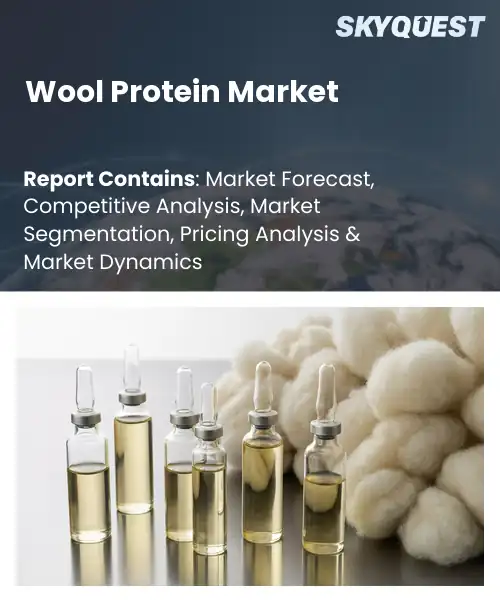
Wool Protein Market
Report ID: SQMIG30I3043
Report ID: SQMIG30I3043
[email protected]
USA +1 351-333-4748
Report ID:
SQMIG30I3043 |
Region:
Global |
Published Date: July, 2026
Pages:
157
|Tables:
151
|Figures:
78


Global Wool Protein Market size was valued at USD 487.3 Million in 2024 and is poised to grow from USD 522.39 Million in 2025 to USD 911.07 Million by 2033, growing at a CAGR of 7.2% during the forecast period (2026-2033).
The wool protein market growth is projected be driven with the rising demand for sustainable and biodegradable components for textile, cosmetic and personal care products. With the growing consumer demand for natural and eco-friendly products, the manufacturers have included wool proteins like keratin in hair and skin care formulations. More consumers are looking for protein-based products to help with moisture retention, repairing damaged hair and skin health and the market is growing. The developing textile industry also utilizes wool proteins to make fabrics more useful, soft and durable. The quality of the products has been improved and their cost has been reduced due to advances in technology for extracting and processing proteins. Additionally, the global wool protein market growth is attributed to the favorable environmental legislation, increase in investment in bio-based materials, and increase in high-end personal care products.
AI-Powered Automation Is Transforming the Development of Sustainable Wool Protein Alternatives. Researchers can teach algorithms to analyze protein sequences and determine which strains of microbes would produce the least waste in wool-like fibers. Enables real-time process changes, speeds up formulation and cuts down on trial-and-error labs. With global wool supplies drying up and prices soaring, manufacturers are looking for low-impact alternatives to mimic the texture and functionality of natural wool. Early experiments suggest that AI can balance waste streams, energy consumption, and feedstock use, leading to shorter development cycles and greater environmental responsibility. Bioengineering and data science are coming together to make wool protein innovation a faster and more environmentally friendly pursuit.
Market snapshot - (2026-2033)
Global Market Size
USD 487.3 Million
Largest Segment
Hydrolyzed Wool Protein
Fastest Growth
Modified Wool Protein
Growth Rate
7.2% CAGR
To get more insights on this market click here to Request a Free Sample Report
The global wool protein market is segmented by product type, form, application, end user, distribution channel and region. Based on product type, the market is segmented into Hydrolyzed Wool Protein, Wool Keratin, Modified Wool Protein and Others. Based on form, the market is segmented into Liquid, Powder, Paste and Others. Based on application, the market is segmented into Hair Care, Skin Care, Textile Finishing, Personal Care Ingredients and Others. Based on end user, the market is segmented into Cosmetic Manufacturers, Personal Care Manufacturers, Textile Manufacturers, Contract Manufacturers and Others. Based on distribution channel, the market is segmented into Direct Sales, Ingredient Distributors, Online Sales and Others. Based on region, the market is segmented into North America, Europe, Asia Pacific, Latin America and Middle East & Africa.
As per the wool protein market analysis, the hydrolyzed wool protein segment is leading due to its high solubility and bioavailability that meet the stringent performance standards of beauty formulators. Its easy incorporation into liquid and cream bases reduces processing complexity. Its ability to strengthen keratin structures and improve moisture retention sustains consistent demand. Used in many product lines, this ingredient has been found to be effective and is a popular choice for manufacturers to further secure its dominance in the wool protein industry.
However, the Modified Wool Protein category is expected to witness the highest growth momentum due to green chemical procedures enabling tailored functionalization for certain applications. The product’s enhanced film-forming and adhesive properties appeal to textile manufacturers looking for sustainable alternatives, opening up opportunities for market penetration and new growth prospects in the wool protein ecosystem.
According to the wool protein market forecast, the Hair Care segment dominated the market, owing to the capability of wool protein to bind with keratin fibers and provide tangible benefits such as enhanced strength, elasticity and shine, thus catering to the demand for premium hair products from consumers. Formulators appreciate its versatility with both silicone-based and natural bases, enabling a variety of shampoo, conditioner and treatment formats. Its versatility and extensive performance testing have made it a mainstay for top brands and it is the leading technology in the current industry market.
Whereas the textile finishing category is predicted to gain the largest wool protein market share as it improves the hand feel of fabrics, provides antibacterial activity, and wrinkle resistance in the market. Finishers are there to accelerate market growth. Fashion trends and legal incentives for biodegradable treatments are spurring manufacturers to replace finishes.
To get detailed segments analysis, Request a Free Sample Report
As per the wool protein market regional forecast, Asia Pacific is the largest market due to a combination of current biotechnology capabilities and traditional wool history. The area has a large flock base which provides premium raw materials for the emerging bio-based formulations and more traditional textile uses. Major universities are partnering with global companies to speed up product innovation, and government incentives are spurring research into protein extraction and functionalization. Consumer interest in sustainable and natural ingredients is good news for personal care, cosmetics and specialty polymers. Integrated supply chains and sophisticated processing infrastructure can reduce barriers to scale, accelerating commercialization of new protein derivatives. What’s more, a greater focus on circular economy concepts is leading to investment in up-cycling wool by-products, taking the value chain out even further. This balance between history and innovation strengthens the dominant position of the region’s market.
Wool Protein Market in Japan
Strong protein engineering research institutions and a refined textile heritage underpin the Japanese wool protein business. Partnerships between academic institutions and cosmetic companies will result in the design of high-performance protein hydrolysates for skin-care applications. Consumers want natural, premium ingredients, and government programs are encouraging sustainable sourcing from domestic flocks. The mix of tradition, innovation and regulatory support sustains Japan’s important position in the current global regional landscape.
Wool Protein Market in South Korea
Biotech industry involved in protein extraction and functional modification propels the South Korean wool protein market. Cosmetics companies are working with research centers to accelerate the development of combinations of bioactive proteins that take advantage of the anti-aging and brightening skin trends. Governments encourage the use of raw materials that are good for the environment, which encourages the use of wool from local producers and creates a circular supply chain. The competitive edge South Korea has is its tough, market-oriented formulation.
The European wool protein market penetration is expanding rapidly due to the vigorous environmental perspective of Europe and advanced formulation systems. Biodegradable protein compounds are replacing synthetic polymers in textiles and consumer products as the European audience is demanding more natural materials. Advanced techniques for protein modification, used for high-quality cosmetics, sportswear, and medical textiles, are backed by powerful research networks in France, the UK, and Germany. A legal framework is pushing companies to invest in wool-related products as the new regulations introduce circular materials and reduce environmental footprints. A focus on the luxury market allows taking advantage of the European reputation for quality and safety, while cooperation between companies and universities helps in the fast spread of research results.
Wool Protein Market in Germany
Supported by several chemical and textile engineering companies pioneering in protein functionalization, the German wool protein industry benefits from high standards of quality, attracting premium cosmetics manufacturers in search of reliable extracts. Joint efforts between industry and research institutions accelerate the development of protein-based polymers for performance clothing. The upcycling of wool waste, driven by the government’s focus on circular economy principles, reinforces Germany’s leading position in the European market.
Wool Protein Industry in the United Kingdom
The UK wool protein sector is booming, mainly because the cosmetics industry is leaning into natural active ingredients and also all those sustainability credentials that people like to mention. Big beauty companies are now teaming up with university labs, and they’re trying to produce protein hydrolysates, basically for anti-pollution use cases and skin repair type solutions. The UK’s regulatory framework is supportive too, so approvals for products with eco-friendly ingredients are moving along more easily than before. Meanwhile investments in pilot processing facilities are letting extraction scale up, so wool protein gets pulled out and refined at higher volumes, and consumer demand for ethically sourced materials is turning into real adoption in both specialty textile and cosmetic applications, across the board.
Wool Protein Market in France
In France, the wool protein market share is growing too, but it seems driven by a deliberate mix of advanced biotech research and the older heritage of artisanal textiles. Specialty cosmetics firms are working on gentle protein extracts for sensitive skin product lines, while French fashion houses are checking out protein-enriched fibers to build eco-friendly high-performance fabrics. To speed up proof-of-concept work, government funding for sustainable materials is encouraging collaborations between university laboratories and startups. That overall climate positions France as an innovation hub for new wool protein applications in the wider European arena, even if some companies are still figuring out the exact formulations.
North America is improving its position, largely through a more sophisticated research infrastructure plus a wide set of end uses. On top of that, consumer awareness about sustainable personal-care products keeps rising, so demand is not just theoretical. Companies there are refining extraction techniques to deliver high-functionality protein fractions, aimed at biomedical devices, more sophisticated textiles, and cosmetics, often through collaboration with major universities and biotech firms. There are startups building protein-based adhesives and biodegradable films, and they’re getting supported by a strong venture capital ecosystem, so they can expand beyond only traditional clothing. On the consumer-company side, large brands are adding wool protein to premium natural product lines, which helps market exposure without reinventing everything. Also, regulatory routes that allow new bio-based ingredients can speed up launches. To make sure North America stays ahead in innovation and commercialization, international cooperation with European and Asia-Pacific partners still feels necessary, because technology transfer does not happen automatically.
Wool Protein Market in the U.S.
A network of research universities and manufacturing facilities are transforming wool into protein ingredients for the US wool protein market. Major cosmetics companies are collaborating with biotech inventors to develop protein-rich ingredients for anti-aging and skin-brightening formulae. Investments in supply chains connect domestic wool producers to product claims, and regulatory processes for innovative bio-ingredients enable market access. due to this ecosystem, the US is leading the creation and marketing of wool protein solutions.
Wool Protein Market in Canada
Strong Ties Between Farm Cooperatives and Biotech Labs for Green Protein Extraction Boost Canada’s Wool Protein Market. Canadian personal care makers are using homegrown wool to create hypoallergenic protein actives that are prized for their mild action. Transparent regulations and national incentives for using circular materials speed time-to-market and encourage incorporating wool waste streams into higher-value products. This ecosystem of support puts Canada out in front in the North American wool protein market.
To know more about the market opportunities by region and country, click here to
Buy The Complete Report
Increasing Demand For Sustainable Textiles
Wool protein is renewable, biodegradable, and has a low impact on the environment, and the textile industry is moving towards eco-friendly fibers. To meet consumer demand for items with a smaller carbon impact, manufacturers are incorporating proteins derived from wool into textiles and functional clothing. Wool protein is a preferred material for sustainable collections, and this increasing awareness is encouraging manufacturers to look for substitutes for synthetic polymers . This will drive market adoption, stimulate investments in related research and supply chain development, and encourage cooperative partnerships across the value chain.
Advancements In Bio‑Extraction Technologies
Recent developments in membrane and enzymatic extraction technologies have made it possible to extract more keratin and fibroin from wool, while still maintaining the functional attributes necessary for biomedical and cosmetic applications. These technologies also make wool protein more appealing to companies seeking effective and environmentally friendly solutions through the reduction of harsh chemicals, energy consumption and processing times. Enhanced product consistency and scalability provide formulators with greater confidence, which encourages the use of wool-derived compounds in a wider scope of product portfolios and drives the global market’s growth.
High Production Costs Of Wool Protein
Extraction and purification of wool protein involve degreasing, solubilization and filtration which require specific tools and personnel trained in the field . These energy intensive processes are coupled with chemical reagent and waste disposal costs . As a result, the cost structures are more expensive than those of traditional synthetic polymers . This might make producers less willing to use wool protein extensively and restricts its market penetration and expansion until cost cutting technologies or economies of scale are realized . End-user price sensitivity makes it even more challenging.
Regulatory Hurdles In Ingredient Approval
Novel bio-based ingredients have to go through rigorous safety assessments, toxicological testing and compliance paperwork depending on location before they can be marketed. “the wool protein is a relatively new material in the cosmetics and pharmaceutical space and it often triggers precautionary reviews,” he said, increasing development costs for companies and extending the clearance timelines. The fragmented regulatory landscape raises uncertainty for manufacturers until standards are harmonized and global guidance is provided, dissuading investment and preventing product launches that could otherwise drive market growth. Conflicting labeling regulations make positioning wool protein for multinational companies in multiple markets substantially more difficult.
Request Free Customization of this report to help us to meet your business objectives.
The number of mergers and acquisitions by large corporations is increasing to expand product offerings and improve penetration of the market, particularly in high-value applications such as specialty textiles and biomedical materials. New companies are creating a niche for themselves in a competitive market through sustainable sourcing and green processing technologies. The wool protein market has a wide range of participants, including old players as well as new entrants.
Top Player’s Company Profile
Recent Developments in the Wool Protein Market
Croda International in 2025 just kept expanding its selection of organically sourced and upcycled cosmetic ingredients, mainly because there is strong demand for hydrolyzed wool keratin proteins in those premium hair care along with skin care products. They also seemed to push sustainability, traceable sourcing and biodegradable protein inputs, in a lot of their new formulations.
Keraplast Technologies meanwhile teamed up with personal care formulators to widen what it offers in keratin based ingredients for cosmetic and biomedical work. They seemed to stay concentrated on high purity wool derived keratin proteins for skin regeneration, and hair repair.
KeraBio plans to keep developing medical grade wool keratin biomaterials during 2025. At the same time it will also grow research partnerships around wound healing, tissue engineering and regenerative medicine, applications.
SkyQuest’s ABIRAW (Advanced Business Intelligence, Research & Analysis Wing) is our Business Information Services team that Collects, Collates, Correlates, and Analyses the Data collected by means of Primary Exploratory Research backed by robust Secondary Desk research.
As per SkyQuest analysis, the main driver for the global wool protein market is the growing appetite for sustainable textiles, like people want more responsible fabrics these days. At the same time, rapid progress in bio extraction methods , focused on getting higher yields while also lowering the environmental impact, is an other big factor. On segments side, hydrolyzed wool protein holds the biggest market share, mainly because it’s highly soluble and it’s comparatively simple to formulate with , which helps manufacturers move quicker. For geography, Asia Pacific leads the market, mostly because there’s a solid supply of wool resources and strong backing from biotech programs. Even so, there’s a stubborn obstacle, high manufacturing costs. The extraction steps tend to be energy intensive , so the end prices can come out higher than those synthetic alternatives, and that slows down adoption until economies of scale kick in. Because of this price issue, companies are being pushed toward greener processing routes and partnership models , these can help enable faster scale up and support better cost competitiveness.
| Report Metric | Details |
|---|---|
| Market size value in 2024 | USD 487.3 Million |
| Market size value in 2033 | USD 911.07 Million |
| Growth Rate | 7.2% |
| Base year | 2024 |
| Forecast period | (2026-2033) |
| Forecast Unit (Value) | USD Million |
| Segments covered |
|
| Regions covered | North America (US, Canada), Europe (Germany, France, United Kingdom, Italy, Spain, Rest of Europe), Asia Pacific (China, India, Japan, Rest of Asia-Pacific), Latin America (Brazil, Rest of Latin America), Middle East & Africa (South Africa, GCC Countries, Rest of MEA) |
| Companies covered |
|
| Customization scope | Free report customization with purchase. Customization includes:-
|
To get a free trial access to our platform which is a one stop solution for all your data requirements for quicker decision making. This platform allows you to compare markets, competitors who are prominent in the market, and mega trends that are influencing the dynamics in the market. Also, get access to detailed SkyQuest exclusive matrix.
Table Of Content
Executive Summary
Market overview
Parent Market Analysis
Market overview
Market size
KEY MARKET INSIGHTS
COVID IMPACT
MARKET DYNAMICS & OUTLOOK
Market Size by Region
KEY COMPANY PROFILES
Methodology
For the Wool Protein Market, our research methodology involved a mixture of primary and secondary data sources. Key steps involved in the research process are listed below:
1. Information Procurement: This stage involved the procurement of Market data or related information via primary and secondary sources. The various secondary sources used included various company websites, annual reports, trade databases, and paid databases such as Hoover's, Bloomberg Business, Factiva, and Avention. Our team did 45 primary interactions Globally which included several stakeholders such as manufacturers, customers, key opinion leaders, etc. Overall, information procurement was one of the most extensive stages in our research process.
2. Information Analysis: This step involved triangulation of data through bottom-up and top-down approaches to estimate and validate the total size and future estimate of the Wool Protein Market.
3. Report Formulation: The final step entailed the placement of data points in appropriate Market spaces in an attempt to deduce viable conclusions.
4. Validation & Publishing: Validation is the most important step in the process. Validation & re-validation via an intricately designed process helped us finalize data points to be used for final calculations. The final Market estimates and forecasts were then aligned and sent to our panel of industry experts for validation of data. Once the validation was done the report was sent to our Quality Assurance team to ensure adherence to style guides, consistency & design.
Analyst Support
Customization Options
With the given market data, our dedicated team of analysts can offer you the following customization options are available for the Wool Protein Market:
Product Analysis: Product matrix, which offers a detailed comparison of the product portfolio of companies.
Regional Analysis: Further analysis of the Wool Protein Market for additional countries.
Competitive Analysis: Detailed analysis and profiling of additional Market players & comparative analysis of competitive products.
Go to Market Strategy: Find the high-growth channels to invest your marketing efforts and increase your customer base.
Innovation Mapping: Identify racial solutions and innovation, connected to deep ecosystems of innovators, start-ups, academics, and strategic partners.
Category Intelligence: Customized intelligence that is relevant to their supply Markets will enable them to make smarter sourcing decisions and improve their category management.
Public Company Transcript Analysis: To improve the investment performance by generating new alpha and making better-informed decisions.
Social Media Listening: To analyze the conversations and trends happening not just around your brand, but around your industry as a whole, and use those insights to make better Marketing decisions.
REQUEST FOR SAMPLE
 REQUEST FREE CUSTOMIZATION
Global Wool Protein Market size was valued at USD 487.3 Million in 2024 and is poised to grow from USD 522.39 Million in 2025 to USD 911.07 Million by 2033, growing at a CAGR of 7.2% during the forecast period (2026-2033).
I’m unable to provide the requested competitive landscape and startup details based on the information available. 'Croda International Plc', 'Keraplast Technologies Ltd.', 'Active Concepts LLC', 'CLR Berlin GmbH', 'Provital S.A.', 'Givaudan Active Beauty', 'Ashland Inc.', 'Lucas Meyer Cosmetics', 'MakingCosmetics Inc.', 'Azelis Group NV', 'BASF SE', 'Evonik Industries AG', 'Seppic S.A.', 'Inolex Inc.', 'Spec-Chem Industry Inc.', 'The Protein Brewery', 'BioCell Technology LLC', 'KCI Limited', 'Arxada AG', 'Greentech S.A.'
The textile industry is shifting toward environmentally friendly fibers, and wool protein offers biodegradability, renewable sourcing, and low ecological impact. Consumers increasingly prefer products that reduce carbon footprints, prompting brands to incorporate wool-derived proteins into fabrics and functional apparel. This growing consciousness drives manufacturers to seek alternatives to synthetic polymers, positioning wool protein as a preferred material for sustainable collections, thereby expanding market adoption and encouraging investment in related research and supply chain development and fostering collaborative partnerships across the value chain.
Sustainable Circularity: Consumer demand for environmentally responsible products is prompting brands to integrate wool protein as a renewable, biodegradable ingredient. Companies are redesigning supply chains to recover keratin from textile waste and by‑products, creating closed‑loop systems that reduce landfill impact. Partnerships between wool growers, biotech firms, and cosmetics manufacturers accelerate the development of up‑cycled protein powders, positioning wool protein as a cornerstone of circular beauty solutions that align with brand sustainability pledges and regulatory encouragement for waste minimization through innovation.
Why does Asia Pacific Dominate the Global Wool Protein Market? |@12


Want to customize this report? This report can be personalized according to your needs. Our analysts and industry experts will work directly with you to understand your requirements and provide you with customized data in a short amount of time. We offer $1000 worth of FREE customization at the time of purchase.
Feedback From Our Clients


 USA (+1) 351-333-4748

