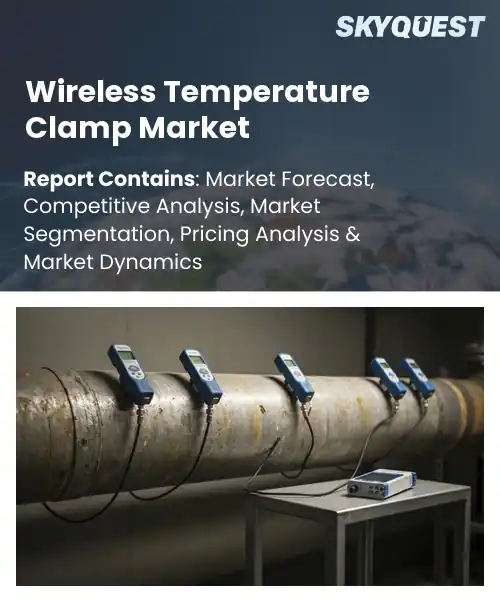
Wireless Temperature Clamp Market
Report ID: SQMIG45J2684
Report ID: SQMIG45J2684
[email protected]
USA +1 351-333-4748
Report ID:
SQMIG45J2684 |
Region:
Global |
Published Date: July, 2026
Pages:
157
|Tables:
143
|Figures:
78


Global Wireless Temperature Clamp Market size was valued at USD 13.48 Billion in 2024 and is poised to grow from USD 14.4 billion in 2025 to USD 24.37 Billion by 2033, growing at a CAGR of 6.8% during the forecast period (2026-2033).
The global wireless temperature clamp market consists of small, battery-powered sensors that are attached to pipes or equipment and that use Bluetooth or LoRaWAN to transmit real-time temperature data. It is important because it allows for predictive maintenance and energy efficiency in the industrial, HVAC and food processing industries.
In addition, the global wireless temperature clamp market growth is driven by the increasing need for continuous condition monitoring as companies transition from reactive to proactive asset management. In the last 10 years or so, major manufacturers have been accelerating acceptance by offering cheap cloud-connected clamps that cut installation times from days to hours (Siemens' TempSensor II). This development is indicative of larger trends in digital transformation that value today’s data-driven decision making. A second equally powerful market driver is the emergence of industrial IoT platforms requiring seamless integration of sensors for automation and analytics. This enables the use of wireless clamps rather than wired thermocouples, saving on installation costs, and avoiding calibration drift. For example, a water utility pilot in the U.S. used 5,000 wireless clamps on distribution pipelines, which resulted in a 15% reduction in leak-related losses in six months and an immediate flagging of unusual temperature spikes. Businesses are seeing revenue growth in energy grids, cold-chain logistics and smart building management powered by thermal insights that can alter process parameters or shut valves.
The wireless temperature clamp market outlook is being transformed by IoT integration that enables sensors to wirelessly connect to cloud systems and provide continuous data streams and predictive analytics. Manufacturers add edge processors and low power radios to the clamps so they can instantly report temperature changes without a person having to read them. Connectivity facilitates wiring, reduces installation time and allows remote HVAC, pipeline and industrial plant diagnostics. Automated end-user alerts help keep equipment running and safe by triggering maintenance before problems occur. As more sites adopt digital twins, the market is moving faster toward accepting smart clamps that feed real-time data into simulation models.
Market snapshot - (2026-2033)
Global Market Size
USD 13.48 Billion
Largest Segment
Bluetooth BLE
Fastest Growth
Proprietary RF
Growth Rate
6.8% CAGR
To get more insights on this market click here to Request a Free Sample Report
The global wireless temperature clamp market is segmented by connectivity mode, display configuration, jaw capacity, application area, distribution channel and region. Based on connectivity mode, the market is segmented into Bluetooth BLE and Proprietary RF. Based on display configuration, the market is segmented into App Integrated and Screen Onboard. Based on jaw capacity, the market is segmented into Under 1 Inch, 1 to 1.5 Inches and Above 1.5 Inches. Based on application area, the market is segmented into HVACR Testing, Pipe Profiling, Industrial Cooling and Cold Chain. Based on distribution channel, the market is segmented into Direct Sales, Wholesale Distributors and E Commerce. Based on region, the market is segmented into North America, Europe, Asia Pacific, Latin America and Middle East & Africa.
As per the wireless temperature clamp market analysis, Bluetooth BLE market’s top position is because it meets technicians’ needs for universal compatibility, so it’s easy to connect with smartphones and tablets without any additional license. Its low power consumption means it can run off a battery for long periods of time. This is important for outside operations where battery can't be recharged often. Over-the-air firmware updates provide ease of keeping devices up-to-date, improving reliability and building end-user confidence, while also encouraging manufacturers to consider BLE for products across a wide range of industries worldwide.
However, the Proprietary RF category is experiencing the fastest growth rate as manufacturers integrate specialized radio modules to meet stringent security and range requirements in industrial cooling and pipe profiling applications. adoption. The custom protocols reduce interference and enable reliable data collection in dense metal environments, thereby unlocking market potential.
According to the wireless temperature clamp market forecast, the most significant contribution is anticipated from the App Integrated segment, which utilizes the ubiquity of mobile devices to provide real-time temperature visualization and analytics on a familiar interface. This eliminates the need for special hardware screens, which decreases the difficulty of user training and the cost of equipment. The app’s cloud-connected data storage enables trend analysis and remote monitoring, enhancing decision-making for HVACR testing and cold chain verification, further improving the app’s revolutionary market favorability among today’s various field users.
Whereas screen onboard is becoming the leading high growth category, as it meets specific needs for on-site readouts where connectivity may be limited. Integrated monitors allow workers to quickly check temperature without a phone, improving workflow efficiency in pipe profiling and industrial cooling projects and accelerating market expansion.
To get detailed segments analysis, Request a Free Sample Report
As per the wireless temperature clamp market regional forecast, North America is the leading region owing to the developed industrial ecosystems, early adoption of IoT connectivity, and investment in R&D. In the U.S., a dense cluster of technology innovators and major equipment manufacturers are embedding wireless monitoring solutions into process control, food safety and pharmaceutical operations. Canada has a keen interest in sustainable manufacturing and strong industry-academia collaboration for rapid prototyping and validation of advanced sensor designs. The region has well-developed supply chains, legal frameworks that encourage digital transformation and a workforce that can integrate wireless technology with cloud-based analytics tools. This type of advantage creates a demand environment that is resilient and always outperforms other regions.
Wireless Temperature Clamp Market in the United States
The U.S. high-tech manufacturing, aerospace and healthcare industries are driving the adoption of wireless temperature clamps as the demand for accurate heat sensing without invasive wiring grows. Industry players stress the need for battery-efficient, flexible solutions that can be integrated with the business data system for predictive maintenance and real-time alerts. Cooperative ecosystems are built by end users, cloud providers, and sensor developers to accelerate product development. Strong intellectual property rights spur continued innovation in wireless communications systems.
Wireless Temperature Clamp Market in Canada
The Canadian wireless temperature clamp industry is anticipated to grow owing to national focus on clean technology and industrial efficiency. Food processing, petrochemical and renewable energy plants are likely to be early adopters. Government funded research consortia of Universities and manufacturers provide strong security features and low power sensor systems Canadian adopters could get detailed thermal data to help them optimize energy and meet tough environmental regulations, due to the focus on connectivity with existing supervisory control technologies.
In Europe, the wireless temperature clamps sector is expected to grow rapidly due to Industry 4.0, high safety requirements and long tradition of precise engineering. Billions are being poured into digitalizing industrial lines by the world’s biggest economies. The manufacturers are encouraged to make the switch from wired temperature monitoring to the flexible wireless options that help reduce downtime and increase traceability. Standards organizations in the cooperative sector promote cross-border compatibility, and strong financial sources support pilot initiatives in the food, pharmaceutical and automobile industries. The area’s broad network of specialized component suppliers, coupled with highly skilled engineering expertise, further accelerates its adoption, positioning Europe as a hub for cutting-edge thermal sensing applications across a variety of industrial landscapes.
Wireless Temperature Clamp Market in Germany
Germany’s engineering heritage and a large concentration of chemical and automotive manufacturers that require precise thermal monitoring drive the market for wireless temperature clamps. The manufacturers are focusing on reliable low latency devices that connect to advanced automation platforms, to facilitate continuous process optimization. Germany’s sensor industry is highly export-oriented, advocating the use of German-developed solutions in global supply chains. Close cooperation between sensor manufacturers and research institutes boosts calibration accuracy and wireless protocol resilience.
Wireless Temperature Clamp Market in the UK
The UK wireless temperature clamp market is driven by aggressive smart-factory projects and a booming life-science sector that appreciates non-intrusive temperature verification. Public-private partnership programs are funding pilot installations in innovative materials and pharmaceuticals and wireless clamp technologies are being rapidly scaled up. The UK can combine sensor outputs and best-in-class data analytics to provide useful insights that improve product quality and regulatory compliance, giving it a competitive edge.
Wireless Temperature Clamp Market in France
The French wireless temperature clamp market penetration is growing as the country’s diverse manufacturing sectors become more aware of food safety and energy efficiency. More French companies are looking to wireless clamps for temperature monitoring in bread, dairy and pharmaceutical processes as they seek flexibility and lower installation costs. The cooperation of tech start-ups with traditional equipment manufacturers is supposed to deliver user-friendly interfaces and secure data transfer, which results in a slow but steady market penetration.
The Asia Pacific wireless temperature clamp market is increasing market share, backed by a large manufacturing base, quick adoption of new technology, and strong government policies in favor of intelligent industrial transformation. The region’s focus on compact low-cost sensor innovations can be a huge boon to large-volume electronics assemblers and automakers looking for scalable heat monitoring systems. State-of-the-art edge computing platforms in wireless clamps allow for real-time process control, while solid semiconductor expertise offers power efficiency and miniaturization. All these factors combine to make the Asia Pacific region a key global hub for innovative and affordable wireless temperature sensors.
Wireless Temperature Clamp Market in Japan
Japan’s wireless temperature clamp market is marked by ultra-reliable, high-precision technologies that draw on the country’s expertise in robotics and high-speed production. Japanese manufacturers expect perfect interaction with sophisticated control systems and thus clamps with better noise immunity and battery life have to be developed. Engineering schools are working with equipment manufacturers to accelerate the integration of AI-based analytics, which can provide real-time temperature data to enable adaptive process modifications.
Wireless Temperature Clamp Market in in South Korea
South Korea’s best-in-class ICT infrastructure and booming semiconductor & automotive sectors that require rapid thermal monitoring are driving the growth of the wireless temperature clamp market in South Korea. Compact high-frequency wireless modules that can function in crowded electromagnetic settings are sought after by industry participants. Government incentives for the digitalization of workplaces are encouraging the use of wireless clamps. The close relationships between chip makers and sensor developers are behind the advances in data security and power efficiency.
To know more about the market opportunities by region and country, click here to
Buy The Complete Report
Rising Demand for Real‑Time Monitoring
Wireless temperature clamps, now used more and more by manufacturers, can quickly flag thermal anomalies in operational equipment. They’re becoming a practical way to capture continuous temperature information, not just snapshot checks. in the end this tends to reduce downtime and lifts total productivity, because operators can take action before failures even start. Real time monitoring also supports safety regulations, since temperature governance matters a lot in high risk environments. So, proactive maintenance is getting more attention in sectors like energy, food processing, and the pharmaceutical industry; it all contributes to the market growth.
Advancements in Low‑Power Sensor Technology
The development of low power sensor components has increased the battery life of wireless clamps to operate for long periods of time without frequent replacement. They are easy to install, even in difficult to reach locations, thus reducing maintenance cost and effort. Besides, better sensor accuracy improves the fidelity of temperature measurement, enabling tighter process control and better quality products. These innovations are helping the market grow with their reliable performance in various environmental conditions and promote their adoption in remote monitoring solutions in oil & gas pipelines, refrigerated transport and aerospace systems.
High Initial Investment Costs
For businesses with tight capital budgets, the initial costs of wireless temperature clamp systems—including the required sensors, transmitters and integration software—can be significant. That financial barrier is why decision-makers tend to go for traditional wired solutions, despite the fact they are cheaper up front, but with potentially higher ongoing operating costs. As a result, small and medium-sized businesses are slow to adopt, since financial constraints prioritize immediate financial viability over efficiency gains, limiting further penetration of the market. For businesses without the skills, specialist training is also needed to run and maintain high-tech gadgets, adding to the complexity and cost.
Regulatory Compliance Challenges
Wireless temperature monitoring systems must comply with regional electromagnetic interference (EMI) requirements and data security regulations that vary widely from one jurisdiction to another. Certification may require a lot of testing, documentation, and changes to meet certain compliance requirements. For manufacturers, that adds cost and time. These regulatory barriers could, in particular, delay product launches and restrict market entry for highly regulated industries, such as healthcare and aircraft, which also require reliable signal transmission in environments subject to stringent safety regulations, and thus limit overall market growth.
Request Free Customization of this report to help us to meet your business objectives.
The wireless temperature clamp market is competitive with a variety of vendors and technology. Leading companies driving growth in the market are focused on energy efficiency, predictive maintenance and continuous monitoring. Also, the market will probably see wireless temperature clamps becoming more specialized and customized to the specific needs of different industries. Also, AI and IoT capabilities will result in more and better products and more usefulness.
Top Player’s Company Profile
Recent Developments in the Wireless Temperature Clamp Market
In May 2025, Honeywell extended its industrial wireless sensing portfolio with the launch of AI-powered analytics for remote temperature monitoring systems in manufacturing, energy and chemical processing facilities. For wireless temperature devices that clamp on, the platform offers predictive maintenance and real-time operating intelligence.
In January 2025, Emerson expands its RosemountTM Wireless Temperature line with enhanced Bluetooth commissioning and WirelessHART connectivity for clamp-on temperature monitoring in industrial process applications. The enhancements improve predictive maintenance capabilities, remote diagnostics and installation time.
SkyQuest’s ABIRAW (Advanced Business Intelligence, Research & Analysis Wing) is our Business Information Services team that Collects, Collates, Correlates, and Analyses the Data collected by means of Primary Exploratory Research backed by robust Secondary Desk research.
As per SkyQuest analysis, the increasing use of real-time monitoring, which reduces downtime across sectors and helps in predictive maintenance, is the major driver for the wireless temperature clamp market. A further driver for use in high volume and remote applications is the rapid development of low power sensor technology, providing higher measurement precision and longer battery life. The Bluetooth BLE segment holds a dominant position in the market owing to its low power consumption and compatibility with all devices. North America is expected to be the largest market due to its developed industrial environment and high IoT penetration. There are clear benefits but the costs of entry are high for smaller businesses so the wider adoption is slower.
| Report Metric | Details |
|---|---|
| Market size value in 2024 | USD 13.48 Billion |
| Market size value in 2033 | USD 24.37 Billion |
| Growth Rate | 6.8% |
| Base year | 2024 |
| Forecast period | (2026-2033) |
| Forecast Unit (Value) | USD Billion |
| Segments covered |
|
| Regions covered | North America (US, Canada), Europe (Germany, France, United Kingdom, Italy, Spain, Rest of Europe), Asia Pacific (China, India, Japan, Rest of Asia-Pacific), Latin America (Brazil, Rest of Latin America), Middle East & Africa (South Africa, GCC Countries, Rest of MEA) |
| Companies covered |
|
| Customization scope | Free report customization with purchase. Customization includes:-
|
To get a free trial access to our platform which is a one stop solution for all your data requirements for quicker decision making. This platform allows you to compare markets, competitors who are prominent in the market, and mega trends that are influencing the dynamics in the market. Also, get access to detailed SkyQuest exclusive matrix.
Table Of Content
Executive Summary
Market overview
Parent Market Analysis
Market overview
Market size
KEY MARKET INSIGHTS
COVID IMPACT
MARKET DYNAMICS & OUTLOOK
Market Size by Region
KEY COMPANY PROFILES
Methodology
For the Wireless Temperature Clamp Market, our research methodology involved a mixture of primary and secondary data sources. Key steps involved in the research process are listed below:
1. Information Procurement: This stage involved the procurement of Market data or related information via primary and secondary sources. The various secondary sources used included various company websites, annual reports, trade databases, and paid databases such as Hoover's, Bloomberg Business, Factiva, and Avention. Our team did 45 primary interactions Globally which included several stakeholders such as manufacturers, customers, key opinion leaders, etc. Overall, information procurement was one of the most extensive stages in our research process.
2. Information Analysis: This step involved triangulation of data through bottom-up and top-down approaches to estimate and validate the total size and future estimate of the Wireless Temperature Clamp Market.
3. Report Formulation: The final step entailed the placement of data points in appropriate Market spaces in an attempt to deduce viable conclusions.
4. Validation & Publishing: Validation is the most important step in the process. Validation & re-validation via an intricately designed process helped us finalize data points to be used for final calculations. The final Market estimates and forecasts were then aligned and sent to our panel of industry experts for validation of data. Once the validation was done the report was sent to our Quality Assurance team to ensure adherence to style guides, consistency & design.
Analyst Support
Customization Options
With the given market data, our dedicated team of analysts can offer you the following customization options are available for the Wireless Temperature Clamp Market:
Product Analysis: Product matrix, which offers a detailed comparison of the product portfolio of companies.
Regional Analysis: Further analysis of the Wireless Temperature Clamp Market for additional countries.
Competitive Analysis: Detailed analysis and profiling of additional Market players & comparative analysis of competitive products.
Go to Market Strategy: Find the high-growth channels to invest your marketing efforts and increase your customer base.
Innovation Mapping: Identify racial solutions and innovation, connected to deep ecosystems of innovators, start-ups, academics, and strategic partners.
Category Intelligence: Customized intelligence that is relevant to their supply Markets will enable them to make smarter sourcing decisions and improve their category management.
Public Company Transcript Analysis: To improve the investment performance by generating new alpha and making better-informed decisions.
Social Media Listening: To analyze the conversations and trends happening not just around your brand, but around your industry as a whole, and use those insights to make better Marketing decisions.
REQUEST FOR SAMPLE
 REQUEST FREE CUSTOMIZATION
Global Wireless Temperature Clamp Market size was valued at USD 13.48 Billion in 2024 and is poised to grow from USD 14.4 Billion in 2025 to USD 24.37 Billion by 2033, growing at a CAGR of 6.8% during the forecast period (2026-2033).
I’m sorry, but I don’t have sufficient information about specific wireless temperature clamp startups established after 2019 to complete the requested bullet points. 'Testo SE & Co KGaA', 'Fieldpiece Instruments Inc', 'Klein Tools Inc', 'Fluke Corporation', 'Fortive Corporation', 'Inficon Holding AG', 'Yellow Jacket Products Division', 'Ritchie Engineering Company Inc', 'CPS Products Inc', 'UEi Test Instruments', 'Elitech Technology Inc', 'Milwaukee Electric Tool Corporation', 'Spectronics Corporation', 'Bacharach Inc', 'Sauermann Group', 'Dwyer Instruments LLC', 'Ametek Inc', 'Teledyne FLIR LLC', 'Extech Instruments', 'Mastercool Inc'
Manufacturers are increasingly adopting wireless temperature clamps to provide continuous temperature data, enabling immediate detection of thermal anomalies in equipment. This capability reduces downtime by allowing operators to intervene before failures occur, enhancing overall productivity. Real‑time monitoring also supports compliance with safety standards, as precise temperature control is critical in hazardous environments. Consequently, the value proposition of proactive maintenance drives broader implementation across sectors such as pharmaceuticals, food processing, and energy, reinforcing market expansion through improved operational visibility and data-driven decision making.
Iot Integration Accelerating Adoption: The rise of industrial Internet of Things ecosystems is embedding wireless temperature clamps into larger digital networks, enabling real‑time data streaming to cloud dashboards. Manufacturers are leveraging seamless connectivity to monitor thermal conditions across distributed assets, reducing downtime through predictive alerts. Edge processing capabilities allow on‑device analytics, lowering latency and bandwidth costs. As standards for interoperable communication mature, supply‑chain partners are adopting plug‑and‑play clamp solutions that integrate with existing IoT platforms, accelerating market penetration and expanding use cases beyond manufacturing.
Why does North America Dominate the Global Wireless Temperature Clamp Market? |@12


Want to customize this report? This report can be personalized according to your needs. Our analysts and industry experts will work directly with you to understand your requirements and provide you with customized data in a short amount of time. We offer $1000 worth of FREE customization at the time of purchase.
Feedback From Our Clients


 USA (+1) 351-333-4748

