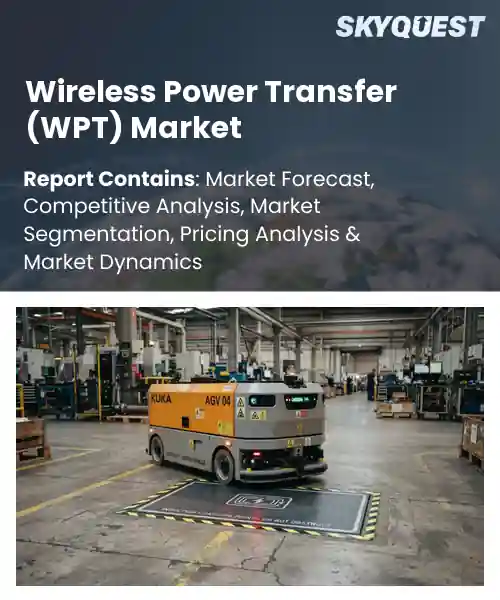
Wireless Power Transfer (WPT) Market
Report ID: SQMIG20D2865
Report ID: SQMIG20D2865
[email protected]
USA +1 351-333-4748
Report ID:
SQMIG20D2865 |
Region:
Global |
Published Date: August, 2026
Pages:
157
|Tables:
146
|Figures:
78


Global Wireless Power Transfer (Wpt) Market size was valued at USD 19.42 Billion in 2024 and is poised to grow from USD 23.65 Billion in 2025 to USD 114.58 Billion by 2033, growing at a CAGR of 21.8% during the forecast period (2026-2033).
Building on this foundation, the main growth catalyst for the global WPT market is the convergence of emissions regulations and the rapid rollout of electric‑mobility ecosystems, which push manufacturers toward seamless charging that cuts downtime and infrastructure costs. As fleets adopt wireless stations, vehicle uptime improves, encouraging broader consumer acceptance and prompting automakers to embed resonant coils in chassis. At same time, smart‑home appliances such as robot vacuums and kitchen gadgets use standardized Qi and emerging 6.78 MHz protocols to provide operation, creating revenue for OEMs. These examples show how pressure, standards, and demand together expand market size and foster partnerships.
How is AI integration shaping the wireless power transfer market?
AI is becoming the brain behind smarter wireless power ecosystems. It enables dynamic load forecasting, adaptive frequency tuning and real‑time safety monitoring, turning static chargers into responsive hubs. Machine‑learning models analyze usage patterns across devices, optimizing coil alignment and power routing without human intervention. Edge AI processors embedded in transmitters adjust field strength on the fly, reducing interference and extending range. These capabilities are attracting automotive and consumer‑electronics makers, who see AI‑enhanced WPT as a way to simplify user experience while meeting stringent efficiency standards. The result is a market that is not only growing in size but also evolving toward highly intelligent, self‑optimising power networks.In January 2026, WiTricity, introduced an AI‑driven coil‑optimization platform that automatically reshapes magnetic fields for each device, boosting transfer efficiency and supporting seamless integration across multiple product lines. This innovation illustrates how AI accelerates market adoption and operational excellence.
Market snapshot - (2026-2033)
Global Market Size
USD 19.42 Billion
Largest Segment
Inductive Coupling
Fastest Growth
Magnetic Resonance
Growth Rate
21.8% CAGR
To get more insights on this market click here to Request a Free Sample Report
Global wireless power transfer (wpt) market is segmented by technology, power range, application, transmission type, end user and region. Based on technology, the market is segmented into Inductive Coupling, Magnetic Resonance, Radio Frequency and Microwave. Based on power range, the market is segmented into Up to 10 W, 10–100 W, 101 W–1 kW and Above 1 kW. Based on application, the market is segmented into Consumer Electronics, Electric Vehicles, Industrial Equipment and Healthcare Devices. Based on transmission type, the market is segmented into Near-Field and Far-Field. Based on end user, the market is segmented into Consumer, Commercial and Industrial. Based on region, the market is segmented into North America, Europe, Asia Pacific, Latin America and Middle East & Africa.
Inductive Coupling segment dominates because it offers a simple, cost effective architecture that integrates easily with existing consumer device designs. The technology’s ability to transfer power over short distances without complex alignment mechanisms reduces manufacturing hurdles and enhances user convenience. Its mature ecosystem of standards and accessories further accelerates market acceptance, prompting device makers to embed inductive coils as default charging solutions across a broad product portfolio for everyday use applications.
Meanwhile, Magnetic Resonance segment is emerging as the key high growth area as it enables power transfer across modest gaps with greater spatial freedom. Advances in coil geometry and adaptive tuning are expanding its suitability for wearables and IoT devices, driving designers to explore resonant solutions that overcome the alignment constraints of inductive systems.
101 W–1 kW segment dominates because it aligns with the energy demands of heavy duty industrial machinery while maintaining manageable thermal profiles. The ability to deliver sufficient power without extensive cooling infrastructure encourages adoption in factories and processing plants. Engineers favor this range for its balance between efficiency and system complexity, leading OEMs to prioritize designs that operate within these limits. Consequently, supply chains and component standards coalesce around this power envelope.
Meanwhile, Above 1 kW segment is witnessing the strongest growth momentum as emerging high capacity manufacturing lines demand uninterrupted power for robotics and additive manufacturing tools. Innovations in resonant coupling and advanced thermal management are unlocking feasibility, prompting investors and developers to channel resources toward scaling solutions that exceed traditional limits.
To get detailed segments analysis, Request a Free Sample Report
Asia Pacific leads the global WPT market through a confluence of advanced research ecosystems, strong manufacturing capabilities, and aggressive adoption of emerging technologies. The region benefits from a deep pool of engineering talent and substantial investment in semiconductor and battery innovation, fostering rapid prototyping and scale‑up of wireless charging solutions. Collaborative initiatives between academia, industry consortia, and government programs accelerate standards development and commercial rollout. Consumer demand for seamless connectivity and a cultural emphasis on convenience further drive early market penetration, while the presence of global OEMs in the region ensures robust supply chains and continuous product refinement.
Japan Wireless Power Transfer (WPT) Market
Wireless Power Transfer (WPT) Market in Japan thrives on a tradition of precision engineering and a mature electronics supply base. The nation’s emphasis on high‑efficiency power conversion and safety standards fuels confidence among manufacturers and end‑users alike. Strategic partnerships between leading automotive firms and technology providers accelerate integration of wireless charging into electric mobility platforms, positioning Japan as a hub for innovative pilot projects and cross‑industry collaboration.
South Korea Wireless Power Transfer (WPT) Market
Wireless Power Transfer (WPT) Market in South Korea is propelled by a dynamic blend of strong ICT infrastructure and proactive governmental support for smart‑city initiatives. The country’s leadership in mobile communications and component miniaturization enables rapid integration of wireless power solutions into consumer electronics and public transport systems. Corporate investment in research centers focusing on resonant coupling and multi‑device charging reinforces South Korea’s reputation as a testing ground for cutting‑edge wireless power applications.
North America experiences swift expansion of the WPT market due to a consumer‑focused ecosystem that prioritizes convenience and technological leadership. The region’s robust venture capital environment fuels startups developing next‑generation charging platforms, while established technology firms leverage extensive patent portfolios to bring mature solutions to market. Strong demand from electric vehicle manufacturers for seamless charging experiences aligns with governmental incentives supporting clean transportation, further energizing the sector. Additionally, widespread adoption of smart home devices creates a fertile market for integrated wireless power solutions across residential and commercial settings.
United States Wireless Power Transfer (WPT) Market
Wireless Power Transfer (WPT) Market in the United States benefits from a vibrant innovation landscape and a large consumer base eager for frictionless charging experiences. Leadership in semiconductor design and high‑frequency components enables domestic firms to produce efficient wireless chargers at scale. Collaborative research initiatives among universities, national labs, and industry consortia accelerate standardization efforts, while major automotive players pursue integration of wireless charging into vehicle platforms, reinforcing market momentum.
Canada Wireless Power Transfer (WPT) Market
Wireless Power Transfer (WPT) Market in Canada leverages a strong emphasis on sustainable technologies and a collaborative research environment. The country’s focus on clean energy transitions encourages adoption of wireless charging in public transport and infrastructure projects. Partnerships between governmental agencies and technology firms foster test‑bed deployments in urban centers, highlighting the practicality of contactless power delivery for both consumer electronics and emerging mobility solutions.
Europe is strengthening its position in the WPT market by championing regulatory harmonization, fostering cross‑border research collaborations, and emphasizing sustainability in product design. Regional standards bodies work closely with industry players to ensure interoperability and safety, boosting confidence among manufacturers and consumers. Significant funding mechanisms support joint ventures between leading automotive firms and technology specialists, encouraging the rollout of wireless charging for electric vehicles across multiple markets. Moreover, a cultural shift toward environmentally responsible consumption drives demand for wireless power solutions that reduce reliance on conventional connectors and enhance user convenience.
Germany Wireless Power Transfer (WPT) Market
Wireless Power Transfer (WPT) Market in Germany draws on a reputation for engineering excellence and a strong automotive sector that actively explores wireless charging for electric mobility. The country’s extensive research institutions collaborate with manufacturers to refine resonant and inductive technologies, promoting reliable, high‑power solutions. Focus on energy efficiency and integration with renewable power sources strengthens Germany’s role as a leader in sustainable wireless power deployment.
United Kingdom Wireless Power Transfer (WPT) Market
Wireless Power Transfer (WPT) Market in the United Kingdom benefits from a dynamic startup ecosystem and a proactive approach to standard development. Collaborative hubs linking universities, government research funds, and industry accelerate prototype testing and commercial scaling of wireless charging for consumer devices and transport applications. Emphasis on user experience and regulatory alignment helps the United Kingdom position itself as a forward‑looking market for contactless power technologies.
France Wireless Power Transfer (WPT) Market
Wireless Power Transfer (WPT) Market in France is driven by a strategic focus on smart‑city initiatives and a commitment to reducing carbon emissions. Partnerships between urban planners and technology firms enable the deployment of wireless charging stations in public transport and municipal infrastructure. The French emphasis on design innovation and user‑centric solutions supports the broader European agenda of expanding wireless power accessibility across diverse sectors
To know more about the market opportunities by region and country, click here to
Buy The Complete Report
Rising Adoption Of IoT Devices
Expansion Of Smart Home Ecosystems
Regulatory Safety Compliance Challenges
High Cost Of Infrastructure Deployment
Request Free Customization of this report to help us to meet your business objectives.
The competitive landscape of the global Wireless Power Transfer market is shaped by rapid technology innovation, strategic partnerships, and aggressive financing, driving firms to secure market share through collaborations and acquisitions. Notable moves include Reach’s $30 million Series B to scale industrial‑scale power‑at‑a‑distance, Powerwave’s ¥910 million Series A to advance on‑the‑move transfer, and ORiS’s €4.5 million pre‑Seed to commercialize laser‑based transmission, reflecting intense rivalry and consolidation among semiconductor suppliers, system integrators, and emerging deep‑tech startups.
Top Player’s Company Profile
Recent Developments
SkyQuest’s ABIRAW (Advanced Business Intelligence, Research & Analysis Wing) is our Business Information Services team that Collects, Collates, Correlates, and Analyses the Data collected by means of Primary Exploratory Research backed by robust Secondary Desk research. As per SkyQuest analysis, the global WPT market is being propelled primarily by the rising adoption of IoT devices, which pushes manufacturers to embed wireless power modules for battery‑free operation. A second strong catalyst is the rapid expansion of smart‑home ecosystems, creating demand for seamless, cable‑free power in lighting, security and entertainment fixtures. The market’s leading region is Asia Pacific, benefiting from robust R&D, manufacturing capacity and early consumer uptake. Inductive coupling remains the dominant technology segment because of its low cost, mature standards and ease of integration into consumer electronics. However, stringent regulatory safety compliance poses a notable restraint, extending development cycles and increasing product costs.
| Report Metric | Details |
|---|---|
| Market size value in 2024 | USD 19.42 Billion |
| Market size value in 2033 | USD 114.58 Billion |
| Growth Rate | 21.8% |
| Base year | 2024 |
| Forecast period | (2026-2033) |
| Forecast Unit (Value) | USD Billion |
| Segments covered |
|
| Regions covered | North America (US, Canada), Europe (Germany, France, United Kingdom, Italy, Spain, Rest of Europe), Asia Pacific (China, India, Japan, Rest of Asia-Pacific), Latin America (Brazil, Rest of Latin America), Middle East & Africa (South Africa, GCC Countries, Rest of MEA) |
| Companies covered |
|
| Customization scope | Free report customization with purchase. Customization includes:-
|
To get a free trial access to our platform which is a one stop solution for all your data requirements for quicker decision making. This platform allows you to compare markets, competitors who are prominent in the market, and mega trends that are influencing the dynamics in the market. Also, get access to detailed SkyQuest exclusive matrix.
Table Of Content
Executive Summary
Market overview
Parent Market Analysis
Market overview
Market size
KEY MARKET INSIGHTS
COVID IMPACT
MARKET DYNAMICS & OUTLOOK
Market Size by Region
KEY COMPANY PROFILES
Methodology
For the Wireless Power Transfer (WPT) Market, our research methodology involved a mixture of primary and secondary data sources. Key steps involved in the research process are listed below:
1. Information Procurement: This stage involved the procurement of Market data or related information via primary and secondary sources. The various secondary sources used included various company websites, annual reports, trade databases, and paid databases such as Hoover's, Bloomberg Business, Factiva, and Avention. Our team did 45 primary interactions Globally which included several stakeholders such as manufacturers, customers, key opinion leaders, etc. Overall, information procurement was one of the most extensive stages in our research process.
2. Information Analysis: This step involved triangulation of data through bottom-up and top-down approaches to estimate and validate the total size and future estimate of the Wireless Power Transfer (WPT) Market.
3. Report Formulation: The final step entailed the placement of data points in appropriate Market spaces in an attempt to deduce viable conclusions.
4. Validation & Publishing: Validation is the most important step in the process. Validation & re-validation via an intricately designed process helped us finalize data points to be used for final calculations. The final Market estimates and forecasts were then aligned and sent to our panel of industry experts for validation of data. Once the validation was done the report was sent to our Quality Assurance team to ensure adherence to style guides, consistency & design.
Analyst Support
Customization Options
With the given market data, our dedicated team of analysts can offer you the following customization options are available for the Wireless Power Transfer (WPT) Market:
Product Analysis: Product matrix, which offers a detailed comparison of the product portfolio of companies.
Regional Analysis: Further analysis of the Wireless Power Transfer (WPT) Market for additional countries.
Competitive Analysis: Detailed analysis and profiling of additional Market players & comparative analysis of competitive products.
Go to Market Strategy: Find the high-growth channels to invest your marketing efforts and increase your customer base.
Innovation Mapping: Identify racial solutions and innovation, connected to deep ecosystems of innovators, start-ups, academics, and strategic partners.
Category Intelligence: Customized intelligence that is relevant to their supply Markets will enable them to make smarter sourcing decisions and improve their category management.
Public Company Transcript Analysis: To improve the investment performance by generating new alpha and making better-informed decisions.
Social Media Listening: To analyze the conversations and trends happening not just around your brand, but around your industry as a whole, and use those insights to make better Marketing decisions.
REQUEST FOR SAMPLE
 REQUEST FREE CUSTOMIZATION


Want to customize this report? This report can be personalized according to your needs. Our analysts and industry experts will work directly with you to understand your requirements and provide you with customized data in a short amount of time. We offer $1000 worth of FREE customization at the time of purchase.
Feedback From Our Clients


 USA (+1) 351-333-4748

