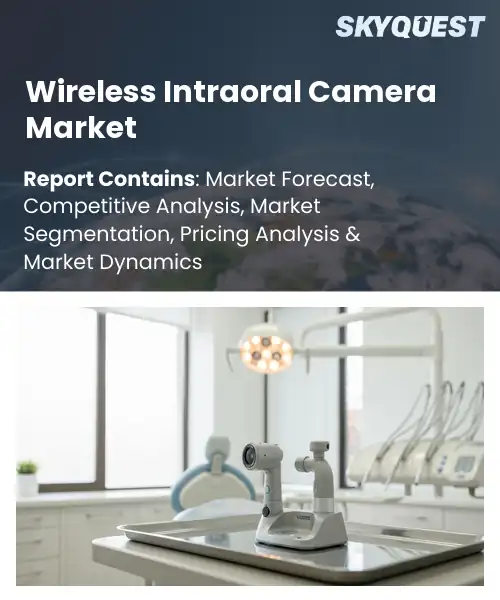
Wireless Intraoral Camera Market
Report ID: SQMIG35A4230
Report ID: SQMIG35A4230
[email protected]
USA +1 351-333-4748
Report ID:
SQMIG35A4230 |
Region:
Global |
Published Date: July, 2026
Pages:
157
|Tables:
174
|Figures:
79


Global Wireless Intraoral Camera Market size was valued at USD 281.5 Million in 2024 and is poised to grow from USD 308.81 Million in 2025 to USD 647.65 Million by 2033, growing at a CAGR of 9.7% during the forecast period (2026-2033).
Wireless intraoral cameras are battery devices that capture images of teeth and soft tissues and transmit them to a dentist’s monitor or a cloud platform. Their emergence matters because they enable diagnosis, improve patient communication, and streamline workflow in dental practices. The primary driver behind market formation has been the rapid digitization of dentistry, spurred by advances in miniaturized CMOS sensors, low‑energy Bluetooth modules, and record systems. Over the past decade, wired models gave way to cordless units such as the Suni and iTero PocketCam, which clinicians use to document procedures, educate patients, and integrate imaging data with CAD/CAM planning.
The key trend driving the global wireless intraoral camera sector growth is integration of wireless cameras with practice‑management platforms and artificial‑intelligence diagnostics, which turns captured visuals into treatment plans. As clinicians adopt cloud records, imaging accelerates case acceptance by letting patients see anomalies instantly, increasing procedure bookings. AI lesion detection shortens diagnostic time and supports tele‑dentistry, opening new revenue streams in rural clinics where specialist access is limited. Companies such as DentalZoom and MouthWatch have launched subscription models that bundle software analytics with hardware, showing how services convert hardware sales into recurring income and spur wider adoption across developed and emerging global markets today.
How is AI Improving Image Quality in the Wireless Intraoral Camera Market?
AI is elevating image quality in wireless intraoral cameras by applying real‑time noise reduction, color correction and edge enhancement directly on the sensor. Machine‑learning models learn from thousands of dental images, allowing the camera to automatically adjust exposure and focus for each patient’s mouth geometry. This results in clearer, more detailed visuals that help clinicians detect early lesions and streamline diagnosis. The technology also compresses high‑resolution frames without losing fidelity, enabling smooth wireless streaming to practice software. As dental offices adopt these smarter devices, workflow efficiency improves and patient confidence rises, driving broader market adoption.
In April 2026, UMGroupen launched an AI‑enhanced wireless intraoral camera, delivering sharper images that support faster examinations and reinforce market growth.
Market snapshot - (2026-2033)
Global Market Size
USD 281.5 Million
Largest Segment
Handheld Wireless Intraoral Cameras
Fastest Growth
Integrated Wireless Intraoral Camera Systems
Growth Rate
9.7% CAGR
To get more insights on this market click here to Request a Free Sample Report
Global wireless intraoral camera market is segmented by product type, technology, application, end user, connectivity, image resolution and region. Based on product type, the market is segmented into handheld wireless intraoral cameras, USB-connected wireless intraoral cameras and integrated wireless intraoral camera systems. Based on technology, the market is segmented into HD intraoral cameras, full HD intraoral cameras, AI-enabled intraoral cameras and autofocus intraoral cameras. Based on application, the market is segmented into dental diagnosis, patient education, treatment planning, cosmetic dentistry documentation and others. Based on end user, the market is segmented into dental clinics, hospitals and dental academic & research institutes. Based on connectivity, the market is segmented into Wi-Fi, bluetooth and proprietary wireless connectivity. Based on image resolution, the market is segmented into below 1 MP, 1–5 MP and above 5 MP. Based on region, the market is segmented into North America, Europe, Asia Pacific, Latin America and Middle East & Africa.
Based on the global wireless intraoral camera market growth, handheld wireless intraoral cameras segment dominates because clinicians prioritize ease of maneuverability and immediate image capture during examinations. The ergonomic design aligns with fast‑paced appointment schedules, allowing dentists to position the device without cords and reduce infection control steps. This practicality drives widespread adoption across practices, reinforcing its central role in routine diagnostics and patient communication, thereby cementing its market leadership.
However, integrated wireless intraoral camera systems are witnessing the strongest growth momentum as dental offices seek seamless data integration with electronic health records and treatment planning software. Their built in connectivity eliminates external devices, fostering streamlined workflows and richer clinical documentation, which accelerates adoption and expands market opportunities.
AI enabled intraoral cameras segment dominates because artificial intelligence augments diagnostic accuracy by automatically highlighting caries, periodontal lesions, and structural anomalies. This intelligent assistance reduces interpretation time and supports less experienced clinicians, increasing confidence in clinical decisions. The ability to generate real time analytics integrates smoothly with practice management systems, making AI driven devices essential for modern dental workflows and reinforcing their predominant market position.
Meanwhile, autofocus intraoral cameras are emerging as the key high growth area because they eliminate manual focusing, enhancing image sharpness across varied oral anatomies. This automation reduces procedure time and learning curve, attracting new adopters and driving integration into portable platforms, thereby accelerating market expansion and creating fresh opportunities for accessory and software ecosystems.
To get detailed segments analysis, Request a Free Sample Report
As per the global wireless intraoral camera market share, North America retains a clear lead in the industry due to a mature dental ecosystem, high adoption of digital workflow, and robust investment in research and development. Strong presence of leading manufacturers and technology innovators within the United States accelerates product refinement and integration with practice management software. Health care reimbursement frameworks encourage clinicians to incorporate advanced imaging tools, while extensive professional training programs facilitate rapid skill acquisition. Canada contributes a supportive regulatory environment and collaborative healthcare networks that reinforce market uptake. Together, these factors create a synergistic landscape where advanced image capture, data security, and seamless connectivity are prioritized, reinforcing the region’s position as a global benchmark for innovation and clinical excellence.
Wireless intraoral camera market in the United States benefits from close collaboration between dental schools, research institutes, and industry partners, fostering continuous innovation. Early adoption of cloud‑based imaging platforms and integration with electronic health records streamline clinical workflows. Practitioner enthusiasm for patient education tools drives demand, while a competitive supplier landscape ensures rapid introduction of feature‑rich devices. This environment sustains a high level of product sophistication and broad clinical acceptance.
Wireless intraoral camera market in Canada is shaped by a proactive healthcare policy that emphasizes preventive dentistry and patient‑centered care. Strong emphasis on data privacy and cross‑border interoperability encourages vendors to tailor solutions for local practice needs. Collaborative networks among provincial dental associations promote shared learning and standardized best practices. These dynamics, combined with a growing focus on minimally invasive diagnostics, nurture steady market expansion and encourage adoption of next‑generation imaging technologies.
Based on global wireless intraoral camera regional forecast, Europe experiences rapid expansion of the industry as a result of unified regulatory standards, widespread commitment to digital health transformation, and increasing patient demand for transparent care. Collaborative research initiatives across leading dental hubs stimulate innovation and accelerate product certification processes. Reimbursement incentives in several countries reward the use of advanced imaging for early detection, while strong academic curricula integrate wireless technologies into clinical training. Additionally, the emergence of interoperable platforms that link imaging data with broader oral health management systems enhances value proposition for practitioners. These converging forces create a fertile environment for market growth and position Europe as a hub of sophisticated, patient‑focused imaging solutions.
Wireless intraoral camera market in Germany is anchored by a dense network of precision engineering firms that prioritize reliability and high image quality. Close ties between manufacturers and university dental clinics foster rapid prototyping and rigorous testing. National health insurance schemes endorse the use of digital diagnostic tools, encouraging widespread clinician uptake. Emphasis on data security and compliance with stringent European privacy regulations further strengthens market confidence, driving sustained investment in next‑generation camera systems.
Wireless intraoral camera market in the United Kingdom is propelled by an accelerated adoption rate among private and NHS dental providers seeking to enhance patient engagement. Strong support from professional bodies promotes continuous education on digital imaging benefits. Innovation clusters in technology‑focused cities generate start‑ups that integrate artificial intelligence with imaging, creating differentiated solutions. The regulatory framework facilitates swift market entry, while patient expectations for visual explanations of treatment drive demand for intuitive, wireless devices.
Wireless intraoral camera market in France is emerging as a vibrant segment supported by governmental initiatives that champion digital health integration. Collaborative projects between research institutes and device manufacturers accelerate the development of user‑friendly imaging solutions. Dental education programs increasingly incorporate wireless camera training, preparing new graduates to adopt these tools. A growing awareness of aesthetic dentistry among consumers fuels interest in visual documentation, encouraging practitioners to incorporate wireless cameras into routine examinations.
As per global wireless intraoral camera regional outlook, Asia Pacific is strengthening its position in the industry through a combination of rapid technological adoption, expanding dental infrastructure, and a cultural emphasis on preventive oral care. Strong manufacturing capabilities in the region enable cost‑effective production of high‑performance devices, while rising middle‑class populations increase demand for sophisticated dental services. Government health programs that prioritize early detection encourage clinicians to integrate wireless imaging into routine practice. Collaborative ecosystems linking universities, tech firms, and dental clinics accelerate innovation, leading to features such as AI‑assisted diagnostics and seamless cloud connectivity. These dynamics collectively elevate the region’s influence and set a trajectory toward becoming a leading hub for both consumption and development of wireless intraoral imaging technologies.
Wireless intraoral camera market in Japan benefits from a long‑standing tradition of precision medical device engineering and a highly digitized healthcare system. Integration of imaging tools with national electronic health records promotes efficient data sharing and patient‑centered workflows. Professional societies actively disseminate best practices, fostering rapid clinician confidence in wireless solutions. Consumer expectations for high‑quality visual explanations encourage widespread adoption in both urban and suburban clinics. Combined with strong R&D investment from local manufacturers, these factors drive a sophisticated market environment where advanced imaging capabilities are standard.
Wireless intraoral camera market in South Korea is propelled by a tech‑savvy dental community and robust government support for digital health initiatives. Aggressive investment in artificial intelligence and 5G connectivity enables real‑time image transmission and enhanced diagnostic algorithms. Collaboration between leading electronics firms and dental equipment manufacturers results in compact, high‑resolution cameras tailored for modern practice needs. Educational programs emphasize early exposure to wireless imaging, creating a generation of clinicians comfortable with digital tools. This convergence of technology, policy, and education positions South Korea as a dynamic contributor to the region’s overall market momentum.
To know more about the market opportunities by region and country, click here to
Buy The Complete Report
Increasing Demand For Digital Imaging
Integration With CAD/CAM Solutions
High Initial Equipment Cost
Limited Reimbursement Policies
Request Free Customization of this report to help us to meet your business objectives.
The competitive landscape of the global wireless intraoral camera market outlook is shaped by rapid AI integration, aggressive venture funding, and cross‑border expansion, driving firms to outpace rivals through technology upgrades and strategic alliances; for example, Dentio leveraged Andreessen Horowitz backing to embed AI assistants in dental workflows, while Arcreal secured new capital to accelerate AI‑driven scanner development and enter U.S. and European markets.
Top Player’s Company Profile
Recent Developments
SkyQuest’s ABIRAW (Advanced Business Intelligence, Research & Analysis Wing) is our Business Information Services team that Collects, Collates, Correlates, and Analyses the Data collected by means of Primary Exploratory Research backed by robust Secondary Desk research.
As per SkyQuest analysis, the rapid demand for digital imaging is the key driver propelling the global wireless intraoral camera industry, while high initial equipment cost acts as the main restraint limiting adoption in smaller clinics. North America emerges as the dominating region thanks to its mature dental ecosystem and strong R&D base, and handheld wireless intraoral cameras remain the dominating segment because of their ergonomic convenience for daily diagnostics. A second driver is the integration of cameras with CAD/CAM and AI‑enabled platforms, which shortens treatment cycles and boosts clinical efficiency, further accelerating market growth. These trends suggest that vendors focusing on affordable, AI‑driven solutions will capture the expanding demand across both established and emerging markets.
| Report Metric | Details |
|---|---|
| Market size value in 2024 | USD 281.5 Million |
| Market size value in 2033 | USD 647.65 Million |
| Growth Rate | 9.7% |
| Base year | 2024 |
| Forecast period | (2026-2033) |
| Forecast Unit (Value) | USD Million |
| Segments covered |
|
| Regions covered | North America (US, Canada), Europe (Germany, France, United Kingdom, Italy, Spain, Rest of Europe), Asia Pacific (China, India, Japan, Rest of Asia-Pacific), Latin America (Brazil, Rest of Latin America), Middle East & Africa (South Africa, GCC Countries, Rest of MEA) |
| Companies covered |
|
| Customization scope | Free report customization with purchase. Customization includes:-
|
To get a free trial access to our platform which is a one stop solution for all your data requirements for quicker decision making. This platform allows you to compare markets, competitors who are prominent in the market, and mega trends that are influencing the dynamics in the market. Also, get access to detailed SkyQuest exclusive matrix.
Table Of Content
Executive Summary
Market overview
Parent Market Analysis
Market overview
Market size
KEY MARKET INSIGHTS
COVID IMPACT
MARKET DYNAMICS & OUTLOOK
Market Size by Region
KEY COMPANY PROFILES
Methodology
For the Wireless Intraoral Camera Market, our research methodology involved a mixture of primary and secondary data sources. Key steps involved in the research process are listed below:
1. Information Procurement: This stage involved the procurement of Market data or related information via primary and secondary sources. The various secondary sources used included various company websites, annual reports, trade databases, and paid databases such as Hoover's, Bloomberg Business, Factiva, and Avention. Our team did 45 primary interactions Globally which included several stakeholders such as manufacturers, customers, key opinion leaders, etc. Overall, information procurement was one of the most extensive stages in our research process.
2. Information Analysis: This step involved triangulation of data through bottom-up and top-down approaches to estimate and validate the total size and future estimate of the Wireless Intraoral Camera Market.
3. Report Formulation: The final step entailed the placement of data points in appropriate Market spaces in an attempt to deduce viable conclusions.
4. Validation & Publishing: Validation is the most important step in the process. Validation & re-validation via an intricately designed process helped us finalize data points to be used for final calculations. The final Market estimates and forecasts were then aligned and sent to our panel of industry experts for validation of data. Once the validation was done the report was sent to our Quality Assurance team to ensure adherence to style guides, consistency & design.
Analyst Support
Customization Options
With the given market data, our dedicated team of analysts can offer you the following customization options are available for the Wireless Intraoral Camera Market:
Product Analysis: Product matrix, which offers a detailed comparison of the product portfolio of companies.
Regional Analysis: Further analysis of the Wireless Intraoral Camera Market for additional countries.
Competitive Analysis: Detailed analysis and profiling of additional Market players & comparative analysis of competitive products.
Go to Market Strategy: Find the high-growth channels to invest your marketing efforts and increase your customer base.
Innovation Mapping: Identify racial solutions and innovation, connected to deep ecosystems of innovators, start-ups, academics, and strategic partners.
Category Intelligence: Customized intelligence that is relevant to their supply Markets will enable them to make smarter sourcing decisions and improve their category management.
Public Company Transcript Analysis: To improve the investment performance by generating new alpha and making better-informed decisions.
Social Media Listening: To analyze the conversations and trends happening not just around your brand, but around your industry as a whole, and use those insights to make better Marketing decisions.
REQUEST FOR SAMPLE
 REQUEST FREE CUSTOMIZATION
Global Wireless Intraoral Camera Market size was valued at USD 281.5 Million in 2024 and is poised to grow from USD 308.81 Million in 2025 to USD 647.65 Million by 2033, growing at a CAGR of 9.7% during the forecast period (2026-2033).
The competitive landscape of the global wireless intraoral camera market is shaped by rapid AI integration, aggressive venture funding, and cross‑border expansion, driving firms to outpace rivals through technology upgrades and strategic alliances; for example, Dentio leveraged Andreessen Horowitz backing to embed AI assistants in dental workflows, while Arcreal secured new capital to accelerate AI‑driven scanner development and enter U.S. and European markets. 'Dentsply Sirona Inc.', 'Carestream Dental LLC', 'Acteon Group', 'Owandy Radiology', 'MouthWatch LLC', 'Digital Doc LLC', 'Good Doctors Co., Ltd.', 'Dürr Dental SE', 'Flight Dental Systems', 'Air Techniques, Inc.', 'Shofu Inc.', 'TPC Advanced Technology, Inc.', 'Foshan Anle Medical Apparatus Co., Ltd.', 'Foshan Myray Technology Co., Ltd.', 'Best Dent Equipment Co., Limited', 'TEKNE DENTAL S.r.l.', 'Rolence Enterprise Inc.', 'Denterprise International Inc.', 'KaVo Dental', 'iTD GmbH'
Clinicians are increasingly preferring digital intraoral imaging because it provides immediate visual feedback, enhances diagnostic accuracy, and streamlines patient communication. The ability to capture high‑resolution images and instantly share them with specialists reduces appointment time and improves treatment planning efficiency. As dental practices adopt integrated digital workflows, demand for wireless intraoral cameras grows, driving market expansion through broader adoption across general dentistry, orthodontics, and oral surgery sectors. Furthermore, the enhanced patient experience resulting from clear visual explanations encourages repeat visits and referrals, further reinforcing growth prospects for manufacturers.
Ai‑Enhanced Diagnostic Imaging: The integration of artificial intelligence into wireless intraoral cameras enables real‑time analysis of mucosal textures, color variations, and lesion morphology, allowing clinicians to detect pathologies earlier than visual inspection alone. Machine‑learning models continuously improve diagnostic accuracy as they process diverse patient data, fostering confidence in remote consultations. This capability shortens treatment timelines, reduces unnecessary referrals, and aligns with the growing demand for precision dentistry, positioning AI‑driven imaging as a pivotal growth catalyst for market participants across global clinical settings today continually.
Why does North America Dominate the Global Wireless Intraoral Camera Market? |@12


Want to customize this report? This report can be personalized according to your needs. Our analysts and industry experts will work directly with you to understand your requirements and provide you with customized data in a short amount of time. We offer $1000 worth of FREE customization at the time of purchase.
Feedback From Our Clients


 USA (+1) 351-333-4748

