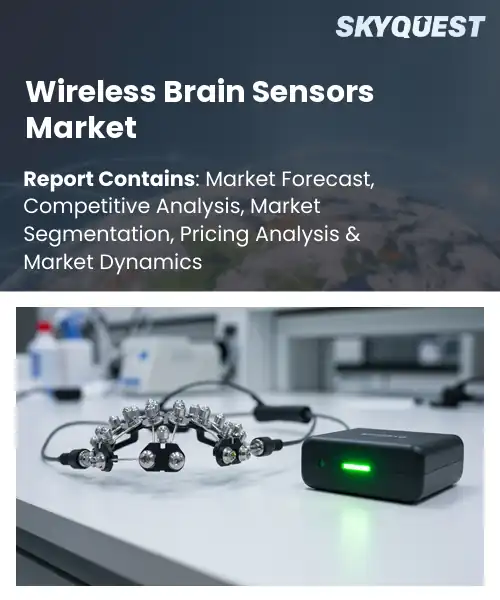
Wireless Brain Sensors Market
Report ID: SQMIG35A3915
Report ID: SQMIG35A3915
[email protected]
USA +1 351-333-4748
Report ID:
SQMIG35A3915 |
Region:
Global |
Published Date: June, 2026
Pages:
157
|Tables:
97
|Figures:
76


Global Wireless Brain Sensors Market size was valued at USD 568.3 Million in 2024 and is poised to grow from USD 620.58 Million in 2025 to USD 1254.82 Million by 2033, growing at a CAGR of 9.2% during the forecast period (2026-2033).
The global wireless brain‑sensor market comprises miniature, implantable or wearable devices that capture neural activity without tethered connections, transmitting data via Bluetooth, Wi‑Fi or telemetry. Its importance stems from the ability to monitor cognition, motor function and disease biomarkers in real time, enabling neuro‑therapies and advancing brain‑computer interfaces. The market emerged from early electroencephalography rigs in the 1960s, accelerated by miniaturization of CMOS chips in the 2000s, and reached commercial relevance after the FDA clearance of the first wireless intracranial pressure monitor in 2018. This evolution reflects a convergence of semiconductor scaling, cloud analytics and rising demand for patient monitoring.
Clinical adoption of wireless brain sensors is driven by the rising prevalence of neurodegenerative diseases, which demands continuous, unobtrusive monitoring. When disease activity is captured outside the clinic, physicians can modify treatments in near real time, decreasing readmissions and overall costs. This cause‑effect relationship has attracted med‑tech firms and venture capital, leading to platforms such as the FDA‑approved NeuroVista system that predicts seizures in epilepsy patients. The creation of usable metrics from raw neuron data through advanced AI signal-processing technologies brings about valuable new opportunities in drug development via customized clinical trial delivery. With payers starting to reimburse remote neural monitoring, there will likely be a rapid increase in the volume of remote sensing devices deployed throughout the healthcare ecosystem.
How is AI Enhancing Performance and Adoption of Wireless Brain Sensor Technology?
Wireless brain sensors work with AI to enhance the signal quality of neural signals, decrease their power requirements and allow for more sophisticated data interpretation. By utilizing machine learning algorithms, noisy signals can be filtered and motion artifacts can be corrected prior to capturing or transmitting a neural signal. As a result, smaller and lighter devices can be created which produce a higher quality signal than would otherwise be possible with a more bulky device. Using edge AI processors enable an individual to analyze and compare their neural patterns on the device itself, providing real-time feedback for neurofeedback and clinical monitoring purposes. In addition, adaptive models allow sensor settings for each individual to be customized, increasing the sensor's battery life and making calibration easier.
In April 2025, Neuroelectrics joined the PREDICTOM project to develop artificial intelligence-based tools for the early detection of Alzheimer’s disease using wireless EEG brain-monitoring systems. The initiative combines AI algorithms with brain signal analysis and computational modeling to identify neurological changes earlier, improving diagnostic accuracy and expanding the clinical adoption of wireless brain sensor technologies.
Market snapshot - (2026-2033)
Global Market Size
USD 568.3 Million
Largest Segment
EEG (Electroencephalography) Sensors
Fastest Growth
Hybrid Brain Monitoring Sensors
Growth Rate
9.2% CAGR
To get more insights on this market click here to Request a Free Sample Report
Global wireless brain sensors market is segmented by product type, application, end user and region. Based on product type, the market is segmented into EEG (electroencephalography) sensors, ECoG (electrocorticography) sensors, intracranial neural sensors, hybrid brain monitoring sensors and others. Based on application, the market is segmented into neurological disorder monitoring, brain-computer interface (BCI), cognitive & behavioral research, sleep monitoring, rehabilitation & neurofeedback and others. Based on end user, the market is segmented into hospitals & clinics, research institutes & universities, ambulatory surgical centers, home care settings and others. Based on region, the market is segmented into North America, Europe, Asia Pacific, Latin America and Middle East & Africa.
EEG (electroencephalography) sensors segment dominates because they provide non‑invasive, real‑time neural activity capture that aligns with the core value proposition of wireless brain monitoring. In both clinical and experimental settings, the ability to easily place a patient, create a comfortable space, and fit within established clinical work patterns has led to the rapid adoption of this technology. The large scale adoption of this technology supports to promote ongoing research and development for improving miniaturization and batteries for both of these technologies, reinforcing market share and increasing integration with upcoming AI analytics.
Meanwhile, hybrid brain monitoring sensors segment emerges as the most rapidly expanding area, fueled by its ability to combine electrophysiological and hemodynamic data within a single wireless device. Fundamental to this multi-modal aspect of providing complex diagnostic solutions; fostering research partnerships and enabling manufacturers to build diversified, global reach.
Neurological disorder monitoring application dominates because it directly addresses urgent clinical needs for early detection and management of conditions such as epilepsy, Parkinson’s disease, and stroke. Wireless brain sensors enable continuous, home‑based observation, reducing hospital visits while delivering actionable data to clinicians. This clear health impact drives strong reimbursement support and motivates developers to fine‑tune sensor accuracy and connectivity, cementing its leading market position, supported by diverse patients, evolving therapies, broader adoption.
On the other hand, cognitive & behavioral research application is witnessing the strongest growth momentum, driven by rising interest in brain‑computer interfaces and learning tools. Using wireless sensors, researchers are able to record fine-grained neural activities associated with task execution. These advanced technologies lamped onto understanding neural properties help establish neurotechnology startups as well as generate grant revenue to support program efforts.
To get detailed segments analysis, Request a Free Sample Report
North America leads due to a convergence of deep scientific expertise, substantial investment capital, and an ecosystem that encourages rapid translation from lab to clinic. Through strong partnerships between leading academic institutions and innovative start-up companies, there is a strong foundation for sensor technology linked to neuroscience. The regulatory environment provides expedited approval processes. Also, established healthcare systems provide a clear line of reimbursement for approved products. Additionally, established manufacturers of medical devices provide added exposure through strategic partnerships and expand access through their networks. Finally, a culture of open communication and collaboration among multiple disciplines ensures constant improvement in wireless neurotechnology.
Wireless brain sensors market in the United States benefits from a dense network of research universities and a vibrant venture capital community that fuels early‑stage development. Strong intellectual property protections encourage commercial exploitation, while collaborative initiatives between government agencies and industry accelerate clinical validation. The United States leads in innovation because of significant funding for large studies, which allows more patients to receive the benefits through a well-established reimbursement structure.
Wireless brain sensors market in Canada is shaped by extensive government research programs and a collaborative approach between public health institutions and private firms. A focus on how to deliver patient-centered care has motivated many neurological practices to adopt wireless solutions. Additionally, regulators have taken active steps to make it easier for these innovations to enter the market. The presence of well-established research institutions across North America supports the transfer of new technologies between clinical and commercial entities.
Europe’s expansion is propelled by coordinated policy frameworks that prioritize digital health and neurotechnology, coupled with deep engineering expertise across leading industrial economies. Public and private research funds are key to helping cross-border collaborative research efforts succeed, especially in neuromodulation and the development of brain-computer interfaces. A single regulatory process shared by all member states simplifies the product certification process for manufacturers, and strongly stresses patient safety to give clinicians confidence. Increased demand for the minimally invasive monitoring of ageing populations, combined with increasingly established strategic relationships between medical device manufacturers and healthcare providers, creates increasing momentum for the value of these products across Europe.
Wireless brain sensors market in Germany thrives on a legacy of precision engineering and a strong industrial base that merges hardware excellence with biomedical research. Collaborative clusters linking universities, research institutes, and manufacturers accelerate prototype development and scale‑up. Robust funding schemes support translational projects, and a clear regulatory environment ensures timely market entry. The introduction of wireless sensors into existing clinical practice shows Germany’s commitment to leading the way in developing advanced neurotechnologies for clinical use.
Wireless brain sensors market in the United Kingdom experiences swift growth driven by world‑renowned neuroscience research centers and an entrepreneurial ecosystem that nurtures spin‑outs. There are also strong partnerships between the academic and industry sectors that enable faster iteration of sensor design and the establishment of frameworks for the delivery of health services that support early adoption in specialist clinics. The UK is a leader in innovative, collaborative approaches and serves as a vibrant center for the advancement of wireless neurotechnology.
Wireless brain sensors market in France is emerging through strong governmental support for medical innovation and a vibrant biotech cluster that combines expertise in optics, electronics, and neuroscience. Collaboration between startups and research laboratories can create fast moving development cycles, while health reform efforts focus on better monitoring technologies. A positive approach toward cooperating with European regulatory guidelines will help to reduce barriers to market entry. The rapidly increasing need for Non-Invasive Diagnostic solutions in hospitals around France also contributes to their use within hospitals.
Asia Pacific advances by leveraging a blend of rapid technology adoption, manufacturing prowess, and expanding healthcare infrastructure. Research and development are heavily invested by the countries of the region, which leads to the development of local expertise for miniaturization of sensors and wireless communications. The presence of strong supply chain capabilities allows companies to produce their products at an economical price to their customers, while government health care initiatives facilitate the use of new technologies to advance monitoring systems in clinical facilities. The ability to create collaborative ecosystems between universities, technology companies, and hospitals has allowed for rapid commercialization of innovative technologies, and the culture of being open to new medical solutions has resulted in higher acceptance rates across many countries.
Wireless brain sensors market in Japan benefits from a deep tradition of precision electronics and a proactive stance on healthcare technology integration. The transition from concept to clinic for medical devices is expedited by collaborative programs established between manufacturers of medical devices and leading Universities. Additionally, Government Health Strategies emphasize early detection and ongoing monitoring, which create demand for wireless neuro-solution devices. The Japanese focus on quality and dependability builds the confidence of clinicians, which helps sustain growth in the market.
Wireless brain sensors market in South Korea is reinforced by a dynamic startup culture and strong governmental incentives for digital health. Advanced semiconductor technology has made it possible to design more sophisticated sensors and the cooperation between research centres and industry means that product development can take place quickly. National health policies encouraging innovative monitoring solutions foster rapid clinical uptake. South Korea’s focus on seamless integration of technology into patient care positions it as a rising leader in the wireless brain sensor arena.
To know more about the market opportunities by region and country, click here to
Buy The Complete Report
Growing Demand For Neurofeedback
Advancements In Miniaturization Technology
Stringent Data Privacy Regulations
High Manufacturing Cost Challenges
Request Free Customization of this report to help us to meet your business objectives.
The competitive landscape in the global wireless brain sensors market outlook is shaped by a handful of technology leaders accelerating product differentiation through advanced signal‑processing algorithms and low‑power wireless protocols, while market demand is driven by hospitals adopting continuous neuro‑monitoring for early diagnosis. Recent partnerships between sensor manufacturers and neuro‑imaging firms aim to integrate real‑time data streams into clinical workflows, intensifying rivalry and prompting rapid innovation cycles.
Top Player’s Company Profile
Recent Developments
SkyQuest’s ABIRAW (Advanced Business Intelligence, Research & Analysis Wing) is our Business Information Services team that Collects, Collates, Correlates, and Analyses the Data collected by means of Primary Exploratory Research backed by robust Secondary Desk research.
As per SkyQuest analysis the wireless brain sensors market is being propelled primarily by the growing demand for neurofeedback, which encourages integration of real‑time, movement‑free monitoring into both clinical and consumer platforms, while AI‑driven signal analytics serves as a second catalyst by turning raw neural data into actionable insights and extending battery life. The EEG sensor segment continues to dominate because of its non‑invasive ease of use and alignment with existing workflows. North America leads the market thanks to robust research ecosystems, venture capital, and supportive regulatory pathways. However, stringent data‑privacy regulations pose a significant restraint, adding compliance complexity and slowing broader adoption across regions.
| Report Metric | Details |
|---|---|
| Market size value in 2024 | USD 568.3 Million |
| Market size value in 2033 | USD 1254.82 Million |
| Growth Rate | 9.2% |
| Base year | 2024 |
| Forecast period | (2026-2033) |
| Forecast Unit (Value) | USD Million |
| Segments covered |
|
| Regions covered | North America (US, Canada), Europe (Germany, France, United Kingdom, Italy, Spain, Rest of Europe), Asia Pacific (China, India, Japan, Rest of Asia-Pacific), Latin America (Brazil, Rest of Latin America), Middle East & Africa (South Africa, GCC Countries, Rest of MEA) |
| Companies covered |
|
| Customization scope | Free report customization with purchase. Customization includes:-
|
To get a free trial access to our platform which is a one stop solution for all your data requirements for quicker decision making. This platform allows you to compare markets, competitors who are prominent in the market, and mega trends that are influencing the dynamics in the market. Also, get access to detailed SkyQuest exclusive matrix.
Table Of Content
Executive Summary
Market overview
Parent Market Analysis
Market overview
Market size
KEY MARKET INSIGHTS
COVID IMPACT
MARKET DYNAMICS & OUTLOOK
Market Size by Region
KEY COMPANY PROFILES
Methodology
For the Wireless Brain Sensors Market, our research methodology involved a mixture of primary and secondary data sources. Key steps involved in the research process are listed below:
1. Information Procurement: This stage involved the procurement of Market data or related information via primary and secondary sources. The various secondary sources used included various company websites, annual reports, trade databases, and paid databases such as Hoover's, Bloomberg Business, Factiva, and Avention. Our team did 45 primary interactions Globally which included several stakeholders such as manufacturers, customers, key opinion leaders, etc. Overall, information procurement was one of the most extensive stages in our research process.
2. Information Analysis: This step involved triangulation of data through bottom-up and top-down approaches to estimate and validate the total size and future estimate of the Wireless Brain Sensors Market.
3. Report Formulation: The final step entailed the placement of data points in appropriate Market spaces in an attempt to deduce viable conclusions.
4. Validation & Publishing: Validation is the most important step in the process. Validation & re-validation via an intricately designed process helped us finalize data points to be used for final calculations. The final Market estimates and forecasts were then aligned and sent to our panel of industry experts for validation of data. Once the validation was done the report was sent to our Quality Assurance team to ensure adherence to style guides, consistency & design.
Analyst Support
Customization Options
With the given market data, our dedicated team of analysts can offer you the following customization options are available for the Wireless Brain Sensors Market:
Product Analysis: Product matrix, which offers a detailed comparison of the product portfolio of companies.
Regional Analysis: Further analysis of the Wireless Brain Sensors Market for additional countries.
Competitive Analysis: Detailed analysis and profiling of additional Market players & comparative analysis of competitive products.
Go to Market Strategy: Find the high-growth channels to invest your marketing efforts and increase your customer base.
Innovation Mapping: Identify racial solutions and innovation, connected to deep ecosystems of innovators, start-ups, academics, and strategic partners.
Category Intelligence: Customized intelligence that is relevant to their supply Markets will enable them to make smarter sourcing decisions and improve their category management.
Public Company Transcript Analysis: To improve the investment performance by generating new alpha and making better-informed decisions.
Social Media Listening: To analyze the conversations and trends happening not just around your brand, but around your industry as a whole, and use those insights to make better Marketing decisions.
REQUEST FOR SAMPLE
 REQUEST FREE CUSTOMIZATION
Global Wireless Brain Sensors Market size was valued at USD 568.3 Million in 2024 and is poised to grow from USD 620.58 Million in 2025 to USD 1254.82 Million by 2033, growing at a CAGR of 9.2% during the forecast period (2026-2033).
The competitive landscape is shaped by a handful of technology leaders accelerating product differentiation through advanced signal‑processing algorithms and low‑power wireless protocols, while market demand is driven by hospitals adopting continuous neuro‑monitoring for early diagnosis. Recent partnerships between sensor manufacturers and neuro‑imaging firms aim to integrate real‑time data streams into clinical workflows, intensifying rivalry and prompting rapid innovation cycles. 'Neuralink', 'Synchron', 'Paradromics', 'Blackrock Neurotech', 'Precision Neuroscience', 'EMOTIV', 'Neurosity', 'Cognionics', 'g.tec medical engineering GmbH', 'Advanced Brain Monitoring', 'ANT Neuro', 'Brain Products GmbH', 'Neuroelectrics', 'Compumedics Neuroscan', 'Bitbrain', 'Kernel', 'Wearable Sensing', 'OpenBCI', 'Muse (InteraXon)', 'Ceribell'
The rising interest in neurofeedback and cognitive enhancement encourages developers to integrate wireless brain sensors into consumer and clinical platforms, because these devices enable real‑time monitoring without restricting movement, thereby improving user experience and data accuracy, which in turn motivates investment from technology firms seeking to expand their health‑tech portfolios and accelerates partnerships with research institutions, fostering a cycle of innovation that continuously broadens application scenarios and sustains market momentum by offering seamless data integration with existing digital health records across the global healthcare ecosystem.
Neuro-Interface Integration Surge: The convergence of wearable neurotechnology and mainstream consumer electronics is accelerating adoption of wireless brain sensors. Companies are embedding EEG and fNIRS modules into headphones, gaming headsets, and AR glasses, turning passive devices into active health and performance platforms. This cross‑industry collaboration expands user bases beyond clinical settings, fuels demand for seamless data capture, and prompts manufacturers to prioritize ergonomics, low latency, and intuitive user experiences, positioning brain‑sensor ecosystems as a standard feature in everyday tech today globally.
Why does North America Dominate the Global Wireless Brain Sensors Market? |@12


Want to customize this report? This report can be personalized according to your needs. Our analysts and industry experts will work directly with you to understand your requirements and provide you with customized data in a short amount of time. We offer $1000 worth of FREE customization at the time of purchase.
Feedback From Our Clients


 USA (+1) 351-333-4748

