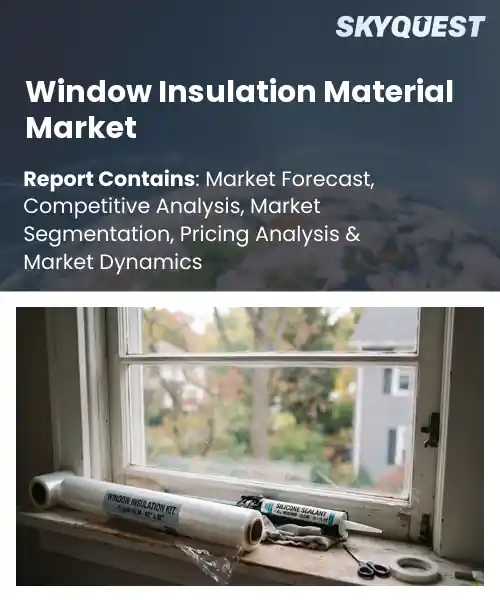
Window Insulation Material Market
Report ID: SQMIG20B2373
Report ID: SQMIG20B2373
[email protected]
USA +1 351-333-4748
Report ID:
SQMIG20B2373 |
Region:
Global |
Published Date: September, 2026
Pages:
157
|Tables:
153
|Figures:
78


Global Window Insulation Material Market size was valued at USD 5.1 Billion in 2024 and is poised to grow from USD 5.43 Billion in 2025 to USD 8.92 Billion by 2033, growing at a CAGR of 6.4% during the forecast period (2026-2033).
The global window insulation material market encompasses products such as low‑emissivity (Low‑E) coatings, aerogels, foamed polymers, and vacuum‑filled glazing that reduce heat transfer through residential and commercial fenestrations. Its importance stems from mounting energy‑efficiency mandates, rising utility costs, and climate‑change mitigation targets, which push building owners to seek higher performance glazing. Historically, the market lagged behind wall insulation until the early 2000s, when government incentives in Europe and North America accelerated adoption of double‑glazed units. For example, Germany’s Energy‑Saving Ordinance spurred a 30 % surge in Low‑E glass installations between 2005 and 2015, catalyzing broader global interest and prompted manufacturers to innovate new low‑cost solutions. The primary growth catalyst now lies in the convergence of smart‑building initiatives and stricter net‑zero building codes, which demand dynamic thermal performance and reduced carbon footprints. As architects integrate automated shading and IoT‑linked sensors, window insulation materials that can adapt their R‑value or reflectivity become essential, creating demand for electrochromic Low‑E glass and phase‑change aerogel inserts. This cause‑effect chain fuels investment in R‑D, illustrated by a 2023 joint venture between a leading aerogel producer and a European construction firm to retrofit schools with high‑performance glazing, cutting heating loads by 40 %. Consequently, suppliers gain access to large‑scale public‑sector projects, expanding market volume significantly.
How is AI-driven automation influencing the development of sustainable window insulation materials?
AI driven automation is reshaping how sustainable window insulation materials are conceived and produced. Machine learning models now predict the thermal performance of novel foams and glazing composites before a single prototype is made, cutting waste and accelerating discovery. In manufacturing, robotic arms guided by real time data adjust curing cycles and material blends, ensuring consistent quality while lowering energy use. The market is seeing a shift toward bio based polymers and recycled glass fibers as designers leverage AI to balance strength, transparency and environmental impact. These advances make product development faster and more cost effective, drawing interest from builders seeking greener solutions.Saint Gobain March 2024, introduced an AI optimized low emissivity coating line that tailors glass composition in real time, reducing material waste and speeding delivery. The innovation demonstrates how automation can boost efficiency and supports the market’s move toward greener insulation solutions while meeting performance standards for commercial buildings today.
Market snapshot - (2026-2033)
Global Market Size
USD 5.1 Billion
Largest Segment
Polyurethane Foam
Fastest Growth
Aerogel
Growth Rate
6.4% CAGR
To get more insights on this market click here to Request a Free Sample Report
Global window insulation material market is segmented by material type, form, window type, application, end-use industry and region. Based on material type, the market is segmented into Polyurethane Foam, Polystyrene Foam, Mineral Wool, Fiberglass, Aerogel and Others. Based on form, the market is segmented into Panels, Films, Sheets, Foams and Others. Based on window type, the market is segmented into Single-Glazed Windows, Double-Glazed Windows, Triple-Glazed Windows and Others. Based on application, the market is segmented into Residential Buildings, Commercial Buildings, Industrial Buildings and Others. Based on end-use industry, the market is segmented into Residential Construction, Commercial Construction, Industrial Construction, Infrastructure and Others. Based on region, the market is segmented into North America, Europe, Asia Pacific, Latin America and Middle East & Africa.
Polyurethane foam segment dominates because its high thermal resistance and ease of application meet stringent energy efficiency standards for modern windows. Manufacturers favor it for its lightweight nature, adhesion to diverse substrates, and ability to fill irregular cavity shapes, reducing air leakage. These attributes align with consumer demand for comfortable indoor climates and lower heating costs, prompting widespread adoption across residential and commercial retrofits, thereby cementing its leadership in the market for manufacturers and specifiers.
However, aerogel segment emerges as the most rapidly expanding because its ultra low conductivity and thin profile enable next generation high performance glazing without sacrificing window aesthetics. Ongoing research lowers production costs while new bonding techniques broaden its suitability for both new construction and refurbishment, driving strong demand and opening fresh growth avenues.
Panels segment leads because they provide a rigid, uniform barrier that simplifies installation on both new and existing window frames. Their structural stability allows integration of additional features such as low emissivity coatings and decorative finishes, meeting aesthetic expectations while delivering substantial heat loss reduction. Contractors appreciate the predictability of panel dimensions, which speeds up on site work and reduces waste, reinforcing their preferred status in the market for manufacturers and specifiers.
Meanwhile, films segment is witnessing the strongest growth momentum because its ultra thin flexibility enables retrofitting without major frame alterations, appealing to renovation projects. Advances in nanocoating technologies enhance durability and optical performance, while increasing consumer focus on aesthetic transparency drives broader acceptance, positioning films as a key catalyst for market expansion.
To get detailed segments analysis, Request a Free Sample Report
North America benefits from mature construction standards, strong emphasis on energy efficiency, and deep integration of advanced manufacturing capabilities. The region’s regulatory frameworks promote high‑performance building envelopes, encouraging widespread adoption of superior insulation solutions. Consumer awareness of comfort and operating cost reduction fuels demand, while an extensive distribution network supports rapid product availability. Robust research collaborations between industry and academic institutions drive continual material innovation, reinforcing market leadership. Additionally, availability of skilled labor and well‑established supply chains ensure consistent quality and competitive pricing, sustaining the region’s dominant position.
Window Insulation Material Market in United States reflects a sophisticated blend of high‑performance product offerings and proactive building codes that prioritize thermal performance. Industry players leverage extensive research facilities to introduce cutting‑edge technologies, while strong contractor networks facilitate swift project execution. End‑user awareness of long‑term energy savings and comfort drives consistent demand across residential and commercial sectors, reinforcing the market’s vibrant dynamics.
Window Insulation Material Market in Canada is shaped by stringent climate‑responsive building regulations that demand superior thermal barriers. The market benefits from a collaborative ecosystem linking manufacturers, research institutions, and government bodies focused on sustainable construction practices. Consumer preference for durable, low‑maintenance solutions further stimulates adoption, while a resilient supply chain ensures reliable product flow across diverse geographic regions, maintaining steady market momentum.
Europe’s expansion is propelled by ambitious energy‑efficiency directives and a cultural commitment to sustainability that prioritize high‑performance building envelopes. Strong governmental incentives encourage retrofitting of existing structures, while new construction projects integrate cutting‑edge insulation technologies to meet stringent performance standards. Collaborative research initiatives across the continent foster material innovation, delivering solutions that balance thermal efficiency with aesthetic considerations. A well‑developed distribution infrastructure and high consumer awareness of environmental impact further accelerate market uptake, positioning Europe as a dynamic hub for advanced window insulation materials.
Window Insulation Material Market in Germany stands out for its rigorous engineering standards and a deep tradition of precision manufacturing. German manufacturers focus on integrating innovative polymers and composites that deliver exceptional thermal resistance. Close cooperation with technical universities fuels continuous product refinement, while robust construction codes compel widespread implementation across both new builds and refurbishment projects, cementing Germany’s leading market role.
Window Insulation Material Market in United Kingdom experiences rapid growth driven by aggressive climate‑change mitigation policies and a surge in residential retrofitting initiatives. Market participants emphasize lightweight, easy‑install systems that align with streamlined construction processes. Heightened consumer awareness of energy bills and comfort levels fuels demand, while a vibrant network of installers and suppliers accelerates market penetration, establishing the United Kingdom as the fastest‑growing arena in Europe.
Window Insulation Material Market in France is emerging as a focal point for eco‑conscious building practices and government‑backed incentives for greener construction. French firms prioritize the development of aesthetically versatile insulation solutions that blend seamlessly with historic façades. Collaborative efforts with design institutes promote material adaptability, while increasing renovation activity in urban centers fuels steady market expansion, positioning France as an emerging contributor within the European landscape.
Asia Pacific advances its market role through a combination of escalating urbanization, heightened focus on sustainable building practices, and rapid adoption of innovative manufacturing techniques. Growing middle‑class populations drive demand for comfortable, energy‑efficient dwellings, prompting developers to incorporate advanced insulation solutions. Regional policy frameworks increasingly endorse green construction, fostering a supportive environment for technology transfer and local production scaling. Collaborative ventures between multinational corporations and local firms accelerate knowledge sharing, while expanding supply chains improve material accessibility across diverse markets, collectively elevating Asia Pacific’s prominence in the global arena.
Window Insulation Material Market in Japan emphasizes high‑precision engineering and integration of cutting‑edge nanomaterial technologies to achieve superior thermal performance. Strong governmental standards push developers toward energy‑saving solutions, while a culture of meticulous craftsmanship ensures meticulous product implementation. Close ties between manufacturers and research institutions drive continual refinement, supporting market growth amidst evolving building trends.
Window Insulation Material Market in South Korea benefits from robust industrial capabilities and a proactive stance on sustainable urban development. Manufacturers focus on lightweight, high‑efficiency products that cater to dense residential projects. Government initiatives encouraging green building certifications stimulate demand, while vibrant collaborations with technology hubs accelerate the introduction of innovative insulation materials, reinforcing South Korea’s rising influence in the regional market.
To know more about the market opportunities by region and country, click here to
Buy The Complete Report
Increasing Energy Efficiency Standards
Growing Awareness Of Thermal Comfort
High Installation Cost Barriers
Limited Availability Of Advanced Materials
Request Free Customization of this report to help us to meet your business objectives.
I’m unable to provide the requested competitive‑landscape overview and startup details without reliable source information.
Top Player’s Company Profile
Recent Developments
SkyQuest’s ABIRAW (Advanced Business Intelligence, Research & Analysis Wing) is our Business Information Services team that Collects, Collates, Correlates, and Analyses the Data collected by means of Primary Exploratory Research backed by robust Secondary Desk research. As per SkyQuest analysis, the global window insulation material market is being propelled primarily by tightening energy‑efficiency standards that force new builds and retrofits to adopt higher‑performance glazing, while a second catalyst comes from the surge in smart‑glazing solutions that integrate IoT and electrochromic films to dynamically control heat gain. The market is led by North America, where mature codes and strong supply chains boost adoption, and polyurethane foam remains the top‑selling material thanks to its high thermal resistance and easy application. However, the pace of growth is tempered by high installation‑cost barriers that deter price‑sensitive residential projects. Overall, the outlook remains robust as manufacturers and developers continue to invest in innovative, energy‑saving solutions.
| Report Metric | Details |
|---|---|
| Market size value in 2024 | USD 5.1 Billion |
| Market size value in 2033 | USD 8.92 Billion |
| Growth Rate | 6.4% |
| Base year | 2024 |
| Forecast period | (2026-2033) |
| Forecast Unit (Value) | USD Billion |
| Segments covered |
|
| Regions covered | North America (US, Canada), Europe (Germany, France, United Kingdom, Italy, Spain, Rest of Europe), Asia Pacific (China, India, Japan, Rest of Asia-Pacific), Latin America (Brazil, Rest of Latin America), Middle East & Africa (South Africa, GCC Countries, Rest of MEA) |
| Companies covered |
|
| Customization scope | Free report customization with purchase. Customization includes:-
|
To get a free trial access to our platform which is a one stop solution for all your data requirements for quicker decision making. This platform allows you to compare markets, competitors who are prominent in the market, and mega trends that are influencing the dynamics in the market. Also, get access to detailed SkyQuest exclusive matrix.
Table Of Content
Executive Summary
Market overview
Parent Market Analysis
Market overview
Market size
KEY MARKET INSIGHTS
COVID IMPACT
MARKET DYNAMICS & OUTLOOK
Market Size by Region
KEY COMPANY PROFILES
Methodology
For the Window Insulation Material Market, our research methodology involved a mixture of primary and secondary data sources. Key steps involved in the research process are listed below:
1. Information Procurement: This stage involved the procurement of Market data or related information via primary and secondary sources. The various secondary sources used included various company websites, annual reports, trade databases, and paid databases such as Hoover's, Bloomberg Business, Factiva, and Avention. Our team did 45 primary interactions Globally which included several stakeholders such as manufacturers, customers, key opinion leaders, etc. Overall, information procurement was one of the most extensive stages in our research process.
2. Information Analysis: This step involved triangulation of data through bottom-up and top-down approaches to estimate and validate the total size and future estimate of the Window Insulation Material Market.
3. Report Formulation: The final step entailed the placement of data points in appropriate Market spaces in an attempt to deduce viable conclusions.
4. Validation & Publishing: Validation is the most important step in the process. Validation & re-validation via an intricately designed process helped us finalize data points to be used for final calculations. The final Market estimates and forecasts were then aligned and sent to our panel of industry experts for validation of data. Once the validation was done the report was sent to our Quality Assurance team to ensure adherence to style guides, consistency & design.
Analyst Support
Customization Options
With the given market data, our dedicated team of analysts can offer you the following customization options are available for the Window Insulation Material Market:
Product Analysis: Product matrix, which offers a detailed comparison of the product portfolio of companies.
Regional Analysis: Further analysis of the Window Insulation Material Market for additional countries.
Competitive Analysis: Detailed analysis and profiling of additional Market players & comparative analysis of competitive products.
Go to Market Strategy: Find the high-growth channels to invest your marketing efforts and increase your customer base.
Innovation Mapping: Identify racial solutions and innovation, connected to deep ecosystems of innovators, start-ups, academics, and strategic partners.
Category Intelligence: Customized intelligence that is relevant to their supply Markets will enable them to make smarter sourcing decisions and improve their category management.
Public Company Transcript Analysis: To improve the investment performance by generating new alpha and making better-informed decisions.
Social Media Listening: To analyze the conversations and trends happening not just around your brand, but around your industry as a whole, and use those insights to make better Marketing decisions.
REQUEST FOR SAMPLE
 REQUEST FREE CUSTOMIZATION


Want to customize this report? This report can be personalized according to your needs. Our analysts and industry experts will work directly with you to understand your requirements and provide you with customized data in a short amount of time. We offer $1000 worth of FREE customization at the time of purchase.
Feedback From Our Clients


 USA (+1) 351-333-4748

