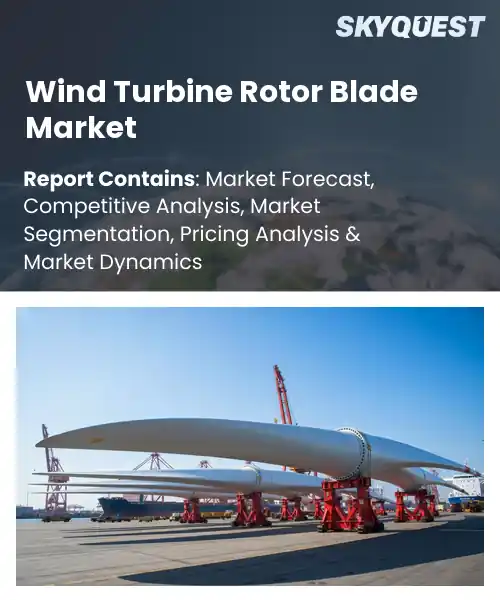
Wind Turbine Rotor Blade Market
Report ID: SQMIG55F2095
Report ID: SQMIG55F2095
[email protected]
USA +1 351-333-4748
Report ID:
SQMIG55F2095 |
Region:
Global |
Published Date: February, 2026
Pages:
199
|Tables:
61
|Figures:
70


Global Wind Turbine Rotor Blade Market size was valued at USD 25.1 Billion in 2024 and is poised to grow from USD 26.91 Billion in 2025 to USD 46.93 Billion by 2033, growing at a CAGR of 7.2% during the forecast period (2026-2033).
The wind turbine rotor blade industry is experiencing robust growth resulting from an increase in demand for renewable energy sources globally and investments made by the governments in wind power projects.
Additionally, improvements in technology to manufacture rotor blades have allowed greater use of materials to manufacture larger rotor blades and improvements in efficiency and durability. This has led to a significant increase in the demand for onshore rotor blades and an increase in the demand for offshore rotor blades due to the introduction of more extended, high-capacity rotor blades that are being developed and produced.
The Asia-Pacific region is expected to dominate this market, particularly China and India, due to their aggressive renewable energy goals and their increasing manufacturing capabilities. Onshore projects currently dominate the market; however, the demand for offshore projects is increasing rapidly as manufacturers continue to innovate with long, high-capacity rotor blades. The use of advanced composite materials, such as glass and carbon fibers, will provide greater performance and efficiency for large rotor blades, though challenges remain concerning the cost of composite materials and the recycling of these materials.
The market is also being driven using governmental incentives, the introduction of innovations that enable the automated manufacture of rotor blades and the development and production of smart rotor blades, whereas the transportation and logistics challenges of delivering large rotor blades continue to be challenges.
How AI in Rotor Blade Innovation is Leading Market?
Wind turbine rotor blades are rapidly being advanced through the implementation of Artificial Intelligence (AI) technologies, which improve design, manufacturing, and operational processes in every aspect of the blade's life. With the help of AI technologies such as simulation tools and optimization algorithms, designers will have access to many more variants of designs than they previously had access to through conventional means, allowing them to better fit blades to a specific type of wind or the desired performance of the blade.
Apart from the design phase, AI technologies are now being used in the quality control process for manufacturing and in predictive maintenance systems. Through machine learning, these systems can identify defects in the earliest stages of manufacturing, allow manufacturers to improve their production processes and enable manufacturers to anticipate when their blades require maintenance, reducing the number of maintenance problems and increasing the lifetime of the blades.
Market snapshot - 2026-2033
Global Market Size
USD 55.49 Billion
Largest Segment
Carbon Fiber
Fastest Growth
Glass Fiber
Growth Rate
9.62% CAGR
To get more insights on this market click here to Request a Free Sample Report
Global Wind Turbine Rotor Blade Market is segmented by Blade Material, Blade Design, End-User Industry, Length Category and region. Based on Blade Material, the market is segmented into Fiberglass, Carbon Fiber and Wood-Laminate. Based on Blade Design, the market is segmented into Horizontal Axis and Vertical Axis. Based on End-User Industry, the market is segmented into Onshore and Offshore. Based on Length Category, the market is segmented into Short Blades and Long Blades. Based on region, the market is segmented into North America, Europe, Asia Pacific, Latin America and Middle East & Africa.
As per global wind turbine rotor blade market outlook, onshore segment dominates the market. Onshore wind is faster to deploy, lower in capital, and many regions have established infrastructure to grow. Countries that have large amounts of land are looking to expand onshore capacity to hit clean energy goals and improve reliability in local power supply.
The offshore segment is expected to grow rapidly due to its high energy output potential and strong backing from coastal governments. Favorable policies, investment incentives, and technological advancements make offshore projects attractive, enabling larger-scale installations, greater efficiency, and significant contributions to renewable energy targets worldwide.
As per global wind turbine rotor blade market analysis, glass fiber segment continues to lead the market due to the desirable combination of mechanical performance, low-cost relative to performance, and the ability to manufacture large quantities economically. Wind turbine blades in both onshore and offshore applications are made from glass fiber-reinforced composite materials as this material exhibits high-performance properties with very good resistance to fatigue and corrosion, making glass fiber-reinforced composite materials very suitable for producing in mass quantities.
As per global wind turbine rotor blade market forecast, the carbon fiber segment is rapidly expanding as wind turbine designs become larger and more powerful, particularly in offshore applications. Carbon fiber has significantly higher stiffness-to-weight ratios and strength-to-weight ratios than glass fiber, thus allowing manufacturers to produce longer, lighter, and stronger wind turbine blades, producing less structural loads and improved energy capture on the wind turbine. While the carbon fiber blade segment does cost more, the decreasing cost of carbon fiber material, new hybrid blade designs, and the demand for ultra-long blades have led to the increased use and consumption of carbon fiber.
To get detailed segments analysis, Request a Free Sample Report
In North America, the market has continued to expand steadily. This wind turbine rotor blade market trend has been facilitated by long-term renewable energy policy implementation, increased modernization of antiquated wind turbine farms, and the addition of larger capacity wind turbines. The trend has been towards the development of longer and more efficient rotor blades to maximize energy capture from the environment, especially for low-wind and offshore wind applications.
The largest wind turbine rotor blade market in North America is the United States, which is supported by an extensive amount of installed onshore wind turbine capacity and an increasing number of offshore wind projects under development along both the East and West Coasts. Additionally, the demand for wind turbine rotor blades is being driven by a significant number of repowering projects currently underway, in which older wind turbines are replaced with newer models that utilize larger rotor blades. Manufacturers also contribute to wind turbine rotor blade market growth by manufacturing blades domestically, creating new composite materials, and using digital technologies to monitor the performance of rotor blades.
The Canada wind turbine rotor blade market has benefited from a high-quality resource of wind available for conversion into electricity that is also supported by many provincial energy policies. Canadian rotor blade manufacturers have produced rotor blades that are designed to perform well in icy conditions, resist fatigue due to extreme weather, and to perform well over time in cold climates. Most of the growth in this market has occurred with investments made in onshore wind energy projects.
As per wind turbine rotor blade regional outlook, the Asia Pacific region represents a considerable growth opportunity due to increasing energy demand, supportive government programs, and large offshore wind projects in emerging markets. Lower manufacturing costs and developing local supply chains are also attractive. China, India and countries throughout Southeast Asia have significant commitment to expanding their wind capacity, and many large manufacturers are establishing wind turbine production facilities locally.
As per wind turbine rotor blade regional forecast, Japan market is growing due to the country's strategic desire to increase offshore wind power to decrease dependence on both imports and of nuclear generated power. Government-backed offshore wind auctions and feed-in-tariffs have opened the market to international players. Innovative thinking, partnerships with local companies, and collaborations with experienced global technology partners allow market entry and deployment to develop wind energy generation in offshore marine environments.
Through its Green New Deal initiative, South Korea is rapidly developing wind energy, specifically offshore wind projects. The government's ambitious goals and strong shipbuilding and construction industries have piqued the interest of blade manufacturers.
Europe's strong wind infrastructure, climate commitments, and offshore wind targets make its market attractive. The EU Green Deal and energy transition goals create demand for advanced blade technologies. Countries with established manufacturing bases, and established regulatory environments, are a natural place for firms to invest, innovate, and scale.
As per wind turbine rotor blade industry analysis, the UK leads the offshore wind sector in Europe, resulting in strong demand for turbine blades. The UK is currently a hotbed for investment. New government auctions, decarbonization commitments, and coastal wind opportunities are driving new investment towards offshore wind. Blade manufacturers are increasing local production and local R&D, specifically in ports, where upcoming North Sea projects and existing port facilities overlap.
Germany's wind turbine rotor blade market is benefiting from the country’s commitment to phase out coal and nuclear. While onshore repowering, and offshore expansion, provide blade replacement and innovation opportunities. When combined with favorable policies, abundant skilled labor, and a robust supply chain, Germany is an excellent location for blade manufacturing and exporting throughout Europe.
France is gaining momentum in offshore wind, with several large-scale projects under development. Government tenders and a clear roadmap for renewable growth are supporting blade demand. Manufacturers are eyeing coastal regions for new facilities. Local sourcing requirements and investment incentives are also drawing international players to participate in the French wind energy push.
To know more about the market opportunities by region and country, click here to
Buy The Complete Report
Increasing Focus on Renewable Energy
Improved Blade Design and Materials
High Raw Material and Manufacturing Costs
Transportation, Installation, and End-of-Life Challenges
Request Free Customization of this report to help us to meet your business objectives.
The global wind turbine rotor blades industry is extremely competitive and consists of many different types of companies. The largest manufacturers of rotor blades are typically global blade manufacturers and vertically integrated wind turbine original equipment manufacturers (OEMs). Established global companies are constantly innovating to develop longer lengths for rotor blades, as well as improved aerodynamics and composite materials that enable blade capture and maximize durability when used in offshore applications. Technologies, manufacturing scale, supply chain efficiencies, and long-term contracts with wind farm developers all contribute to a highly competitive environment among competition in the wind turbine rotor blade market.
Startup companies working in the rotor blade development area are primarily addressing issues of blade maintenance, inspection, and performance optimization, rather than focusing on developing large manufacturing facilities to produce rotor blades on a large scale.
SkyQuest’s ABIRAW (Advanced Business Intelligence, Research & Analysis Wing) is our Business Information Services team that Collects, Collates, Correlates, and Analyses the Data collected by means of Primary Exploratory Research backed by robust Secondary Desk research.
As per SkyQuest analysis, growing demand for renewable energy coupled with government support and deployment of onshore and offshore wind energy projects has resulted in moderate growth for the wind turbine rotor blade market. Key factors contributing to this growth are the growing demand for clean energy; the advances in technology relating to rotor blade aerodynamics and composites; and the higher capacity, resulting in a trend toward larger turbine and rotor blade combinations. However, several factors hinder the continued growth of this industry, including high manufacturing costs and raw materials; the logistical problems that come with moving oversized rotor blades; and the fact that only limited recycling options are available for composite materials. Key trends shaping the industry include the growing number of companies using carbon fibre and hybrid composites; increased incorporation of digital and AI-based design and monitoring technologies; and an increased emphasis on sustainable and recyclable blade materials. The Asia-Pacific region dominates the wind turbine rotor blade market due to the presence of large-scale installations of wind power and the region's strength in manufacturing.
| Report Metric | Details |
|---|---|
| Market size value in 2024 | USD 25.1 Billion |
| Market size value in 2033 | USD 46.93 Billion |
| Growth Rate | 7.2% |
| Base year | 2024 |
| Forecast period | 2026-2033 |
| Forecast Unit (Value) | USD Billion |
| Segments covered |
|
| Regions covered | North America (US, Canada), Europe (Germany, France, United Kingdom, Italy, Spain, Rest of Europe), Asia Pacific (China, India, Japan, Rest of Asia-Pacific), Latin America (Brazil, Rest of Latin America), Middle East & Africa (South Africa, GCC Countries, Rest of MEA) |
| Companies covered |
|
| Customization scope | Free report customization with purchase. Customization includes:-
|
To get a free trial access to our platform which is a one stop solution for all your data requirements for quicker decision making. This platform allows you to compare markets, competitors who are prominent in the market, and mega trends that are influencing the dynamics in the market. Also, get access to detailed SkyQuest exclusive matrix.
Table Of Content
Executive Summary
Market overview
Parent Market Analysis
Market overview
Market size
KEY MARKET INSIGHTS
COVID IMPACT
MARKET DYNAMICS & OUTLOOK
Market Size by Region
KEY COMPANY PROFILES
Methodology
For the Wind Turbine Rotor Blade Market, our research methodology involved a mixture of primary and secondary data sources. Key steps involved in the research process are listed below:
1. Information Procurement: This stage involved the procurement of Market data or related information via primary and secondary sources. The various secondary sources used included various company websites, annual reports, trade databases, and paid databases such as Hoover's, Bloomberg Business, Factiva, and Avention. Our team did 45 primary interactions Globally which included several stakeholders such as manufacturers, customers, key opinion leaders, etc. Overall, information procurement was one of the most extensive stages in our research process.
2. Information Analysis: This step involved triangulation of data through bottom-up and top-down approaches to estimate and validate the total size and future estimate of the Wind Turbine Rotor Blade Market.
3. Report Formulation: The final step entailed the placement of data points in appropriate Market spaces in an attempt to deduce viable conclusions.
4. Validation & Publishing: Validation is the most important step in the process. Validation & re-validation via an intricately designed process helped us finalize data points to be used for final calculations. The final Market estimates and forecasts were then aligned and sent to our panel of industry experts for validation of data. Once the validation was done the report was sent to our Quality Assurance team to ensure adherence to style guides, consistency & design.
Analyst Support
Customization Options
With the given market data, our dedicated team of analysts can offer you the following customization options are available for the Wind Turbine Rotor Blade Market:
Product Analysis: Product matrix, which offers a detailed comparison of the product portfolio of companies.
Regional Analysis: Further analysis of the Wind Turbine Rotor Blade Market for additional countries.
Competitive Analysis: Detailed analysis and profiling of additional Market players & comparative analysis of competitive products.
Go to Market Strategy: Find the high-growth channels to invest your marketing efforts and increase your customer base.
Innovation Mapping: Identify racial solutions and innovation, connected to deep ecosystems of innovators, start-ups, academics, and strategic partners.
Category Intelligence: Customized intelligence that is relevant to their supply Markets will enable them to make smarter sourcing decisions and improve their category management.
Public Company Transcript Analysis: To improve the investment performance by generating new alpha and making better-informed decisions.
Social Media Listening: To analyze the conversations and trends happening not just around your brand, but around your industry as a whole, and use those insights to make better Marketing decisions.
REQUEST FOR SAMPLE
 REQUEST FREE CUSTOMIZATION
Global Wind Turbine Rotor Blade Market size was valued at USD 55.49 Billion in 2025 and is poised to grow from USD 115.7 Billion in 2026 to USD 113.93 Billion by 2033, growing at a CAGR of 9.62% during the forecast period (2026-2033).
The global wind turbine rotor blades industry is extremely competitive and consists of many different types of companies. The largest manufacturers of rotor blades are typically global blade manufacturers and vertically integrated wind turbine original equipment manufacturers (OEMs). Established global companies are constantly innovating to develop longer lengths for rotor blades, as well as improved aerodynamics and composite materials that enable blade capture and maximize durability when used in offshore applications. Technologies, manufacturing scale, supply chain efficiencies, and long-term contracts with wind farm developers all contribute to a highly competitive environment among competition in the wind turbine rotor blade market. 'LM Wind Power (Denmark)', 'Siemens Gamesa Renewable Energy, S.A. (Spain)', 'TPI Composites, Inc. (United States)', 'Vestas Wind Systems A/S (Denmark)', 'Nordex SE (Germany)', 'General Electric Company (United States)', 'Enercon GmbH (Germany)', 'Suzlon Energy Limited (India)', 'Goldwind Science & Technology Co., Ltd. (China)', 'Envision Energy (China)', 'Mitsubishi Heavy Industries, Ltd. (Japan)', 'CS Wind Corporation (South Korea)', 'Senvion S.A. (Germany)', 'Acciona S.A. (Spain)', 'Aeris Energy S/A (Brazil)'
Various governments and businesses are pushing towards renewable energy to meet climate targets, which is advancing wind projects. This emphasis on renewable energy creates additional demand for quality turbine blades. Given that new installations and repowering are increasing globally, now it provides blade manufacturers with steady growth opportunities.
Integration of Smart Blade Technology: As per wind turbine rotor blade market industry trends, manufacturers are experimenting with smart blade technology with integrated sensors and real-time monitoring systems. This technology optimizes blade performance, anticipates maintenance, and minimizes down time. The emerging trend supports more efficient wind energy generation and a longer life of the equipment.
Why Is North America Ahead in Wind Turbine Rotor Blade Adoption?


Want to customize this report? This report can be personalized according to your needs. Our analysts and industry experts will work directly with you to understand your requirements and provide you with customized data in a short amount of time. We offer $1000 worth of FREE customization at the time of purchase.
Feedback From Our Clients


 USA (+1) 351-333-4748

