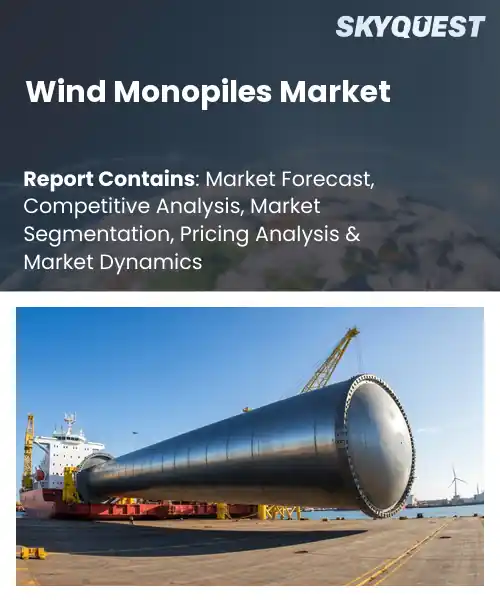
Wind Monopiles Market
Report ID: SQMIG20E2238
Report ID: SQMIG20E2238
[email protected]
USA +1 351-333-4748
Report ID:
SQMIG20E2238 |
Region:
Global |
Published Date: July, 2026
Pages:
157
|Tables:
149
|Figures:
78


Global Wind Monopiles Market size was valued at USD 624.3 Million in 2024 and is poised to grow from USD 659.26 Million in 2025 to USD 1019.46 Million by 2033, growing at a CAGR of 5.6% during the forecast period (2026-2033).
The global wind monopile market is putting more focus on steel bases for offshore wind turbines, which is a crucial chunk of renewable energy development. The rising demand for lower-carbon electricity is nudging governments and utilities toward offshore farms with rotors that are actually larger than what is typically seen.
A key driver for the wind monopiles market growth is the rise climb in capacity, set right alongside the shift toward bigger turbines that, as a rule, demand deeper plus stronger foundations. As OEMs move toward 12- to 15-MW units, monopile providers will basically need to enlarge pile diameters and extend embedment lengths, that in turn boosts steel demand and also accelerates the evolution of high-strength alloys. This upscaling creates opportunities for integrated service providers. Hornsea Two project demonstrates how 12-meter piles allowed a 1.2 GW farm at 70 meters depth. This results in heavy investment into deep water areas such as the UK and Taiwan, cementing the growth of renewable energy sources and creating large ancillary markets for protective coatings and offshore logistics.
AI-based automation is transforming the wind monopiles market outlook, with intelligent software connecting design, manufacturing, and logistics. Machine-learning models can predict the soil conditions and load requirements, so engineers can size the monopiles with the least amount of waste. Robots guarantee constant quality in cutting, welding and surface treatment, freeing qualified people to work on higher added value projects. By feeding digital twins real-time data from sensors on production lines, they can identify bottlenecks well in advance of a project stalling. The seamless flow reduces lead times and allows the industry to go deeper water and larger foundations – keeping projects on schedule as offshore wind demand accelerates.
Market snapshot - (2026-2033)
Global Market Size
USD 624.3 Million
Largest Segment
Standard Monopiles
Fastest Growth
XL Monopiles
Growth Rate
5.6% CAGR
To get more insights on this market click here to Request a Free Sample Report
The global wind monopiles market is segmented by monopile type, water depth, foundation diameter, application, end user and region. Based on monopile type, the market is segmented into Standard Monopiles, XL Monopiles, Transition Piece Monopiles and Others. Based on water depth, the market is segmented into Shallow Water, Transitional Water, Deep Water and Others. Based on foundation diameter, the market is segmented into Up to 8 m, 8–10 m, Above 10 m and Others. Based on application, the market is segmented into Offshore Wind Farms, Nearshore Wind Farms, Demonstration Projects and Others. Based on end user, the market is segmented into Wind Farm Developers, EPC Contractors, Offshore Installation Companies and Others. Based on region, the market is segmented into North America, Europe, Asia Pacific, Latin America and Middle East & Africa.
As per the wind monopiles market analysis, Standard monopiles dominate the market, due to their proven reliability and cost-effectiveness, and they are supported by supply chains that can meet most turbine demands. Also, the simple design reduces fabrication time, providing developers with the confidence that they can meet project deadlines. Preference is largely based on knowledge of the industry, lower engineering risk and compatibility with existing installation vessels. This further consolidates its position as the preferred choice for the majority of wind farm projects, irrespective of project sizes and turbine capacities.
However, the highest development velocity is seen in the XL Monopiles market, as engineers are targeting bigger turbine models that need higher load capacity. Improved fabrication and metallurgy now allow wider and longer piles to be constructed. Where possible, the depth of the water is increased. This invention unlocks the possibility for higher energy sites and speeds up market development and attracts new investment in the offshore sector.
According to the wind monopiles market forecast, the Shallow Water category dominates because project developers prefer sites where installation vessels can be operated with minimal logistical difficulty. The reduced water depth translates into fewer piles, reducing material costs and simplifying pile driving procedures. The efficiencies that shallow sites allow means faster project timelines and lower CAPEX in general, which is why shallow sites are still the preferred choice for many developers, particularly for early-stage farms that want to prove viability and manage financial exposure.
Whereas deep water segment is the main high development area, as developers seek out locations with higher wind resources farther offshore and turbine capacity expands. The improved pile-driving equipment and installation vessels reduce the risk of operations, and legislative incentives encourage the use of sites with higher energy content. This causes demand to increase and speeds up the industry in the future.
To get detailed segments analysis, Request a Free Sample Report
As per the wind monopiles market regional forecast, Asia Pacific is leveraging on high offshore wind potential, the region’s strong engineering capabilities and progressive policy frameworks to retain its market leadership. South Korea and Japan’s sophisticated manufacturing ecosystems enable the production of high-quality steel and precision construction of monopile solutions. Strategic port infrastructure enables effective logistics in large scale project deployments. The collaborative nature of these research projects means technology is constantly improving. Government incentives to support renewable energy integration. The technical expertise, strong supply chain and regulatory landscape are giving us a competitive edge that keeps us ahead with a range of offshore wind projects.
Japan Wind Monopiles Market
The Japanese wind monopiles sector has reliable parts for offshore projects given the strong maritime engineering tradition and the developed industrial base. Design standards that are “green” are spurring innovation in corrosion resistance and material efficiency. Monopile suppliers and turbine manufacturers are collaborating closely to speed up project timelines and domestic legislative incentives are promoting the development of renewable energy. Collaborative research centers also play a role in design optimization, establishing Japan as a leader in high-performance monopile solutions.
South Korea Wind Monopiles Market
The South Korea’s wind monopile industry is fueled by its vibrant steel industry with its focus on fast production cycles and tight quality controls. Government-backed renewable projects are driving demand for offshore infrastructure and local businesses are at the forefront of cutting-edge fabrication techniques. Strategic coastal facilities and integrated supply chains reduce installation and transportation procedures. South Korea’s continued investment in R&D is improving the design of monopiles for deeper waters, positioning the country as a leader in the region’s nascent offshore wind market.
Europe is growing its wind monopiles market share due to strong renewable targets, advanced knowledge in offshore wind and a collaborative ecosystem where engineering capabilities meet favorable legislative conditions”. Leading countries invest heavily in research to increase the endurance of monopiles and reduce the costs of installation. Specialist producers form a strong network and high-quality components are readily available. The ports of the European Union are well positioned to conduct logistics efficiently and the common regulatory regimes facilitate cross-border financing of projects. All these things coalesce to form a framework that puts Europe at the forefront of building offshore wind infrastructure.
Germany Wind Monopiles Market
The wind monopile market in Germany is supported by a strong steel industry and a long history of precise engineering producing reliable, high-strength parts. With the government funding offshore wind projects there is a need for sophisticated monopile solutions and manufacturers are forced to use novel production techniques. Integrated supply chains and a well-developed port infrastructure lead to shortened lead times. The aim of joint research institutes is to improve fatigue performance. This blend of policy support and technical sophistication guarantees Germany’s lead in the European market.
UK Wind Monopiles Market
The UK wind monopile market penetration is growing quickly driven by aggressive offshore wind deployment plans and targeted subsidies to reduce project risk. Shipyards and specialized manufacturing facilities that are effective in production and installation exist already. Academia and industry are working together to improve monopile design for deeper water sites. The project deadlines have been not only shortened but the streamlined approvals also bolster the UK’s role as a key growth driver for Europe’s wind monopile sector.
France Wind Monopiles Market
The French wind monopiles market is growing, primarily due to significant investments in offshore wind corridors and a growing local manufacturing base. The development of corrosion-resistant monopile solutions for a variety of seabed conditions has been centred around sustainable engineering practices. Cooperation between steel makers and energy developers will boost supply chain resilience. Industry-friendly fiscal policies will attract international cooperation. These joint efforts are driving France’s evolution from a small player to a major player in the European wind monopile market.
North America is beefing up its stake on wind monopiles, with a combination of a growing pipeline of offshore projects, state-of-the-art manufacturing techniques and strong federal incentives for clean energy integration. The US has a far larger coastline and better wind resources, so it has gone for larger turbine platforms and more sophisticated monopile designs. Canada’s massive steel-making capacity and cold-weather engineering expertise provide strong components for northern projects. Ports that are strategically located are supporting logistics, and research done in collaboration aims to improve the performance of monopiles in deeper waters. This holistic approach supports the growing local awareness of offshore wind infrastructure.
U.S. Wind Monopiles Market
A robust pipeline of offshore wind projects along the Atlantic and Gulf Coast is driving the U.S. wind monopile market. Coastal ports able to handle heavy lifts are speeding up component deliveries, while advanced manufacturing facilities are providing high-strength steel for larger turbine diameters. Government efforts are focused on increasing domestic manufacturing to build a strong supply chain and lower dependence on imports. Engineering research that improves fatigue resistance and installation efficiency enhances the United States’ ability to meet growing expectations for offshore renewable energy.
Canada Wind Monopiles Market
The Canadian wind monopile market, which manufactures monopiles for harsh marine conditions, is supported by strong steel production and knowledge of cold weather engineering. Demand for locally manufactured components is driven by federal support for green projects, and the port infrastructure on the Atlantic coast supports exports and installations. Manufacturers and research organizations are working together to improve structural integrity and corrosion protection for deep-water use. Canada has the industrial capacity and the regulatory support to play a meaningful role in the development of offshore wind in North America.
To know more about the market opportunities by region and country, click here to
Buy The Complete Report
Increasing Renewable Energy Policies
Governments worldwide are setting ambitious sustainable energy targets and the wind farm industry is benefiting from favourable regulatory frameworks. Developers like monopile foundation projects because of the strong investment environment these policies create. This leads to a need for reliable and cost-effective support systems, thereby encouraging the development of industrial capacity expansion and supply chain maturity. This consistent policy push accelerates market development by aligning stakeholder interests for deployment of sustainable energy infrastructure and creating long-term commitments from utilities and investors across all the major offshore regions.
Advancements In Monopile Design
Recent engineering advances have made it possible to produce T-Lighter, more structurally robust monopiles, which can be used in deeper water and more aggressive seabed conditions. These developments make offshore wind projects more attractive to developers by easing the logistics of the foundation and improving the overall project economics. This boosts the quantity of viable sites and cuts down on material usage, which lets manufacturers propose sharper solutions that keep adapting as turbine requirements evolve. So, the sector is getting way more engaging , because innovators are taking advanced monopile systems from shared research efforts across the world , and using them to squeeze more energy out and also push down levelized costs.
High Installation Cost Challenges
The major barrier is the high installation costs. To install the monopiles in the offshore environment, specialized vessels and large lift equipment are required. Such resources and complex seabed preparatory work are deterrents to smaller developers and increase budgets for projects overall. The lack of funding possibilities is making stakeholders more frugal and they are re-evaluating their choice of foundation. Thus, even though the monopile installation can have long term benefits and comply with the regulatory criteria, the market expansion is limited by the financial risk assessment which favours other cheaper alternatives.
Logistical Constraints In Remote Areas
Many sites are remote or deep-water, limiting logistics for handling and transport of massive monopile components, and requiring extensive coordination and custom infrastructure. Installation windows are constrained by harsh marine conditions and lack of port capacity requires reliance on remote facilities, increasing lead times and operating uncertainty. These challenges increase the risk and cost of the project and discourage investment in areas lacking adequate support services. “As a result, market expansion slows as developers turn their attention to more accessible places with simpler supply chain solutions.
Request Free Customization of this report to help us to meet your business objectives.
The global monopiles market for wind power is highly competitive, with manufacturers focusing on strategic M&A, joint ventures, and technology-based product improvements. Recently, leading companies have hired specialized foundation experts to expand their offshore portfolios and are working with turbine OEMs to accelerate the deployment of larger diameter monopiles for next generation turbines. The rise of digital manufacturing platforms and modular construction, which allow for faster deployment and lower costs, is a key differentiator and heightens regional rivalry.
Top Player’s Company Profile
Recent Developments in the Wind Monopiles Market
July 2025: Bladt Industries A/S and CS Wind Corporation jointly developed a modular offshore monopile system for rapid installation in the North Sea. As moving forward to the next generation of large-scale 10-megawatt turbines, Bladt’s experience in precision pipe manufacturing and CS Wind’s expertise in aerodynamic tower design are coming together to reduce construction times and improve adaptability.
January 2025: Dillinger Group purchased a pipe-fabrication company in the Baltic region, broadening its production base and adopting a new automated welding process for monopile production. The move boosts Dillinger’s ability to deliver complete turnkey solutions to offshore developers in Europe, and improves project lead times and supply chain resilience overall.
SkyQuest’s ABIRAW (Advanced Business Intelligence, Research & Analysis Wing) is our Business Information Services team that Collects, Collates, Correlates, and Analyses the Data collected by means of Primary Exploratory Research backed by robust Secondary Desk research.
As per SkyQuest analysis, the global wind monopile market is driven by the increasing wind energy policies, which provide a stable investment climate for offshore projects. A significant factor is also the pace of change in monopile design, with lighter structures being developed for installation in deeper waters. Legislation is encouraging and steel production is robust, giving the Asia Pacific region a competitive advantage in the industry. The monopod is the most widely used foundation, because it is proven to be reliable, and also cost effective, in practice. Still, the higher installation costs can discourage smaller developers and bump up project budgets, which in turn slows the overall growth. Taken together, these elements suggest a market that should keep growing steadily.
| Report Metric | Details |
|---|---|
| Market size value in 2024 | USD 624.3 Million |
| Market size value in 2033 | USD 1019.46 Million |
| Growth Rate | 5.6% |
| Base year | 2024 |
| Forecast period | (2026-2033) |
| Forecast Unit (Value) | USD Million |
| Segments covered |
|
| Regions covered | North America (US, Canada), Europe (Germany, France, United Kingdom, Italy, Spain, Rest of Europe), Asia Pacific (China, India, Japan, Rest of Asia-Pacific), Latin America (Brazil, Rest of Latin America), Middle East & Africa (South Africa, GCC Countries, Rest of MEA) |
| Companies covered |
|
| Customization scope | Free report customization with purchase. Customization includes:-
|
To get a free trial access to our platform which is a one stop solution for all your data requirements for quicker decision making. This platform allows you to compare markets, competitors who are prominent in the market, and mega trends that are influencing the dynamics in the market. Also, get access to detailed SkyQuest exclusive matrix.
Table Of Content
Executive Summary
Market overview
Parent Market Analysis
Market overview
Market size
KEY MARKET INSIGHTS
COVID IMPACT
MARKET DYNAMICS & OUTLOOK
Market Size by Region
KEY COMPANY PROFILES
Methodology
For the Wind Monopiles Market, our research methodology involved a mixture of primary and secondary data sources. Key steps involved in the research process are listed below:
1. Information Procurement: This stage involved the procurement of Market data or related information via primary and secondary sources. The various secondary sources used included various company websites, annual reports, trade databases, and paid databases such as Hoover's, Bloomberg Business, Factiva, and Avention. Our team did 45 primary interactions Globally which included several stakeholders such as manufacturers, customers, key opinion leaders, etc. Overall, information procurement was one of the most extensive stages in our research process.
2. Information Analysis: This step involved triangulation of data through bottom-up and top-down approaches to estimate and validate the total size and future estimate of the Wind Monopiles Market.
3. Report Formulation: The final step entailed the placement of data points in appropriate Market spaces in an attempt to deduce viable conclusions.
4. Validation & Publishing: Validation is the most important step in the process. Validation & re-validation via an intricately designed process helped us finalize data points to be used for final calculations. The final Market estimates and forecasts were then aligned and sent to our panel of industry experts for validation of data. Once the validation was done the report was sent to our Quality Assurance team to ensure adherence to style guides, consistency & design.
Analyst Support
Customization Options
With the given market data, our dedicated team of analysts can offer you the following customization options are available for the Wind Monopiles Market:
Product Analysis: Product matrix, which offers a detailed comparison of the product portfolio of companies.
Regional Analysis: Further analysis of the Wind Monopiles Market for additional countries.
Competitive Analysis: Detailed analysis and profiling of additional Market players & comparative analysis of competitive products.
Go to Market Strategy: Find the high-growth channels to invest your marketing efforts and increase your customer base.
Innovation Mapping: Identify racial solutions and innovation, connected to deep ecosystems of innovators, start-ups, academics, and strategic partners.
Category Intelligence: Customized intelligence that is relevant to their supply Markets will enable them to make smarter sourcing decisions and improve their category management.
Public Company Transcript Analysis: To improve the investment performance by generating new alpha and making better-informed decisions.
Social Media Listening: To analyze the conversations and trends happening not just around your brand, but around your industry as a whole, and use those insights to make better Marketing decisions.
REQUEST FOR SAMPLE
 REQUEST FREE CUSTOMIZATION
Global Wind Monopiles Market size was valued at USD 624.3 Million in 2024 and is poised to grow from USD 659.26 Million in 2025 to USD 1019.46 Million by 2033, growing at a CAGR of 5.6% during the forecast period (2026-2033).
The competitive landscape of the global wind monopiles market is shaped by intense rivalry among manufacturers pursuing strategic M&A, joint ventures, and technology‑driven product upgrades. Recent years have seen leading firms acquire niche foundation specialists to broaden their offshore portfolios, while partnerships with turbine OEMs accelerate the rollout of larger‑diameter monopiles designed for next‑generation turbines. Innovation in modular construction and digital manufacturing platforms is a key differentiator, enabling faster deployment and cost reductions that intensify competition across regions. 'Dillinger Group', 'EEW Special Pipe Constructions GmbH', 'Sif Holding N.V.', 'CS Wind Corporation', 'Steelwind Nordenham GmbH', 'Bladt Industries A/S', 'Navantia S.A.', 'Haizea Wind Group', 'SeAH Steel Holdings Corporation', 'Welcon A/S', 'Smulders Group', 'Marmen Inc.', 'Shanghai Taisheng Wind Power Equipment Co., Ltd.', 'Zhuhai Guangtong Marine Engineering Co., Ltd.', 'TPCO (Tianjin Pipe Corporation)', 'Baosteel Co., Ltd.', 'JFE Steel Corporation', 'Nippon Steel Corporation', 'Mitsui E&S Co., Ltd.', 'Lamprell plc'
Renewable Grid Integration: The accelerating deployment of offshore wind farms is driving utilities to prioritize seamless grid integration, prompting manufacturers to design monopiles with enhanced compatibility for larger turbine platforms and advanced foundation monitoring systems. Stakeholders are collaborating on standardized connection protocols and digital twins that simulate load dynamics, reducing commissioning delays. This focus on grid readiness not only improves project reliability but also aligns with policy incentives encouraging renewable energy penetration, thereby expanding demand for adaptable, high‑performance monopile solutions across emerging markets.
Why does Asia Pacific Dominate the Global Wind Monopiles Market? |@12


Want to customize this report? This report can be personalized according to your needs. Our analysts and industry experts will work directly with you to understand your requirements and provide you with customized data in a short amount of time. We offer $1000 worth of FREE customization at the time of purchase.
Feedback From Our Clients


 USA (+1) 351-333-4748

