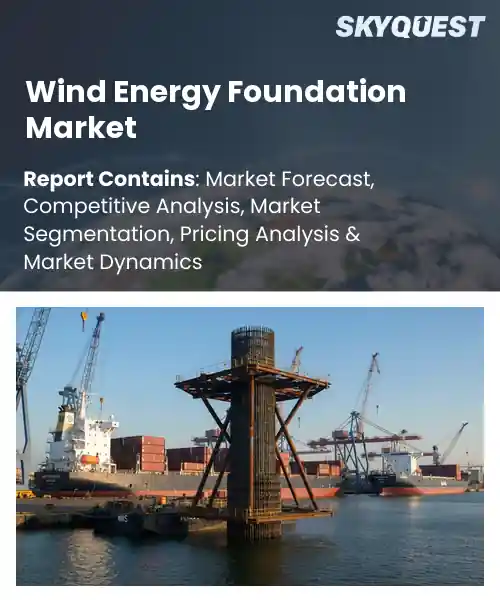
Wind Energy Foundation Market
Report ID: SQMIG10B2182
Report ID: SQMIG10B2182
[email protected]
USA +1 351-333-4748
Report ID:
SQMIG10B2182 |
Region:
Global |
Published Date: June, 2026
Pages:
157
|Tables:
119
|Figures:
77


Global Wind Energy Foundation Market size was valued at USD 66.95 Billion in 2024 and is poised to grow from USD 71.17 Billion in 2025 to USD 116.02 Billion by 2033, growing at a CAGR of 6.3% during the forecast period (2026-2033).
Rising investments in renewable energy infrastructure, increasing deployment of onshore and offshore wind farms, supportive government policies for clean energy generation, advancements in turbine technologies, and rising demand for low-carbon electricity are driving sales of wind energy foundations.
Growing focus on renewable power generation and decarbonization is expected to primarily drive wind energy foundation market growth. Increasing turbine scaling and further moves to greater water depths off shore are the latest of a series of large growth drivers. The increasingly powerful nature of turbines is necessitating a greater load capacity of foundations under increasing difficult conditions. This is seeing more advanced monopile and jacket type structures and floating foundations, as well as investments in manufacturing capability and capacity, heavy lift vessel and digital engineering technology. The increasing build of offshore wind capacity offers further opportunity for manufacturers of foundations, and also the many firms providing engineering and construction services to build and install the structures. Long term policy, including auction processes and local content, offer long term project security and drive investment, helping to support a strong growth of this sector.
However, high installation and transportation costs, supply chain constraints for large steel components, complex permitting requirements, and exposure to raw material price fluctuations are anticipated to slow down wind energy foundation market penetration across the forecast period.
How is AI Enhancing Wind Energy Foundation Design Efficiency?
By combining ground conditions, the site location, structural analysis and designs into one design process, AI technology has sped up design on wind energy foundation market. Engineers can examine more designs much faster, and take less risks by applying these technologies. AI technology is capable of analyzing the ground condition, foundation loads and the effects of the environment to find out design easier for manufacturing, transportation and installation. As wind turbines get bigger and offshore locations getting deeper, the engineering complexities will grow higher and higher. It could help developers in optimizing the monopile, jacket, floating foundation designs in material usage reduction, shorten development cycle time.
Market snapshot - (2026-2033)
Global Market Size
USD 66.95 Billion
Largest Segment
Monopile
Fastest Growth
Floating
Growth Rate
6.3% CAGR
To get more insights on this market click here to Request a Free Sample Report
Global wind energy foundation market is segmented by foundation type, turbine orientation, installation type, application, and region. Based on foundation type, the market is segmented into monopile, jacket, gravity based, floating, and others. Based on turbine orientation, the market is segmented into horizontal axis and vertical axis. Based on installation type, the market is segmented into grid connected and off grid. Based on application, the market is segmented into commercial, industrial, residential, utility, and others. Based on region, the market is segmented into North America, Europe, Asia Pacific, Latin America, and Middle East & Africa.
The monopile segment is anticipated to account for the highest global wind energy foundation market share going forward. Its straightforward geometry and well-established installation method cut down the engineering work and allow fast deployment on the shallow to intermediate water sites. Construction vendors have working knowledge of common piling gear and standard design, thereby reducing project risk and expediting project execution. Such cumulative working knowledge experience leads to perceived cost advantages, smoother logistics and consistent flow of operations further strengthening monopile’s position at the pre-project and procurement stage of shallow to intermediate water projects.
However, jacket foundations are emerging as the most rapidly expanding segment as per this wind energy foundation market forecast. As their larger size and design allows them to operate at greater depths and with more weight, thus creating a resource to be exploited in regions that were previously inaccessible to development. Advances in modular fabrication techniques and the capabilities of installation vessels, together with the growing enthusiasm for platform stability among developers, stimulate development, creating more demand for specialist suppliers and services.
The horizontal axis segment is anticipated to lead the global wind energy foundation market revenue generation over the coming years. Due to aerodynamic efficiencies and evolved turbine technology, predictable load trends are already known and allow easier foundation design and certification. A large number of operational data and a well-developed supply chain offer developers and engineers with technical certainty and decreased perceived risk. This knowledge of load transfer and foundation interface has led to selection of fairly standard foundations and helped develop contractor experience, and has facilitated permitting and financing for a variety of sites.
However, vertical axis turbines are emerging as the fastest-growing segment enabled by reduced footprint size and a reduced number of dynamic loads which facilitate new and less costly foundation designs. As a result, renewed interest and prototype installations are stimulating specialty manufacturers and investors, which in turn spurs more research and development into other foundation-interface approaches and opens new opportunities for other site-constrained or challenging applications.
To get detailed segments analysis, Request a Free Sample Report
Extensive coastal and inland wind resources, concentrated industrial capacity for foundation fabrication, and integrated supply chains are helping this region hold sway over others. In many countries, policies in the region have prioritized the implementation of renewable infrastructure, creating a reliable market for foundations as well as supporting the development of local procurement and installation expertise. As the number of specialized engineering firms and port facilities located in the Asia-Pacific grows, so does the number of their projects that have unique requirements for foundation types due to the nature of the location (offshore and nearshore) and environmental conditions. Growing support of new and innovative foundations has been further accelerated by collaborative research between utilities, fabricators, and universities, which is making it possible for new and innovative foundations to be developed and deployed more quickly than ever before. In addition, the availability of regional financing mechanisms as well as increased levels of construction experience with foundations has also decreased the perceived risk of building large-scale foundation programs in the region.
Wind energy foundation market in Japan leverages a skilled marine engineering base and advanced fabrication capabilities to support fixed and floating foundation deployments. Established port infrastructure and experienced contractors enable complex logistics and offshore installation. Collaboration between manufacturers, utilities, and research institutions adapts foundation designs to local seabed conditions. Policy emphasis on energy security stimulates project pipelines, encouraging domestic supply chain development and sustained market activity and supports regional installation capacity.
Demand for wind energy foundation in South Korea benefits from an established heavy fabrication industry and competitive shipyard capabilities that translate into robust foundation manufacturing. Proximity of engineering consultancies and marine logistics hubs simplifies project mobilization for nearshore and offshore developments. Public and private collaboration fosters technology transfer and skill development, enabling adaptation of foundation solutions to varied seabed profiles. This integrated ecosystem supports domestic demand and positions local firms for exports.
Ambitious decarbonization goals, concentrated offshore wind resource development, and a mature industrial base are helping boost demand for wind energy foundation solutions in Europe. The use of long-term policy frameworks and coordinated maritime spatialization will help eliminate permitting obstacles and create predictable project pipelines, encouraging investment in specialization, including monopole, jacket, and floating foundations. An extensive network of ports, specialized construction yards, and contracted installers facilitates effective project delivery. Cross country working on standards, certifications, and joint procurement helps to provide a healthy regional supply chain, while active domestic markets within key countries help to promote localized manufacturing and innovation and support Europe's dominant position in foundation engineering and installation. Extensive investment in research and development and robust technical training systems will provide a steady supply of engineers and installers who are experienced in solving complex marine geotechnical problems. The focus on standardization and incremental design optimization decreases execution risk and enables manufacturing companies to expand their fabrication practices into various markets.
Wind energy foundation market in Germany benefits from an integrated manufacturing ecosystem, equipped shipyards, and deep engineering expertise that support delivery of complex foundation types. Demand from domestic and regional projects fosters specialization across monopile and jacket fabrication. Coordination among ports, logistics providers, and installation contractors enables efficient mobilization. Policy stability and a skilled workforce encourage refinement of foundation engineering, while research programs promote innovation and standardization across supply chains and export market engagement.
Wind energy foundation market in the United Kingdom benefits from extensive offshore development experience and specialized installation contractors adept at challenging marine conditions. A concentration of port upgrades and logistics capabilities supports efficient staging and lift operations for complex foundations. Industry collaboration on certification and safety practices accelerates adoption of foundation concepts, while strong professional services underpin geotechnical and engineering design. This environment attracts investment in fabrication, installation expertise and foundation approaches.
Wind energy foundation demand in France is emerging through investments in port upgrades, fabrication yards, and geotechnical expertise to support offshore foundation projects. A growing ecosystem of engineering consultancies and marine contractors adapts international designs to local seabed and environmental requirements. Public procurement and pilot initiatives encourage experimentation with foundation typologies, while integration with domestic manufacturing strengthens local content. These developments build a credible foundation market with growing technical depth locally.
Domestic manufacturing, port modernization, and collaboration between public and private stakeholders that streamline foundation procurement and installation create new opportunities. Consolidation and strategic alliances create a flow of knowledge between onshore/offshore practices and provide support for the safe adoption of newly developed foundation technologies through partnerships with research organizations and certification companies. Efforts focused on workforce training, standardization of processes, and supplier readiness will reduce risks associated with execution and improve regional competitiveness in the delivery of foundations. Finally, public incentives or funding programs to promote growth at strategic yards and renovation of existing facilities to facilitate the fabrication and assembly of foundations will improve project timelines and social license for foundation projects through greater efficiencies in the environmental permitting process and community engagement; thus enabling a more reliable program delivery and attracting vendors to increase production for foundations for North American projects.
Wind energy foundation market in the United States leverages an industrial base and port infrastructure alongside specialized fabrication yards and installation contractors. Coordination between permitting authorities, research institutions, and industry supports efficient project planning and technological adaptation. Investment in workforce training and vessel capacity improves readiness for offshore foundation programs. These factors support expansion of domestic fabrication and enable United States suppliers to participate more actively in regional projects and export opportunities.
Demand for wind energy foundation in Canada benefits from strategic port locations, growing fabrication capability, and strong engineering services adapting foundation designs for local marine conditions. Partnerships between provincial governments, industry, and research bodies contribute to geotechnical review and adoption of technology. Investments in upgrading of ports and in heavy lift capability increase staging space for fabrication of foundations. These strengths allow Canada to scale up domestic fabrication, as well as to provide specialized services to other offshore projects and partnerships in the region.
To know more about the market opportunities by region and country, click here to
Buy The Complete Report
Increasing Government Renewable Targets
Advances In Turbine Efficiency
Transmission And Grid Bottlenecks
Supply Chain Material Constraints
Request Free Customization of this report to help us to meet your business objectives.
Competition in the wind energy foundation market is intensifying as firms pursue industrialized foundation designs and installation solutions to lower project complexity and supply chain risk; this drives consolidation through M&A and strategic alliances, and accelerates platform innovation. Recent examples include large contractors taking majority stakes in floating foundation ventures and dedicated partnership projects on modular floating concepts, alongside new entrants demonstrating folding platforms and safe anchorage systems.
SkyQuest’s ABIRAW (Advanced Business Intelligence, Research & Analysis Wing) is our Business Information Services team that Collects, Collates, Correlates, and Analyses the Data collected by means of Primary Exploratory Research backed by robust Secondary Desk research.
As per SkyQuest analysis, deployment of onshore and offshore wind farms, supportive government policies for clean energy generation, advancements in turbine technologies, and rising demand for low-carbon electricity are anticipated to drive the demand for wind energy foundations going forward. However, high installation and transportation costs, supply chain constraints for large steel components, complex permitting requirements, and exposure to raw material price fluctuations are slated to slow down the adoption of wind energy foundations in the future. Asia Pacific is slated to spearhead the demand for wind energy foundations owing to its strong offshore wind development pipeline, ambitious renewable energy targets, supportive policy framework, and substantial investments in grid modernization and clean energy infrastructure. Development of AI-powered foundation design solutions, integration of digital twins for project planning and validation, and growing adoption of advanced monopile, jacket, and floating foundation technologies are anticipated to be key trends driving the wind energy foundation market over the coming years.
| Report Metric | Details |
|---|---|
| Market size value in 2024 | USD 66.95 Billion |
| Market size value in 2033 | USD 116.02 Billion |
| Growth Rate | 6.3% |
| Base year | 2024 |
| Forecast period | (2026-2033) |
| Forecast Unit (Value) | USD Billion |
| Segments covered |
|
| Regions covered | North America (US, Canada), Europe (Germany, France, United Kingdom, Italy, Spain, Rest of Europe), Asia Pacific (China, India, Japan, Rest of Asia-Pacific), Latin America (Brazil, Rest of Latin America), Middle East & Africa (South Africa, GCC Countries, Rest of MEA) |
| Companies covered |
|
| Customization scope | Free report customization with purchase. Customization includes:-
|
To get a free trial access to our platform which is a one stop solution for all your data requirements for quicker decision making. This platform allows you to compare markets, competitors who are prominent in the market, and mega trends that are influencing the dynamics in the market. Also, get access to detailed SkyQuest exclusive matrix.
Table Of Content
Executive Summary
Market overview
Parent Market Analysis
Market overview
Market size
KEY MARKET INSIGHTS
COVID IMPACT
MARKET DYNAMICS & OUTLOOK
Market Size by Region
KEY COMPANY PROFILES
Methodology
For the Wind Energy Foundation Market, our research methodology involved a mixture of primary and secondary data sources. Key steps involved in the research process are listed below:
1. Information Procurement: This stage involved the procurement of Market data or related information via primary and secondary sources. The various secondary sources used included various company websites, annual reports, trade databases, and paid databases such as Hoover's, Bloomberg Business, Factiva, and Avention. Our team did 45 primary interactions Globally which included several stakeholders such as manufacturers, customers, key opinion leaders, etc. Overall, information procurement was one of the most extensive stages in our research process.
2. Information Analysis: This step involved triangulation of data through bottom-up and top-down approaches to estimate and validate the total size and future estimate of the Wind Energy Foundation Market.
3. Report Formulation: The final step entailed the placement of data points in appropriate Market spaces in an attempt to deduce viable conclusions.
4. Validation & Publishing: Validation is the most important step in the process. Validation & re-validation via an intricately designed process helped us finalize data points to be used for final calculations. The final Market estimates and forecasts were then aligned and sent to our panel of industry experts for validation of data. Once the validation was done the report was sent to our Quality Assurance team to ensure adherence to style guides, consistency & design.
Analyst Support
Customization Options
With the given market data, our dedicated team of analysts can offer you the following customization options are available for the Wind Energy Foundation Market:
Product Analysis: Product matrix, which offers a detailed comparison of the product portfolio of companies.
Regional Analysis: Further analysis of the Wind Energy Foundation Market for additional countries.
Competitive Analysis: Detailed analysis and profiling of additional Market players & comparative analysis of competitive products.
Go to Market Strategy: Find the high-growth channels to invest your marketing efforts and increase your customer base.
Innovation Mapping: Identify racial solutions and innovation, connected to deep ecosystems of innovators, start-ups, academics, and strategic partners.
Category Intelligence: Customized intelligence that is relevant to their supply Markets will enable them to make smarter sourcing decisions and improve their category management.
Public Company Transcript Analysis: To improve the investment performance by generating new alpha and making better-informed decisions.
Social Media Listening: To analyze the conversations and trends happening not just around your brand, but around your industry as a whole, and use those insights to make better Marketing decisions.
REQUEST FOR SAMPLE
 REQUEST FREE CUSTOMIZATION
Global Wind Energy Foundation Market size was valued at USD 66.95 Billion in 2024 and is poised to grow from USD 71.17 Billion in 2025 to USD 116.02 Billion by 2033, growing at a CAGR of 6.3% during the forecast period (2026-2033).
Competition in the wind energy foundation market is intensifying as firms pursue industrialized foundation designs and installation solutions to lower project complexity and supply chain risk; this drives consolidation through M&A and strategic alliances, and accelerates platform innovation. Recent examples include large contractors taking majority stakes in floating foundation ventures and dedicated partnership projects on modular floating concepts, alongside new entrants demonstrating folding platforms and safe anchorage systems. 'Bladt Industries', 'Sif Group', 'EEW Group', 'Smulders', 'Steelwind Nordenham', 'Dajin Heavy Industry', 'Taisun', 'Navantia', 'Lamprell', 'GICON', 'Ramboll Group', 'Arup', 'ArcelorMittal', 'Nippon Steel Corporation', 'DNV', 'Fugro', 'Peikko Group', 'COWI', 'Jan De Nul Group', 'Van Oord'
These targets create policy certainty and long horizon demand signals that encourage investment, capacity expansion, and long-term planning for wind energy projects, strengthening the foundation market. By setting clear goals, authorities stimulate supportive frameworks such as permitting acceleration, incentives, and coordinated grid upgrades, which reduce perceived project risk and attract public and private capital. The resulting alignment among stakeholders fosters supply chain scaling, technology deployment, and confidence in sustained market opportunities, thereby directly supporting expansion of global wind energy initiatives.
Floating Offshore Wind Scale: As developers pursue deeper-water sites, demand for novel foundation technologies and foundation solutions shifts toward floating platforms and advanced mooring systems. This trend stimulates collaboration across engineering, fabrication, and marine installation services, encouraging longer-term contracts and specialized vessel utilization. Policy support and pilot projects accelerate technology validation, while environmental and permitting considerations reshape foundation design choices. The foundation market sees opportunity in modular, adaptable systems and lifecycle service offerings that reduce deployment risk and enable more competitive project economics outcomes.
Why does Asia Pacific Dominate the Global Wind Energy Foundation Market? |@12


Want to customize this report? This report can be personalized according to your needs. Our analysts and industry experts will work directly with you to understand your requirements and provide you with customized data in a short amount of time. We offer $1000 worth of FREE customization at the time of purchase.
Feedback From Our Clients


 USA (+1) 351-333-4748

