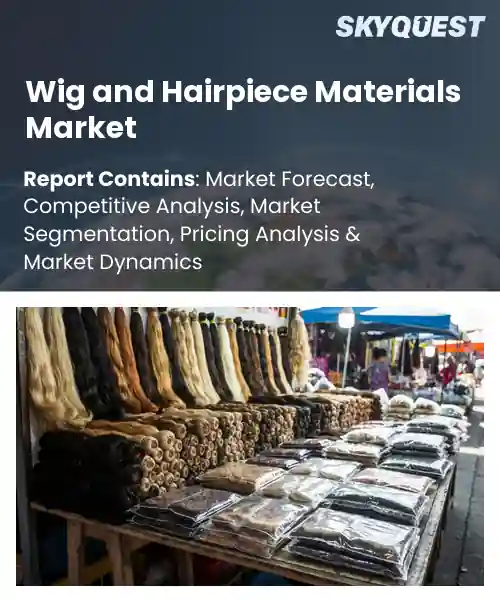
Wig and Hairpiece Materials Market
Report ID: SQMIG30L2466
Report ID: SQMIG30L2466
[email protected]
USA +1 351-333-4748
Report ID:
SQMIG30L2466 |
Region:
Global |
Published Date: July, 2026
Pages:
157
|Tables:
118
|Figures:
76


Global Wig and Hairpiece Materials Market size was valued at USD 840.12 Million in 2024 and is poised to grow from USD 876.25 Million in 2025 to USD 1227.16 Million by 2033, growing at a CAGR of 4.3% during the forecast period (2026-2033).
The Market for Global Wig and Hair Piece Materials refers to the production and sale of artificial materials like synthetic fibers, human hair, and combination of both, for use in manufacture of wigs. This market is very important as it has been witnessing an increasing need from medical patients, fashionistas, and showbiz personalities who require these products for aesthetic reasons. From very basic horsehair wigs available during the 19th century to modern heat-resistant polymer-based materials in early 2000, there have been significant improvements in the material used and thus growing needs of consumers. The current driving factor is increased incidence of hair loss due to chemotherapy.
The driving force behind the market for the materials used in wigs and hairpieces is the use of sustainable polymers, creating new opportunities for both manufacturers and consumers. With the growing need to reduce the release of microplastics into the environment, producers modify their nylon and polyester mixtures using biodegradable additives to create lightweight, strong fibers that keep their shine. In this case, fashion brands can introduce their green line of products that will be attractive to millennials, while the medical sector benefits from the lower amounts of allergens in those products.
How is AI-driven Material Optimization Influencing the Global Wig and Hairpiece Market?
Fiber selection using AI is revolutionizing the wig market by allowing designers to choose the right fibers, adhesives, and bases with greater accuracy. Artificial intelligence models measure durability, texture, and comfort, thus reducing the prototyping process. Also, this technology is capable of predicting how blends of synthetic materials will perform in different climate conditions, hence allowing brands to offer products tailored to the needs of different regions. Considering growing consumer preference for durable and comfortable wigs, the use of AI tools offers the information necessary to achieve a balance between costs and quality.
Market snapshot - (2026-2033)
Global Market Size
USD 840.12 Million
Largest Segment
Human Hair
Fastest Growth
Synthetic Fibers
Growth Rate
4.3% CAGR
To get more insights on this market click here to Request a Free Sample Report
Global wig and hairpiece materials market is segmented by core material, base foundation material, sourcing texture, distribution channel and region. Based on core material, the market is segmented into Human Hair and Synthetic Fibers. Based on base foundation material, the market is segmented into Lace Mesh, Monofilament Fabric, Polyurethane Skin and Others. Based on sourcing texture, the market is segmented into Straight, Wavy, Curly and Kinky. Based on distribution channel, the market is segmented into Business Wholesalers, Retail Hair Salons and E Commerce Marketplaces. Based on region, the market is segmented into North America, Europe, Asia Pacific, Latin America and Middle East & Africa.
Human hair segment dominates because it delivers unmatched authenticity and tactile feel that consumers associate with natural appearance. Its inherent ability to be styled, dyed, and blended with personal hair creates a seamless integration that synthetic alternatives struggle to replicate. The emotional connection to real hair, alongside proven durability and long term wear, fuels its preference among professional stylists and end users for bridal occasions, theatrical productions and confidence boosting.
However, synthetic fibers segment is witnessing the fastest growth rate because polymer engineering now delivers realistic shine, heat resistance, and tactile softness that narrow the gap with natural hair. Eco friendly production and lower cost attract price sensitive consumers and manufacturers, expanding application in ready to wear collections and enabling rapid market scaling.
Lace mesh segment leads because its fine netting gives unparalleled breathability and invisibility, allowing wearers to achieve a seamless scalp illusion that higher visibility bases cannot provide. The material’s lightweight nature reduces strain on the head, while its ability to be hand stitched enhances bespoke styling and color matching. These attributes satisfy consumer demand for comfort, realism, and personalization, making lace mesh the preferred choice among designers and salons worldwide today.
Meanwhile, polyurethane skin segment is emerging as the fastest growing segment because its silicone based surface mimics natural scalp texture while offering waterproof durability and easy maintenance. Compatibility with bonding adhesives expands use in medical wigs and active lifestyle collections, attracting users and stimulating attachment technology innovation. This momentum broadens market reach and creates revenue streams.
To get detailed segments analysis, Request a Free Sample Report
Asia Pacific benefits from a confluence of culture appreciating hair styling, large-scale manufacturing capabilities, and an abundance of skilled labor in textiles and polymer engineering. Consumers in this part of the world highly appreciate versatility in aesthetics, which leads to consistent demand for new synthetic fibers, combinations of human and artificial hair, and new adhesives. Well-developed logistics channels due to presence of major textile clusters provide for fast prototyping and low-cost manufacturing. Joint scientific institutions develop materials suited not only for every day use but also for particular medical purposes.
Market of Materials for Wigs and Hairpieces in Japan is characterized by an advanced consumer base which values quality and elegance in their products. Local producers combine skilled craftsmanship with top-quality synthetics to cater to their customers' demands. The focus on light and natural appearance goes well with the trend towards elegant minimalism in the local culture. Good collaboration between design firms and suppliers fuels innovation in the market.
South Korea Market of Wig and Hairpiece Materials succeeds owing to a strong fashion culture and quick adaptation to the latest trends. Local manufacturers demonstrate outstanding skills in the use of advanced polymer technology, which ensures durability and flexibility of the materials. The emphasis on bright colors and variety of possibilities fits the preferences of young people who strive for individual styling. Partnership between beauty bloggers and material inventors facilitates the development of products.
The continent of North America enjoys the advantage of a combination of healthy consumer confidence, varied lifestyles, and developed beauty retail sector. Consumer confidence is significantly linked to the importance placed on individualism, which creates demand for wigs among both regular and special users. Innovations from research centers are responsible for the manufacture of breathable fabrics, light weight polymers, and natural adhesives, making the product comfortable for the user. Personalized fitting retail outlets increase market presence, and the regulatory framework guarantees safety and quality of products.
The US Wig and Hairpieces Materials Market is characterized by diverse needs of customers, starting from casual uses to performance-oriented uses. Companies make use of advanced synthetic materials combining realism and durability to satisfy the demand for long-lasting products. Introduction of innovative textile features like moisture-wicking or thermal control solves comfort-related issues. The well-established distribution channels and e-commerce channels help with the rapid diffusion of products.
Canadian Wig and Hairpiece Materials Market concentrates on maintaining high levels of quality and sustainability in line with the consumers’ preferences for ethically sourced materials. Canadian manufacturers concentrate on developing blends, which possess natural appearance and are durable enough to withstand different weather conditions. Cooperation with research institutes promotes the development of bio-degradable polymers and production technologies. Personalized fitting at retail stores builds consumer confidence and expands the market.
To know more about the market opportunities by region and country, click here to
Buy The Complete Report
Rising Demand for Customizable Wigs
Advancements in Synthetic Fiber Technology
High Cost of Premium Materials
Regulatory Scrutiny on Chemical Processes
Request Free Customization of this report to help us to meet your business objectives.
The environment is determined by the rapid pace of M&A undertaken by manufacturers to consolidate synthetic fiber producers, as well as collaborations between dominant brands and textile firms to develop light, airy wig caps; instances include an M&A deal undertaken by a dominant hairpiece producer with a polymer company and a collaboration between a leading brand and a 3-D printer manufacturer for customized hair fiber mixes.
SkyQuest’s ABIRAW (Advanced Business Intelligence, Research & Analysis Wing) is our Business Information Services team that Collects, Collates, Correlates, and Analyses the Data collected by means of Primary Exploratory Research backed by robust Secondary Desk research.
As per SkyQuest analysis, the global market for wig and hairpiece materials is mainly driven by an increasing requirement for customized wigs, leading manufacturers to offer flexible ranges, while the second factor influencing the market is the fast development of artificial fibers technology providing lighter, heat-resistant, and realistic-looking strands. A major constraint for the market is the costly prices of high-quality natural fibers and medical-grade polymers, which may restrain their adoption due to costs. The Asia Pacific region leads the market owing to its high cultural inclination towards hair dressing, vast textile industry, and cost-efficient manufacturing capabilities. In terms of product, the human hair core material type is the dominant one due to its high level of authenticity.
| Report Metric | Details |
|---|---|
| Market size value in 2024 | USD 840.12 Million |
| Market size value in 2033 | USD 1227.16 Million |
| Growth Rate | 4.3% |
| Base year | 2024 |
| Forecast period | (2026-2033) |
| Forecast Unit (Value) | USD Million |
| Segments covered |
|
| Regions covered | North America (US, Canada), Europe (Germany, France, United Kingdom, Italy, Spain, Rest of Europe), Asia Pacific (China, India, Japan, Rest of Asia-Pacific), Latin America (Brazil, Rest of Latin America), Middle East & Africa (South Africa, GCC Countries, Rest of MEA) |
| Companies covered |
|
| Customization scope | Free report customization with purchase. Customization includes:-
|
To get a free trial access to our platform which is a one stop solution for all your data requirements for quicker decision making. This platform allows you to compare markets, competitors who are prominent in the market, and mega trends that are influencing the dynamics in the market. Also, get access to detailed SkyQuest exclusive matrix.
Table Of Content
Executive Summary
Market overview
Parent Market Analysis
Market overview
Market size
KEY MARKET INSIGHTS
COVID IMPACT
MARKET DYNAMICS & OUTLOOK
Market Size by Region
KEY COMPANY PROFILES
Methodology
For the Wig and Hairpiece Materials Market, our research methodology involved a mixture of primary and secondary data sources. Key steps involved in the research process are listed below:
1. Information Procurement: This stage involved the procurement of Market data or related information via primary and secondary sources. The various secondary sources used included various company websites, annual reports, trade databases, and paid databases such as Hoover's, Bloomberg Business, Factiva, and Avention. Our team did 45 primary interactions Globally which included several stakeholders such as manufacturers, customers, key opinion leaders, etc. Overall, information procurement was one of the most extensive stages in our research process.
2. Information Analysis: This step involved triangulation of data through bottom-up and top-down approaches to estimate and validate the total size and future estimate of the Wig and Hairpiece Materials Market.
3. Report Formulation: The final step entailed the placement of data points in appropriate Market spaces in an attempt to deduce viable conclusions.
4. Validation & Publishing: Validation is the most important step in the process. Validation & re-validation via an intricately designed process helped us finalize data points to be used for final calculations. The final Market estimates and forecasts were then aligned and sent to our panel of industry experts for validation of data. Once the validation was done the report was sent to our Quality Assurance team to ensure adherence to style guides, consistency & design.
Analyst Support
Customization Options
With the given market data, our dedicated team of analysts can offer you the following customization options are available for the Wig and Hairpiece Materials Market:
Product Analysis: Product matrix, which offers a detailed comparison of the product portfolio of companies.
Regional Analysis: Further analysis of the Wig and Hairpiece Materials Market for additional countries.
Competitive Analysis: Detailed analysis and profiling of additional Market players & comparative analysis of competitive products.
Go to Market Strategy: Find the high-growth channels to invest your marketing efforts and increase your customer base.
Innovation Mapping: Identify racial solutions and innovation, connected to deep ecosystems of innovators, start-ups, academics, and strategic partners.
Category Intelligence: Customized intelligence that is relevant to their supply Markets will enable them to make smarter sourcing decisions and improve their category management.
Public Company Transcript Analysis: To improve the investment performance by generating new alpha and making better-informed decisions.
Social Media Listening: To analyze the conversations and trends happening not just around your brand, but around your industry as a whole, and use those insights to make better Marketing decisions.
REQUEST FOR SAMPLE
 REQUEST FREE CUSTOMIZATION
Global Wig And Hairpiece Materials Market size was valued at USD 840.12 Million in 2024 and is poised to grow from USD 876.25 Million in 2025 to USD 1227.16 Million by 2033, growing at a CAGR of 4.3% during the forecast period (2026-2033).
The competitive landscape is shaped by manufacturers accelerating M&A to consolidate synthetic fiber suppliers, while leading brands forge partnerships with textile innovators to launch lightweight, breathable wig caps; recent examples include a strategic acquisition of a polymer producer by a major hairpiece maker and a joint venture between a leading extension brand and a 3‑D printing firm to customize hair fiber blends, intensifying pressure on newcomers to differentiate through technology and supply‑chain agility. 'Kaneka Corporation', 'Toyokalon Co Ltd', 'Toray Industries Inc', 'Teijin Limited', 'Asahi Kasei Corporation', 'Mitsubishi Chemical Group Corporation', 'Lenenzing AG', 'Yiwu Hair Products Co Ltd', 'Henan Rebecca Hair Products Co Ltd', 'Rebecca', 'Xuchang Hengyuan Hair Products Co Ltd', 'Hair Zone Inc', 'Sensationnel', 'Outre Hair Products', 'Vivica A Fox Hair Collection', 'Shake-N-Go Fashion Inc', 'Mastermind', 'Indique Hair LLC', 'Great Lengths Universal Hair Extensions Srl'
The growing preference for personalized appearance drives consumers to seek wigs that match specific style, length, and color preferences, prompting manufacturers to expand product lines with interchangeable components and tailored solutions. This consumer‑centric focus encourages investment in design flexibility and rapid prototyping, which in turn enhances market attractiveness by aligning offerings with individual identity expression and cultural trends. As a result, demand for versatile hairpiece materials intensifies, fostering sustained expansion across multiple distribution channels and increases brand loyalty among end users.
Sustainable Fiber Integration: Consumers are increasingly prioritizing eco‑friendly products, prompting manufacturers to adopt biodegradable or recycled fibers such as bamboo, Tencel, and up‑cycled polyester. This shift reduces reliance on traditional petroleum‑based synthetics and aligns brand narratives with sustainability expectations. Suppliers are investing in closed‑loop processing that minimizes waste, while designers emphasize natural texture and breathability. As retail channels highlight green credentials, the market sees a rise in premium yet responsibly sourced wigs, expanding appeal among environmentally conscious buyers through targeted online storytelling campaigns.
Why does Asia Pacific Dominate the Global Wig and Hairpiece Materials Market? |@12


Want to customize this report? This report can be personalized according to your needs. Our analysts and industry experts will work directly with you to understand your requirements and provide you with customized data in a short amount of time. We offer $1000 worth of FREE customization at the time of purchase.
Feedback From Our Clients


 USA (+1) 351-333-4748

