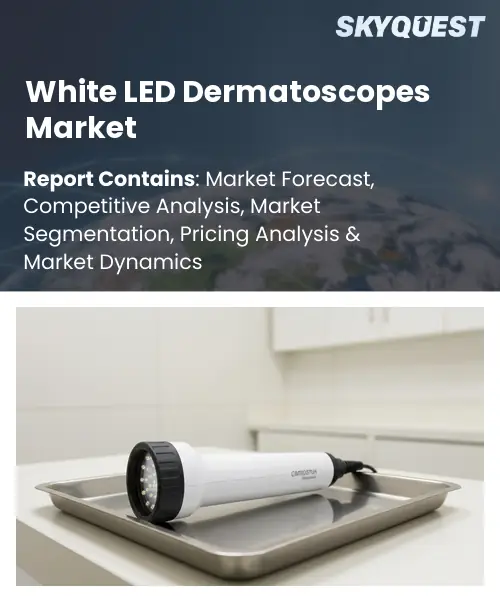
White LED Dermatoscopes Market
Report ID: SQMIG35A4254
Report ID: SQMIG35A4254
[email protected]
USA +1 351-333-4748
Report ID:
SQMIG35A4254 |
Region:
Global |
Published Date: July, 2026
Pages:
157
|Tables:
116
|Figures:
77


Global White Led Dermatoscopes Market size was valued at USD 246.8 Million in 2024 and is poised to grow from USD 267.53 Million in 2025 to USD 510.05 Million by 2033, growing at a CAGR of 8.4% during the forecast period (2026-2033).
The global white LED dermatoscope market comprises instruments that use white light to illuminate skin lesions, enabling clinicians to capture images for diagnosis and consultation. Its relevance stems from the rising demand for non‑invasive tools that shorten examinations and reduce biopsy reliance, improving patient outcomes. The primary driver has been the widespread adoption of digital dermoscopy in skin‑cancer screening programs across North America and Europe, where early detection is a health‑system priority. In the decade manufacturers have replaced halogen sources with LEDs, lowering power use and extending battery life; the 2015 launch of a portable dermatoscope accelerated significant market growth. The ensuing expansion is fueled primarily by the integration of artificial‑intelligence algorithms into white LED dermatoscopes, which transforms captured images into diagnostic scores and triage recommendations. By automating early lesion assessment, clinicians can allocate biopsy resources more efficiently, a benefit that health‑care providers in high‑volume dermatology clinics have already reported as reducing wait times by 30 percent. This capability also opens revenue streams for device makers through subscription‑based AI platforms and data‑analytics services. Moreover, rising tele‑dermatology adoption in emerging markets creates demand for portable, battery‑efficient white LED units, prompting manufacturers to partner with tele‑health providers and expand distribution networks globally.
How is AI-powered image analysis influencing the white LED dermatoscopes market?
AI-powered image analysis is reshaping white LED dermatoscopes by turning static visual data into actionable clinical insights. The technology enhances lesion detection, improves diagnostic confidence, and streamlines workflow by automatically flagging suspicious patterns. Integration with white LED illumination ensures consistent lighting, which boosts algorithm accuracy across diverse skin tones. Clinicians now benefit from real‑time feedback that reduces reliance on manual interpretation and supports tele‑dermatology consultations. This synergy of advanced optics and machine learning is driving broader adoption, especially in high‑volume dermatology practices seeking faster, more reliable assessments while maintaining patient comfort.In June 2024 DermLite introduced an AI‑enabled white LED dermatoscope that combines deep‑learning lesion classification with optimized illumination, accelerating diagnosis and supporting early intervention, thereby reinforcing market growth.
Market snapshot - (2026-2033)
Global Market Size
USD 246.8 Million
Largest Segment
Handheld Dermatoscopes
Fastest Growth
Video Dermatoscopes
Growth Rate
8.4% CAGR
To get more insights on this market click here to Request a Free Sample Report
Global white led dermatoscopes market is segmented by product type, modality, application, end user and region. Based on product type, the market is segmented into Handheld Dermatoscopes, Digital Dermatoscopes and Video Dermatoscopes. Based on modality, the market is segmented into Contact and Non-Contact. Based on application, the market is segmented into Skin Cancer Diagnosis, General Dermatology and Trichology. Based on end user, the market is segmented into Hospitals, Dermatology Clinics and Diagnostic Centers. Based on region, the market is segmented into North America, Europe, Asia Pacific, Latin America and Middle East & Africa.
Handheld dermatoscopes segment dominates because they combine portability with ease of use, allowing clinicians to perform rapid assessments at the bedside or in community settings. Their compact design aligns with the demand for cost‑effective tools that do not require extensive training, fostering widespread adoption. This accessibility drives consistent sales and reinforces their position as the core offering in the White LED dermatoscopes market by simplifying integration into routine examinations and supporting teledermatology workflows.
Meanwhile, digital dermatoscopes are witnessing the strongest growth momentum because advances in sensor technology and cloud connectivity enable high‑resolution image capture and data sharing. These capabilities attract dermatology practices seeking better diagnostic accuracy and longitudinal records. Growing image‑driven research and supportive reimbursement pathways accelerate market expansion and open opportunities for providers and innovators.
Skin cancer diagnosis segment leads because early detection demands high‑contrast illumination and precise color rendering, which white LED technology delivers reliably. Clinicians prioritize devices that enhance lesion visualization, reducing false negatives and improving patient outcomes. Regulatory endorsement of white LED tools for standardized assessments and continuous education programs boost physician confidence, expanding adoption across primary care and specialist settings and cementing this segment’s central role in market dynamics.
Conversely, general dermatology is emerging as the key high‑growth area because broader skin condition monitoring drives demand for versatile, user‑friendly devices. White LED dermatoscopes equipped with multiple magnification options and ergonomic designs appeal to clinicians treating a wide array of lesions beyond malignancy. This expanding clinical scope fuels procurement in outpatient settings, spurring innovation and opening new revenue streams for manufacturers.
To get detailed segments analysis, Request a Free Sample Report
North America maintains a leading position due to a confluence of advanced clinical research ecosystems, early adoption of innovative illumination technologies, and robust reimbursement frameworks that encourage investment in dermatological equipment. Strong collaboration between academic institutions and device manufacturers accelerates product refinement and drives a pipeline of next‑generation solutions. Health‑care providers in the region prioritize high‑resolution visualization, which aligns with the performance attributes of white LED dermatoscopes. Additionally, regulatory agencies in the United States and Canada provide clear pathways for device approval, reducing time to market and fostering confidence among clinicians. Moreover, the emphasis on preventive skin health and early detection of malignancies fuels ongoing procurement cycles. This combination of technological readiness, supportive policy environment, and heightened clinical awareness consolidates North America’s dominant market stance.
White LED Dermatoscopes Market in United States benefits from a mature ecosystem of research hospitals and dermatology clinics that prioritize advanced diagnostic tools. Payer reimbursement structures and aggressive adoption by leading skin cancer screening programs drive procurement. Collaboration between leading technology firms and clinical societies accelerates feature enhancements, while medical education programs ensure clinicians are skilled in leveraging the improved illumination. This environment sustains demand across private and academic settings.
White LED Dermatoscopes Market in Canada is propelled by a coordinated dermatology network that emphasizes early detection and equitable access to advanced imaging. Healthcare reimbursement policies facilitate acquisition by both hospital-based and community clinics. Partnerships between technology innovators and regional research centers foster customization to local clinical protocols. Professional development initiatives keep practitioners adept at exploiting the superior light quality. This supportive framework sustains steady demand across diverse care environments.
Europe exhibits a dynamic landscape for white LED dermatoscopes, driven by a convergence of rigorous clinical standards, strong reimbursement incentives, and a growing emphasis on preventative dermatology across its healthcare systems. Collaborative research initiatives among leading universities and device manufacturers accelerate technology transfer, while regulatory harmonization across member states simplifies market entry. The region’s commitment to digital health integration encourages the adoption of LED‑based imaging within tele‑dermatology platforms, expanding accessibility. Additionally, an increasing awareness of skin cancer prevalence among clinicians and patients fuels demand for high‑precision illumination tools. National health agencies also fund training programs that familiarize practitioners with LED technology, ensuring consistent application across varied clinical settings.
White LED Dermatoscopes Market in Germany thrives on a strong tradition of medical engineering and a robust network of university hospitals that prioritize precision diagnostics. Reimbursement policies support adoption in both inpatient and outpatient dermatology units. Close collaboration between device innovators and leading research institutes drives continuous refinement of LED illumination parameters. Comprehensive training curricula embedded in specialist programs ensure clinicians leverage the technology effectively, sustaining steady market significant uptake.
White LED Dermatoscopes Market in United Kingdom experiences rapid growth fueled by public health campaigns that emphasize early skin cancer detection. National health service procurement frameworks streamline acquisition for both tertiary referral centers and community dermatology practices. Partnerships between academic dermatology departments and LED manufacturers accelerate the integration of advanced imaging into examinations. Professional development workshops equip clinicians with practical skills, reinforcing confidence in the technology and driving market expansion.
White LED Dermatoscopes Market in France is emerging as clinicians seek to upgrade tools with brighter illumination. Reimbursement schemes recognize the diagnostic value of LED‑based dermoscopy, encouraging adoption in both hospital dermatology units and private practices. Collaborative projects between French biomedical firms and research institutes focus on optimizing spectral output for skin types. Educational seminars organized by professional societies raise awareness of clinical benefits, fostering but steady significant market penetration.
Asia Pacific is rapidly advancing its position in the white LED dermatoscopes market through vigorous investment in medical device innovation and expanding healthcare infrastructure across key economies. Strong governmental support for dermatology research catalyzes development of LEDs with superior spectral performance tailored for regional skin tone variations. Growing awareness of skin cancer risks and increasing adoption of tele‑dermatology platforms drive demand for portable, high‑quality illumination solutions. Collaborative partnerships between local manufacturers and international technology leaders accelerate market entry and promote technology transfer, reinforcing the region’s emerging prominence. In addition, the launch of national screening initiatives and the integration of digital imaging into primary care pathways further embed LED dermatoscopes into everyday clinical practice, creating a sustainable growth trajectory. Regulatory bodies are also streamlining approval processes, allowing faster market penetration for innovative LED devices and encouraging competitive pricing across the region.
White LED Dermatoscopes Market in Japan benefits from advanced optical engineering expertise and a healthcare system that values precision diagnostics. Government subsidies support acquisition by university hospitals and specialized skin clinics. Close collaboration between LED manufacturers and dermatology research centers drives continuous enhancement of illumination spectra suited to the population’s skin characteristics. Structured training programs incorporated into residency curricula ensure clinicians can fully exploit the technology, sustaining steady market demand.
White LED Dermatoscopes Market in South Korea is strengthened by a vibrant medical device sector and public health policies encouraging skin disease detection. Reimbursement frameworks facilitate procurement for both tertiary hospitals and outpatient dermatology centers. Partnerships with leading LED technology firms enable customization of light output for melanin levels common in the population. Ongoing clinician education workshops promote proficient use, while rapid regulatory pathways accelerate product launch, fostering market growth.
To know more about the market opportunities by region and country, click here to
Buy The Complete Report
Advances In LED Illumination Technology
Growing Adoption Of Teledermatology Services
High Initial Capital Expenditure
Regulatory Approval Complexity Across Regions
Request Free Customization of this report to help us to meet your business objectives.
The competitive landscape of the global White LED Dermatoscopes market is shaped by intense rivalry among manufacturers leveraging advanced LED technology to enhance diagnostic accuracy. Companies are pursuing strategic M&A to acquire niche imaging firms, forming partnerships with dermatology clinics to embed devices in routine care, and accelerating tech innovation through integration of AI-driven image analysis, exemplified by recent collaborations that combine high‑intensity white LEDs with proprietary software platforms.
Top Player’s Company Profile
Recent Developments
SkyQuest’s ABIRAW (Advanced Business Intelligence, Research & Analysis Wing) is our Business Information Services team that Collects, Collates, Correlates, and Analyses the Data collected by means of Primary Exploratory Research backed by robust Secondary Desk research. As per SkyQuest analysis, the global white LED dermatoscopes market is being propelled primarily by advances in LED illumination technology that deliver brighter, more uniform light and extend battery life, while the rapid growth of teledermatology services creates a strong second push by demanding compact, high‑quality imaging tools for remote consultations. The handheld dermatoscopes segment leads the market because of its portability and ease of use, and North America remains the dominant region thanks to robust research ecosystems, clear regulatory pathways and supportive reimbursement. However, the high initial capital expenditure required for advanced devices acts as a notable restraint, tempering adoption in cost‑sensitive settings.
| Report Metric | Details |
|---|---|
| Market size value in 2024 | USD 246.8 Million |
| Market size value in 2033 | USD 510.05 Million |
| Growth Rate | 8.4% |
| Base year | 2024 |
| Forecast period | (2026-2033) |
| Forecast Unit (Value) | USD Million |
| Segments covered |
|
| Regions covered | North America (US, Canada), Europe (Germany, France, United Kingdom, Italy, Spain, Rest of Europe), Asia Pacific (China, India, Japan, Rest of Asia-Pacific), Latin America (Brazil, Rest of Latin America), Middle East & Africa (South Africa, GCC Countries, Rest of MEA) |
| Companies covered |
|
| Customization scope | Free report customization with purchase. Customization includes:-
|
To get a free trial access to our platform which is a one stop solution for all your data requirements for quicker decision making. This platform allows you to compare markets, competitors who are prominent in the market, and mega trends that are influencing the dynamics in the market. Also, get access to detailed SkyQuest exclusive matrix.
Table Of Content
Executive Summary
Market overview
Parent Market Analysis
Market overview
Market size
KEY MARKET INSIGHTS
COVID IMPACT
MARKET DYNAMICS & OUTLOOK
Market Size by Region
KEY COMPANY PROFILES
Methodology
For the White LED Dermatoscopes Market, our research methodology involved a mixture of primary and secondary data sources. Key steps involved in the research process are listed below:
1. Information Procurement: This stage involved the procurement of Market data or related information via primary and secondary sources. The various secondary sources used included various company websites, annual reports, trade databases, and paid databases such as Hoover's, Bloomberg Business, Factiva, and Avention. Our team did 45 primary interactions Globally which included several stakeholders such as manufacturers, customers, key opinion leaders, etc. Overall, information procurement was one of the most extensive stages in our research process.
2. Information Analysis: This step involved triangulation of data through bottom-up and top-down approaches to estimate and validate the total size and future estimate of the White LED Dermatoscopes Market.
3. Report Formulation: The final step entailed the placement of data points in appropriate Market spaces in an attempt to deduce viable conclusions.
4. Validation & Publishing: Validation is the most important step in the process. Validation & re-validation via an intricately designed process helped us finalize data points to be used for final calculations. The final Market estimates and forecasts were then aligned and sent to our panel of industry experts for validation of data. Once the validation was done the report was sent to our Quality Assurance team to ensure adherence to style guides, consistency & design.
Analyst Support
Customization Options
With the given market data, our dedicated team of analysts can offer you the following customization options are available for the White LED Dermatoscopes Market:
Product Analysis: Product matrix, which offers a detailed comparison of the product portfolio of companies.
Regional Analysis: Further analysis of the White LED Dermatoscopes Market for additional countries.
Competitive Analysis: Detailed analysis and profiling of additional Market players & comparative analysis of competitive products.
Go to Market Strategy: Find the high-growth channels to invest your marketing efforts and increase your customer base.
Innovation Mapping: Identify racial solutions and innovation, connected to deep ecosystems of innovators, start-ups, academics, and strategic partners.
Category Intelligence: Customized intelligence that is relevant to their supply Markets will enable them to make smarter sourcing decisions and improve their category management.
Public Company Transcript Analysis: To improve the investment performance by generating new alpha and making better-informed decisions.
Social Media Listening: To analyze the conversations and trends happening not just around your brand, but around your industry as a whole, and use those insights to make better Marketing decisions.
REQUEST FOR SAMPLE
 REQUEST FREE CUSTOMIZATION


Want to customize this report? This report can be personalized according to your needs. Our analysts and industry experts will work directly with you to understand your requirements and provide you with customized data in a short amount of time. We offer $1000 worth of FREE customization at the time of purchase.
Feedback From Our Clients


 USA (+1) 351-333-4748

