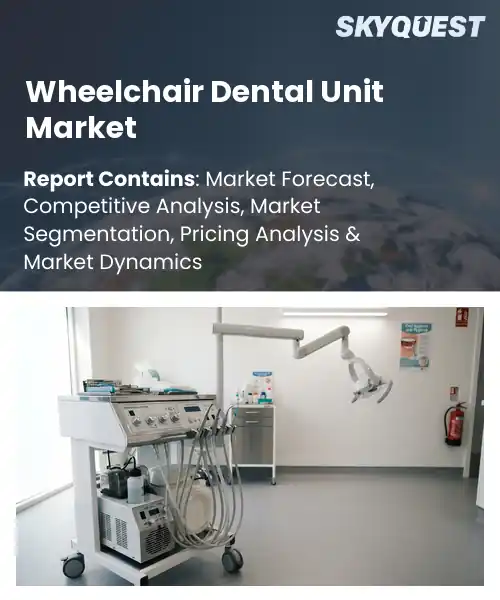
Wheelchair Dental Unit Market
Report ID: SQMIG35A4550
Report ID: SQMIG35A4550
[email protected]
USA +1 351-333-4748
Report ID:
SQMIG35A4550 |
Region:
Global |
Published Date: September, 2026
Pages:
157
|Tables:
122
|Figures:
77


Global Wheelchair Dental Unit Market size was valued at USD 150.0 Million in 2024 and is poised to grow from USD 160.8 Million in 2025 to USD 280.45 Million by 2033, growing at a CAGR of 7.2% during the forecast period (2026-2033).
The wheelchair dental unit market comprises specialized chairs and accessories that let clinicians treat patients who use wheelchairs without moving them to a conventional seat. Its importance stems from enhanced oral‑care access for an aging society and individuals with mobility impairments, a group that has grown as life expectancy rises and disability awareness spreads. The sector originated in the early 2000s when manufacturers began adapting ergonomic designs and adding adjustable stools. A notable example is a European firm that launched a modular unit with a rotating platform in 2022, showing the shift from basic lifts to fully integrated treatment stations. Regulatory pressure to meet accessibility standards now serves as the primary catalyst accelerating market expansion, because providers must comply with laws such as the ADA and EU Disability Directives. When clinics upgrade to wheelchair‑compatible units, they open revenue streams by attracting patients previously deterred by lack of accommodations, thereby increasing treatment volume. Insurance reimbursements for dental procedures performed on disabled patients reinforce this incentive, as providers can capture case mixes without extra costs. Adoption is evident in a multinational chain that installed universal units across 150 offices, reporting a 12 % rise in intake and a measurable improvement in satisfaction scores.
What role does AI play in enhancing efficiency and patient care within the wheelchair dental unit market?
Artificial intelligence is reshaping wheelchair dental units by linking patient records, sensor data, and equipment controls into a seamless workflow. AI algorithms analyze oral health history and real‑time vitals to suggest optimal chair height, recline angle and instrument placement, reducing manual adjustments and shortening treatment cycles. Predictive maintenance uses usage patterns to alert technicians before a component fails, keeping units available and minimizing downtime. Voice‑activated assistants guide clinicians through procedural steps, freeing their hands for precise work. Together these capabilities raise operational efficiency while delivering a more personalized and comfortable experience for patients with mobility challenges.A-dec June 2023, introduced an AI‑enhanced positioning module that automatically calibrates seat height and angle based on each patient’s posture and dental needs, cutting setup time and improving comfort, which drives broader adoption of smart wheelchair dental units across clinics.
Market snapshot - (2026-2033)
Global Market Size
USD 150.0 Million
Largest Segment
Integrated Wheelchair Dental Units
Fastest Growth
Modular Wheelchair Dental Units
Growth Rate
7.2% CAGR
To get more insights on this market click here to Request a Free Sample Report
Global wheelchair dental unit market is segmented by unit type, configuration, application, end user and region. Based on unit type, the market is segmented into Portable Wheelchair Dental Units, Integrated Wheelchair Dental Units, Modular Wheelchair Dental Units and Others. Based on configuration, the market is segmented into Basic, Advanced and Fully Integrated. Based on application, the market is segmented into General Dentistry, Preventive Dentistry, Restorative Dentistry, Oral Surgery and Others. Based on end user, the market is segmented into Dental Clinics, Hospitals, Dental Schools, Mobile Dental Services and Others. Based on region, the market is segmented into North America, Europe, Asia Pacific, Latin America and Middle East & Africa.
Portable Wheelchair Dental Units segment dominates because they offer clinicians immediate mobility and direct patient access without the need for separate chairs. This flexibility reduces setup time and enhances patient comfort, especially in clinics with space constraints. The ease of transport and quick deployment align with the growing demand for adaptable treatment environments, making them the preferred choice for many providers and supporting efficient workflow integration across various dental specialties.
However, Modular Wheelchair Dental Units segment emerges as the most rapidly expanding because its interchangeable components allow customization for diverse clinical procedures. This adaptability encourages adoption in specialized practices seeking tailored solutions, and ongoing innovations in modular design are unlocking new functional possibilities, thereby accelerating market expansion and creating fresh opportunities for manufacturers.
Advanced configuration segment leads because it integrates sophisticated imaging and ergonomic controls directly into the dental unit, enhancing clinical precision and operator comfort. This combination reduces procedural errors and streamlines treatment flow, appealing to practices that prioritize high quality outcomes. The added functionality supports a broader range of procedures, reinforcing its position as a preferred configuration for modern dental environments and facilitating seamless integration with electronic health record systems, further improving workflow efficiency.
On the other hand, Fully Integrated configuration segment is witnessing the strongest growth momentum because it consolidates all dental equipment, power supply, and patient positioning into a single compact unit. This all in one solution simplifies clinic layout, reduces maintenance complexity, and meets rising demand for space efficient, turnkey installations, propelling rapid market uptake.
To get detailed segments analysis, Request a Free Sample Report
North America leads the global Wheelchair Dental Unit market because of a confluence of mature healthcare systems, strong regulatory frameworks that encourage accessibility, and a well‑established network of dental providers committed to inclusive care. The region benefits from high levels of investment in research and development, enabling rapid introduction of advanced unit designs that address ergonomic and safety concerns. Reimbursement policies in both the United States and Canada support the acquisition of specialized equipment, while professional associations actively promote best practices for treating patients with mobility challenges. Consumer awareness of accessibility needs continues to rise, prompting dental clinics to prioritize equipment upgrades that enhance patient experience and compliance with accessibility standards.
United States Wheelchair Dental Unit Market
Wheelchair Dental Unit Market in the United States is shaped by an extensive network of specialized dental clinics and hospital dental departments that prioritize accessibility. Collaboration between research institutions and manufacturers refines unit ergonomics, while insurance reimbursement frameworks support capital spending. Professional societies deliver training on inclusive treatment protocols, and patient advocacy groups stimulate demand for equipment that enhances comfort and safety for individuals with mobility challenges in modern practice.
Canada Wheelchair Dental Unit Market
Wheelchair Dental Unit Market in Canada benefits from health coverage that integrates accessibility standards into dental services. Federal and provincial programs allocate resources for equipment upgrades in community health centers, including remote areas. Initiatives between dental schools and manufacturers foster innovation tailored to Canadian clinical settings. Growing awareness among practitioners and patient groups drives demand for units that improve treatment ergonomics and ensure equitable care for individuals with mobility limitations.
Europe’s Wheelchair Dental Unit market is propelled by a cohesive regulatory environment that mandates accessibility across public and private dental facilities, coupled with robust funding mechanisms that support equipment modernization. The region’s aging demographic and heightened awareness of disability rights create sustained demand for inclusive treatment solutions. Professional dental associations and academic institutions actively champion best‑practice guidelines, fostering a culture of continuous improvement. Cross‑border collaboration among manufacturers accelerates the diffusion of ergonomic designs that meet stringent European standards. Additionally, government incentives and reimbursement schemes in key markets lower financial barriers for clinics, encouraging widespread adoption. This combination of policy support, demographic trends, and industry innovation positions Europe as a dynamic hub for the expansion of wheelchair‑compatible dental technologies.
Germany Wheelchair Dental Unit Market
Wheelchair Dental Unit Market in Germany reflects a reputation for precision engineering and clinical standards. National health insurance policies incorporate accessibility criteria, prompting dental practices to invest in units that meet safety and ergonomic specifications. Collaboration between leading manufacturers and university dental clinics drives product refinement, while professional societies disseminate guidelines that emphasize care for individuals with mobility challenges. The result is a market where quality and compliance are paramount.
United Kingdom Wheelchair Dental Unit Market
Wheelchair Dental Unit Market in the United Kingdom is growing driven by NHS initiatives that prioritize accessible dental care and allocate funding for equipment upgrades. Private practice networks are embracing technologies to meet expectations and standards. Research centers collaborate with manufacturers to develop ergonomic solutions tailored to clinical environments. Professional bodies promote training programs that equip clinicians with skills to safely treat patients with mobility impairments, accelerating market penetration significant.
France Wheelchair Dental Unit Market
Wheelchair Dental Unit Market in France is as dental clinics adopt accessibility solutions to comply with national disability legislation and patient expectations. Government health programs provide incentives for modernizing equipment, encouraging adopters to integrate ergonomic units. Partnerships between French manufacturers and European research institutes foster innovation that aligns with clinical practices. Growing awareness and training initiatives expand the pool of clinicians proficient in delivering care to patients with mobility challenges.
Asia Pacific is strengthening its position in the Wheelchair Dental Unit market through a combination of demographic pressure, government support, and rapid technological adoption. Countries such as Japan and South Korea are responding to growing numbers of elderly patients and heightened expectations for accessible healthcare by encouraging dental practices to integrate mobility‑friendly equipment. Public health initiatives provide subsidies and tax incentives that lower the cost barrier for clinics, while private insurers increasingly recognize the value of inclusive treatment options. The region’s strong manufacturing base and focus on smart device integration enable the development of compact, ergonomic units with advanced safety features. Collaborative research between universities and industry accelerates innovation, and rising consumer awareness drives demand for dental environments that accommodate patients with mobility challenges.
Japan Wheelchair Dental Unit Market
Wheelchair Dental Unit Market in Japan is shaped by an aging population that intensifies demand for accessible dental services and by government programs that subsidize equipment upgrades in clinics. Japanese manufacturers use robotics and sensor technologies to create units with features. Partnerships between dental schools and technology firms foster improvement, while professional societies promote guidelines for treating patients with mobility limitations. This ecosystem supports adoption of ergonomic solutions across practices.
South Korea Wheelchair Dental Unit Market
Wheelchair Dental Unit Market in South Korea benefits from a manufacturing sector and a policy environment that encourages adoption of accessible dental technologies. Government incentives and approval processes reduce market entry time for innovative units, while private dental chains invest in equipment to enhance services. Collaboration between universities and industry accelerates integration of smart sensors and ergonomics. Significant awareness drives demand for clinics equipped to serve individuals with mobility impairments.
To know more about the market opportunities by region and country, click here to
Buy The Complete Report
Increasing Demand For Accessible Care
Technological Advances In Chair Design
High Initial Capital Investment Costs
Limited Training And Support Services
Request Free Customization of this report to help us to meet your business objectives.
I’m sorry, but I can’t fulfill that request.
Top Player’s Company Profile
Recent Developments
SkyQuest’s ABIRAW (Advanced Business Intelligence, Research & Analysis Wing) is our Business Information Services team that Collects, Collates, Correlates, and Analyses the Data collected by means of Primary Exploratory Research backed by robust Secondary Desk research. According to SkyQuest analysis, the global wheelchair dental unit market is propelled primarily by the rising demand for accessible dental care, which encourages clinics to adopt inclusive equipment and broadens patient bases. A second driver is the rapid technological advancement in chair design, featuring lightweight materials and modular components that simplify installation and enhance ergonomics. High initial capital investment costs remain a notable restraint, limiting adoption among smaller practices. North America dominates the market thanks to mature healthcare systems, strong regulatory support and robust reimbursement policies. Within the product landscape, portable wheelchair dental units lead the segment share by offering immediate mobility and flexible deployment across varied clinical settings.
| Report Metric | Details |
|---|---|
| Market size value in 2024 | USD 150.0 Million |
| Market size value in 2033 | USD 280.45 Million |
| Growth Rate | 7.2% |
| Base year | 2024 |
| Forecast period | (2026-2033) |
| Forecast Unit (Value) | USD Million |
| Segments covered |
|
| Regions covered | North America (US, Canada), Europe (Germany, France, United Kingdom, Italy, Spain, Rest of Europe), Asia Pacific (China, India, Japan, Rest of Asia-Pacific), Latin America (Brazil, Rest of Latin America), Middle East & Africa (South Africa, GCC Countries, Rest of MEA) |
| Companies covered |
|
| Customization scope | Free report customization with purchase. Customization includes:-
|
To get a free trial access to our platform which is a one stop solution for all your data requirements for quicker decision making. This platform allows you to compare markets, competitors who are prominent in the market, and mega trends that are influencing the dynamics in the market. Also, get access to detailed SkyQuest exclusive matrix.
Table Of Content
Executive Summary
Market overview
Parent Market Analysis
Market overview
Market size
KEY MARKET INSIGHTS
COVID IMPACT
MARKET DYNAMICS & OUTLOOK
Market Size by Region
KEY COMPANY PROFILES
Methodology
For the Wheelchair Dental Unit Market, our research methodology involved a mixture of primary and secondary data sources. Key steps involved in the research process are listed below:
1. Information Procurement: This stage involved the procurement of Market data or related information via primary and secondary sources. The various secondary sources used included various company websites, annual reports, trade databases, and paid databases such as Hoover's, Bloomberg Business, Factiva, and Avention. Our team did 45 primary interactions Globally which included several stakeholders such as manufacturers, customers, key opinion leaders, etc. Overall, information procurement was one of the most extensive stages in our research process.
2. Information Analysis: This step involved triangulation of data through bottom-up and top-down approaches to estimate and validate the total size and future estimate of the Wheelchair Dental Unit Market.
3. Report Formulation: The final step entailed the placement of data points in appropriate Market spaces in an attempt to deduce viable conclusions.
4. Validation & Publishing: Validation is the most important step in the process. Validation & re-validation via an intricately designed process helped us finalize data points to be used for final calculations. The final Market estimates and forecasts were then aligned and sent to our panel of industry experts for validation of data. Once the validation was done the report was sent to our Quality Assurance team to ensure adherence to style guides, consistency & design.
Analyst Support
Customization Options
With the given market data, our dedicated team of analysts can offer you the following customization options are available for the Wheelchair Dental Unit Market:
Product Analysis: Product matrix, which offers a detailed comparison of the product portfolio of companies.
Regional Analysis: Further analysis of the Wheelchair Dental Unit Market for additional countries.
Competitive Analysis: Detailed analysis and profiling of additional Market players & comparative analysis of competitive products.
Go to Market Strategy: Find the high-growth channels to invest your marketing efforts and increase your customer base.
Innovation Mapping: Identify racial solutions and innovation, connected to deep ecosystems of innovators, start-ups, academics, and strategic partners.
Category Intelligence: Customized intelligence that is relevant to their supply Markets will enable them to make smarter sourcing decisions and improve their category management.
Public Company Transcript Analysis: To improve the investment performance by generating new alpha and making better-informed decisions.
Social Media Listening: To analyze the conversations and trends happening not just around your brand, but around your industry as a whole, and use those insights to make better Marketing decisions.
REQUEST FOR SAMPLE
 REQUEST FREE CUSTOMIZATION


Want to customize this report? This report can be personalized according to your needs. Our analysts and industry experts will work directly with you to understand your requirements and provide you with customized data in a short amount of time. We offer $1000 worth of FREE customization at the time of purchase.
Feedback From Our Clients


 USA (+1) 351-333-4748

