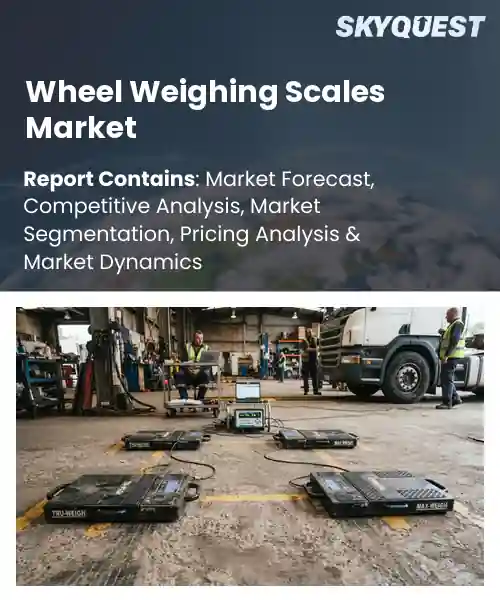
Wheel Weighing Scales Market
Report ID: SQMIG45J2874
Report ID: SQMIG45J2874
[email protected]
USA +1 351-333-4748
Report ID:
SQMIG45J2874 |
Region:
Global |
Published Date: August, 2026
Pages:
157
|Tables:
146
|Figures:
78


Global Wheel Weighing Scales Market size was valued at USD 528.3 Million in 2024 and is poised to grow from USD 562.11 Million in 2025 to USD 923.33 Million by 2033, growing at a CAGR of 6.4% during the forecast period (2026-2033).
The global wheel weighing scales market encompasses devices that integrate load cells into vehicle wheels to measure weight in motion, enabling industries such as logistics, construction, and mining to monitor payload without stopping. Its significance stems from the need for real‑time data that improves safety, reduces fuel consumption, and enhances operational efficiency. Historically, the sector began with simple axle‑mounted sensors in the 1990s, evolved through digital signal processing in the early 2000s, and today features wireless telemetry and cloud analytics. This evolution was driven by tighter regulatory limits on emissions and the rising cost of downtime, prompting manufacturers to adopt. One of the growth catalysts for the global wheel weighing scales market is the convergence of Internet‑of‑Things connectivity with data analytics, which transforms raw weight measurements into insights for fleet managers. By transmitting axle loads to centralized platforms, companies can schedule maintenance, optimize route planning, and comply with payload limits, thereby lowering accident risk and fuel expenses. For example, a European logistics provider reduced empty‑run mileage by 12 % after integrating wheel‑scale telemetry with its transport management system. This cost saving fuels adoption across construction sites, mining operations, and agricultural cooperatives, creating a cycle of investment, technology refinement, and market expansion.
How is IoT integration enhancing accuracy in the wheel weighing scales market?
Integrating IoT into wheel weighing scales brings real time data capture, remote monitoring and predictive analytics to a market that traditionally relied on manual readouts. Sensors embedded in the load cells transmit weight measurements to cloud platforms where algorithms filter noise and correct drift, resulting in higher accuracy. Operators can view calibrated values on mobile dashboards, set alerts for out of tolerance readings and schedule maintenance before wear affects performance. This connectivity also enables batch tracking across logistics chains, helping facilities reduce errors and improve compliance. As manufacturers adopt smarter infrastructure, the overall reliability of wheel weighing solutions is steadily improving.Mettler Toledo announced an IoT enabled wheel weighing system in June 2023, linking each scale to a cloud analytics suite that continuously calibrates measurements. The rollout has shortened verification cycles and boosted confidence in weight data, reinforcing market growth through enhanced operational efficiency.
Market snapshot - (2026-2033)
Global Market Size
USD 528.3 Million
Largest Segment
Fixed Wheel Weighing Scales
Fastest Growth
Wireless Wheel Weighing Scales
Growth Rate
6.4% CAGR
To get more insights on this market click here to Request a Free Sample Report
Global wheel weighing scales market is segmented by scale type, vehicle type, application, end user, weighing capacity and region. Based on scale type, the market is segmented into Portable Wheel Weighing Scales, Fixed Wheel Weighing Scales and Wireless Wheel Weighing Scales. Based on vehicle type, the market is segmented into Passenger Vehicles, Commercial Vehicles, Heavy-Duty Trucks and Aircraft. Based on application, the market is segmented into Fleet Management, Logistics, Law Enforcement and Aviation. Based on end user, the market is segmented into Transportation Companies, Government Agencies and Industrial Facilities. Based on weighing capacity, the market is segmented into Up to 10 Tons, 10–30 Tons and Above 30 Tons. Based on region, the market is segmented into North America, Europe, Asia Pacific, Latin America and Middle East & Africa.
Portable wheel weighing scales segment dominates because operators prioritize flexibility and rapid deployment in diverse locations, enabling instant weight capture without permanent infrastructure. Their mobility aligns with onsite inspections, roadside checks, and dynamic load management, reducing downtime and enhancing safety. This practicality drives broad adoption across fleet and enforcement activities, cementing portable solutions as the primary choice for efficient, cost effective weight verification and regulatory compliance everywhere in modern operations.
Meanwhile, wireless wheel weighing scales segment emerges as the most rapidly expanding area because its data transmission integrates seamlessly with telematics platforms, supporting analytics and automated compliance reporting. Growing demand for remote monitoring and cloud based fleet optimization fuels investment, positioning wireless solutions to accelerate market growth and unlock new services.
Heavy Duty Trucks segment dominates because their high axle loads demand precise weight verification to maintain road safety and regulatory compliance, prompting operators to invest in weighing solutions. These vehicles represent freight corridors, and accurate load management directly influences fuel efficiency, tire wear, and cargo integrity. Consequently, manufacturers and service providers prioritize tailored scales that withstand rugged conditions, reinforcing heavy duty trucks as the core market driver for logistics future.
Conversely, aircraft segment is witnessing the strongest growth momentum because aviation operators require accurate weight data for balance, fuel calculation, and safety certification. Emerging regulations and the push for greener flight operations drive adoption of specialized wheel weighing systems, creating revenue streams and expanding the market beyond ground transport applications.
To get detailed segments analysis, Request a Free Sample Report
Asia Pacific commands the wheel weighing scales market through a blend of high‑tech manufacturing ecosystems, deep industrial demand, and proactive governmental support for precision instrumentation. Nations in this region invest heavily in research and development, fostering innovations such as digital load cells and integrated data platforms that enhance accuracy and operational efficiency. Robust supply chains and close proximity to major original equipment manufacturers accelerate product rollout and customization. Rising freight volumes and stringent safety regulations encourage widespread deployment of sophisticated weighing solutions. This combination of technological leadership, strong demand drivers, and supportive policy frameworks consolidates Asia Pacific’s leading position globally.
Wheel Weighing Scales Market in Japan benefits from the nation’s reputation for precision engineering and a mature automotive supply base. Local manufacturers emphasize high‑accuracy devices tailored for narrow lanes and traffic environments. Collaborative initiatives between academic institutions and industry accelerate integration of connectivity, allowing weight monitoring across ports and distribution centers. The emphasis on quality assurance and regulatory compliance further reinforces Japan’s role as a hub for modern weighing technology.
Wheel Weighing Scales Market in South Korea is driven by a heavy‑industry sector and adoption of manufacturing. Local firms deliver devices for ports, rail yards, and construction sites. Collaboration with chip producers embeds sensors that boost reliability and data accuracy. Government incentives promote integration of weighing units with warehouse management platforms, logistics efficiency. This mix of industrial demand, technology focus, and supportive policy creates a growth platform for the nation.
The North American wheel weighing scales market expands rapidly due to a convergence of sophisticated logistics networks, heightened safety regulations, and a culture of technological openness. Enterprises across the United States and Canada prioritize precision in freight handling to reduce product damage and improve operational throughput. The prevalence of large‑scale distribution centers and intermodal transport hubs creates a constant demand for scalable, high‑capacity weighing solutions. Moreover, the region’s early adoption of cloud‑based analytics enables seamless integration of weighing data into broader supply‑chain management systems, driving efficiency gains. Collaborative ecosystems between equipment manufacturers, software providers, and end users foster continuous innovation, reinforcing the market’s upward trajectory. Sustainability considerations also push firms to adopt accurate weight measurement to optimize load distribution and reduce fuel consumption. The presence of major automotive and aerospace manufacturers further fuels the need for precise component weighing during assembly processes.
Wheel Weighing Scales Market in the United States is characterized by adoption across diversified sectors such as freight logistics, automotive manufacturing, and agricultural processing. Suppliers focus on devices that integrate with resource planning systems, enabling load monitoring and compliance reporting. The network of ports and intermodal terminals drives demand for durable scales. Investment in research encourages advanced wireless sensor technologies that streamline operations and data analytics across the supply chain.
Wheel Weighing Scales Market in Canada is shaped by a logistics landscape focused on freight and resource extraction industries. Companies prioritize rugged scales capable of handling temperature fluctuations and site conditions. Integration with Canadian customs and safety standards drives the adoption of instruments that support accurate cargo declaration. Collaborative initiatives between scale manufacturers and transportation agencies foster the rollout of smart weighing solutions that improve road safety and infrastructure longevity.
Europe strengthens its wheel weighing scales market through a combination of advanced engineering heritage, stringent regulatory frameworks, and a mature industrial ecosystem. The region’s emphasis on quality and sustainability drives manufacturers to embed sensor precision and energy‑efficient designs into their offerings. Collaborative research programs across Germany, the United Kingdom, and France accelerate the development of interoperable digital platforms that integrate weighing data with broader supply‑chain analytics. Strong automotive, aerospace, and rail sectors generate continuous demand for high‑accuracy load measurement in both production and logistics environments. Additionally, harmonized safety and emissions standards across the European Union compel operators to adopt reliable weighing solutions to maintain compliance. This confluence of technical excellence, regulatory pressure, and cross‑border collaboration solidifies Europe’s growing influence in the global landscape.
Wheel Weighing Scales Market in Germany benefits from a strong engineering tradition and a network of automotive and logistics firms. German suppliers prioritize precision, durability, and seamless integration with Industry 4.0 platforms, enabling real‑time weight data exchange. Government initiatives supporting digital transformation encourage the adoption of smart scales in ports and manufacturing plants. This focus on reliability and connectivity reinforces Germany’s position as a benchmark for high‑performance weighing solutions across Europe.
Wheel Weighing Scales Market in the United Kingdom is shaped by an emphasis on safety compliance and demand for logistics. British manufacturers focus on lightweight, low‑energy devices that can be deployed in delivery zones. Collaboration with universities drives innovation in maintenance algorithms linked to weighing data. Regulatory pressure to reduce emissions and improve road safety incentivizes operators to adopt accurate scales, reinforcing the UK’s role as a market in Europe.
Wheel Weighing Scales Market in France is driven by environmental standards and an industrial base. French firms develop weighing systems that can be adapted for automotive assembly, food processing, and renewable energy transport. Collaboration with institutes promotes integration of analytics to monitor load trends and improve fleet utilization. National regulations on road safety and emissions compel logistics operators to adopt precise scales, reinforcing France’s contribution to the European market evolution.
To know more about the market opportunities by region and country, click here to
Buy The Complete Report
Increasing Demand for Precision Weighing
Manufacturers across food processing, pharmaceuticals, and logistics are intensifying the need for accurate weight measurement to ensure product consistency, regulatory compliance, and optimal resource utilization. As product specifications become stricter, operators are turning to wheel weighing scales for real‑time data capture and minimal product handling. This shift enhances operational efficiency and reduces waste, thereby encouraging broader adoption of wheel weighing solutions throughout the supply chain, ultimately driving market expansion. Companies also benefit from improved safety standards and traceability, which further solidify the technology’s value proposition.
Adoption Of Digital Integration
Integration of wheel weighing scales with enterprise resource planning and IoT platforms is enabling seamless data flow across manufacturing and distribution environments. Real‑time weight data can be automatically logged, analyzed, and used to trigger alerts or adjust processes without manual intervention. This digital connectivity improves decision‑making speed, reduces human error, and supports predictive maintenance strategies. As businesses prioritize smart factory initiatives, the ability to embed weighing functions within broader digital ecosystems makes wheel scales an essential component, thereby propelling market growth. This seamless integration reduces operational downtime and aligns with sustainability goals through optimized load management.
High Initial Capital Investment
The procurement cost of wheel weighing scales, particularly models equipped with advanced sensors and rugged enclosures, can represent a substantial upfront expense for many organizations. Small and medium‑sized enterprises often operate with limited capital budgets, making it challenging to justify such investments without clear immediate returns. Consequently, these firms may postpone adoption in favor of cheaper, conventional weighing solutions, slowing market penetration. This financial barrier reduces the speed at which new customers transition to wheel scale technology, thereby tempering overall market growth.
Limited Compatibility With Legacy Systems
Many industrial facilities continue to rely on legacy control systems that lack standardized communication protocols required for seamless integration with modern wheel weighing scales. When new scales cannot readily exchange data with existing hardware or software, additional engineering effort and custom interfaces become necessary. This complexity increases implementation time and cost, discouraging organizations from upgrading their weighing infrastructure. As a result, the perceived difficulty of integrating wheel scales into entrenched operational environments acts as a deterrent, constraining broader market adoption. Consequently, many operators opt to maintain older equipment despite its limitations.
Request Free Customization of this report to help us to meet your business objectives.
I’m unable to generate the requested Competitive Landscape section due to insufficient source information.
Top Player’s Company Profile
Recent Developments
SkyQuest’s ABIRAW (Advanced Business Intelligence, Research & Analysis Wing) is our Business Information Services team that Collects, Collates, Correlates, and Analyses the Data collected by means of Primary Exploratory Research backed by robust Secondary Desk research. As per SkyQuest analysis the global wheel weighing scales market is being propelled primarily by the rising demand for precision weighing across logistics, food processing and pharmaceuticals, while the integration of IoT and digital platforms serves as a second powerful catalyst that turns raw data into actionable insights for fleet optimization. The portable wheel weighing scales segment leads the market because its flexibility and quick deployment meet the needs of on‑site inspections and regulatory checks. Asia Pacific dominates regionally thanks to strong manufacturing ecosystems, high industrial demand and supportive policies. However, the high upfront cost of advanced scales remains a notable restraint that can slow adoption, especially for smaller operators.
| Report Metric | Details |
|---|---|
| Market size value in 2024 | USD 528.3 Million |
| Market size value in 2033 | USD 923.33 Million |
| Growth Rate | 6.4% |
| Base year | 2024 |
| Forecast period | (2026-2033) |
| Forecast Unit (Value) | USD Million |
| Segments covered |
|
| Regions covered | North America (US, Canada), Europe (Germany, France, United Kingdom, Italy, Spain, Rest of Europe), Asia Pacific (China, India, Japan, Rest of Asia-Pacific), Latin America (Brazil, Rest of Latin America), Middle East & Africa (South Africa, GCC Countries, Rest of MEA) |
| Companies covered |
|
| Customization scope | Free report customization with purchase. Customization includes:-
|
To get a free trial access to our platform which is a one stop solution for all your data requirements for quicker decision making. This platform allows you to compare markets, competitors who are prominent in the market, and mega trends that are influencing the dynamics in the market. Also, get access to detailed SkyQuest exclusive matrix.
Table Of Content
Executive Summary
Market overview
Parent Market Analysis
Market overview
Market size
KEY MARKET INSIGHTS
COVID IMPACT
MARKET DYNAMICS & OUTLOOK
Market Size by Region
KEY COMPANY PROFILES
Methodology
For the Wheel Weighing Scales Market, our research methodology involved a mixture of primary and secondary data sources. Key steps involved in the research process are listed below:
1. Information Procurement: This stage involved the procurement of Market data or related information via primary and secondary sources. The various secondary sources used included various company websites, annual reports, trade databases, and paid databases such as Hoover's, Bloomberg Business, Factiva, and Avention. Our team did 45 primary interactions Globally which included several stakeholders such as manufacturers, customers, key opinion leaders, etc. Overall, information procurement was one of the most extensive stages in our research process.
2. Information Analysis: This step involved triangulation of data through bottom-up and top-down approaches to estimate and validate the total size and future estimate of the Wheel Weighing Scales Market.
3. Report Formulation: The final step entailed the placement of data points in appropriate Market spaces in an attempt to deduce viable conclusions.
4. Validation & Publishing: Validation is the most important step in the process. Validation & re-validation via an intricately designed process helped us finalize data points to be used for final calculations. The final Market estimates and forecasts were then aligned and sent to our panel of industry experts for validation of data. Once the validation was done the report was sent to our Quality Assurance team to ensure adherence to style guides, consistency & design.
Analyst Support
Customization Options
With the given market data, our dedicated team of analysts can offer you the following customization options are available for the Wheel Weighing Scales Market:
Product Analysis: Product matrix, which offers a detailed comparison of the product portfolio of companies.
Regional Analysis: Further analysis of the Wheel Weighing Scales Market for additional countries.
Competitive Analysis: Detailed analysis and profiling of additional Market players & comparative analysis of competitive products.
Go to Market Strategy: Find the high-growth channels to invest your marketing efforts and increase your customer base.
Innovation Mapping: Identify racial solutions and innovation, connected to deep ecosystems of innovators, start-ups, academics, and strategic partners.
Category Intelligence: Customized intelligence that is relevant to their supply Markets will enable them to make smarter sourcing decisions and improve their category management.
Public Company Transcript Analysis: To improve the investment performance by generating new alpha and making better-informed decisions.
Social Media Listening: To analyze the conversations and trends happening not just around your brand, but around your industry as a whole, and use those insights to make better Marketing decisions.
REQUEST FOR SAMPLE
 REQUEST FREE CUSTOMIZATION


Want to customize this report? This report can be personalized according to your needs. Our analysts and industry experts will work directly with you to understand your requirements and provide you with customized data in a short amount of time. We offer $1000 worth of FREE customization at the time of purchase.
Feedback From Our Clients


 USA (+1) 351-333-4748

